 0
0
 0
0
There is a sentence almost everyone who had a hard childhood has heard at least once.
It was a long time ago. You should be over it by now.
It is usually meant kindly. It is also usually said by someone who assumes that the past is a story you are choosing to keep telling. Put the story down, the thinking goes, and the effect goes with it. Which raises a question that used to have no good answer: how childhood stress changes the brain, and whether anything is still physically there years later.
On 7 August 2026, researchers at Washington University School of Medicine in St. Louis and Princeton University published a study in the journal Neuron that makes that sentence a lot harder to say. Working with mice, they found something physical that early stress leaves behind. Not a memory. Not a habit. A change in the way DNA is folded and packed inside particular brain cells — still sitting there in adulthood, long after the stressful part of life had ended.
And then they did something that almost nobody expected. They reached in and undid it.
How childhood stress changes the brain, at the level of the spool
Start with a piece of biology that sounds odd the first time you hear it.
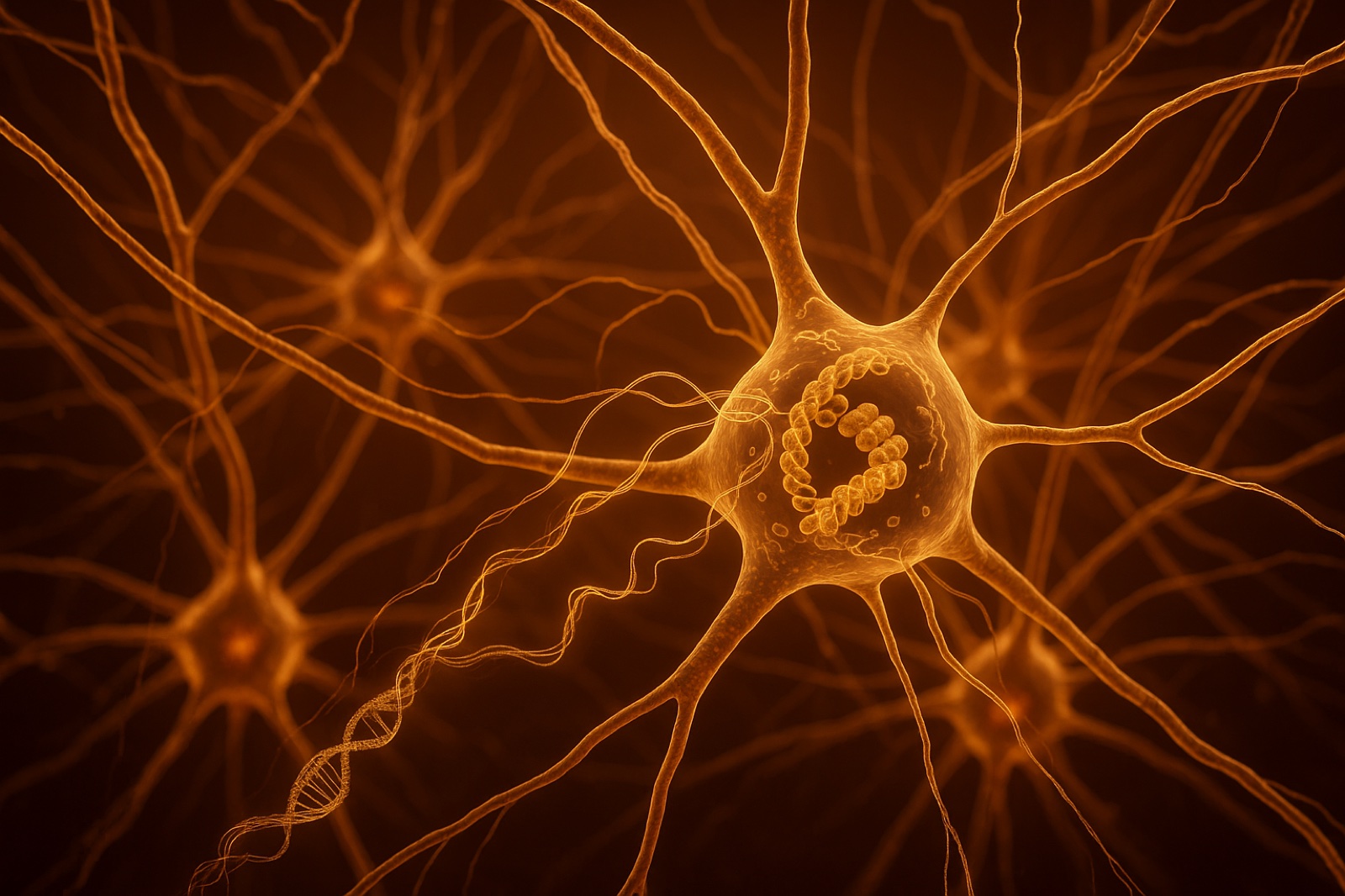
The DNA in your cells does not float around loose. There is far too much of it. It gets wound around small proteins, a bit like thread wound around a row of spools, then packed away. How tightly a stretch of DNA is wound decides something important: whether the cell can actually read the instructions written there. Wound tight, a gene is filed away and quiet. Loosened off, it is available.
Nothing about the instructions changes. What changes is access.
The research team looked at young mice that had been through early-life stress, and then at a specific population of dopamine-producing neurons in a brain region called the ventral tegmental area. In the stressed animals, they found more of an enzyme called SETD7. SETD7’s job is to place a small chemical tag — labelled H3K4me1 — onto the packing proteins. That tag marks the DNA to be loosened off.
So the stress was not writing new instructions. It was changing which of the existing ones stayed easy to reach, for years.
The finding runs the opposite way to what you would guess
Here is the part worth slowing down for, because almost everyone guesses it backwards.
If you had to predict what early hardship does to a brain, you would probably predict less. Shut down. Dulled. Withdrawn. Something switched off to make life survivable.
The mark these researchers found does the reverse. It leaves the DNA more open. More readable. The cell ends up more reactive to whatever happens next, not less.
That matches something people describe about themselves far more often than numbness: not that they feel too little, but that ordinary-sized events land at an enormous size. A tone of voice. A door closing a bit too hard. A message left on read. Something small comes in and the response that arrives is entirely out of proportion to it — the state now often described as emotional flooding. In the mice, the adult animals carrying that early mark were less social, less exploratory, and their dopamine neurons fired more readily.
Not broken. Turned up.
They ran the experiment in both directions
This is what lifts the study above an interesting observation.
First, they went forwards. They artificially raised SETD7 in young mice that had had a perfectly fine start — no early stress at all. Those animals grew up with the loosened DNA structure, lower stress tolerance as adults, more reactive dopamine neurons, and more anxious behaviour than controls.
The mark alone was enough. The hard childhood was not required.
Then they went backwards. In mice that had been through early-life stress, they blocked SETD7’s ability to place the tag. The DNA stayed tightly packed. And those animals — despite the early stress, and despite being stressed again as adults — stayed as social and as exploratory as mice that had never been through any of it, with dopamine neurons active at normal levels.
Read that timing again, because it is the whole thing. The block came after the stress. Nobody prevented anything. Nobody gave those mice a gentler childhood. The event still happened. What got interrupted was what the event was in the middle of writing.
What this does and does not mean
It would be very easy to oversell this, so here is the honest shape of it.
This was mice. Not people. Mouse brains are a genuinely useful model for this kind of mechanism, and they are not a small furry version of a human being. Nothing here has been shown to work in a person.
There is no treatment. There is no pill. One of the researchers, Catherine Jensen Peña, put the reason for the work plainly: “There are currently no treatments for what early-life stress does to the brain, partially because we have not had a clear picture of what molecular mechanisms to target.” That is a statement about a map, not a cure. What this study delivers is a target — an address where something is happening.
The researchers’ own careful suggestion is that supportive care, therapy, or social resources during a child’s sensitive developmental windows might protect the epigenome and let the developing brain build its own resilience. That is a hypothesis they raised on the strength of the mechanism, not something this study tested. It is worth knowing, and it is worth not repeating as though it were proven.
What can be said, carefully, is this. In this animal model, the effect of early stress was not fixed, not permanent, and not a matter of the animal’s effort. It was a physical arrangement — and physical arrangements can be rearranged. Similar work has been quietly rewriting other assumptions too: research reported earlier this year found that depression stalls the brain’s production of new cells, which is another old certainty about permanence coming loose.
The thing that is strange about all of this
Notice where this finding puts the problem.
Not in the person’s memory, where talking might reach it. Not in their choices, where discipline might reach it. Underneath both — in the physical packing of a molecule inside a cell that the animal has no awareness of and no access to. You cannot try your way to a differently folded strand of DNA. The mice that ended up well did not perform better. Something was changed at a level they could not have touched.
Which is a strange rhyme with something very old.
Long before anyone had seen a cell, let alone the proteins DNA is wound around, people trying to describe how a human being actually changes kept arriving at the same odd conclusion — and it always cut against the obvious advice. The oldest accounts do not say try harder, or want it more, or be more disciplined about it. They describe the deepest kind of change as something a person receives rather than performs: a heart replaced rather than repaired, by God, at a depth the person could not reach on their own. That has always sounded like poetry, or like an excuse. It reads a little differently next to a paper about a mark sitting on a spool of DNA, entirely outside the reach of anybody’s willpower.
What to actually do with this
Very little of this is in your hands, and that is not a bad thing to hear. But a few small, free things follow from it honestly:
- Stop reading your reactions as a character flaw. A response that arrives too big is not proof of weakness. In the animals, it was the mark, not the mouse.
- Take the size of it seriously rather than arguing with it. “It was a long time ago” has never once made anyone’s nervous system agree.
- Notice that the intervention came after the damage. Nothing about being years past a hard start put those animals beyond reach. There is no window that closed on you at eighteen.
- If you are near a child in a hard season, be near them. The researchers’ best guess about what protects a developing brain is ordinary supportive presence. That costs nothing and needs no qualification.
If you are reading this and quietly recognising yourself in the reactive-rather-than-numb description, it can help just to see it laid out plainly — this short, free How Anxious Am I? assessment walks through where that reactivity is actually showing up in a normal week.
Back to the sentence at the beginning
It was a long time ago. You should be over it by now.
The most useful thing this study does is not prove that sentence cruel. It is more precise than that. It says the reason the sentence does not work is that it is addressed to the wrong part of you — to the part that decides things, about a change that happened somewhere else entirely.
What got written was real. It was written at a depth nobody chose and nobody can reach by resolving harder.
And in a laboratory in August, in a small animal that had already been through it, it turned out to be the kind of thing that can be written over.
A Question for You
Do you think knowing that a difficulty has a physical, measurable cause makes it easier to carry — or does it make it feel more permanent? Both answers make sense, and people land in very different places on it. Tell us which way it lands for you in the comments.
Share This
- Scientists just found the physical mark early stress leaves in brain cells. It does not switch anything off — it leaves the DNA more open, so everything afterward lands harder. https://bgodinspired.com/index.php/bible-resources/bible-and-science/how-childhood-stress-changes-the-brain/
- “You should be over it by now” is aimed at the part of you that decides things. The change happens somewhere you cannot reach by deciding. New study, and it is worth ten minutes: https://bgodinspired.com/index.php/bible-resources/bible-and-science/how-childhood-stress-changes-the-brain/
- The best part of this study is the timing. They blocked the damage after the stress had already happened — and the animals grew up steady anyway. No window closed. https://bgodinspired.com/index.php/bible-resources/bible-and-science/how-childhood-stress-changes-the-brain/
Questions People Are Asking
How does childhood stress change the brain?
A study published in the journal Neuron on 7 August 2026 by researchers at Washington University School of Medicine in St. Louis and Princeton University found that early-life stress in mice raises levels of an enzyme called SETD7 in dopamine-producing neurons of the ventral tegmental area. SETD7 places a chemical tag (H3K4me1) that loosens how tightly DNA is packed around its supporting proteins, making certain genes easier for the cell to read. The genetic instructions themselves are unchanged; what changes is access to them, and that change was still present in adulthood.
Does early-life stress make the brain shut down or become more sensitive?
More sensitive, according to this research. The chemical mark identified in the 2026 Neuron study loosens DNA packaging rather than tightening it, which leaves affected brain cells more reactive to later events rather than dulled. In the study, adult mice carrying the mark were less social and less exploratory, and their dopamine neurons fired more readily than those of unstressed animals.
Can the effects of early-life stress be reversed?
In mice, in this study, yes — and the reversal was applied after the stress had already occurred. When researchers blocked SETD7 from placing its tag in animals that had been through early-life stress, the DNA stayed tightly packed and those animals remained as social and exploratory as mice that had never been stressed, even when stressed again as adults. This has only been demonstrated in mice. There is currently no equivalent treatment for humans.
Is there a drug or treatment for what early-life stress does to the brain?
No. Researcher Catherine Jensen Peña stated that there are currently no treatments for what early-life stress does to the brain, in part because the molecular mechanisms to target had not been clearly identified. The value of the 2026 study is that it identifies such a mechanism — SETD7 and the H3K4me1 mark — giving future research a specific target. It does not itself provide a therapy.
What did the researchers say might protect a child’s developing brain?
The researchers suggested that supportive care, therapy, or social resources during a child’s sensitive developmental windows may help protect the epigenome and allow the developing brain to build natural resilience. This was presented as an implication of the mechanism they identified, not as a result the study tested directly.