 0
0
 0
0
A NASA space telescope is falling out of the sky faster than anyone expected. So a private company built a spacecraft to go catch it. And then, in the middle of the rescue, the rescuer lost control of itself.
If that sounds like the setup to a movie nobody would greenlight for being too on-the-nose, that’s because it’s real, it’s happening right now, and nobody knows yet how it ends.
The Telescope That’s Been Watching the Sky for 22 Years
The spacecraft in trouble is NASA’s Neil Gehrels Swift Observatory. It launched in 2004, and for more than two decades it has been one of the most useful eyes humans have ever pointed at the universe. Swift specializes in catching gamma-ray bursts — sudden, violent flashes of energy from dying stars and colliding black holes that can appear anywhere in the sky without warning and vanish within seconds. In 2022, Swift helped astronomers spot the single brightest gamma-ray burst ever recorded, a blast so extreme scientists just started calling it the BOAT: the Brightest Of All Time.
That’s the kind of workhorse Swift has been. It doesn’t get the headlines Hubble or Webb get, but for 22 years it’s been the reason scientists get a phone call within minutes when something in the universe explodes.
The problem is that Swift is old, its orbit is decaying, and this year that decay sped up. The sun has been unusually active, and an active sun heats and expands Earth’s upper atmosphere. A puffier atmosphere means more drag on anything flying through it — including a 22-year-old telescope that was never built to fight its way back up. Swift is losing altitude faster than its own team predicted, and without help, it’s on a path to burn up in the atmosphere well before its work is done.
Enter the Rescue Spacecraft — Built by a Company You’ve Probably Never Heard Of
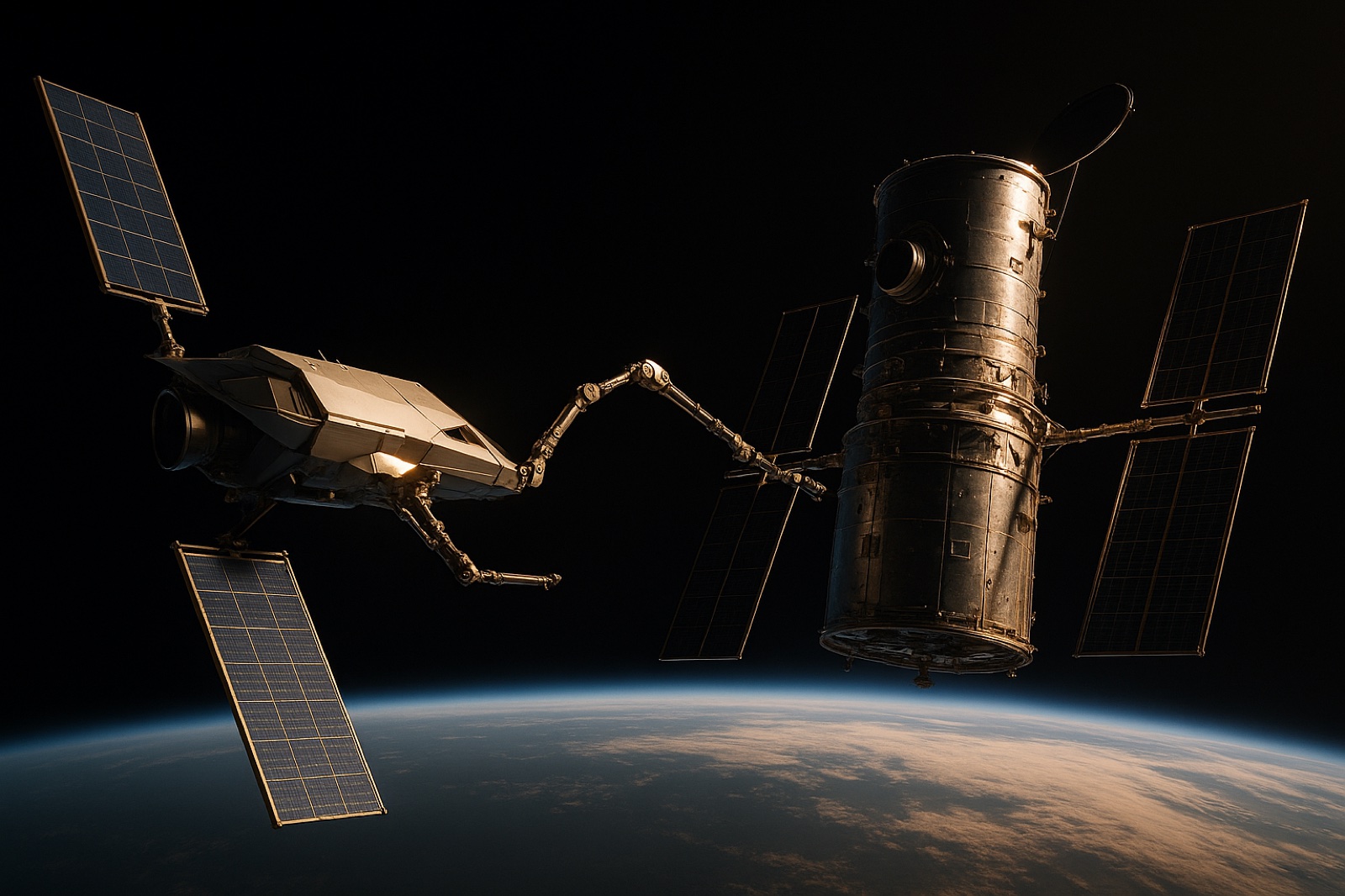
This is where it gets interesting. Instead of letting Swift fall, an Arizona-based startup called Katalyst Space Technologies built a $30 million servicing spacecraft with a name that reads like a mission statement: LINK, short for Lightweight In-Space Navigation and Kinematics. LINK launched in July 2026 with one job — rendezvous with Swift, dock or nudge it, and push it back into a stable, higher orbit where it can keep working.
This is part of a genuinely new industry: satellite servicing. For most of spaceflight history, when something in orbit broke or ran low on fuel, the answer was simple — you let it die and you launched a new one. Servicing spacecraft like LINK are trying to change that math, treating aging satellites the way you’d treat a car that still runs fine except for one part, instead of hauling it straight to the junkyard.
It’s a good idea. It’s also, as it turns out, a hard one to pull off.
Then the Rescuer Needed a Rescuer
On July 29, 2026 — with the mission barely underway — LINK lost attitude control. It started spinning. Its propulsion system faltered, and its communications with ground controllers became sporadic, cutting in and out as the spacecraft tumbled.
So now there are two spacecraft in trouble instead of one: an aging telescope falling out of the sky, and the brand-new rescue ship sent to save it, spinning out of control before it ever got the chance.
Katalyst’s engineers are working to stabilize LINK — adjusting its software to compensate for whatever hardware failed, trying to get it calm enough to even attempt the approach to Swift. The company says it still believes there’s a viable path to complete the mission. But as of this week, nobody can say for certain whether the rescuer is going to make it to the thing it was sent to rescue.
What a Broken Rescue Mission Quietly Points To
There’s something almost too fitting about a rescue mission that itself needs rescuing. We build these elaborate systems — technological, financial, even personal — specifically to save the things we don’t want to lose, and then the system meant to do the saving turns out to have its own weak point, its own single mode of failure, its own need to be caught.
It’s worth sitting with, because it’s not really a space story. It’s the story of every rescue humans have ever tried to build. The friend who shows up to save you but is drowning in their own crisis. The plan that was supposed to fix everything but had one dependency nobody stress-tested. Ancient wisdom has always pointed toward something different — a kind of help that isn’t just stronger or more advanced than the last thing that failed, but doesn’t carry the same built-in fragility to begin with. Not a bigger machine. A different category of rescuer entirely, one that doesn’t wobble under the weight of what it’s holding up.
What Happens Next
Katalyst is still working the problem. If LINK stabilizes, NASA and Katalyst will decide together whether it’s healthy enough to safely approach Swift — because docking a wobbling spacecraft next to a 22-year-old telescope is its own kind of risk. If it doesn’t stabilize in time, Swift’s clock keeps running regardless.
Either way, this is what people have always done: build something to save what they love, watch it wobble, and keep working the problem instead of walking away. Swift is still up there right now, still falling a little more every day, still waiting to find out who — or what — actually reaches it in time.
Join the Conversation
If you were running Katalyst’s mission control this week, what’s the first problem you’d want solved before anything else — LINK’s spin, its propulsion, or its communications blackouts? Tell us in the comments.
Share This
- “NASA built a spacecraft to rescue a falling telescope. The rescue spacecraft just lost control of itself. Two things are in trouble now instead of one. 🛰️”
- “A $30 million rescue mission to save NASA’s Swift Observatory just started spinning out of control before it even reached the telescope it was sent to save. Wild story unfolding right now.”
- “Sometimes the thing sent to save you needs saving too. NASA’s Swift Observatory rescue mission just proved that, literally, in orbit.”
Questions People Are Asking
What is NASA’s Swift Observatory?
NASA’s Neil Gehrels Swift Observatory is a space telescope launched in 2004 that specializes in detecting gamma-ray bursts — brief, extremely powerful flashes of energy from dying stars and colliding black holes. In 2022, it helped detect the brightest gamma-ray burst ever recorded, nicknamed the BOAT (Brightest Of All Time).
Why is the Swift Observatory falling to Earth?
Increased solar activity has heated and expanded Earth’s upper atmosphere, creating more drag on objects in low orbit. That extra drag is pulling the aging Swift Observatory down faster than originally predicted, putting it at risk of reentering the atmosphere and burning up before a replacement mission is ready.
What is Katalyst Space’s LINK spacecraft?
LINK (Lightweight In-Space Navigation and Kinematics) is a $30 million servicing spacecraft built by Arizona-based Katalyst Space Technologies. It launched in July 2026 with the goal of rendezvousing with the Swift Observatory and boosting it into a higher, more stable orbit.
What happened to the LINK rescue mission?
On July 29, 2026, LINK lost attitude control and suffered propulsion issues shortly after launch, causing it to spin and resulting in intermittent communication with ground controllers. Katalyst is working to stabilize the spacecraft before it can attempt to reach Swift.
Will NASA’s Swift Observatory be saved?
As of early August 2026, it’s still undetermined. Katalyst says it believes LINK has a viable path to complete the rescue if it can be stabilized, but both the timeline for Swift’s decay and the recovery of LINK remain uncertain.
Curious how other NASA missions have turned setbacks into something unexpected? NASA’s Psyche spacecraft just took the long way to a metal world — on purpose, and the Webb Telescope once found a planet that had been hiding in plain sight for years. And if you want another story about something real that stayed just out of reach, Europa’s ocean is real — and still nearly unreachable.