 0
0
 0
0
For more than a hundred years, nobody could answer a simple question about one of the most famous cave paintings in the world: when, exactly, was it made?
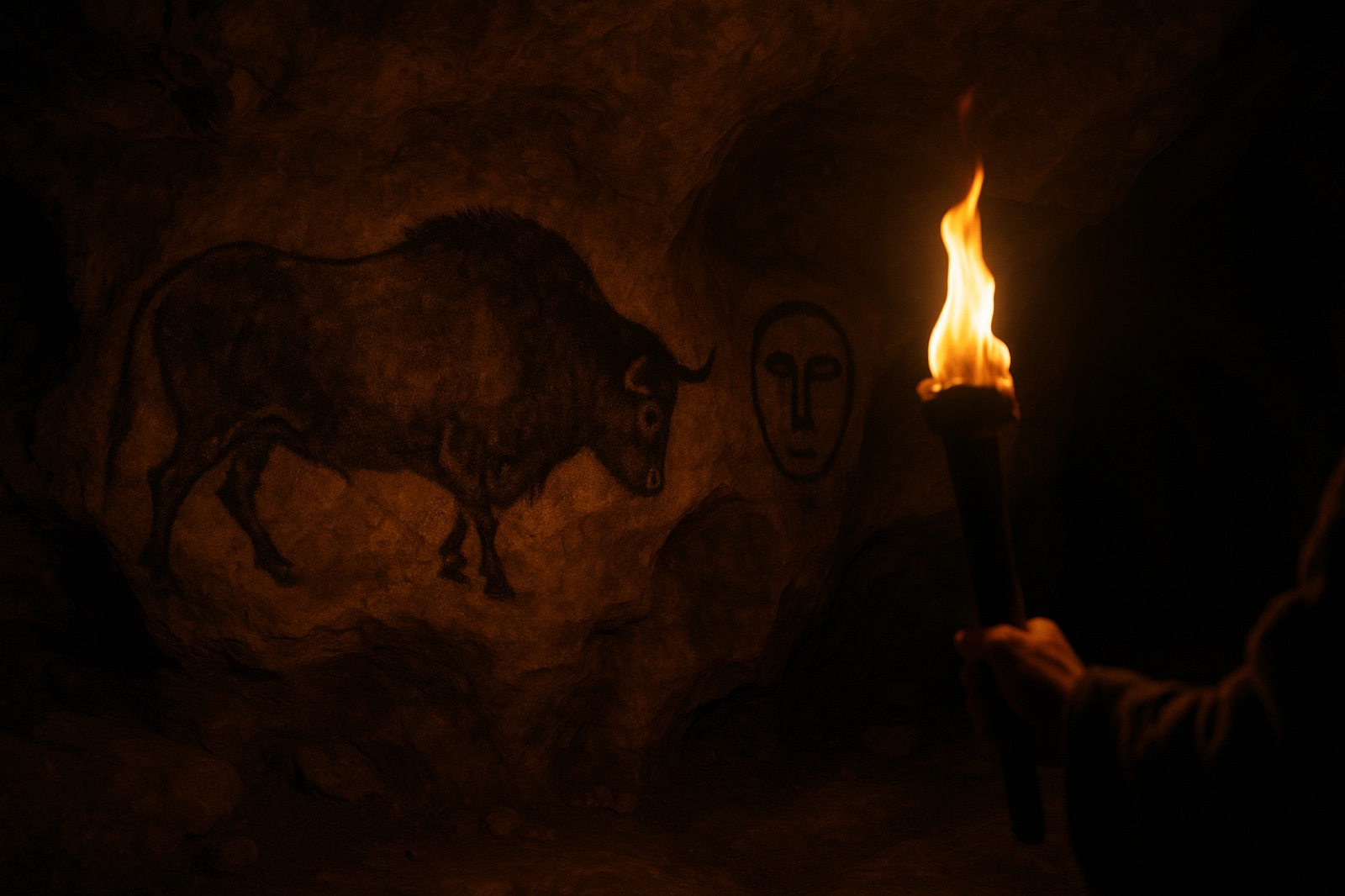
Not “roughly during the Ice Age.” Not “sometime in the last 20,000 years, give or take a few millennia.” The actual year — or at least, the actual century. Scientists have wanted that answer since the paintings at Font-de-Gaume, in the Dordogne region of southwestern France, were first discovered in 1901. The site is one of the last places on Earth where you can still see original Ice Age polychrome paintings in place, on the walls where the artists left them. And for over a century, the black pigment in those paintings — a bison, and a strange, mask-like face — seemed to be made of nothing but mineral: iron and manganese oxide. No carbon. No way to run a radiocarbon date. The paintings sat there, undeniably ancient, permanently un-datable.
Then a team of French researchers looked closer.
The Clue Was Hiding Inside the Paint
Using Raman microspectrometry and hyperspectral imaging — tools sensitive enough to map the molecular makeup of a single fleck of pigment — researchers found something everyone had missed: traces of charcoal buried inside what looked like pure mineral paint. Wherever there’s charcoal, there’s carbon. And wherever there’s carbon, there’s a radiocarbon date waiting to be read.
It let them do something that had never been done in this region before: pull a real, calibrated date directly out of the paint itself, not off a nearby torch mark or a bone fragment found on the cave floor that might have nothing to do with the artwork. This time, the black pigment on the wall could finally speak for itself.
It’s a different kind of “oldest ever found” than the 430,000-year-old wooden tools recently confirmed as the oldest ever discovered — those were built to solve a problem. This wasn’t. The bison came back dated to roughly 13,200 to 13,460 years ago. The mask-like figure told an even stranger story: different sections of the same image dated to different periods, one stretch nearly 16,000 years old, another separated from it by thousands of years, and a third section added later still. One figure, visited and reworked across a span of time longer than all of recorded human history combined. Published this year in the Proceedings of the National Academy of Sciences, it’s the first time cave art in this part of France has ever been dated directly and precisely — down to a window of decades, not eras.
Nobody Needed to Make This
Here’s the detail that’s easy to skim past: Font-de-Gaume isn’t a shallow shelter near a cave mouth where a family might have huddled by a fire for warmth. The painted chambers sit deep inside the rock, in absolute, total darkness. To make this art, someone had to carry fire in with them — a torch, or an animal-fat lamp — just to see the wall they were painting on. They had to grind pigment, mix it, choose a surface, and work carefully enough to render a recognizable bison in a space where the flame might gutter out at any moment and leave them alone in the black.
None of that helped anyone survive the next winter. It didn’t feed a family, build a shelter, or ward off a predator. Every minute spent grinding ochre and steadying a torch against a cave wall was a minute not spent hunting, foraging, or resting. And they did it anyway — not once, but across generations, revisiting that same mask-like figure over thousands of years, adding to it long after whoever painted the first section was gone.
That’s the part researchers keep circling back to. This wasn’t a one-time fluke by one unusually artistic person. It was a pattern, sustained across an almost unimaginable stretch of time, in the one place on the whole landscape where no one would ever see it unless they went looking — with fire, in the dark, on purpose.
It also isn’t an isolated case. Researchers have found geometric engravings on ostrich eggshells dating back 60,000 years, patterns that served no survival function either — just early evidence that abstract, symbolic thought was already switched on in the human mind tens of thousands of years before Font-de-Gaume’s painters ever picked up a torch.
What That Might Actually Mean
It’s tempting to explain this away as decoration, or ritual, or some early form of storytelling — and it may well have been all three. But those explanations don’t really answer the deeper question: why would a species fighting for survival in an Ice Age landscape spend its scarcest resource — time — on something with zero practical payoff, in a place built for nobody to casually stumble across?
Somewhere in the history of belief, there’s a quieter idea worth sitting with: that the drive to make something beautiful for no reason at all isn’t a side effect of intelligence, or a lucky accident of evolution — it’s a signature. Something bigger than survival instinct, stamped into us from the very beginning, showing up in the dark long before anyone needed it to show up anywhere. Not a tool. Not a strategy. Just beauty, made because it wanted to exist, by people who wanted to make it. The same way a years-long detour built into a modern space mission turned out to be the plan all along, exactly — some things only look accidental until you see the whole shape of them.
If that impulse really does go back further than survival itself, then wanting to create — a poem nobody asked for, a song hummed just for yourself, a doodle in the margin of a notebook — was never a luxury bolted onto being human. It was there from the start.
You’re Still Doing the Same Thing
Think about the last time you made something with absolutely no practical reason to — rearranged furniture for no occasion, hummed a tune nobody else heard, doodled in a meeting, cooked a meal that took longer than it needed to just because you wanted it to look right on the plate. You weren’t doing that to survive. You were doing it because some part of you, the same part that carried a torch into a dark cave 16,000 years ago, still can’t help it.
Maybe that’s not a quirk to explain away. Maybe it’s one of the oldest, most consistent things we know about being human — older than agriculture, older than cities, older than written language itself. And it’s still running in you, right now, whether or not you ever set foot in a cave.
Discussion Question
If the drive to create beauty for no practical reason really is older than survival itself, what does that say about what we’re actually here for? Do you think usefulness is the point of a life — or is it something else? Tell us what you think in the comments.
Share This
- Cave painters in France carried fire into total darkness to paint a bison 13,000+ years ago — for absolutely no survival benefit. Wild what that says about being human.
- Scientists just dated Ice Age cave art to the exact decade for the first time ever — and the real story isn’t the dating method. It’s that humans have been making pointless, gorgeous art since before recorded history began.
- 16,000 years ago, someone crawled into a pitch-black cave with a torch to paint something nobody needed. We’ve never stopped doing exactly that.
Questions People Are Asking
How old are the Font-de-Gaume cave paintings?
Using new radiocarbon dating methods, researchers dated a bison painting at Font-de-Gaume to roughly 13,200-13,460 years old, and sections of a separate mask-like figure to periods ranging from around 8,600 to nearly 16,000 years old, showing the image was revisited and added to across thousands of years.
How did scientists finally date these cave paintings after over a hundred years?
For over a century, the black pigment at Font-de-Gaume was believed to contain only mineral oxides, which can’t be radiocarbon dated. Using Raman microspectrometry and hyperspectral imaging, researchers discovered hidden traces of charcoal within the pigment, which gave them the carbon they needed to run a direct radiocarbon date on the paint itself for the first time.
Where is Font-de-Gaume cave located?
Font-de-Gaume is located near the town of Les Eyzies in the Dordogne region of southwestern France, an area with one of the highest concentrations of Ice Age cave art sites in the world.
Why did Ice Age humans paint in caves if it didn’t help them survive?
The painted chambers at sites like Font-de-Gaume are located deep inside the rock in total darkness, meaning artists had to carry fire in specifically to create and view the work. Because this art offered no direct survival benefit, researchers see it as evidence that the drive to create was present in early humans as its own distinct impulse, not simply a byproduct of practical skills.
What does this cave art discovery reveal about human creativity?
The fact that a single painted figure was revisited and reworked across thousands of years suggests that the desire to make and add to art wasn’t a one-time occurrence but a sustained, generational pattern — one of the oldest consistently documented human behaviors on record.