 0
0
 0
0
You’ve probably put a few dollars in an offering plate right after someone in front of you dropped in a check for a few hundred. Or chipped in a small amount toward a group gift, watching the running total climb from names attached to bigger numbers. Nobody said anything. Nobody had to. You just quietly assumed your part didn’t really register.
That’s almost exactly the scene Jesus was watching when He noticed a widow at the temple treasury — and the real widow’s mite meaning has almost nothing to do with the two coins she dropped in. It’s about what Jesus saw that day that nobody else in that courtyard was even looking for.
A Treasury Built for People to Watch
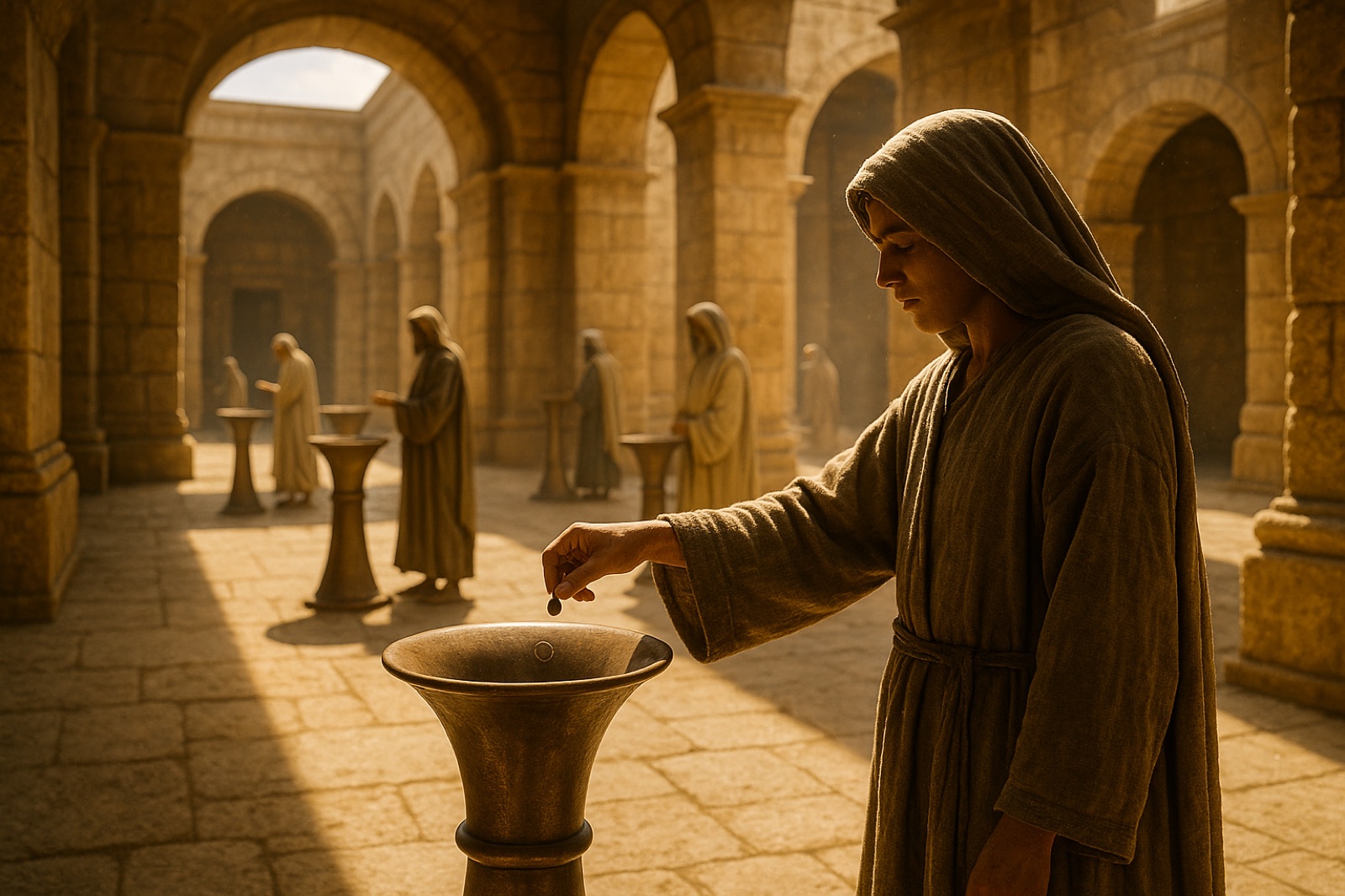
The temple treasury in Jerusalem wasn’t a quiet drop box. It sat in the Court of Women, and Scripture describes thirteen metal, trumpet-shaped receptacles where worshippers came to give — receptacles designed, historians note, to make a sound as coins hit metal. Giving here was public. You could see who walked up. You could hear how much landed.
Mark tells us Jesus “sat over against the treasury, and beheld how the people cast money into the treasury” (Mark 12:41). That word matters — He wasn’t passing by. He sat down specifically to watch this happen. And what He watched first was ordinary: “many that were rich cast in much” (Mark 12:41). Large sums, probably landing loud, probably drawing a glance or two.
If you’ve ever felt like your effort was too small to matter next to someone else’s obvious, visible contribution, you already know this feeling from the inside. The comparison isn’t new. It’s just usually happening in a break room or a group chat instead of a temple courtyard.
Two Mites, and Everything She Had
Then Mark narrows the camera. “And there came a certain poor widow, and she threw in two mites, which make a farthing” (Mark 12:42). A “mite” — the Greek word is lepton, literally “thin” or “small” — was the smallest coin in circulation in first-century Judea. Two of them together were worth a fraction of a single day’s wage. Next to the sums the wealthy were dropping in, her gift wouldn’t have registered as a sound worth turning around for.
A widow in that culture had no husband’s income, no inheritance rights most of the time, and often no real safety net beyond family or charity. Two mites weren’t pocket change she was rounding down from a bigger amount. For her, it likely was the amount — or close to all of it.
What Jesus Said Next
Here’s where the widow’s mite meaning actually lives — not in the coins, but in what Jesus does immediately after. He calls His disciples over. Not to point at the wealthy givers. To point at her.
“And he called unto him his disciples, and saith unto them, Verily I say unto you, That this poor widow hath cast more in, than all they which have cast into the treasury: For all they did cast in of their abundance; but she of her want did cast in all that she had, even all her living.” (Mark 12:43-44)
That’s not sentimental exaggeration. Jesus is doing a completely different kind of math than everyone else in that courtyard. The wealthy gave out of surplus — money they’d never miss, gone before dinner. She gave out of want, and what she gave cost her something real. Jesus wasn’t measuring the coins. He was measuring what the gift took from her, and what that took revealed about what she trusted.
It Was Never About the Amount
Here’s the turn most people miss when this story gets used as a stewardship pitch: Jesus never told His disciples to give more. He told them to see differently. The lesson isn’t “give until it hurts.” It’s that the size of your offering was never the thing being measured in the first place. What’s being measured is what it cost you, and whether you trusted there’d be enough left over to still be okay.
That reframes a lot more than money. Maybe it’s the encouraging text you sent that felt too small to matter. The extra ten minutes you gave someone when you were already running on empty. The prayer you kept praying for a situation with zero visible movement. None of it made a sound loud enough for anyone else to notice. You may have assumed, quietly, that it didn’t count. It’s the same principle behind how Luke 6:38 quietly multiplies what you give — the math isn’t the point Jesus is making.
Jesus sat down specifically to watch for exactly that kind of gift. Not the one everyone already saw. The one nobody was tracking but Him. It’s worth remembering that Jesus spent 90% of His own life hidden, unseen by anyone who thought His story mattered yet. The One who noticed her two coins knows exactly what it’s like to be overlooked while doing something that counted.
If it ever feels like your gift went unanswered, unnoticed, or unreciprocated, our free What Jesus Teaches assistant can walk through more of what Jesus actually said about giving and being seen — it opens free in ChatGPT.
Actions to Take This Week
- Name one thing you gave recently that felt too small to matter. A moment, a text, a few dollars, an hour of your time. Write it down. Don’t minimize it — just name it honestly.
- Give one thing today that costs you something real, even small. Not for an audience. Ten minutes of undistracted attention to someone who needs it, or the thing you’ve been putting off because it’s inconvenient, not because it’s hard.
- Stop keeping score against other people’s “much.” The next time you catch yourself measuring your effort against someone else’s more visible one, say out loud: “This isn’t a competition God is scoring by volume.”
Journaling Prompts
- Where in your life have you assumed something didn’t count because it looked small next to someone else’s contribution?
- What’s something you’ve given — time, patience, money, attention — that actually cost you, even if no one else clocked it?
- If God isn’t measuring your life by volume, what might God actually be measuring in you right now?
A Prayer for When You Feel Like Your Part Doesn’t Count
God, I don’t always believe the small things I do actually matter. I compare what I have to give against what other people seem to have, and I quietly decide mine doesn’t count. Help me remember that You weren’t watching the coins land in that treasury — You were watching her heart. See what I’ve been holding back because it felt too small to offer. Thank You for noticing what I thought no one saw.
One Question Worth Sitting With
If Jesus were sitting across the room watching how you spend your time, your money, and your attention this week — not to judge it, just to notice it — what do you think He’d actually point out to someone else? Tell us in the comments.
Share This
- “Jesus wasn’t counting her coins. He was counting what they cost her.” — on the widow’s mite
- God isn’t measuring your gift by its size. God is measuring what it cost you to give it.
- The small thing you gave that nobody noticed? Someone was watching. #WidowsMite
Common Questions About the Widow’s Mite
What is the widow’s mite meaning in the Bible?
The widow’s mite meaning comes from Mark 12:41-44 and Luke 21:1-4, where Jesus watches a poor widow give two small coins at the temple treasury and tells His disciples she gave more than the wealthy people around her — because she gave out of her need, not her surplus. The point isn’t the amount of money; it’s that Jesus measures the cost of a gift to the giver, not its size.
How much was a widow’s mite actually worth?
A “mite” translates the Greek word lepton, the smallest coin in circulation in first-century Judea — worth a small fraction of a single day’s wage. Two mites together were still a tiny amount of money, which is exactly why the story is remarkable: Jesus valued it above the large sums given by wealthy worshippers.
Why did Jesus say the widow gave more than everyone else?
Because Jesus measured the gift by what it cost the giver, not by its total. The wealthy gave “of their abundance” — money they wouldn’t miss. The widow gave “of her want,” meaning it was all she had left to live on. Proportion and sacrifice, not size, is what Jesus pointed His disciples toward.
Is the widow’s mite story about tithing or church giving?
Not primarily. While the story is often used in stewardship messages, Jesus never instructs anyone in the passage to give more money. The core lesson is about how God sees the heart behind an offering — which applies far beyond money, to any small, costly thing a person gives without expecting recognition for it.
Where else does the widow’s mite story appear in the Bible?
The story appears in two Gospels: Mark 12:41-44 and Luke 21:1-4. Both accounts are nearly identical, and both place the moment right before Jesus begins teaching about the temple’s coming destruction — a widow’s quiet faithfulness set against a building that wouldn’t last.