 0
 0
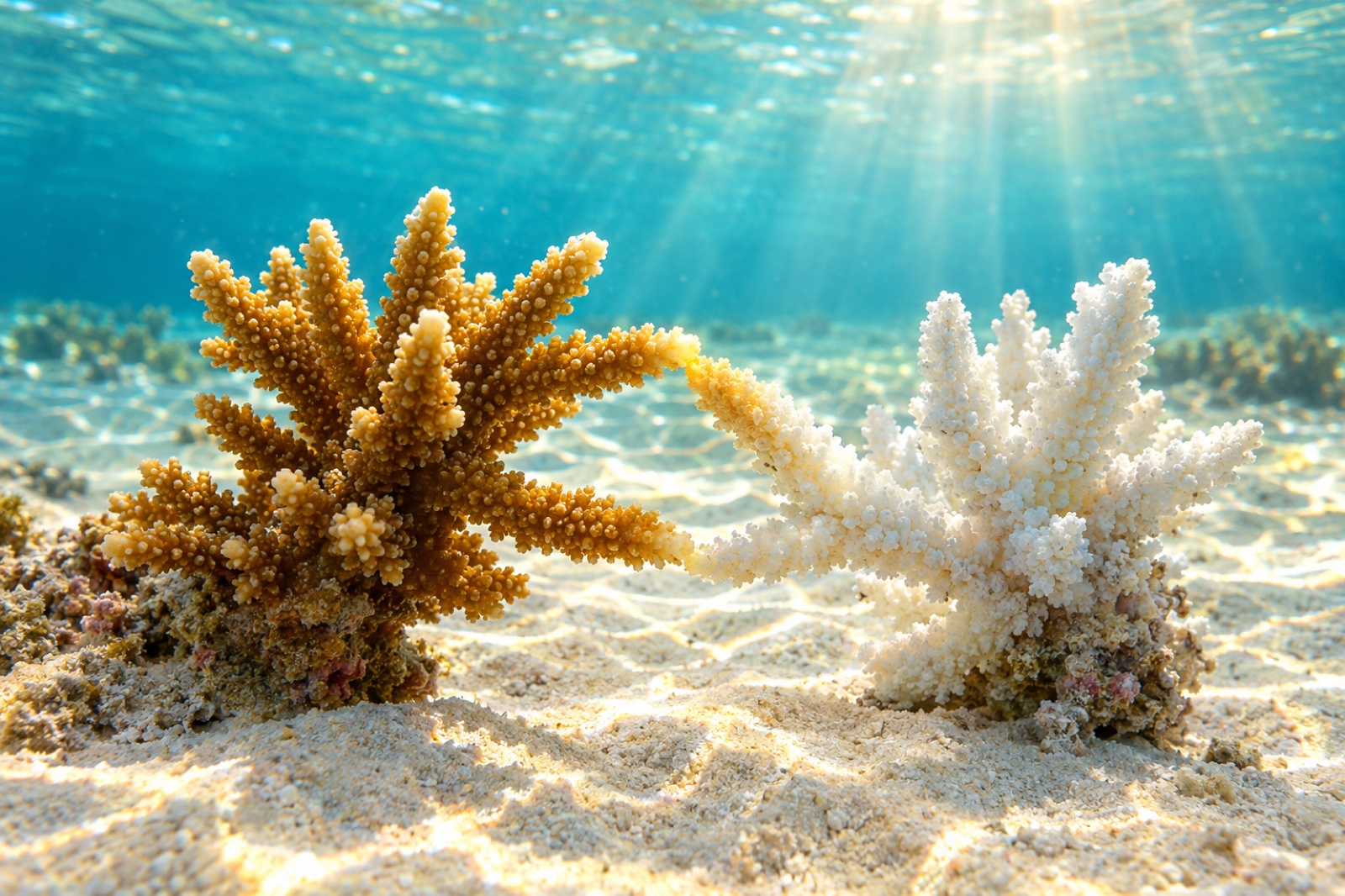
Picture two small pieces of coral sitting on the floor of a tank. They came off the same colony, so they are as close to identical as two living things get. One is a healthy golden-brown. The other is bone white, heat-stressed and starving.
Set them a few millimetres apart and the white one gets worse.
Move them until they touch, and something strange happens. In a recent Stanford experiment, bleached coral recovery – full recovery, colour and all – took about seven weeks. Not for every fragment. Only for the ones that were touching.
The distance between the two outcomes was smaller than the width of a pencil line.
What Bleaching Actually Does to a Coral
A coral is not really one animal. It is an animal that farms.
Inside its tissue live microscopic algae. The algae catch sunlight and make sugars, and most of that food goes straight to the coral. In exchange they get a safe place to live. That partnership is what builds reefs, and it is also what gives coral its colour. The brown, the gold, the olive green – that is the algae showing through.
When the water gets too warm for too long, the partnership breaks. The coral expels the algae. What is left is clear tissue over a white skeleton, which is why we call it bleaching.
Here is the part people often miss: a bleached coral is not a dead coral. It is a hungry one. The animal is still alive, still holding on, but it has lost the thing that was feeding it. If the heat passes and algae come back, it can recover. In the wild, that process is slow and uncertain, and plenty of bleached coral simply runs out of time.
Ten Pairs, and a Gap of a Few Millimetres
The study was published in Science Advances in mid-October 2026, led by Danny Collins, a researcher at Stanford University, with the marine scientist Steve Palumbi among the co-authors. It was covered widely when it appeared.
The setup was almost comically simple. The team made ten pairs of coral fragments, each about four centimetres long. Every pair was one bleached piece and one healthy piece, broken from the same colony – genetically the same individual, split in two.
Five pairs were placed so the branches touched. Five pairs were placed with a gap of a few millimetres between them. Same water, same light, same everything else.
Then they watched.
How Fast Bleached Coral Recovery Happened
Within three days, algae had started crossing over.
Because the two fragments were genetically identical, their tissues did not treat each other as strangers. They recognised each other and fused, opening tiny living channels between the two pieces. Algae and nutrients moved through those channels from the healthy side into the starving one.
And once they arrived, they multiplied fast. “They flood in and start dividing at the fastest rates seen in corals,” Palumbi said.
After about a week of contact, the connection had done its job. The researchers could separate the two fragments, and the formerly bleached one kept recovering on its own. It no longer needed to be attached. It just needed to have been.
By week seven, all five of the touching fragments had fully recovered.
The five that were kept a few millimetres away did badly. Some of them died.
“It was so much faster and more intense than we ever expected,” Collins said.
The Idea Came From Watching Corals Make Each Other Sick
This is the detail that makes the whole study land differently, and it is the one that almost never gets repeated.
The researchers did not set out to invent a healing technique. They started from something grim that was already known: touch is how coral disease spreads. “Harmful bacteria enter corals through physical contact,” Collins explained.
So the question that led to the experiment was not “how do we heal a coral?” It was closer to: contact is the route sickness takes – what happens if we send something good down the same road?
That is a small shift in thinking and an enormous one. The mechanism nobody wanted turned out to be the mechanism that worked. Contact was never the problem. Contact was just the channel, and the only question was what travelled along it.
Why This Is Not a Cure for Reefs
It would be easy to turn this into a headline about saving the oceans. The scientists involved went out of their way to stop that.
The fusion only worked because the two fragments were clones of each other. Corals that are not genetically identical do not merge like this – they clash. So using the method at scale would mean having a healthy copy of every coral, ready in advance, before a heatwave arrived. “We likely will not be touching corals to each other on reefs,” Collins said plainly.
It also does nothing about the cause. “This is a recovery story,” Palumbi said. “It doesn’t blunt heatwaves; it just helps the aftermath.” Warming water is still the thing killing reefs, and nothing in a tank changes that. Terry Hughes, a coral researcher who was not part of the study, made the obvious and necessary point: none of this helps a coral that is already dead.
What the work actually offers is a different idea of what a bleached coral is. Not a corpse. A patient. “While bleached corals may be dying, they are not dead yet,” Collins said. If researchers can work out how to deliver the algae without needing a genetic twin pressed up against it, that changes what is worth trying after a bleaching event. For now, it is a lead, not a rescue.
Reefs have a habit of being written off early. A reef off the coast of Benin was recorded as dead in the 1960s and filmed alive sixty years later, because nobody had ever actually gone down to look.
The Thing a Message Cannot Carry
There is a story people have been telling for about two thousand years about a man with a skin disease. In that time and place, the disease did more than make him ill. It put him outside the town. He was not allowed near anyone, and anyone who touched him became unclean too. Whatever years he had left, he was going to spend them at a distance.
A healer came through, and the man asked to be made clean.
Here is the part that is easy to read straight past. In those same accounts, the healer repeatedly cures people he never goes near. A request arrives from somewhere else, a word is spoken, and a sick person miles away gets up well. Distance was clearly not an obstacle. He could have done this one from where he was standing.
Instead he reached out and put a hand on him first.
Read that next to the corals and it reads differently than it used to. The disease was one problem. Being untouchable was a second one, running alongside it the whole time – and a word sent from a safe distance was never going to reach that. Something had to cross the gap. The oldest descriptions of God tend to run in that same direction: not a message passed down from far away, but a presence that comes close enough to make contact.
What This Looks Like When You Are Not a Coral
None of this is a scientific claim about people. Coral is coral. But most of us already know the gap in the tank, because we have stood on one side of it.
Showing up beats sending. If someone you know is going through it, a message is better than nothing and you should send it. But if you can be in the room – sit with them, walk with them, carry a bag, make the tea – that is a different category of thing, and we tend to assume it matters less than it does.
It may not take as long as you fear. One of the quieter findings here is that the contact phase was days, not weeks. People put off showing up because they imagine being needed forever. Often what is actually required is being close for a short while, early.
Being the one who needs it is not a failure. The bleached fragment did nothing clever. It did not fight its way back. It was simply reachable, and that turned out to be enough. If you are the depleted one right now, your only job is to not keep yourself millimetres away from everyone who could reach you.
If you are not sure how isolated you have actually become, this free How Lonely Am I? check takes a couple of minutes. And if the people around you went quiet when things got hard, here is why friends disappear when you need them most – it is usually not what it looks like.
Back to the Two Fragments
The experiment is small. Ten pairs, one species, one tank, and a result the researchers themselves are careful not to oversell.
But the shape of it is hard to shake. Two living things, identical, in the same water, under the same light, given the same chance. One recovered completely in seven weeks. One did not.
The only difference between them was whether anything was touching.
Something to Think About
We have all had the moment of deciding between sending a message and actually turning up. Which one do you think does more for someone having a hard time – and has that changed as you have got older? Tell me in the comments.
Questions People Ask About Bleached Coral Recovery
Can bleached coral recover?
Yes. Bleaching is not death. A bleached coral has expelled the microscopic algae that live in its tissue and provide most of its food, leaving white skeleton visible through clear tissue, but the coral animal is still alive. If water temperatures return to normal and algae are taken back up, the coral can recover. In the wild this is slow and often fails, because a bleached coral is starving while it waits.
How long does bleached coral recovery take?
In a Stanford laboratory study published in Science Advances in mid-October 2026, bleached coral fragments that were touching a healthy clone fully recovered in about seven weeks. Algae began moving across within three days of contact, and after roughly one week the fragments could be separated and continued recovering on their own. Recovery in the wild, without that contact, is typically much slower and less reliable.
How does touching a healthy coral help a bleached one?
When two coral fragments are genetically identical, their tissues recognise each other and fuse rather than fighting. That fusion creates tiny channels between the two pieces, and symbiotic algae and nutrients pass through those channels from the healthy fragment into the bleached one. The transferred algae then multiply rapidly inside the recovering coral, restoring both its colour and its food supply.
Could this method be used to save coral reefs?
Not as it stands. The technique only worked between fragments that were clones of the same colony, since corals that are not genetically identical do not fuse. Using it on a reef would require a healthy genetic copy of each coral prepared before a bleaching event. The researchers said directly that corals will likely not be touched to each other on reefs, and noted the method addresses the aftermath of a marine heatwave rather than the warming that causes it.
What causes coral bleaching?
Coral bleaching is caused mainly by water that stays warmer than usual for an extended period, which breaks down the partnership between a coral and the algae living in its tissue. Under that stress the coral expels the algae, losing both its colour and its main source of food. Other stresses such as pollution, disease and changes in light or salinity can also trigger bleaching, but marine heatwaves are the dominant driver of large-scale bleaching events.
Share This
Scientists put a bleached coral next to a healthy one from the same colony. The pairs that were touching fully recovered in seven weeks. The pairs held a few millimetres apart did badly, and some died. Same water, same light. https://bgodinspired.com/index.php/nature-and-creation/bleached-coral-recovery-touching-healthy-clone/
The best detail in this coral study: the researchers got the idea from disease. Touch is how coral infections spread – so they asked what would happen if you sent something good down the same road. https://bgodinspired.com/index.php/nature-and-creation/bleached-coral-recovery-touching-healthy-clone/
“While bleached corals may be dying, they are not dead yet.” Read this one if you have ever written something off too early. https://bgodinspired.com/index.php/nature-and-creation/bleached-coral-recovery-touching-healthy-clone/