 0
0
 0
0
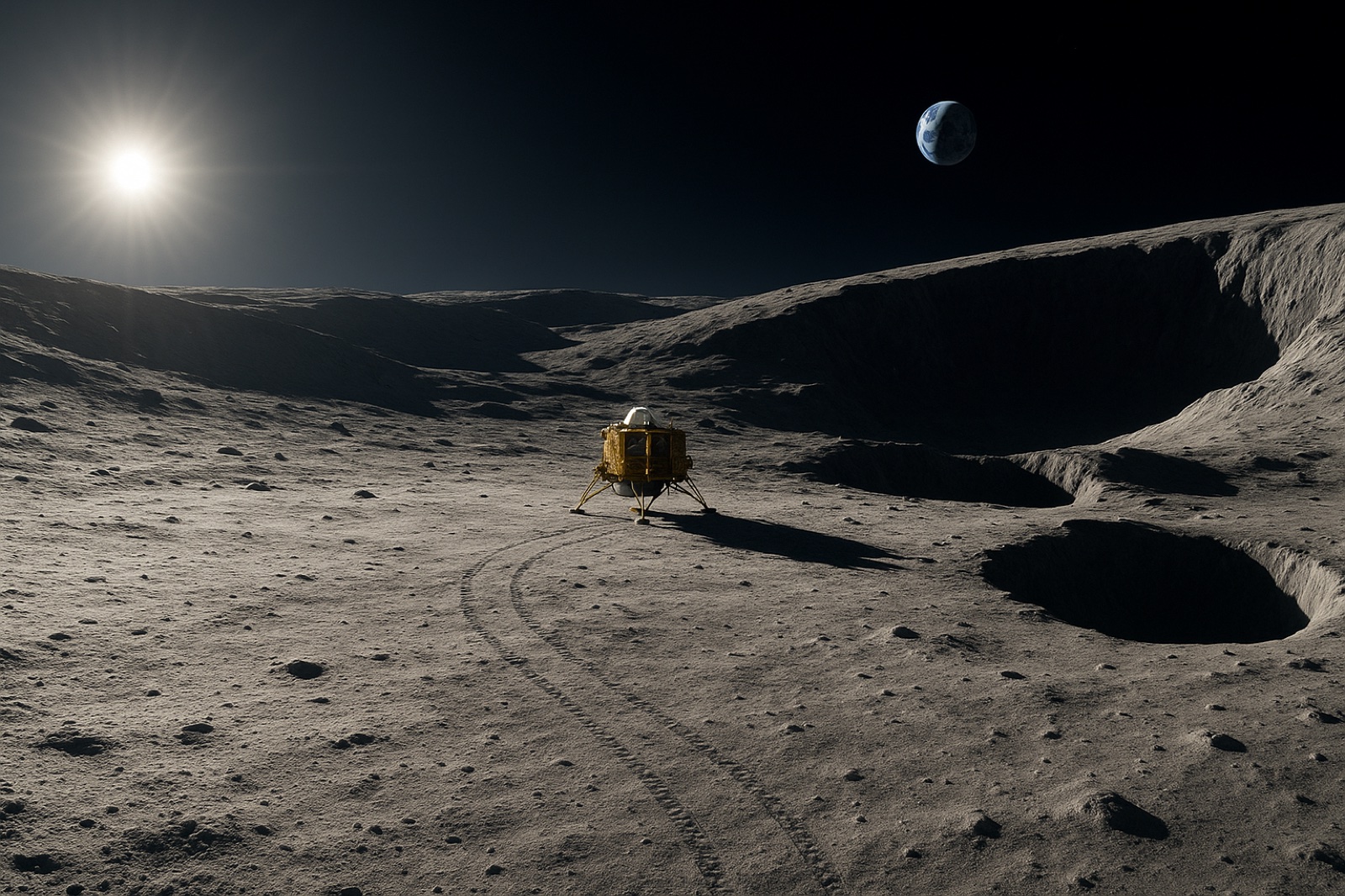
The Moon is about to get busy again. Landers, rovers, crewed missions, a whole queue of hardware pointed at one small patch of it — the south pole, where the sun never quite reaches into some of the craters.
And before any of that arrives, a team of scientists sat down to ask a question that sounds like a film pitch and turns out to be a serious engineering problem: what are we bringing with us?
Not equipment. Passengers. The ones nobody packed.
Can Microbes Survive on the Moon? Here Is What the Study Actually Tested
A NASA-led team looked at whether ordinary Earth microbes — the kind that live on skin, on clothes, on the inside of a spacecraft no matter how carefully it is cleaned — could stay alive on the lunar surface. The work was published on 19 August 2026 in the journal Science Advances, led by Prabal Saxena at NASA’s Goddard Space Flight Center.
Five organisms were studied. Two fungi: Aspergillus niger and a Fusarium species. Three bacteria: Bacillus subtilis, Staphylococcus aureus, and Deinococcus radiodurans. None of them exotic. Most of them are on you, or near you, right now.
Here is the part worth being clear about, because a lot of the coverage blurred it: nobody put a fungus on the Moon. This was a modelling study. The team built detailed maps of the lunar south pole using elevation and temperature data from NASA’s Lunar Reconnaissance Orbiter, added radiation models, and then asked what those conditions would do to each organism.
Three specific places were modelled — Nobile Rim, Connecting Ridge, and De Gerlache Rim. All three are candidate landing territory. All three have terrain that stays permanently in shadow.
And that shadow, it turns out, is the whole story. The same darkness that makes those craters interesting to scientists also makes them unusually kind to a stowaway: brutally cold, which preserves, and shielded from the worst of the radiation, which would otherwise destroy.
The Detail Almost Every Headline Skipped
“Microbes could survive on the Moon” reads like colonies. Like something spreading in the dark.
So it is worth knowing what the study counted as survival. The bar was staying alive for at least one Earth day.
One day. That is the finding. It is a real finding — a day is long enough to matter when you are trying to keep a landing site scientifically clean — but it is a very different picture from the one the headline paints in your head.
The researchers were also unusually direct about the limit of what they had shown. Surviving is not the same as growing. The Moon has no liquid water and none of the moderate temperatures that microbial life needs to feed and reproduce. Nothing is going to take root up there.
So what the study describes is not life on the Moon. It is dormancy on the Moon. Something arriving, going still, and simply not dying.
One more detail that stuck with me: the toughest organism of the five was Aspergillus niger — a common black mould, the sort of thing you find on an onion left too long in the cupboard. It held up best against ultraviolet light, staying viable even in spots that catch some sun. The most resilient traveller was not the exotic radiation-eating bacterium. It was the kitchen mould.
And to be precise about one last thing: no contamination has actually been found on the Moon. This study predicts a risk. It does not report a discovery.
Why a Sleeping Microbe Is Still a Problem
If nothing can grow, why does any of this matter?
Because of what is in those shadows. The permanently dark floors of the south pole craters are where the ice is — water that may have been sitting untouched for a very long time, which makes it both a practical resource for future missions and a record nobody has read yet. Scientists are already going to some trouble to find it; there is work using moonquakes to map the ice hidden beneath the surface.
The value of that record depends entirely on it being untouched. The moment we cannot tell what is lunar from what is ours, we lose the ability to read it — not because we broke it, but because we blurred it. You can only take a first measurement once.
(If working out the age of things from the traces they leave is your kind of question, our free How Old Is the Universe? explorer walks through how those ages actually get measured.)
What Travels With Us
There is something quietly unsettling about this study, and it is not the microbes.
It is that we cannot go anywhere clean. We sterilise the spacecraft, we suit up, we follow the protocol — and a bit of us still makes the trip. Not because anyone was careless. Because that is what it means to be a living thing going somewhere.
Most of us have run a smaller version of this experiment. The new city. The new job. The fresh start that was going to fix it. And then, a few months in, the same argument, the same 2am, the same knot in the stomach — because the thing you were escaping was never in the old place. It came in the luggage. Researchers who study why a reset so often fails to hold keep landing near the same conclusion.
But the study says something gentler than that, too, and it took me a while to notice.
Those microbes are not thriving up there. They are also not dead. They are dormant — waiting for conditions that have not arrived.
Which cuts both ways. The pattern you thought you had beaten by moving may only be sleeping, and hard ground is not the same as healing. But the reverse is just as true, and it is the better half: the things that have gone quiet in you are not automatically finished either. The curiosity. The nerve. The hope you assume you outgrew because you have not felt it in years. Dormant is not dead.
People have been saying something close to this for thousands of years, long before anyone could model a crater floor — that what is inside a person travels with that person, and that nothing in a person is ever quite past reviving. God, in that older way of seeing it, is less interested in relocating you than in changing what you carry.
What Happens Next
The practical answer is unglamorous and pretty encouraging: this is exactly the sort of thing you want found before the missions land, not after. Knowing which organisms hold up, and precisely where the shadowed ground protects them, is what lets people plan around it.
Still — the next time a lander touches down at the lunar south pole, it is worth holding the picture in your head. The cold. The dark. The ice that has been waiting there longer than anyone can properly imagine.
And a few passengers nobody invited, going very still, and waiting to see what conditions bring.
What Do You Think?
If keeping a place scientifically pristine and actually exploring it turn out to be in conflict, which one should win? Tell me where you land in the comments — I genuinely want to know how people weigh that one.
Share This
- NASA modelled whether Earth microbes could survive at the Moon’s south pole. The toughest one wasn’t some exotic radiation-proof bacterium — it was ordinary black mould, the kind that grows on an onion you forgot about.
- Turns out “microbes could survive on the Moon” means they stay alive for about a day and can never grow, because there’s no liquid water up there. Not a colony. Just something dormant, waiting for conditions that never come.
- We sterilise the spacecraft, we follow every protocol, and a bit of us still makes the trip anyway. There’s a version of that most of us have already lived through in a new city.
Quick Questions, Honest Answers
Can microbes survive on the moon?
According to a NASA-led modelling study published on 19 August 2026 in Science Advances, some can — for a limited time, and only in specific places. The team modelled five common Earth organisms against conditions at three regions of the lunar south pole and found that several could remain viable for at least one Earth day in permanently shadowed terrain, where extreme cold preserves them and the surrounding landscape shields them from radiation.
Which microbes did the NASA study look at?
Five: two fungi, Aspergillus niger and a Fusarium species, and three bacteria, Bacillus subtilis, Staphylococcus aureus and Deinococcus radiodurans. All are common organisms associated with people and spacecraft rather than rare or engineered ones. Aspergillus niger, a widespread black mould, proved the most resistant to ultraviolet light and stayed viable even in areas receiving some sunlight.
Could microbes actually grow or spread on the Moon?
No. The researchers were explicit that survival does not mean growth or reproduction. The Moon lacks liquid water and the moderate temperatures microbial life needs to feed and multiply. Any organism carried there would be dormant — alive but inert — rather than establishing itself or spreading.
Has contamination actually been detected on the Moon?
No. The 2026 study is a predictive modelling exercise, not a detection. Researchers combined elevation and temperature maps from NASA’s Lunar Reconnaissance Orbiter with radiation models to estimate what would happen to each organism, rather than sampling the lunar surface. It identifies a risk to plan around ahead of upcoming missions.
Why does microbial contamination of the Moon matter if nothing can grow there?
Because of what the shadowed craters at the lunar south pole contain. Those permanently dark regions hold water ice that may have been undisturbed for an extremely long time, making it both a potential resource for future missions and a scientific record. If Earth organisms are present in that terrain, distinguishing lunar chemistry from material humans brought becomes harder, and the value of the samples for research drops.