 0
0
 0
0
Astronomical Breakthrough Reveals Turbulence in Our Galaxy Influences Cosmic Light
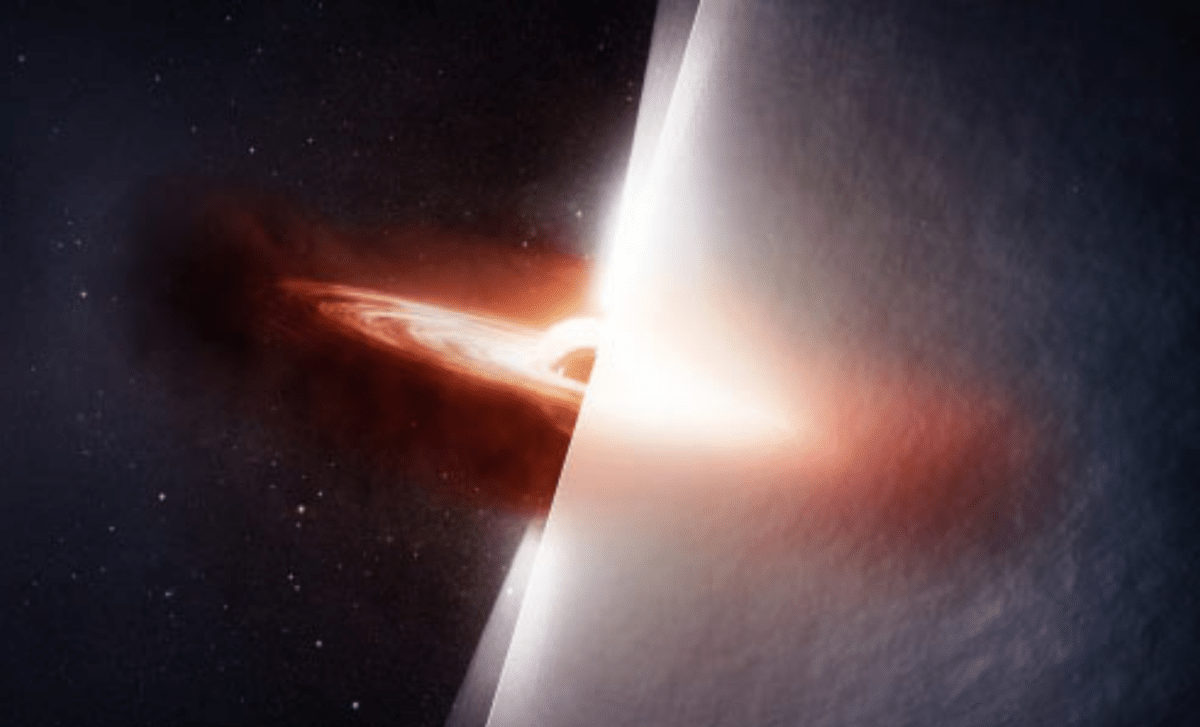
In a groundbreaking development, a team of astronomers has unveiled remarkable insights into how turbulence within the Milky Way bends and distorts light from distant cosmic entities. By using nearly a decade’s worth of archival data, researchers have discovered that radio waves from the quasar TXS 2005+403, located 10 billion light-years away, are significantly affected by the chaotic clouds of ionized gas and electrons in our galaxy. This pivotal study, published in the Astrophysical Journal Letters, heralds a new era of understanding concerning the invisible forces that shape the space between stars.
Tracing the Quasar Through a Turbulent Galaxy
Shining from the constellation Cygnus, the quasar is powered by a supermassive black hole at an extraordinary distance. As its radio waves navigate through the turbulent Cygnus region—in fact, one of the galaxy’s most scattering-prone areas—the waves do not simply fade into obscurity; instead, they reveal intricate, patchy distortions. Such findings provide astronomers with a unique opportunity to investigate the dynamics of interstellar turbulence.
Dr. Alexander Plavin from Harvard & Smithsonian’s Center for Astrophysics emphasized this point: “Most of what we see in the radio data isn’t coming from the quasar itself; it’s coming from the scattering caused by the turbulence in this region of the Milky Way.” This breakthrough challenges previously held assumptions that turbulence would yield only random noise, showing instead that it forms structured patterns that scientists can study in greater detail.
Unexpected Patterns Challenge Assumptions
Conventional theories suggested that the radio waves from the quasar would blur and vanish as they coursed through the turbulent regions of space. To the astonishment of the research team, the distinct signals persisted even at the farthest telescope pairs. Dr. Plavin remarked, “It can’t be explained by simple blurring or by the quasar itself,” demonstrating that what they observed was indeed a reflection of interstellar turbulence.
Such persistent distortions serve as a valuable probe of the Milky Way’s ionized gas clouds, revealing structures previously impossible to measure. The findings may also apply to observations of distant galaxies, supernovae, and various cosmic radio sources.
Implications for Astronomy and Future Research
The implications of understanding interstellar turbulence extend beyond theoretical interest; they hold critical importance for astronomers interpreting radio observations from across the universe. The study reinforces the notion that even the most luminous objects can be reshaped by the environment they traverse.
As stated in the published findings, “The scattering properties along this line of sight through the Galaxy remain persistent over time,” highlighting the stability of certain turbulent phenomena amidst the dynamic cosmos.
Furthermore, this discovery invites contemplation of a profound principle found in Hebrews 3:4: "For every house is built by someone, but God is the builder of everything." Just as builders meticulously design and construct structures—often with unseen influences effecting the end result—so too does nature shape the light we observe from across the universe, revealing a Creator’s intricate design.
An Encouraging Takeaway
As we delve deeper into the mysteries of the cosmos, we can reflect upon how the forces at play in the universe mirror the unseen influences in our own lives. The beautiful intricacies of turbulence—both cosmic and personal—remind us that even in chaotic moments, there is intention and order.
Let this astronomical discovery inspire us to seek understanding in our daily experiences, and to trust in the grand design that shapes our lives, encouraging us to remain curious and connected to both the universe and our spiritual journey.
If you want to want to know more about this topic, check out BGodInspired.com or check out specific products/content we’ve created to answer the question at BGodInspired Solutions
If positive Biblical wisdom matters to you, I’d love your support of the mission
Q&A about
Why do astronomers think the light we see from stars is distorted by interstellar turbulence?
Astronomers believe that interstellar turbulence can change the path of light due to variations in density and temperature in space. This reminds us of how our faith can be influenced by the ‘turbulence’ of life around us. Just as light travels through a complex universe, we are called to persevere through challenges, knowing that "in this world, you will have trouble" but we can take heart because Christ has overcome the world (John 16:33).
How can understanding star light distortion deepen my faith?
Understanding how light is distorted reminds us of how God’s creation is complex and beyond our immediate grasp. It encourages us to marvel at His handiwork and seek His wisdom, as the Scriptures teach us to look to the Lord for understanding, asserting that "the heavens declare the glory of God; the skies proclaim the work of his hands" (Psalm 19:1).
Is there any biblical significance to the idea of light being distorted in the universe?
The phenomenon of light distortion can be seen as a metaphor for spiritual clarity amidst the chaos of life. Just as light can be twisted by cosmic forces, our understanding of truth can be clouded by worldly distractions. Jesus reminds us to seek the light, as "I am the light of the world" (John 8:12), encouraging us to pursue clarity in our faith despite external distortions.
What can interstellar turbulence teach us about God’s creation?
Interstellar turbulence showcases God’s infinite creativity and the complexity of the universe He has made. It leads us to reflect on how God works in ways we can’t always understand, yet we can trust in Him as "the author and perfecter of our faith" (Hebrews 12:2). This complexity should instill wonder and awe in us about God’s grand design and His plans for our lives.