 0
0
 0
0
Cancer is very good at hiding. Not in the way a person hides — not behind a door or under a bed. It hides on a level so small you’d need a microscope to see it. And for a long time, doctors have known this is one of the biggest reasons cancer is so hard to beat: it’s not always that the immune system is too weak to fight cancer. Sometimes the immune system simply can’t find it.
A new study, just published this month, found the exact trick prostate cancer cells use to stay invisible — and a way to switch it off. It’s early. It’s been tested in mice, not people. But it points at something researchers have wanted for years: a way to make the body’s own defenses actually see the enemy they’ve been fighting blind.
The Flag Every Cell Is Supposed to Fly
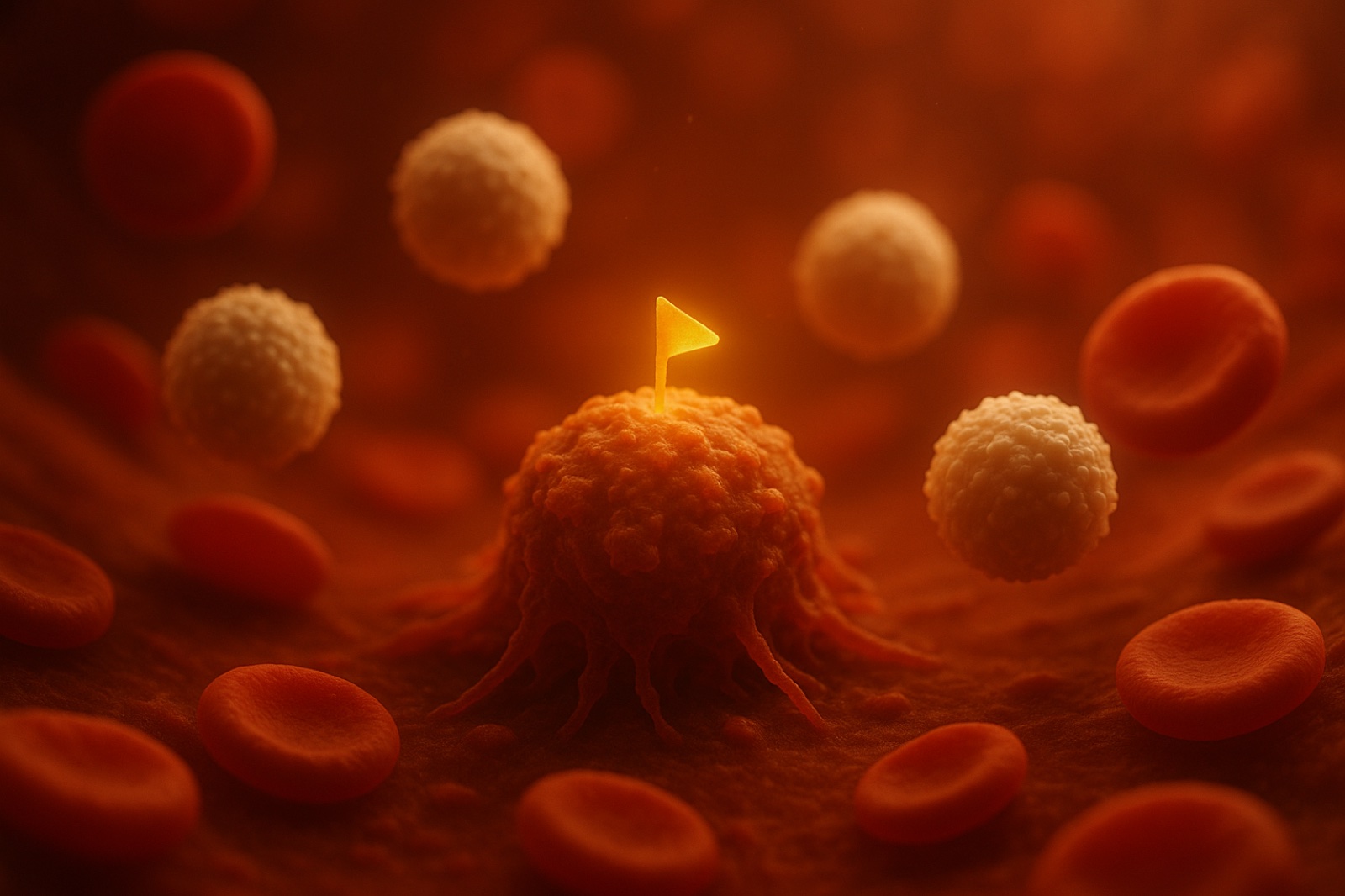
Here’s the part most people never learned in biology class. Almost every cell in your body carries a kind of ID badge on its surface, called MHC-1. Think of it like a tiny flag each cell waves, constantly, so your immune system’s patrol cells — a type of white blood cell called a T-cell — can check it and move on: nothing to see here, this cell belongs.
When a cell turns cancerous, that flag is supposed to change. It’s supposed to start waving a different signal — something’s wrong with me, come deal with this — so T-cells can find it and destroy it before it spreads.
That system works, often. It’s a big part of why your body successfully kills off abnormal cells every single day without you ever knowing it happened.
But some cancers have found a workaround. Prostate cancer is one of the worst at it. Researchers studying it found that these cancer cells make a protein called SPSB1, and SPSB1’s job — its only job, really — is to destroy the flag. No flag, no warning. The T-cells patrol right past a cell that should have been stopped, because as far as they can tell, there’s nothing there to stop.
Doctors have a term for tumors like this: “immune cold.” Not because they’re calm. Because the immune system can’t get a temperature reading on them at all.
How Scientists Found the Off-Switch for the Off-Switch
This is where the new research gets interesting. The team, whose work was published in Nature Biomedical Engineering, went looking for exactly where the sabotage was happening — and traced it down to a single, oddly shortened piece of genetic message inside the cancer cell. That short message is the actual instruction that builds SPSB1, the flag-destroying protein.
So they built a tool to fix it. Using a CRISPR-based system called Cas13 — a precise, programmable molecular tool that can find one exact genetic sequence out of billions and act on it — they targeted that shortened message directly and forced it to lengthen back to its normal, harmless form.
The effect, in mouse models, was almost mechanical in its simplicity. With the sabotage message corrected, the flag came back. The tumors that had been invisible were suddenly visible again. T-cells that had been wandering past started finding their target, moving in, and — paired with existing immunotherapy drugs — actually attacking the cancer instead of ignoring it.
Researchers describe this as a way to “re-sensitize” tumors that current immunotherapy simply can’t touch on its own. It’s the kind of finding that doesn’t cure anything by itself yet, but changes what becomes possible for the treatments that already exist.
What This Actually Means (and What It Doesn’t, Yet)
It’s worth being honest about where this stands. This is a mouse study. It hasn’t been tried in a human patient. There are years of safety testing, dosage work, and clinical trials between here and anything a doctor could offer someone tomorrow.
But the significance isn’t really about this one study. It’s about the door it opens. Prostate cancer isn’t the only “immune cold” cancer — pancreatic cancer, one of the hardest to treat of all, works the same way, hiding its own flag from its own patrol. If this approach holds up in further research, it could eventually apply well beyond where it started.
For a field that has spent decades trying to teach the immune system to fight harder, this study points at something almost the opposite: sometimes the immune system was never weak. It just couldn’t see. It’s the same story researchers found when they mapped the molecular switch behind muscle aging — the body already had the mechanism. Someone just had to find the switch.
Something Older Than the Microscope
There’s an idea that shows up again and again, long before anyone had a microscope to test it: that hidden things don’t heal. Not just in bodies — in people, in relationships, in whatever it is a person carries quietly and never lets anyone see clearly enough to help.
It’s an old instinct, older than modern medicine, and it turns out to be strangely literal at the cellular level too. The tumor wasn’t beaten by getting stronger. It was beaten by being seen. The moment the flag came back on, the outcome changed — not because anything new was added, but because something true was finally allowed to show.
Something bigger than any one field of science seems to have understood that pattern a long time before we had the tools to prove it. It shows up in strange places once you start looking — in the brain circuit that makes deep sleep a genuinely healing event, and in the growing research on why a lighter heart seems to heal the body faster. Different systems, same quiet pattern: what gets brought into the open tends to mend. What stays hidden tends to stay stuck.
Maybe that’s worth sitting with the next time something in your own life feels like it’s better off staying hidden. The body’s own history says otherwise. Being found is usually the first step, not the last one.
What Happens Next
Researchers say the next steps are testing whether the same approach works safely in more advanced disease models, and eventually, whether it can be delivered in a form a human body could tolerate. None of that happens fast. But for patients with immune cold tumors — the ones current immunotherapy has never been able to reach — even a slow “maybe” is more than they had last year.
The flag was there the whole time. It just needed someone to notice it had gone dark, and turn it back on.
A Question Worth Sitting With
If hidden things — in the body, or anywhere else — tend to stay stuck until they’re seen, what’s one thing in your own life that might change simply by being brought into the light instead of managed in the dark? Drop your thoughts in the comments below.
Share This
- “Scientists just found the exact molecular trick cancer uses to hide from your immune system — and a way to switch it back off. Wild.”
- “The immune system wasn’t too weak to fight this cancer. It just couldn’t see it. New CRISPR research found the off-switch for the disguise.”
- “Cancer hides by killing its own warning flag. Scientists just found a way to turn that flag back on in mice. Read this one.”
Questions People Are Asking
How does cancer hide from the immune system?
Many cancer cells, including some prostate cancer cells, produce a protein called SPSB1 that destroys a molecular “ID flag” (called MHC-1) that would normally let the immune system’s T-cells recognize and attack them. Without the flag, T-cells pass by without noticing anything is wrong.
What did the new CRISPR study actually find?
Researchers found the specific shortened genetic message inside prostate cancer cells that builds the flag-destroying protein, and used a CRISPR-based tool called Cas13 to correct it. Restoring the message brought the ID flag back, making the cancer visible to the immune system again.
Is this a cure for prostate cancer?
No. This research has only been tested in mouse models so far, not in humans. It’s an early but promising step that could eventually make existing immunotherapy drugs work on cancers they currently can’t touch, called “immune cold” tumors.
What is an “immune cold” tumor?
It’s a tumor the immune system can’t detect or respond to, often because the cancer has disabled its own warning signals. Immune cold tumors are one of the biggest reasons current immunotherapy drugs fail for some patients.
Could this approach help with other cancers besides prostate cancer?
Potentially. Other hard-to-treat cancers, including pancreatic cancer, are also considered “immune cold” and use similar hiding strategies. Researchers believe the same general approach could eventually be tested there too, though that research hasn’t been done yet.