 0
 0
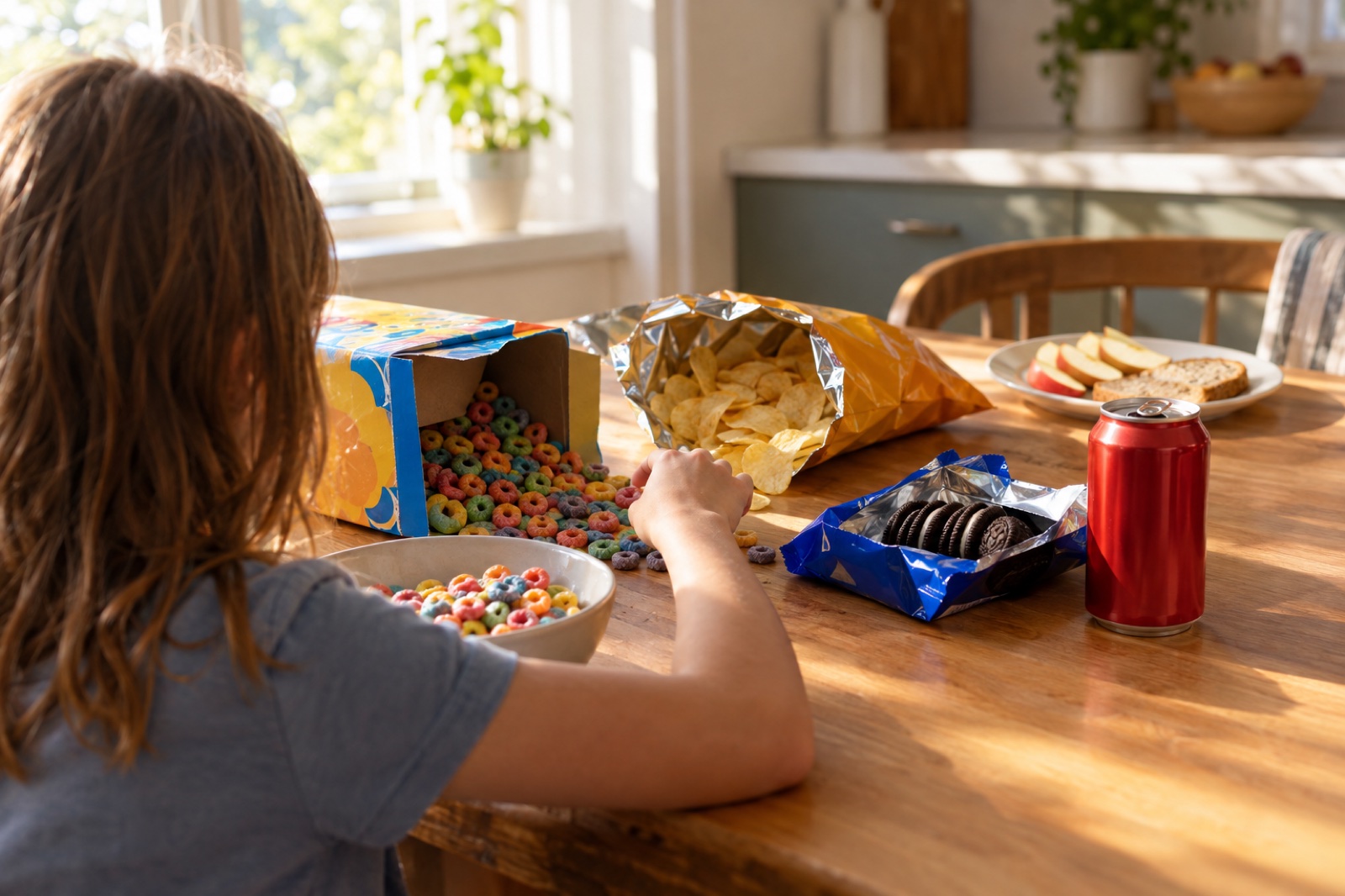
Your child finishes dinner. Twenty minutes later they are back at the cupboard. Not for the apple. For the thing in the shiny bag. You say no, and the asking does not stop. It just gets quieter and more patient.
If that scene feels familiar, a small new study on ultra-processed food and kids might explain something you have been watching for years. Not with a lecture about sugar. With a brain scan. And the most useful part is a detail most of the headlines skipped.
What the ultra-processed food and kids study actually did
Researchers at the Keck School of Medicine at the University of Southern California followed 46 children between seven and ten years old. All of them were at a healthy weight when the study began. They were part of a longer project called BrainChild, which tracks how diet, the brain and weight change as children grow. The results were published in the journal JAMA Network Open in October 2026.
Here is what they measured:
- What the kids ate. Parents and children gave several 24-hour food recalls. The team sorted the foods using the NOVA system, which labels packaged cereals, chips, soda, factory bread and most snack bars as ultra-processed. They then worked out what share of each child’s calories came from those foods.
- What the kids’ brains did. Each child lay in an MRI scanner and looked at photos of tempting food, like fries and cookies, mixed with pictures that were not food. The scanner tracked which parts of the brain responded more to the food.
- What happened a year later. The team measured body mass index, body fat percentage and waist size at the start and again after one year.
The pattern was simple to state. Children who got more of their calories from ultra-processed food showed a stronger response to food pictures in a brain region called the dorsal striatum. And children with a stronger dorsal striatum response gained more body fat and had a bigger rise in BMI over the following year.
When the researchers added the brain response into their maths, the link between ultra-processed food and weight gain got weaker. It shrank by about a third for BMI and by nearly half for body fat percentage. That is their main point. The brain’s reaction to food may be part of how these foods lead to weight gain, not just a side effect of it.
The part everyone is skipping: wanting is not liking
The brain has more than one reward area. Two of them matter here, and the study looked at both.
The ventral striatum is the part people usually mean when they say “pleasure centre.” It is tied to how good something feels. The dorsal striatum is different. It is tied to motivation, habit and the pull to act. Wanting, in other words. Reaching before you have decided to reach.
The kids who ate more ultra-processed food did not show a stronger response in the pleasure part. The difference showed up only in the wanting part. The pleasure region result was not statistically significant.
Read that again with your own kitchen in mind. The child at the cupboard is probably not enjoying the snack more than they enjoyed dinner. The food may not be delivering more joy at all. What has grown is the pull. The habit groove. The hand that moves before the mind has weighed in.
This fits what adults already report. An earlier piece on this site looked at why ultra-processed foods go down fast and leave you unfilled, and another at why some foods never seem to satisfy. The new study adds the childhood version. The chase is being wired in while the brain is still being built.
Senior author Dr. Kathleen Page put it plainly in the university’s announcement: “Children’s brains are still developing, habits are still forming and food preferences are still being made.”
What this study cannot tell you
This is where a lot of coverage went further than the researchers did. They were careful. We should be too.
- It is small. Forty-six children. The authors list that first among their limits. Patterns in a group this size can shift when a bigger group is studied.
- It is observational. Nobody assigned kids to eat chips. The study shows that things travelled together. It cannot show that one caused the other. The team says so directly, and the senior author wants to run a proper trial next, giving children who eat a lot of ultra-processed food more minimally processed food and watching whether the brain response changes.
- Sugar muddies it. The researchers ran an extra check. Added sugar on its own was not linked to the brain response. But when they adjusted for added sugar, the link between ultra-processed food and the dorsal striatum got weaker and was no longer statistically significant. So the study cannot say whether it is the processing itself, the sugar, or something else in these foods doing the work. That caveat sits in the paper. It did not make many headlines.
- The direct weight link was soft. Ultra-processed food on its own was clearly tied to a bigger waist a year later. Its direct links to BMI and body fat pointed the same way but did not reach statistical significance. The stronger predictor of fat gain was the brain response, not the diet score.
- Brain scans are noisy. The authors note that this kind of imaging has known problems with reproducibility, and that each child was scanned once.
None of that makes the study worthless. It makes it a good first look, which is what the researchers called it. It is also one more piece in a pile of evidence that mostly points the same direction. The university’s announcement cites an estimate that children in the United States get about two-thirds of their daily calories from ultra-processed food. In many other countries the share is lower but rising.
What to do with this if you are a parent
The research team said something that deserves repeating. They do not think the burden belongs on families alone, because these foods are often the cheapest, closest and easiest thing to grab. If your budget, your shop or your schedule makes them unavoidable, that is not a moral failure. It is the food environment doing what it was built to do.
Still, the wanting-not-liking finding changes what is worth trying. If the pull is a habit groove rather than a pleasure gap, you do not have to make healthy food more exciting. You have to make the reach a little less automatic. Small, free things help with that:
- Put a pause between the hand and the bag. Keep the packaged snacks out of sight, in a cupboard that takes a step and a decision. The wanting circuit fires on cues. Fewer cues, fewer fires.
- Let the plain food be the easy food. Washed fruit in a bowl on the table. Bread and a boiled egg already made. The study is about which reach is easiest, so make the easiest reach the simpler one.
- Do not fight the craving with a speech. A child who is told sugar is bad while the chips sit open on the counter learns that words lose to cues. Change the counter, not the sermon.
- Watch the first bite of the day. The breakfast cereals in this study count as ultra-processed. If one swap is all you can manage, that is a good one, and oats or eggs cost about the same.
- Notice your own reach. Kids copy what the adult hand does, not what the adult mouth says.
If your child’s eating worries you in a bigger way, talk to a nurse or doctor. One study on 46 children is a reason to adjust the kitchen, not a reason to panic. For a similar honest look at a parenting fear, see what eight years of data found on screen time and kids.
The hunger that eating does not close
There is something older sitting under this study, and it is not about children only.
Thousands of years ago a prophet stood up and asked a crowd a question that sounds like it was written this month. Why do you spend money on what is not bread, and work hard for what does not fill you? It was not a line about food. It was an observation about people. We keep reaching for things that light up the wanting and leave the deeper hunger right where it was. Then we reach again, more quietly and more patiently, like a child at a cupboard.
The scanner has now found a version of that in a seven-year-old’s brain. Wanting that runs ahead of liking. A pull that promises more than it pays. The ancient answer was not a diet. It was an invitation to come and be filled by something that does not run out, something bigger than the shiny bag, something the prophet believed came from God. You do not have to agree with that to notice the pattern. It is the same pattern either way.
Back in the kitchen, then. The cereal box is still open. Your child is still reaching. The study says the reaching is not greed and it is not weakness. It is a groove, cut early, and grooves can be redirected. The slow work of putting the apple where the chips were is small. It is also the kind of thing that compounds, one unremarkable afternoon at a time.
And if you have ever stood at your own cupboard after a full dinner, not even sure what you were looking for, you already know the groove is not only in children. Maybe that is worth sitting with.
A good place to start:
The Beginner’s Guide to Feeling God’s Presence Every Day
A simple guide to noticing something steadier than the next craving, in the ordinary moments of a normal day.
Get the free guide
Free.
Discussion question
The researchers say the fix should not fall on families alone, because ultra-processed food is often the cheapest and easiest option. Do you think the bigger change needs to come from how food is made and sold, or from what happens in each home? Tell us in the comments.
Share this
- A brain scan study of 46 kids found that ultra-processed food lit up the wanting part of the brain, not the enjoying part. That explains a lot about my cupboard. https://bgodinspired.com/index.php/health-and-wellness/ultra-processed-food-and-kids-brains/
- Read this before you blame yourself for your kid’s snacking. The researchers themselves say the burden should not sit on families alone. https://bgodinspired.com/index.php/health-and-wellness/ultra-processed-food-and-kids-brains/
- “Wanting is not liking.” A new study on ultra-processed food and kids, with the caveats the headlines left out. https://bgodinspired.com/index.php/health-and-wellness/ultra-processed-food-and-kids-brains/
Q&A: ultra-processed food and kids
What did the USC study on ultra-processed food and children’s brains find?
The study, published in JAMA Network Open in October 2026, followed 46 children aged seven to ten who were at a healthy weight. Children who got more of their calories from ultra-processed food showed a stronger response to food pictures in the dorsal striatum, a brain region tied to motivation and habit. A stronger dorsal striatum response was linked to more body fat gain and a bigger rise in BMI one year later.
Does ultra-processed food cause weight gain in children?
The USC study cannot prove cause. It was observational, meaning children were not assigned to different diets, so it can only show that higher ultra-processed food intake, stronger brain responses and later fat gain travelled together. The authors plan a trial that changes children’s diets to test whether the brain response changes. Other large studies have linked ultra-processed food to weight gain, but this one adds a possible brain mechanism rather than proof.
What is the difference between the dorsal striatum and the ventral striatum?
Both are reward-related parts of the brain. The ventral striatum is most tied to pleasure, or how good something feels. The dorsal striatum is more tied to motivation, habit and the urge to act. In the USC study on ultra-processed food and kids, only the dorsal striatum responded more strongly in children who ate more ultra-processed food. The ventral striatum result was not statistically significant, which suggests the foods were linked to more wanting rather than more enjoyment.
Was it the sugar in ultra-processed food that affected the children’s brains?
The study cannot settle that. Added sugar on its own was not linked to the brain response. But when the researchers adjusted for added sugar, the link between ultra-processed food and the dorsal striatum became weaker and was no longer statistically significant. So the finding could be driven by sugar, by processing, or by other features of these foods, and the authors say so.
What can parents do about ultra-processed food cravings in kids?
The study suggests the pull is a habit response to food cues more than a pleasure gap, so reducing cues helps more than lecturing. Keep packaged snacks out of sight, leave simple foods like fruit, bread or eggs where they are easiest to reach, swap a sugary breakfast cereal for oats or eggs if only one change is possible, and model the reach you want to see. The researchers also stress that the cheapest and easiest foods are often ultra-processed, so families should not carry all the blame.
Source: Alves JM, Morgan E, Angelo B, et al. “Ultraprocessed Food Intake, Striatal Response to Food Cues, and Adiposity Gain in Children.” JAMA Network Open, October 2026. Summarised in the Keck School of Medicine of USC announcement.