 0
0
 0
0
If your heart gives you trouble, you get sent to one specialist. If your kidneys do, you get sent to another. The two may work in the same building. They will almost certainly keep separate notes, order separate tests, and book separate appointments.
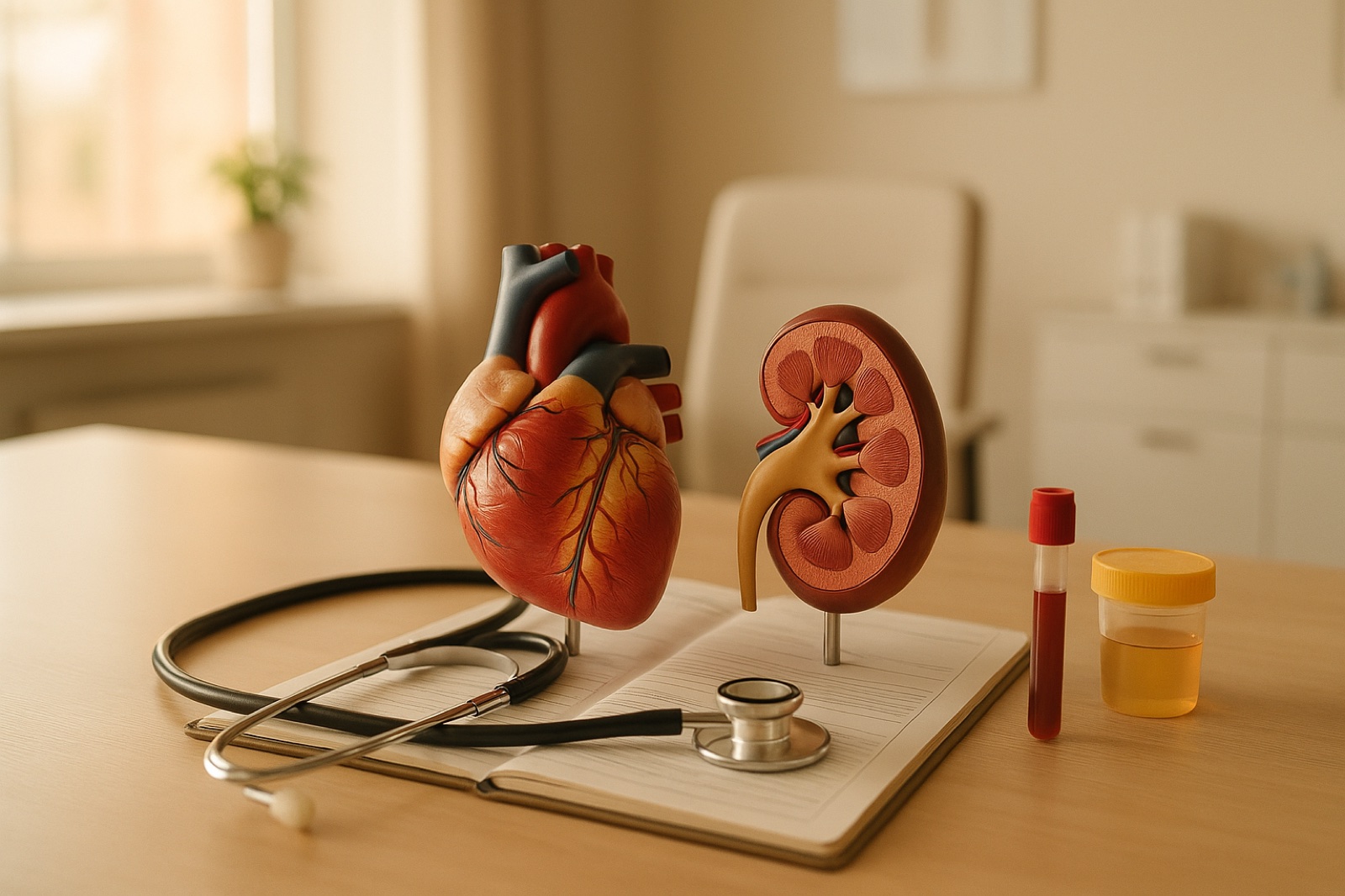
That arrangement has a quiet cost, and it has a name now. Heart and kidney disease are not two illnesses that happen to show up in the same person. Each one speeds the other up. When two organs locked in that kind of loop are managed by two teams who rarely read each other’s files, the loop itself is the thing nobody is watching.
At the end of August 2026, that changed on paper.
What the new heart and kidney disease guidelines actually say
The European Society of Cardiology released its first guidelines devoted to cardiovascular disease and chronic kidney disease together, written with the European Renal Association. They went online in the European Heart Journal on 28 August 2026 and were presented at the ESC Congress the next day.
The main recommendation fits in one sentence: every patient with cardiovascular disease should be tested for kidney disease.
Two tests do it. One is a blood test that estimates how well the kidneys are filtering. The other is a urine test that looks for albumin, a protein that starts leaking into urine when kidneys are damaged.
The scale behind that recommendation is not small. The ESC puts the number of people living with chronic kidney disease across Europe at an estimated 100 million.
The loop these guidelines were written to break
Here is the part that makes this more than a filing change.
A weakened heart pushes less blood out to everything downstream, and the kidneys are downstream. Kidneys that are struggling hold on to fluid and drive blood pressure up, and that extra load lands back on the heart. Neither organ is waiting politely for the other to finish. They hand the damage back and forth.
The guidelines describe the result plainly: the two conditions accelerate each other, which means heart attacks, strokes and the need for dialysis can arrive years earlier than they otherwise would.
Biology is full of things that cannot be understood one piece at a time. It is the same lesson that keeps turning up wherever scientists look closely at how living things are built — even at the very beginning, where the origin of complex life looks like two cells that could not live apart. Separateness is usually the assumption we brought with us, not something we found.
The strangest part: nothing new had to be invented
You would expect a guideline this significant to be built on some new machine or new molecule. It is not.
The blood test is ordinary. The urine test is ordinary. Both are cheap, both are decades old, and both are already available in most places where anyone is treating heart disease at all. Nothing had to be discovered for this recommendation to be possible. It has been possible the whole time.
Professor William Herrington of the University of Oxford, one of the guideline authors, put the situation this way: “Many patients with CKD are treated by the cardiology community and the new ESC Guidelines aim to increase the use of kidney function and urine albumin testing.”
Read that slowly. The patients were already in the room. The tests were already on the menu. What was missing was not knowledge or technology. It was somebody whose job it was to look.
There is real hope in the treatment side too. Associate Professor Kevin Damman of University Medical Centre Groningen, another of the authors, pointed to medicines that are already in wide use — RAS inhibitors and SGLT2 inhibitors alongside statin-based therapy — as “particularly important and effective” when started early. The guidelines package the whole approach under an acronym, STAMP on CKD: screen, triage, address kidney risk, modify heart treatment, plan services.
Which is a long way of saying: look sooner, and treat the person rather than the department.
We do the same sorting with our own lives
Splitting a person into departments is not only a medical habit. It is how most of us handle ourselves.
The money worry goes in one drawer. The sleep goes in another. The short temper, the ache in the shoulder, the friendship you have stopped answering — each one gets its own drawer, and each drawer gets treated on its own, if it gets treated at all. It rarely occurs to us that they are handing damage back and forth the same way two organs do. Researchers keep finding those loops when they bother to look for them: even something as everyday as poor sleep and loneliness turns out to have an arrow running mostly one way, and it is not the direction most people assume.
The idea that a body cannot suffer in one place only is not a new one. One of the oldest descriptions of people we have puts it almost exactly the way the guidelines do — that a body is one thing made of many parts, and when a single part suffers, every other part carries some of it. It was written to describe how a community holds together, long before anyone could measure kidney function or see a blood vessel from the inside. It turns out to have been an accurate description of a person as well, and whatever made us seems to have built us whole rather than modular.
People have been looking at the inside of the human body for a very long time and coming away with the same impression. The anatomist who spent fifty years showing the public what is under their own skin spent his career on exactly that: how connected it all is, once you can see it.
What to do with this
This is news, not medical advice, and nothing here replaces a real conversation with whoever looks after your health. But it is worth carrying two small things:
- If you or someone in your family is being treated for a heart condition, the question “have my kidneys been checked?” is now a reasonable one to ask out loud. The two tests are simple ones.
- The reverse is also worth asking. Kidney trouble raises heart risk, and that direction gets even less attention.
And one thing that costs nothing at all: the next time you catch yourself filing a problem in a drawer and deciding it has nothing to do with the rest of you, notice it. It took two medical specialties years and a joint guideline to admit that the wall between them was doing harm. The walls we build inside our own lives are usually thinner than that, and easier to take down.
What do you think?
Medicine has spent a century getting more specialised, and that specialisation has saved an enormous number of lives. But this guideline is an admission that the boundaries between specialists can themselves cause harm. Do you think health care is now too divided into separate departments — or is deep specialisation worth the gaps it leaves? Tell us where you land in the comments.
Share this
- Two organs were making each other worse for years and nobody’s job was to notice, because they belonged to different departments. The fix required no new technology at all. https://bgodinspired.com/index.php/health-and-wellness/heart-and-kidney-disease-one-loop/
- Cardiologists and kidney doctors just wrote their first joint guideline. The tests it recommends are decades old and cost almost nothing. The problem was never the science — it was who was assigned to look. https://bgodinspired.com/index.php/health-and-wellness/heart-and-kidney-disease-one-loop/
- I have been filing my problems into separate drawers my whole life. Turns out my organs never agreed to that arrangement either. https://bgodinspired.com/index.php/health-and-wellness/heart-and-kidney-disease-one-loop/
Questions people are asking
What are the new ESC guidelines on heart and kidney disease?
The European Society of Cardiology, working with the European Renal Association, released its first guidelines covering cardiovascular disease and chronic kidney disease together. They were published online in the European Heart Journal on 28 August 2026 and presented at ESC Congress 2026 the following day. The central recommendation is that every patient with cardiovascular disease should also be screened for chronic kidney disease.
How are heart disease and kidney disease connected?
Heart disease and chronic kidney disease accelerate each other rather than simply occurring together. A weakened heart delivers less blood to the kidneys, while damaged kidneys retain fluid and drive blood pressure higher, which increases the load on the heart. Because the damage passes in both directions, patients with both conditions can reach serious outcomes such as heart attack, stroke or dialysis considerably earlier than they otherwise would.
Which two tests do the guidelines recommend for heart patients?
Two routine tests. The first is a blood test that estimates the kidneys’ filtering rate, known as the estimated glomerular filtration rate. The second is a urine test that measures the urine albumin-to-creatinine ratio, which detects a protein that leaks into urine when the kidneys are damaged. Both tests are inexpensive and have been available for decades.
What does STAMP on CKD stand for?
STAMP on CKD is the acronym the European Society of Cardiology uses to summarise its recommended approach to chronic kidney disease in heart patients. It stands for screen, triage, address chronic kidney disease risk, modify cardiovascular disease management, and plan health services.
How many people in Europe have chronic kidney disease?
The European Society of Cardiology estimates that around 100 million people across Europe are living with chronic kidney disease, all of whom face a raised risk of a wide range of cardiovascular conditions. That figure is one of the main reasons the guidelines call for screening every cardiovascular patient rather than only those already suspected of kidney problems.