 0
0
 0
0
If you live with pain, you have probably heard some version of the same advice. Keep moving. Stay active. Push through it.
And you have probably tried. Maybe you started a hard program, felt worse for three days, and quietly stopped. Maybe you felt a bit guilty about stopping. Maybe you decided exercise just is not for bodies like yours.
A very large new review has something to say about that. Gentle exercise for pain did not just hold its own. In the numbers, the gentler, shorter programs came out ahead of the hard ones.
What the Review of 2,736 Trials Found About Gentle Exercise for Pain
Researchers led by Dr Ben Singh at Adelaide University in Australia pulled together almost everything that has been studied on exercise and pain. Not one trial. Not ten. They gathered 157 earlier reviews, which between them covered 2,736 controlled trials and 221,279 people. The paper was published in 2026 in the journal PAIN Reports.
That kind of study is called an umbrella review. It is a review of reviews. It is about as wide a view as medical research gets.
Here is what they found:
- Exercise lowered pain. On the usual 0 to 10 pain scale, the average drop was about 1.1 points.
- It worked across many kinds of pain. Joint and muscle pain, nerve pain, inflammatory pain and cancer-related pain all improved.
- Almost every kind of movement helped. Walking and cardio, strength work, and gentler things like yoga, Pilates and tai chi.
- Gentle beat hard. Low-intensity programs showed a bigger drop in pain than moderate-to-hard ones.
- Short beat long. Programs under 12 weeks showed bigger effects than longer ones, and less than two hours a week showed bigger effects than more.
“More exercise wasn’t necessarily better,” Dr Singh said. “In fact, shorter-duration and lower-intensity programs showed greater reductions in pain.”
The researchers boiled their advice down to four words that are worth keeping: start low, go slow.
Is Exercise Really Better Than Painkillers?
This is the line that made the headlines. The university’s summary said the drop in pain was around 60% larger than the average relief reported for common pain medicines in separate chronic pain trials.
It is worth slowing down on that, because the paper itself is more careful than the summary.
The 60% figure compares two different sets of studies. It is not a race where the same people tried pills and then tried exercise. In the paper, the researchers put it more gently: the effect of exercise was “comparable to, or greater than” the effects seen for many pain medicines. They rated their overall confidence in the finding as moderate, not high.
So the honest version is this. Exercise holds up well against many pain medicines, and it has almost none of their side effects. That is a big deal. But it does not mean you should throw out what your doctor gave you. Medicines and movement are not rivals. For many people they work best side by side. We have written before about how one pill can quietly lead to another, which is one more reason a tool with few side effects is worth having in the drawer.
Why Would Gentler Exercise Work Better?
This is the part most of the coverage skipped, and it is the most interesting thing in the paper.
You might guess that gentle exercise is somehow a better medicine. The researchers do not think that is the main reason. They think the answer is simpler, and much more human.
People keep doing it.
In their words, shorter programs “may achieve better adherence, particularly among individuals living with pain, who may be discouraged by longer commitments or fears of exacerbating symptoms.” Adherence just means sticking with it. When they looked at why longer programs showed smaller effects, their best guess was that people were getting less exercise overall, not that the exercise stopped working. The longer plans may simply have been losing people along the way.
Read that again if you once quit a program and blamed yourself. The plan that was too hard was not a test you failed. It was the wrong plan. The one that helps is the one you can actually keep showing up for.
Two other small details stand out:
- How often you train and how long each session lasts did not change much. One or two sessions a week did about as well as three or more. Short sessions did about as well as sessions over an hour.
- Dance scored the biggest effect of any exercise type. But the researchers warn that this came from a single review of people with fibromyalgia, so it is a hopeful hint, not a rule.
If you have ever been told you “just need to move more,” the researchers have a quiet complaint about that too. They wrote that exercise “is rarely prescribed with the same precision as medication,” and that people “commonly receive generic advice to ‘stay active'” instead of a real plan. Vague advice is easy to give and hard to follow. That is not your fault either.
What This Does Not Mean
It does not mean your pain is your fault. Nobody is in pain because they skipped the gym. Some bodies are simply built with weak spots from the very beginning, as researchers found when they studied why some joints are vulnerable to arthritis before birth.
It does not mean exercise fixes everything. A 1.1-point average drop is real and useful. It is not a cure. An average also hides a spread: some people improve more, some less.
It does not tell us how long the benefit lasts. The researchers noted that very few studies followed people for long after the program ended.
It is not a reason to change your medicine on your own. Talk to a doctor, nurse or health worker before stopping anything, and before starting something new if you have a serious condition.
A Load You Can Actually Carry
“No pain, no gain” is one of the most repeated phrases in the world. It sounds tough and true. For a body already in pain, it turns out to be mostly wrong. The gain came from the gentle version, the one people did not quit.
Many of us carry that same motto into other places too. Into work. Into how we think we have to earn rest. Even into how we picture God, as someone who only accepts us after we have suffered enough and tried hard enough.
But one of the oldest invitations ever spoken to tired people was not “try harder.” It was come and rest, and take up a load that actually fits you. Not a life with no work in it. A weight made for your shoulders, so you can keep carrying it tomorrow. It is strange how a stack of 2,736 trials ends up pointing the same way.
How to Start Gentle Exercise for Pain Today
None of this needs a gym, money or special gear.
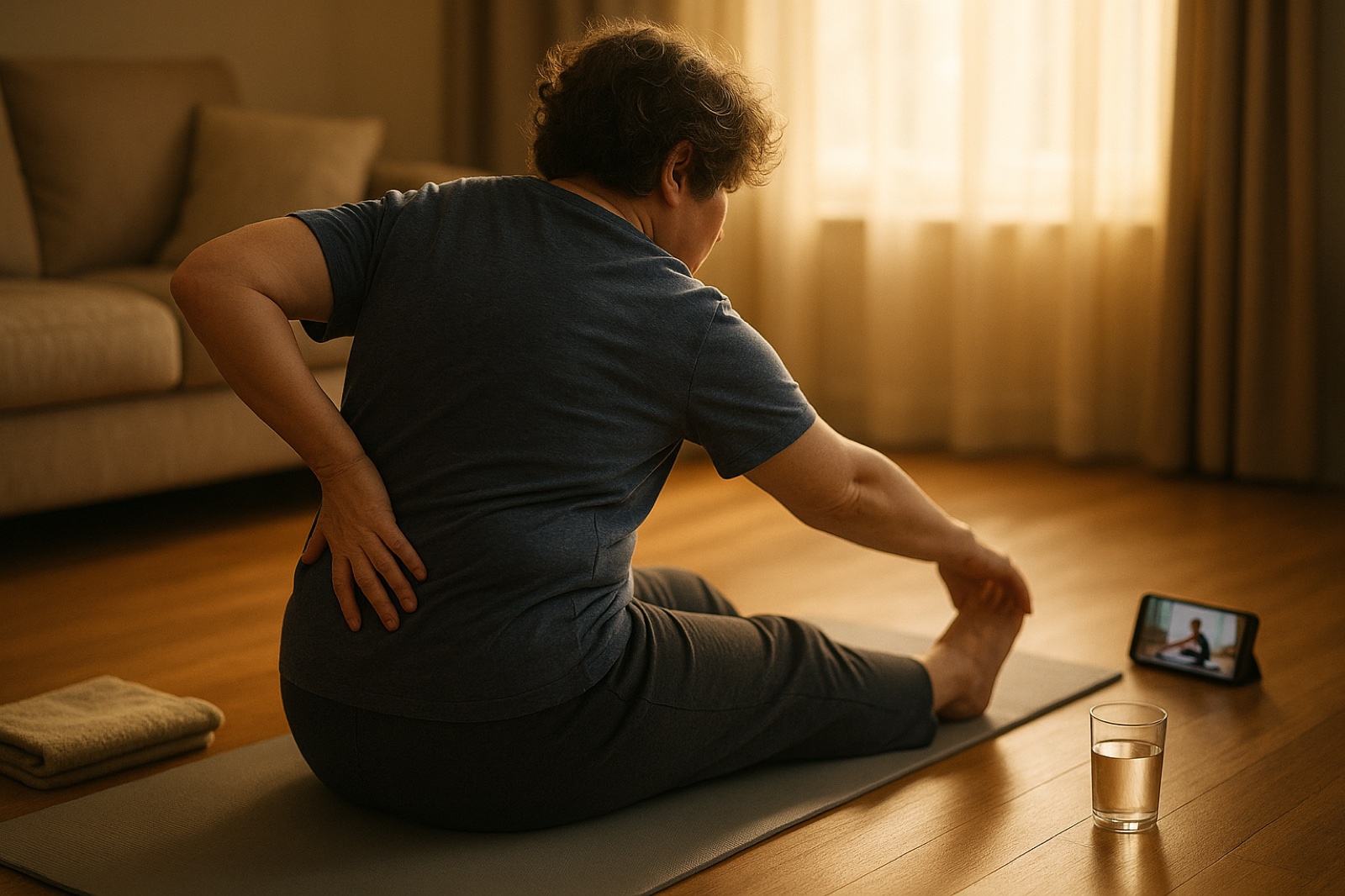
- Pick something gentle you do not dread. A slow walk, stretching on the floor, a free yoga or tai chi video, dancing in the kitchen. The best choice is the one you will do again.
- Go smaller than you think. Ten minutes counts. Two or three short sessions a week counts. The review found benefits well under two hours a week.
- Let a little discomfort be okay, but not sharp pain. Mild stiffness that eases is common when you start. Sharp or worsening pain means ease off.
- Try it for a few weeks, not forever. The shorter programs did best. Commit to four weeks, then check in with yourself.
- Write down your pain number. Rate it 0 to 10 once a day. A drop of about one point is the size of change this research found, and you might not notice it unless you write it down.
If your pain is from knee arthritis, we also looked at 139 trials that ranked 12 non-drug treatments, and warm-water exercise came out near the top.
Where That Leaves You
If you tried the hard way and it did not stick, you were not weak. You were running the kind of plan that loses a lot of people.
The research is pointing at something kinder. Small. Slow. Gentle. Something you can come back to on Thursday even if Tuesday hurt. It does not look like much. It seems to be what works.
Something to Think About
“No pain, no gain” is everywhere, from gyms to offices to schools. After reading this, do you think it is good advice that people take too far, or was it the wrong idea from the start? Tell us what you think in the comments.
Share This
If someone you love lives with pain, this might be the kindest thing you send them today.
- “A review of 2,736 trials found gentle, shorter exercise eased pain more than hard workouts. The researchers’ advice: start low, go slow. https://bgodinspired.com/index.php/bgodinspired-news/bgodinspired-health-news/gentle-exercise-for-pain/”
- “I always thought I quit exercise because I was weak. Turns out the researchers think long programs lose people in pain, and the gentle ones may work better because people keep doing them. https://bgodinspired.com/index.php/bgodinspired-news/bgodinspired-health-news/gentle-exercise-for-pain/”
- “‘No pain, no gain’ might be the worst advice for anyone already in pain. 221,279 people’s worth of research says gentle wins. https://bgodinspired.com/index.php/bgodinspired-news/bgodinspired-health-news/gentle-exercise-for-pain/”
Questions People Ask About Gentle Exercise for Pain
Does gentle exercise really help with chronic pain?
Yes. A 2026 umbrella review in the journal PAIN Reports, led by Dr Ben Singh at Adelaide University, combined 157 systematic reviews covering 2,736 randomised controlled trials and 221,279 people. Exercise reduced pain by about 1.1 points on a 0 to 10 scale on average, and low-intensity exercise showed a larger reduction in pain than moderate-to-vigorous exercise. The researchers rated the certainty of the overall evidence as moderate.
Is exercise better than painkillers for pain relief?
Exercise compares well with many pain medicines, but the evidence is not a head-to-head test. Adelaide University’s summary of its 2026 review said the average pain reduction from exercise was around 60% larger than the average relief reported for common pain medications in separate chronic pain trials. The paper itself describes the effect as comparable to, or greater than, many pharmacological pain treatments. Nobody should stop prescribed pain medicine without talking to a health professional.
How much exercise do you need to reduce pain?
Less than many people expect. In a 2026 review of 2,736 trials on exercise and pain, programs with less than two hours of exercise per week showed larger pain reductions than programs with two hours or more, and programs shorter than 12 weeks showed larger effects than longer programs. Doing one or two sessions a week worked about as well as three or more.
Why do shorter, lower-intensity exercise programs work better for pain?
The researchers behind a 2026 review of exercise for pain think the likeliest reason is that people stick with them. They wrote that shorter programs may achieve better adherence, especially among people living with pain who may be discouraged by long commitments or afraid of making their symptoms worse. They suggested the smaller effects seen in longer programs probably reflect people doing less exercise overall, not the exercise losing its benefit.
What type of exercise is best for pain?
Almost every type helped in a 2026 review of 2,736 trials, including aerobic exercise, strength training, yoga, Pilates and tai chi. Dance showed the largest effect, but the researchers cautioned that this result came from a single review of people with fibromyalgia. For most people, the best exercise for pain is a gentle one they will keep doing, started at a low level and increased slowly.
This article describes published research and is not medical advice. If you live with ongoing pain, a doctor, nurse or physiotherapist can help you build a plan that fits your body.