 0
0
 0
0
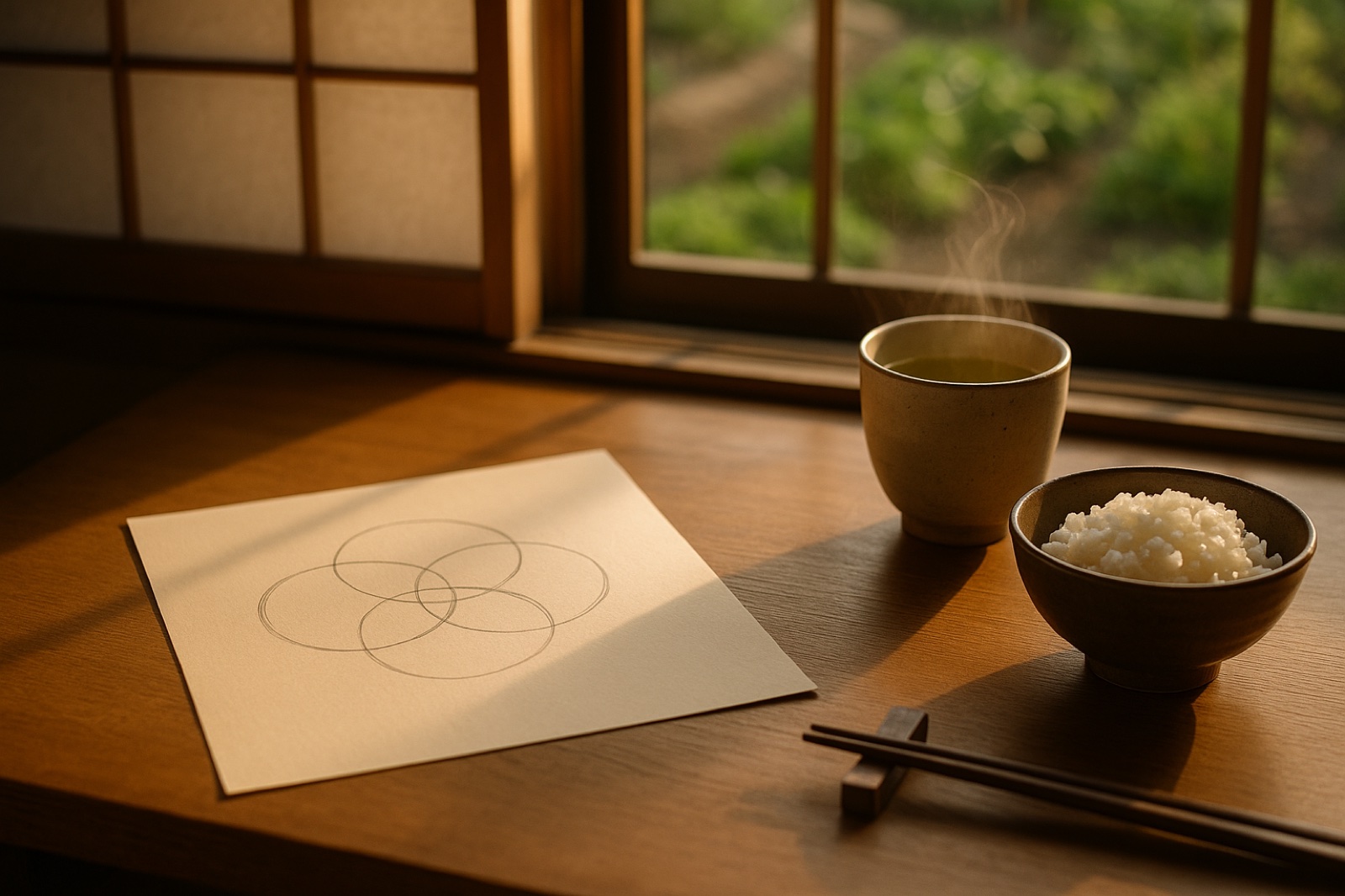
You have probably seen it. Four circles that overlap. One says what you love. One says what you are good at. One says what the world needs. One says what you can be paid for. And in the tiny space in the middle, where all four meet, is one word: ikigai.
So what is ikigai? Most people are told it is that middle spot. The perfect job. The place where passion, skill, need and money finally line up.
Here is the surprise. That diagram is not Japanese. It was put together in the West in 2014. And the man who made it has since said it is not what ikigai really means.
If you have ever looked at those four circles and felt like a failure because your life does not fit in the middle, this is for you. The real idea is much smaller. And much kinder.
What Is Ikigai? The Real Meaning
The word is made of two parts. Iki means life, or being alive. Gai (from kai) means worth, or effect. Put together, ikigai means something like “a reason for living” or “what makes life worth living.”
In everyday Japanese, it is not a big word. A grandmother might say her garden is her ikigai. A man might say his morning walk is. A mother might say it is watching her child eat breakfast. Nobody is asking whether the garden pays.
Akihiro Hasegawa, a Japanese psychologist who studies ikigai, has said the word belongs with daily life, not with big life plans. In his view, Japanese people find ikigai in many small joys, and those small joys add up to a life that feels full.
So the real question behind ikigai is not “What is my one great purpose?” It is much simpler: “What makes me glad to be alive today?”
Where the Ikigai Diagram Actually Came From
The four circles started life as a diagram about purpose, not ikigai. It is usually credited to Andrés Zuzunaga, a Spanish astrologer, who drew it around 2011. The word in the middle was “purpose.”
In 2014, a British blogger named Marc Winn had just learned about ikigai from Dan Buettner’s talks on long-living people in Okinawa, Japan. He took the purpose diagram, swapped the word in the middle for “ikigai,” and posted it under the title “What is your Ikigai?”
Winn later said the post took about 45 minutes to write. It spread around the world. Today millions of people think that diagram is ancient Japanese wisdom.
Here is the part most articles leave out. Winn himself has since written that his diagram is “a Western adaptation, not an authentic representation of Japanese philosophy.” He says real ikigai “isn’t monetised,” that it is found in “simple pleasures, not income,” and that it lives in family, neighbours and local life. He now calls his diagram a career tool, not the real thing.
That is worth sitting with. The man who drew the famous picture is telling us to look past it.
The Woman Who Studied Ikigai Among People Who Had Lost Everything
Long before the diagram, a Japanese psychiatrist named Mieko Kamiya wrote the book that made ikigai a serious idea. It came out in 1966, and its title means On the Meaning of Life (in Japanese, Ikigai ni tsuite).
Where she did her work matters. Kamiya worked at Nagashima Aiseien, a sanatorium on a small island in Japan’s Inland Sea, where people with leprosy were made to live apart from their families and towns. Many had lost their jobs, their homes and their place in the world.
She noticed that even some patients with light symptoms felt life had no meaning. That pushed her to ask a plain question: what makes a person feel that life is worth living?
Think about the four circles for a moment. Most of those patients could not be paid for their work. The wider world did not want them. By the diagram’s rules, almost none of them could ever have ikigai.
Yet that is exactly where the idea was studied most deeply. Kamiya looked at ikigai among people who had almost nothing that the diagram asks for. That tells you what the word was really about all along. Not a perfect job. A reason to get up.
Does Ikigai Help You Live Longer?
There is real research here, and it is worth stating carefully.
In Japan, a large long-term study called the Ohsaki Study followed 43,391 adults. The results were published in 2008 in the journal Psychosomatic Medicine. People who said they did not have a sense of ikigai were more likely to die during the study period. Most of that extra risk came from heart and blood-vessel disease and from outside causes such as accidents. It was not linked to cancer.
Two honest cautions. First, this kind of study shows a link, not a cause. It cannot prove that ikigai itself keeps people alive. Second, the famous story that ikigai is the “secret” of long life in Okinawa comes mostly from popular writing, not from one clear finding.
Still, the pattern is gentle and hopeful. People who feel their life is worth living tend to do better. And notice what the researchers measured. They did not ask people if they had found their dream career. They asked if they had a sense that life was worth living.
How to Find Your Ikigai (the Real, Small Version)
You do not need money, a new job or a big plan for any of this. You need a few quiet minutes.
- List five small things you were glad about this week. A cup of tea. A friend’s text. Sun on your face. Fixing something. Keep them small.
- Look for the ones that involve other people. Cooking for someone. Helping a neighbour. Real ikigai often lives in the roles we play for each other.
- Look at your ordinary week, not your dreams. What you already give your time to says a lot. (Our piece on how to figure out what matters to you walks through this.)
- Protect one small thing tomorrow. Give it ten minutes on purpose. That is it.
- Stop grading your life against four circles. If your job pays the bills and nothing more, you have not failed at ikigai. Your reason for living may be at your kitchen table, not your desk.
If you want a gentle next step, our free What Is My Purpose? assessment takes a few minutes and looks at purpose from more than one angle.
The Old Wisdom That Got There First
There is something funny about all this. We took a small, everyday word and turned it into a giant life project. Then we felt bad for not finishing it.
People have been doing that for a very long time. One of the oldest books of wisdom we have was written by a man who had everything. He built great houses and gardens. He gathered wealth. He tried pleasure, and big projects, and more learning. None of it filled the hole. And where did he end up? At the table. Eat your bread with joy. Enjoy the good in your ordinary work. Love the people you are given. And he called those small things a gift from God.
Thousands of years apart, a Japanese psychiatrist on a small island and an ancient writer who had tried it all seem to land in the same place. The reason to get up in the morning was never hiding in the middle of a diagram. It was on the table the whole time.
Japan has another old word that works the same way. Just as the gold in kintsugi goes right on the crack, ikigai often shows up right in the middle of a plain, imperfect day.
So tomorrow, when you wake up, you do not have to find your one great purpose before breakfast. Just notice the breakfast. That might be the start of it.
Questions People Ask About Ikigai
What is ikigai in simple words?
Ikigai is a Japanese word that means “a reason for living” or “what makes life worth living.” In everyday Japanese use, ikigai usually points to small, daily sources of joy and meaning, such as a garden, family, a hobby or a morning routine, rather than a single grand life purpose or a perfect career.
Is the ikigai Venn diagram really Japanese?
No. The four-circle ikigai diagram (what you love, what you are good at, what the world needs, what you can be paid for) was not created in Japan. It began as a “purpose” diagram usually credited to Spanish astrologer Andrés Zuzunaga around 2011. In 2014, British blogger Marc Winn replaced the word “purpose” with “ikigai.” Winn has since said the diagram is a Western adaptation, not an authentic picture of the Japanese idea.
Who first studied ikigai?
Japanese psychiatrist Mieko Kamiya is widely seen as the pioneer of ikigai research. Her 1966 book Ikigai ni tsuite (On the Meaning of Life) grew out of her work with leprosy patients at Nagashima Aiseien sanatorium in Japan, where she asked what makes a person feel that life is worth living.
Does having ikigai help you live longer?
A large Japanese study, the Ohsaki Study, followed 43,391 adults and was published in 2008 in the journal Psychosomatic Medicine. People without a sense of ikigai had a higher risk of death during the study, mainly from cardiovascular disease and external causes, but not cancer. The study shows a link, not proof that ikigai causes longer life.
Do you need to be paid for something for it to be your ikigai?
No. In its Japanese meaning, ikigai does not need to earn money. Researchers such as psychologist Akihiro Hasegawa describe ikigai as coming from many small joys in daily life. Even Marc Winn, who made the popular ikigai diagram, has said that real ikigai “isn’t monetised.”
Discussion Question
Do you think the four-circle ikigai diagram helps people, or does it make ordinary lives feel like failures? Tell us what you think in the comments. We read every one.
Share This
Post 1: Turns out the famous ikigai diagram (the four circles) was made in the West in 2014, and even its creator says it’s not the real thing. Real ikigai is small: the everyday stuff that makes you glad to be alive. https://bgodinspired.com/index.php/personal-growth-and-life-skills/what-is-ikigai/
Post 2: I always felt like I was failing at ikigai because my job isn’t my passion. Then I read that the Japanese psychiatrist who studied it most deeply did her work with leprosy patients who couldn’t work at all. Ikigai was never about the perfect career. Worth a read: https://bgodinspired.com/index.php/personal-growth-and-life-skills/what-is-ikigai/
Post 3: “What makes me glad to be alive today?” is a much better question than “What is my one great purpose?” This piece on the real meaning of ikigai changed how I think about it. https://bgodinspired.com/index.php/personal-growth-and-life-skills/what-is-ikigai/