 0
0
 0
0
Maybe you have a copy of Marcus Aurelius on your nightstand. Maybe a friend keeps quoting “focus on what you can control.” Maybe you just had a bad week and went looking for something steadier than your own feelings.
So you typed it in: what is Stoicism? You are far from alone. Plenty of people ask that same question every month.
Here is a plain, fair answer. And then a story most people have never heard: the day real Stoic philosophers stood in the Athens marketplace and argued with the apostle Paul. What happened next is still being argued about, in a good way, almost two thousand years later.
What Is Stoicism? A Simple Answer
Stoicism is a way of living that started in Athens around 300 BC. Its founder, Zeno of Citium, taught his students under a painted porch in the city’s marketplace. In Greek, a porch like that is a stoa. So his followers got a nickname: the people of the porch. The Stoics.
At its heart, Stoicism teaches a few big ideas:
- Some things are up to you, and some are not. Your choices, your judgments and your character are yours. Other people, the weather, your reputation and even your health are not fully in your hands.
- A good character is the only true good. Money, comfort and praise are nice, but they cannot make you a good person, and losing them cannot make you a bad one.
- Live by reason. The Stoics believed the whole world runs on a deep reason, which they called the logos. A wise person lives in step with it.
- You can be calm on the inside even when life is not calm on the outside. That inner steadiness is what people usually mean today when they say someone is “stoic.”
The most famous Stoics came later. Seneca was a Roman writer and advisor to the emperor Nero. Epictetus was born a slave and became one of the most loved teachers of his day. Marcus Aurelius was a Roman emperor who wrote private notes to himself, and those notes became the book so many people now keep beside their bed.
It is worth saying clearly: Stoicism is not about hiding your feelings or being cold. At its best it is about not being pushed around by things you cannot change. There is real wisdom in that, and a lot of people have been helped by it. If you have ever noticed how a new thing stops feeling new almost straight away, the Stoics saw that long before modern researchers named the hedonic treadmill.
The Day the Stoics Met Paul
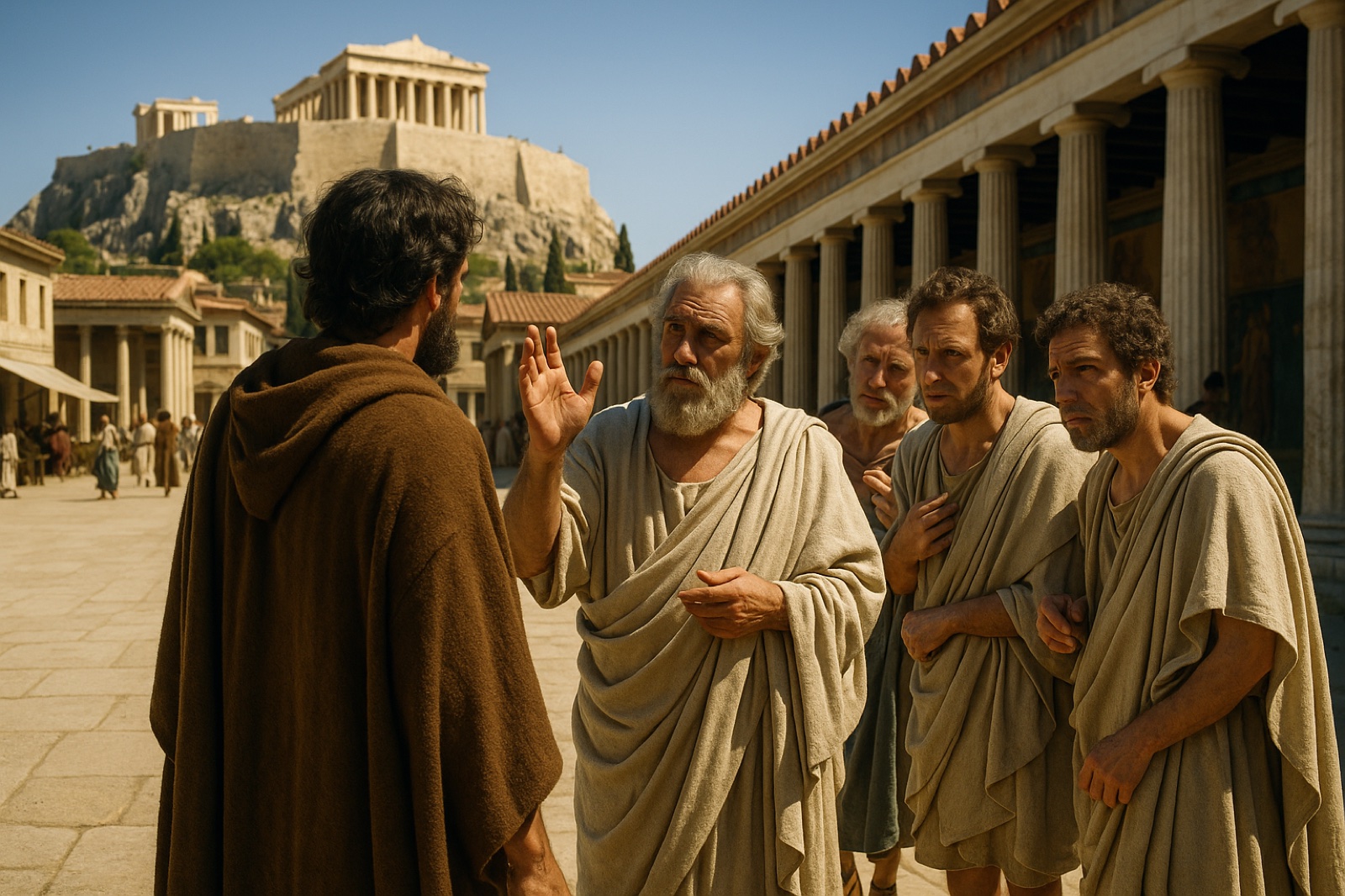
Around the middle of the first century AD, a traveller named Paul arrived in Athens. He was waiting for friends to catch up with him. While he waited, he did what he always did. He talked to people.
Luke, who wrote the book of Acts, tells us exactly who he ran into:
“Then certain philosophers of the Epicureans, and of the Stoicks, encountered him. And some said, What will this babbler say? other some, He seemeth to be a setter forth of strange gods: because he preached unto them Jesus, and the resurrection.” (Acts 17:18, KJV)
That word “babbler” is a fun one. In Greek it is spermologos, which literally means “seed-picker.” It was a word for a bird that pecks up scraps in the street. The philosophers were calling Paul a scrap collector, a man who picked up bits of ideas here and there without really understanding them.
They were curious enough to take him up the hill to a council called the Areopagus to hear more. And when Paul spoke, he did something surprising. He did not start by telling them they were wrong. He quoted one of their own poets:
“For in him we live, and move, and have our being; as certain also of your own poets have said, For we are also his offspring.” (Acts 17:28, KJV)
That line, “we are also his offspring,” comes from a Greek poem called the Phaenomena by a poet named Aratus. Aratus was linked with the early Stoic school, and a famous Stoic hymn by Cleanthes, Zeno’s successor, has a very similar line. So Paul was speaking their language on purpose. He met them inside their own library before he said anything new.
Here is a detail almost nobody mentions. Aratus came from a town called Soli, in a region called Cilicia. And Paul came from Cilicia too.
Where Paul Was From, and What People Often Get Wrong
Paul told a Roman officer, “I am a man which am a Jew of Tarsus, a city in Cilicia, a citizen of no mean city” (Acts 21:39, KJV). “No mean city” means no ordinary city. He was proud of it.
He had reason to be. The Greek geographer Strabo, writing in Paul’s own lifetime, said the people of Tarsus were so eager for philosophy and learning that they outdid even Athens and Alexandria. Strabo lists a whole group of Stoic teachers who came from Tarsus. One of them, Athenodorus, was a tutor to Caesar Augustus himself.
You will often read that Paul “grew up surrounded by Stoics.” That goes a bit too far. Paul himself said he was “born in Tarsus, a city in Cilicia, yet brought up in this city at the feet of Gamaliel” (Acts 22:3, KJV). “This city” is Jerusalem, and Gamaliel was a famous Jewish teacher. Scholars still debate how young Paul was when he moved. So the honest version is this: Paul was born in one of the great Stoic cities of the world, he was trained as a Jewish scholar in Jerusalem, and he could speak to Stoics in their own terms when he needed to.
Strabo adds one more detail that fits Paul oddly well. He says the students of Tarsus usually did not stay home. They finished their education abroad. Paul did exactly that. He just went to Jerusalem instead of Athens.
And here is a small surprise from later in Acts. When Paul was dragged into court in Corinth, the Roman official who threw the case out was a man named Gallio (Acts 18:12-17). Gallio was the older brother of Seneca, the Stoic writer. Paul’s story brushes right past the family of one of the most quoted Stoics who ever lived.
The Stoic Word Paul Used for Contentment
Years after Athens, Paul wrote a letter to friends in the city of Philippi. He wrote it while in custody. He mentions his “bonds” early in the letter (Philippians 1:13). And near the end, he writes one of the best-known lines about contentment ever written:
“Not that I speak in respect of want: for I have learned, in whatsoever state I am, therewith to be content. I know both how to be abased, and I know how to abound: every where and in all things I am instructed both to be full and to be hungry, both to abound and to suffer need. I can do all things through Christ which strengtheneth me.” (Philippians 4:11-13, KJV)
The word translated “content” is the Greek word autarkēs. It means self-sufficient, needing nothing from outside yourself. And it was not just any word. For the Stoics, self-sufficiency was a central goal. Their whole teaching said a good character is enough for a happy life. The wise person is autarkēs. Nothing outside can shake them.
So when a Greek reader in Philippi saw that word, they would have heard the Stoics in it straight away. Paul is saying, in effect: “I have that thing your philosophers talk about. I really have learned to be content, whether I have plenty or nothing.”
Then he does two things a Stoic would not.
First, in verse 12, the phrase “I am instructed” is a Greek word used for being let in on a secret, like someone being initiated into a hidden teaching. Paul is saying contentment is not just a skill he trained. It is a secret he was shown.
Second, verse 13 tells you where the secret is. It is not inside him. It comes from someone who “strengtheneth” him. The oldest Greek copies of this verse actually read more simply: “I can do all things in the one who strengthens me.” The word “Christ” was added in later copies to make clear what the whole letter already makes clear.
Read those three verses together and you see it. Paul took the Stoics’ favourite word for inner calm and then quietly moved its source. The steadiness is real. But it is not self-made. It is given.
Where Stoicism and Christianity Agree, and Where They Part
It would be easy to turn this into a fight. Paul did not, and neither should we.
Where they agree: both say your peace should not depend on your circumstances. Both say you can have very little and still be okay. Both say character matters more than comfort. Both are honest that life is hard. A lot of Christians have found real help in Stoic books, and that is no betrayal. Paul himself quoted a Stoic-leaning poet with respect. The old Greek idea of gentleness as strength under control even shows up in the Bible’s own Greek word for meekness.
Where they part:
- Who is holding things together. For the Stoics, the logos was a kind of reason running through everything, more like a law of nature than a friend. Paul told the Athenians about a God who made the world, who is “not far from every one of us” (Acts 17:27, KJV), and who can be known.
- Where the strength comes from. Stoicism asks you to build a fortress inside yourself. Paul says the strength is supplied from outside you, by someone who loves you.
- What happens at the end. When Paul spoke about the resurrection of the dead, “some mocked” (Acts 17:32, KJV). A body raised to new life did not fit the philosophers’ picture of the world. For Paul, it was the whole point.
The Question Underneath Every Stoic Book
Here is what many people find after a while with Stoicism. The advice is good. “Control what you can. Let go of what you can’t.” But on a bad night, when the fear is loud, you still have to do all the letting go by yourself. The calm depends on how strong you are that day.
That is the real question under the whole thing. Not should I be steady? Everyone agrees on that. The question is: where does the strength to be steady come from when mine runs out?
Paul’s answer was not “try harder.” It was “I have been let in on a secret.” Contentment is not only a muscle you build. It is a gift you receive from a God who is close enough to hold you up. The Stoics were right that peace cannot depend on what happens to you. Paul simply added that it does not have to depend on you either.
If your mind has been running hard lately, you might find the free How Anxious Am I? check-in helpful. It takes a few minutes and gives you an honest picture of where you are.
Actions to Take Today
- Make two short lists. Take a scrap of paper or your phone notes. On one side, write what is worrying you that you can actually change. On the other, what you cannot. This is the Stoic part, and it is good.
- Hand over the second list. Read the “cannot change” list out loud, one line at a time, and after each one say, “I can’t hold this. God, will you?” This is the part Paul added.
- Read Philippians 4:4-13 slowly, just once. It takes about three minutes. Notice what Paul says to do with worry in verse 6 before he ever gets to contentment in verse 11.
Journaling Prompts
- When you are at your calmest, where do you think that calm is coming from?
- What is one thing you have been trying to carry by willpower alone that you were never meant to carry by yourself?
- If contentment is something you can be “let in on,” what might you need to stop doing so you can receive it?
A Prayer for Today
God, I have been trying so hard to stay steady on my own. Some days I manage it, and some days I just can’t. I want the kind of contentment Paul had, the kind that holds whether I have plenty or nothing. Please be the strength I do not have. Let me in on the secret, and help me rest in it today. Amen.
Discussion Question
Do you think a person can be truly content by their own strength alone, or does real contentment always need something outside ourselves? Share your view in the comments below. We would love to hear it.
Share This
- “Paul took the Stoics’ favourite word for inner calm and quietly moved its source. The steadiness is real. It just isn’t self-made.”
- “TIL the Stoic philosophers in Athens called Paul a ‘seed-picker’, a bird that pecks scraps off the street. Then he quoted their own poet back to them. (Acts 17)”
- “Control what you can, let go of what you can’t. Good advice. But who carries the part you let go of? That’s the question I’m sitting with today.”
Questions About Stoicism and the Bible (Q&A)
What is Stoicism in simple words?
Stoicism is a way of living that began in Athens around 300 BC with a teacher named Zeno of Citium. It teaches that some things are up to us and some are not, that good character is the only true good, and that a person can stay calm inside even when life outside is hard. Famous Stoics include Seneca, Epictetus and Marcus Aurelius.
Are Stoics mentioned in the Bible?
Yes. Acts 17:18 says that when the apostle Paul was in Athens, “certain philosophers of the Epicureans, and of the Stoicks, encountered him.” They called him a “babbler,” a Greek word meaning “seed-picker,” and took him to the Areopagus to hear more about Jesus and the resurrection.
Did Paul quote a Stoic poet?
In Acts 17:28, Paul told the Athenians, “as certain also of your own poets have said, For we are also his offspring.” That line comes from the Phaenomena of Aratus, a poet from Soli in Cilicia who was linked with the early Stoic school. A hymn by the Stoic teacher Cleanthes contains a very similar line.
Was Paul influenced by Stoicism?
Paul was born in Tarsus, which the ancient geographer Strabo said was famous for its philosophers, including several Stoic teachers. But in Acts 22:3 Paul says he was “brought up” in Jerusalem under the Jewish teacher Gamaliel. Most likely Paul knew Stoic ideas and vocabulary well and could use them, while his core beliefs came from Jewish scripture and from Jesus.
What does “content” mean in Philippians 4:11?
In Philippians 4:11, the word translated “content” is the Greek word autarkēs, meaning self-sufficient. It was a key Stoic term for the wise person who needs nothing outside themselves. Paul uses it, but two verses later he says the strength behind his contentment comes from the one “which strengtheneth me,” not from himself.