 0
0
 0
0
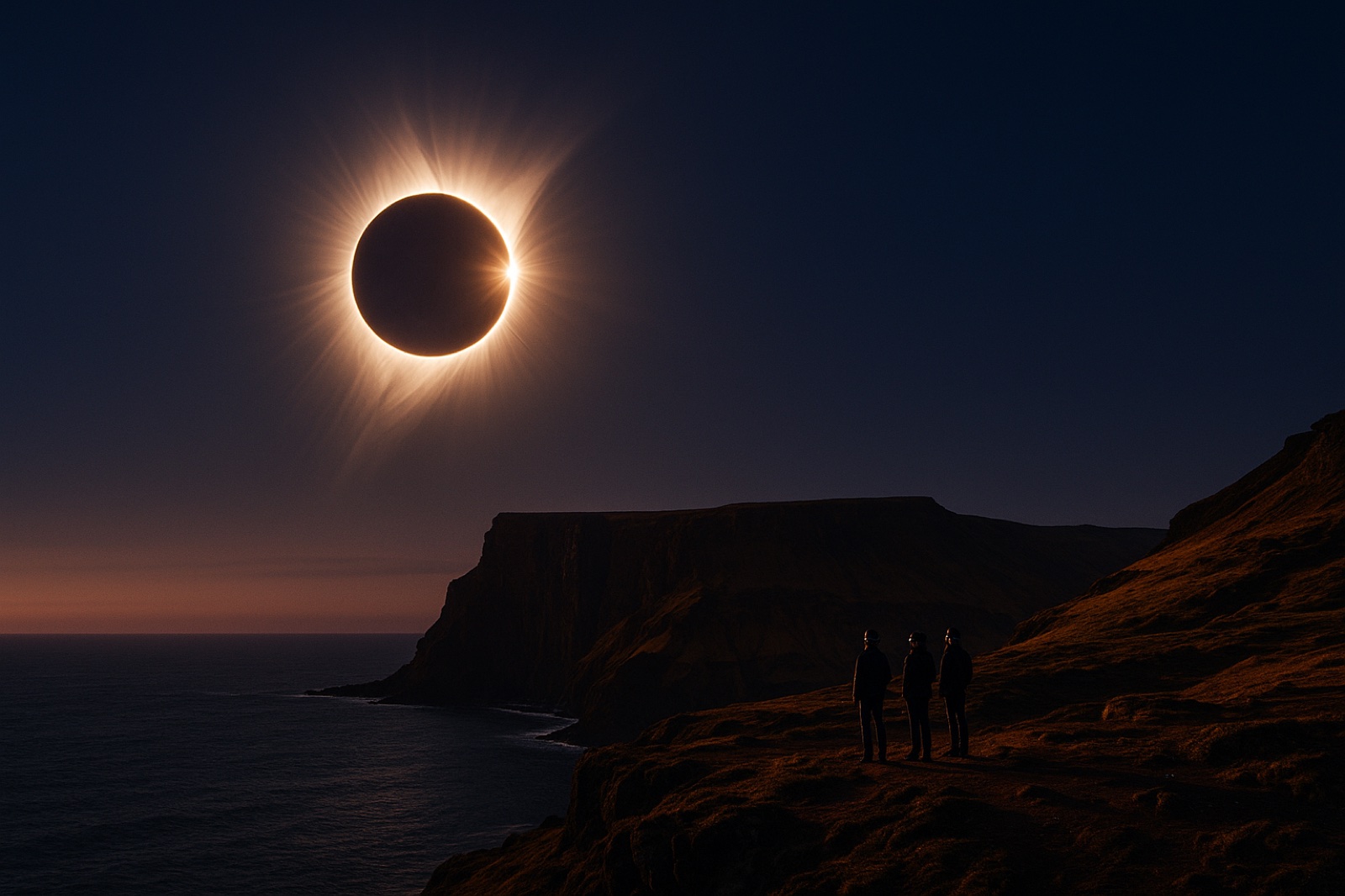
On August 12, 2026, the sky over parts of Greenland, Iceland, northern Spain, and northeastern Portugal is going to go dark in the middle of the afternoon. Not cloudy-dark. Not storm-dark. The sun will disappear behind the moon completely, the temperature will drop, birds will go quiet, and for less than two minutes, people standing in exactly the right place on Earth will be able to look up without glasses and see the sun’s outer atmosphere — something you can never normally see — blazing in a ring around a perfect black circle.
Here’s the part that’s almost stranger than the eclipse itself: astronomers didn’t just guess this was coming. They know the precise second totality begins in each location, the exact width of the shadow’s path, and how long darkness will last down to fractions of a second — and they’ve known it for years, before a single cloud pattern or weather report existed to tell them anything about that day at all.
What’s Actually Happening in the Sky on August 12
A total solar eclipse happens when the moon passes directly between the Earth and the sun, and the moon’s shadow lands on the Earth’s surface. It’s a genuine coincidence of scale: the sun is about 400 times wider than the moon, but it’s also roughly 400 times farther away — so from where we stand, they appear almost exactly the same size in the sky. That near-perfect match is the only reason total eclipses look the way they do. If the moon were slightly smaller or slightly farther from Earth, we’d never see a clean black disc with the sun’s corona flaring around the edges — we’d only ever get partial eclipses, the kind where the sun just looks like it has a bite taken out of it.
For this eclipse, the path of totality — the narrow strip of Earth where the sky goes fully dark — crosses the Arctic, sweeps over Greenland and Iceland, and comes ashore across the northern half of Spain and the very corner of Portugal. Cities like A Coruña, Bilbao, and Zaragoza will see full totality; Madrid and Barcelona sit just outside the path and will only get a deep partial eclipse. Meanwhile, the UK and Ireland will see over 90 percent of the sun covered, and the northernmost edges of the US and Canada will catch a partial eclipse too. Wherever you are in that wider zone, totality itself — the true blackout — will last under two and a half minutes, and in most places, under two.
How Anyone Can Know the Exact Second, Years in Advance
This is the detail that tends to stop people. Nobody is watching the sky in real time and calling this. Astronomers published the precise start and end times for this eclipse, in every city along the path, years before it happens — because the sun, the Earth, and the moon aren’t behaving unpredictably. They’re following orbital paths that are, for all practical purposes, fixed. Once you know an object’s mass, speed, and orbit precisely enough, you can run the math forward for centuries and know exactly where it will be on any given afternoon.
NASA’s eclipse predictions are already published for total solar eclipses happening decades from now — not rough estimates, but exact timing down to the second, for exact coordinates. It’s the same underlying order that let scientists spot stars that had been sitting in plain sight the whole time, once they knew precisely where and how to look, and it’s why a project like the Vera Rubin Observatory’s ten-year survey of the entire southern sky can plan out exactly what it will capture years before the cameras ever turn on. The universe isn’t improvising. It’s running on rules consistent enough that a person with the right math can predict, with total confidence, an event that won’t happen for another twenty years.
The Puzzle Ancient Astronomers Couldn’t Fully Solve — But Tried Anyway
Long before anyone understood gravity or orbital mechanics, ancient Babylonian astronomers noticed that eclipses repeated in a pattern roughly every 18 years, 11 days, and 8 hours — a cycle now called the Saros cycle. They didn’t know why. They had no concept of the moon’s tilted orbit or the mechanics behind it. But they tracked the pattern carefully enough, over centuries of record-keeping, to predict eclipses were coming without ever understanding the reason underneath the pattern.
It took roughly two thousand more years — and Isaac Newton’s laws of gravity — before anyone could explain why the pattern existed at all. And it took modern computing before anyone could calculate it down to the second for a specific town on a specific afternoon. Each layer of understanding didn’t create the order. The order was already there, the whole time, in every one of those centuries when nobody could fully explain it. People just kept getting better instruments for reading something that was never random to begin with — the same way scientists recently found that an asteroid had been slowly, precisely reshaped by nothing but steady sunlight over millions of years. Nothing about it was chaotic. It just took patience to notice.
There’s something worth sitting with in that. Long before telescopes, before Newton, before anyone had a name for gravity, the opening pages of the Bible already described the sun and moon as fixed markers in the sky, set there on purpose, meant to be counted on. Whoever wrote that down didn’t have the math to prove it. They just noticed the same thing the Babylonians noticed: this was never left to chance. Most people would call that order the laws of physics. Some would call it evidence of God. Either way, it was true before anyone had a way to measure it.
How to Actually Watch It
If you’re anywhere in the path of totality or the deep partial zone, a few things matter more than people expect. First: real eclipse glasses, certified to the ISO 12312-2 standard — sunglasses, no matter how dark, do not protect your eyes, and neither does looking through a phone camera unfiltered. Second: if you can’t get certified glasses in time, a simple pinhole projector (even two pieces of cardboard) lets you watch the sun’s crescent shrink safely by looking at its projection instead of the sun itself. Third: if you happen to be inside the actual path of totality, the only moment you can safely remove your glasses is during the few seconds to two minutes of full totality itself, when the sun is completely covered — the second any sliver of the sun reappears, the glasses go back on immediately.
And if you’re nowhere near the path this time, the observatories along the route, along with organizations like Time and Date and NASA, typically livestream the event in real time — you can watch totality happen on the far side of the planet from your kitchen table, at the exact second it was predicted to happen.
What This Kind of Precision Is Actually Worth Noticing
Most days, nobody thinks about the fact that the sun rose exactly on schedule. It’s the most reliable thing in a person’s entire life, and it’s also the thing people notice least — right up until a day like August 12, when that same reliability produces something so strange it stops a person in their tracks. The eclipse isn’t actually a break in the pattern. It’s the pattern, doing exactly what it always does, arranged in a way rare enough that this time, everyone looks up.
A Question Worth Sitting With
If you found out an event happening on a specific afternoon twenty years from now could be predicted today, down to the second — would that make the universe feel more orderly to you, or would it not change how you see things at all? Tell us what you think in the comments.
Share This
- “Astronomers know the exact second the August 12 eclipse starts in every city on its path — and they’ve known for years. That’s a wild amount of order for something that looks this rare. #SolarEclipse2026”
- “The sun and moon are almost exactly the same apparent size in our sky purely by coincidence of distance and scale. That’s the only reason total eclipses even look the way they do. Wild.”
- “Babylonian astronomers were predicting eclipses 2,500+ years before anyone understood gravity. They just tracked the pattern. Turns out it was never random to begin with.”
Questions People Ask About the August 12, 2026 Eclipse
Where will the August 12, 2026 solar eclipse be visible?
The path of totality crosses the Arctic, Greenland, and Iceland, then comes ashore across the northern half of Spain and the far northeastern corner of Portugal. The UK and Ireland will see a deep partial eclipse of over 90 percent, and the northernmost parts of the US and Canada will see a partial eclipse as well.
How long will the total eclipse actually last?
In most locations along the path, totality — the moment the sky goes fully dark — lasts under two minutes. Near the center of the path, in parts of Greenland and the North Atlantic, it stretches slightly longer, but still under two and a half minutes.
How can scientists predict a solar eclipse’s exact timing years in advance?
Because the sun, Earth, and moon move along orbital paths governed by consistent physical laws, astronomers can calculate their positions for any future date using orbital mechanics. Once you know an object’s mass, speed, and orbit precisely, the math can be run forward for centuries with extreme accuracy — which is how NASA already has total solar eclipse predictions published for events decades away.
Is it safe to watch the eclipse without special glasses?
No, except during the brief window of full totality itself, if you’re inside the path. At every other time — including during a partial eclipse — looking at the sun requires eclipse glasses certified to the ISO 12312-2 standard. Regular sunglasses do not provide adequate protection.
Why do total solar eclipses look the way they do, with a bright ring around a black circle?
It comes down to a coincidence of scale: the sun is about 400 times wider than the moon, but also about 400 times farther from Earth, so the two appear almost exactly the same size in our sky. That near-perfect match is what allows the moon to fully cover the sun’s bright disc while still revealing the faint corona — the sun’s outer atmosphere — blazing around the edges.