 0
0
 0
0
Title: Groundbreaking Space Survey Begins: A Visual Journey Through the Cosmos
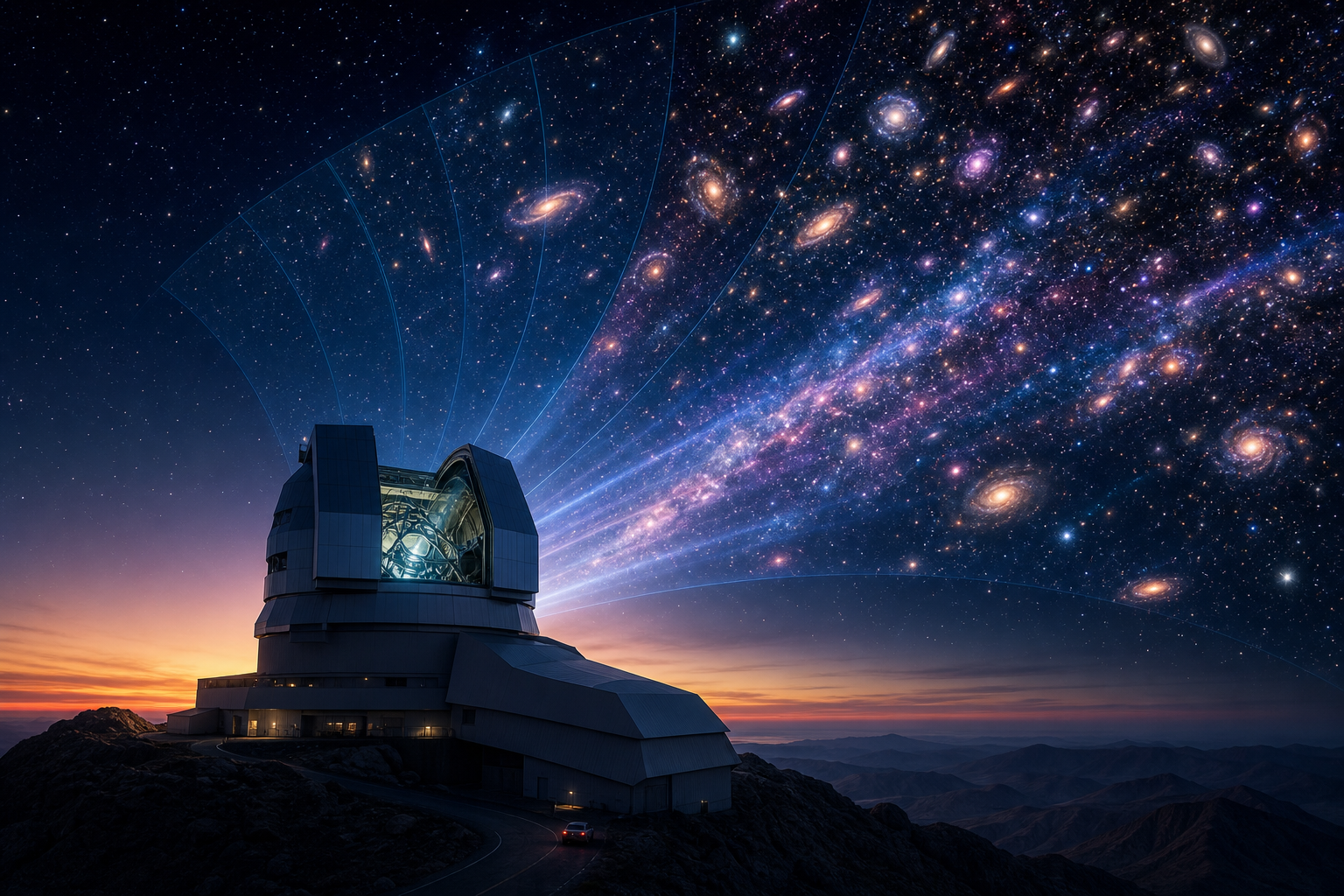
Every 40 seconds over the next ten years, a camera the size of a small car will unveil the wonders of the southern sky, capturing breathtaking images that may unlock the universe’s enduring mysteries. This ambitious project, known as the Legacy Survey of Space and Time (LSST), officially commenced this week at the Vera C. Rubin Observatory in Chile, which houses the world’s largest digital camera, weighing in at an impressive 6,600 pounds.
Through its decade-long study, the LSST will utilize a range of colored filters to grant the camera "superhuman vision," allowing it to track the movement and transformations of celestial objects—from asteroids to supernovae. Such "color-rich" images not only promise to provide a deeper understanding of our universe but also serve as a beacon, guiding other observatories to relevant celestial events for collaborative observations.
The LSST aims to take inventory of our solar system, delve into the mysteries of dark matter by studying distorted light from distant galaxies, and reveal phenomena that have largely remained in the shadows of our understanding. "Today, we begin filming the greatest cosmic movie ever made," remarked Brian Stone, acting director of the U.S. National Science Foundation. He emphasized that this monumental moment reflects decades of vision and innovation backed by federal investment.
Funded jointly by the National Science Foundation and the Department of Energy, the $800 million Rubin Observatory sits atop the Cerro Pachón mountain, where its dark skies provide an optimal vantage point for stargazing. After initial images were taken last year, the LSST was set to begin early in 2026, marking a delay in the project but underscoring the meticulous work required to ensure its success.
The observatory will capture thousands of images each night, completing a full scan of the southern sky every few days. This repetitive observation will allow scientists to witness the dynamic evolution of celestial bodies firsthand. "Rubin is bringing the universe to life, illuminating a treasure trove of discoveries," the observatory team shared, highlighting potential insights into pulsating stars, supernova explosions, and cosmic entities yet unknown.
As the imagery unfolds, researchers will employ AI and machine learning to sift through and interpret the vast data. It’s anticipated that the observatory will issue around 7 million alerts each night, flagging significant movements or events. By the survey’s completion, it promises to amass a dataset containing billions of objects and trillions of measurements—information that will be readily accessible to scientists and the public alike.
The endeavor draws inspiration from biblical principles that celebrate curiosity and the pursuit of knowledge. Proverbs 25:2 reminds us that "It is the glory of God to conceal a matter; to search out a matter is the glory of kings." This verse echoes the sentiment of exploration inherent in the LSST project: a shared human endeavor to seek understanding in the vastness of creation.
In reflecting on the LSST’s monumental task, we are reminded of our own journeys in understanding the intricate world around us. Just as the universe holds countless mysteries waiting to be uncovered, so too does our personal and spiritual growth. The endeavor invites us to approach life with curiosity, openness, and a desire to learn.
Takeaway: As we witness the unfolding story of our universe through the LSST, let us embrace our own quests for insight and truth. In our discoveries—both scientific and spiritual—may we remain humble and persistent, seeking knowledge that enriches our understanding of ourselves and the divine tapestry we are all a part of.
If you want to want to know more about this topic, check out BGodInspired.com or check out specific products/content we’ve created to answer the question at BGodInspired Solutions
If positive Biblical wisdom matters to you, I’d love your support of the mission
Q&A about
How can the Vera Rubin Observatory’s survey of the universe impact our understanding of God’s creation?
The Vera Rubin Observatory promises to unveil the universe’s mysteries, reminding us of Psalm 19:1, which tells us that “the heavens declare the glory of God.” As we explore the cosmos, we reflect on the grandeur of God’s creation and realize that every discovery is an opportunity to praise Him for His infinite wisdom.
Why should Christians be interested in new astronomical discoveries like those made by the Rubin Observatory?
Astronomy can deepen our faith, as Romans 1:20 expresses that creation reveals God’s attributes and divine nature. Each new star or galaxy we learn about can lead to a greater appreciation of God’s handiwork, inviting us to marvel at His creative power and the vastness of His design.
Does the study of the universe at places like the Vera Rubin Observatory contradict faith in God?
No, studying the universe does not contradict faith; rather, it complements it. In John 14:6, Jesus says He is “the way, the truth, and the life,” indicating that the pursuit of knowledge and truth, including scientific exploration, can lead us closer to understanding God’s will and purpose in our lives.
How can I personally apply the findings from the Rubin Observatory to my faith?
As discoveries emerge, use them as a reminder of God’s greatness and your place in His creation. Colossians 1:16 teaches that all things were created through Him and for Him, encouraging you to engage with the findings as opportunities to grow in your faith and share God’s glory with others.