 0
0
 0
0
Cooking is simpler than it sounds. Heat food and the long, folded molecules inside it come loose. A raw egg is clear and runny because its proteins are still folded into tidy shapes. A cooked egg is white and firm because those shapes have fallen open and tangled into each other, and nothing you do will fold them back. That is most of what heat does to living things. It is also why heat is the one thing almost nothing alive can argue with.
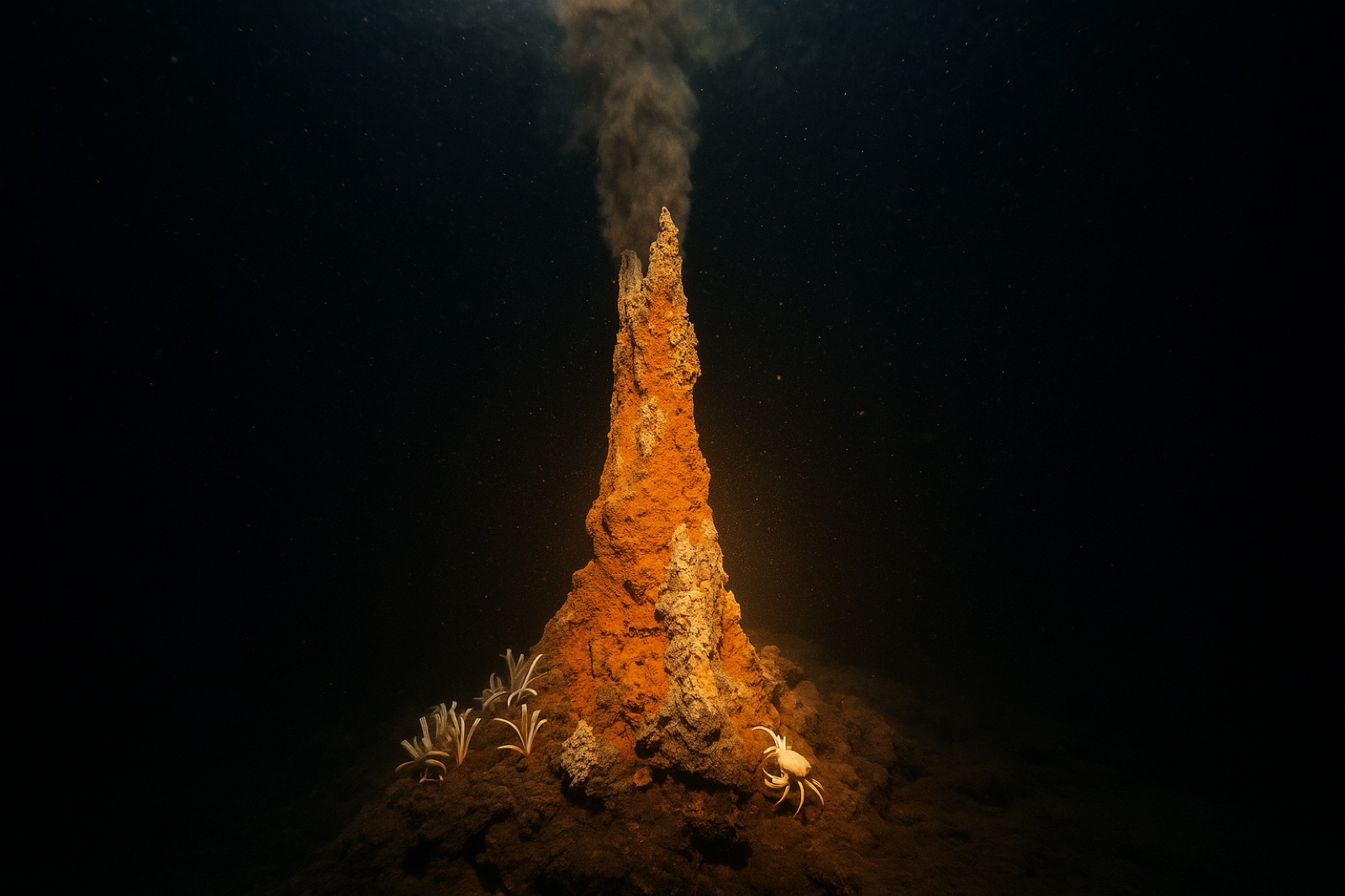
Which is what makes one deep-sea microbe worth a few minutes of your day. It is called Methanocaldococcus infernus, it lives in water venting out of volcanic cracks on the floor of the ocean, and it builds a piece of protein machinery that was still partly holding its shape at 98 °C — about 208 °F, a few degrees short of boiling. Almost any protein you have ever eaten would have been a cooked egg long before that.
In September 2026, a team at the Max Planck Institute for Marine Microbiology in Bremen published the first detailed picture of that machinery in the journal Nature Communications. The lead author is Nevena Maslać; the group is led by Tristan Wagner. What they found is more interesting than “life survives heat” — and the genuinely new part is not the part that got repeated.
What the deep-sea microbe is actually doing down there
The machine in question is called nitrogenase, and it does one of the least appreciated jobs in all of biology.
The air around you is roughly four-fifths nitrogen gas. You cannot use a single breath of it. Neither can wheat, rice, or the tree outside your window. Nitrogen gas is two nitrogen atoms locked together by one of the strongest bonds in ordinary chemistry, and almost nothing alive can pry them apart. Nitrogenase can. It pulls nitrogen out of the air and turns it into ammonia, which is the form living things can actually eat. Every protein in your body traces back, somewhere up the line, to an enzyme like this one doing exactly that.
Industry copies the trick in enormous plants, under great pressure and heat, and it took human engineering a century and a serious share of the world’s energy to get there. A microbe at the bottom of the sea has been doing it quietly, in the dark, at the temperature of a kettle.
The number that matters is 92.3 °C
To find out how tough the enzyme really is, the team purified it straight out of the organism and heated it up.
The melting temperature — the point where half of it has come undone — was estimated at 92.3 °C. For comparison, the same core enzyme taken from a much-studied soil bacterium, Azotobacter vinelandii, had previously been measured at 60.1 °C. That is a gap of roughly 32 degrees between two versions of the same machine. It held together past 90 °C, and pieces of it were still intact at 98 °C.
The team also grew crystals of it clean enough to solve its structure by X-ray crystallography at 1.21 and 1.37 ångström — close enough to place individual atoms.
And it is not merely surviving the heat. At 50 °C, well below the temperature it prefers, the enzyme produced ammonia at 280 ± 18.2 nanomoles per minute per milligram. The authors note that extrapolating that upward suggests it could outwork every nitrogenase measured so far. Worth saying plainly: that last part is an extrapolation, not a measurement taken at full heat.
The record is twenty years old. The machine is new.
Here is the part most coverage skips, and it is the reason this study exists at all.
Back in 2006, Mausmi Mehta and John Baross reported in Science that an archaeon pulled from deep-sea vent fluid — a strain designated FS406-22, a close relative of this one rather than the same species — was reducing nitrogen gas to ammonia at up to 92 °C. That was 28 °C above the known upper temperature limit for biological nitrogen fixation at the time. So “something alive fixes nitrogen near boiling” has been on the books for twenty years.
What nobody had was a picture of the machine doing it. That is what changed.
And in that picture sits the real surprise. The crystals caught the enzyme’s core half in its resting state and half in a working configuration called the turnover state — one that had never been seen before in a molybdenum-based nitrogenase. It had been observed in the vanadium version, and later in the iron-only one. Finding it here too hints that every form of this enzyme may break that stubborn nitrogen bond the same way: one shared mechanism rather than three separate ones.
The researchers also put a caveat on their own result, which is usually the most honest sentence in any paper and usually the first one dropped. The crystals contained a mixture of oxidation states, so the team could not say for certain what was actually bound in the active site. Settling that will take other methods, spectroscopy among them. Wagner described the work as an updated molecular view — not a finished answer. Enzymes have a habit of being stranger than their job description; one found in forest soil turned out to be better at destroying penicillin than at eating the plastic it was named for.
Heat resistance is not immunity. It is a number.
This is the part worth sitting with, and it runs against the way these stories usually get told.
92.3 °C is not the temperature where the enzyme gets tired. It is the temperature where it comes apart. And according to the same paper, the microbe itself can only keep growing on nitrogen gas up to about 91.7 °C. The machine’s failure point sits barely half a degree above the ceiling of the creature depending on it. Built right to the edge, with almost nothing spare.
That is what resistance to heat looks like everywhere in biology. You do not get exemption. You get a higher number. Antarctic krill have turned up alive at hydrothermal vents 1,100 metres down, and they are not fireproof either — they are simply built for that water and not for water ten degrees hotter.
Everything alive has a temperature at which it stops being itself. This microbe’s is unusually high. It still has one.
Which is why one very old story has always been odd in a way people tend to walk straight past.
Three men get thrown into a furnace heated past any sensible margin. They come out. That much gets retold constantly. But the detail the story itself lingers on is not that they lived — it is that the fire left no mark at all. No singed hair. Clothes unchanged. They did not even smell of smoke. There is no number anywhere in it, and nothing about the three of them was built for heat.
The story never claims they were. Its own explanation is not that those men were made of better material. It is that the king staring into the furnace counted four figures walking around in there instead of three — a fourth one nobody in the chapter can name. People have kept that story alive for thousands of years not as evidence that God keeps anyone out of the fire, but as a claim that God turns up inside it. Which is a smaller promise than never burning, and a far stranger one.
Back at the vent
None of the chemistry is settled yet. The team says as much themselves; the exact state of the active site is still open, and the next answer will come from a different instrument.
But the shape of the finding is clear enough. Down where water leaves the rock hot enough to unmake almost anything, something alive has been quietly running one of the hardest reactions in chemistry — and running it, as far as anyone can measure, better than the versions we know best.
You will almost certainly never meet Methanocaldococcus infernus. It is still a fair thing to carry around, the next time the heat in your own week feels like the only fact in the room. Nothing alive is exempt. Plenty of things are still working.
Questions People Ask About This Deep-Sea Microbe
What is the deep-sea microbe that survives heat near boiling point?
It is Methanocaldococcus infernus, an archaeon that lives in fluid venting from volcanic cracks on the ocean floor. In September 2026, researchers at the Max Planck Institute for Marine Microbiology in Bremen published a study in Nature Communications showing that its nitrogenase enzyme has an estimated melting temperature of 92.3 °C, with parts of it still intact at 98 °C.
What temperature do proteins fall apart at?
It depends entirely on the protein. Most familiar ones come apart well below the boiling point of water — that is what cooking is. The nitrogenase enzyme from the soil bacterium Azotobacter vinelandii was measured at 60.1 °C. The version from the deep-sea archaeon Methanocaldococcus infernus was estimated at 92.3 °C, roughly 32 degrees higher, which is among the toughest measured for this particular enzyme.
What is nitrogenase and why does it matter?
Nitrogenase is the enzyme that breaks apart nitrogen gas and turns it into ammonia, a process called nitrogen fixation. Roughly four-fifths of the air is nitrogen gas, but plants and animals cannot use it in that form because the two nitrogen atoms are held by one of the strongest bonds in ordinary chemistry. Nitrogenase is one of the very few things in nature that can break that bond, which makes it the starting point for the nitrogen in nearly every protein alive.
Was nitrogen fixation at 92 °C a new discovery in 2026?
No. Mausmi Mehta and John Baross reported nitrogen fixation at up to 92 °C by a deep-sea vent archaeon in the journal Science in 2006 — 28 °C above the known upper temperature limit for the process at that time. What was new in the 2026 study was the molecular structure of the enzyme itself, solved by X-ray crystallography, including the first sighting of a working “turnover” state in a molybdenum-based nitrogenase.
One Question Before You Go
Which strikes you as the better design: a creature that keeps raising its own limit until it can live beside a volcano, or one that simply never goes near the heat? Both of them survive. Only one of them gets a story told about it. Tell us which one you would rather be — leave a comment below, we read them.
Share This
- A microbe at the bottom of the sea builds a protein that was still holding together at 98 °C. Not immune to heat — just built to a higher number. Everything alive has one. https://bgodinspired.com/index.php/bible-resources/bible-and-science/deep-sea-microbe-survives-heat-near-boiling/
- Turns out the “life survives at 92 °C” headline is twenty years old. What actually changed this month is that someone finally got a picture of the machine doing it, down to individual atoms. https://bgodinspired.com/index.php/bible-resources/bible-and-science/deep-sea-microbe-survives-heat-near-boiling/
- Favourite detail: the enzyme falls apart at 92.3 °C, and the microbe that depends on it tops out at 91.7 °C. Built right to the edge, with about half a degree spare. https://bgodinspired.com/index.php/bible-resources/bible-and-science/deep-sea-microbe-survives-heat-near-boiling/