 0
0
 0
0
NASA’s Lucy spacecraft was built to visit asteroids that share Jupiter’s orbit, the so-called Trojan swarms, on an epic 12-year tour of the outer solar system. But on its way there, it swung past a much smaller, much closer target first: a chunk of rock about five miles long named Donaldjohanson.
Scientists expected to see the scars of a violent past. What they found instead was stranger. Donaldjohanson isn’t just misshapen from an ancient collision. It’s still being reshaped today, slowly, by something almost nobody would guess: sunlight.
What NASA’s Lucy Mission Actually Found
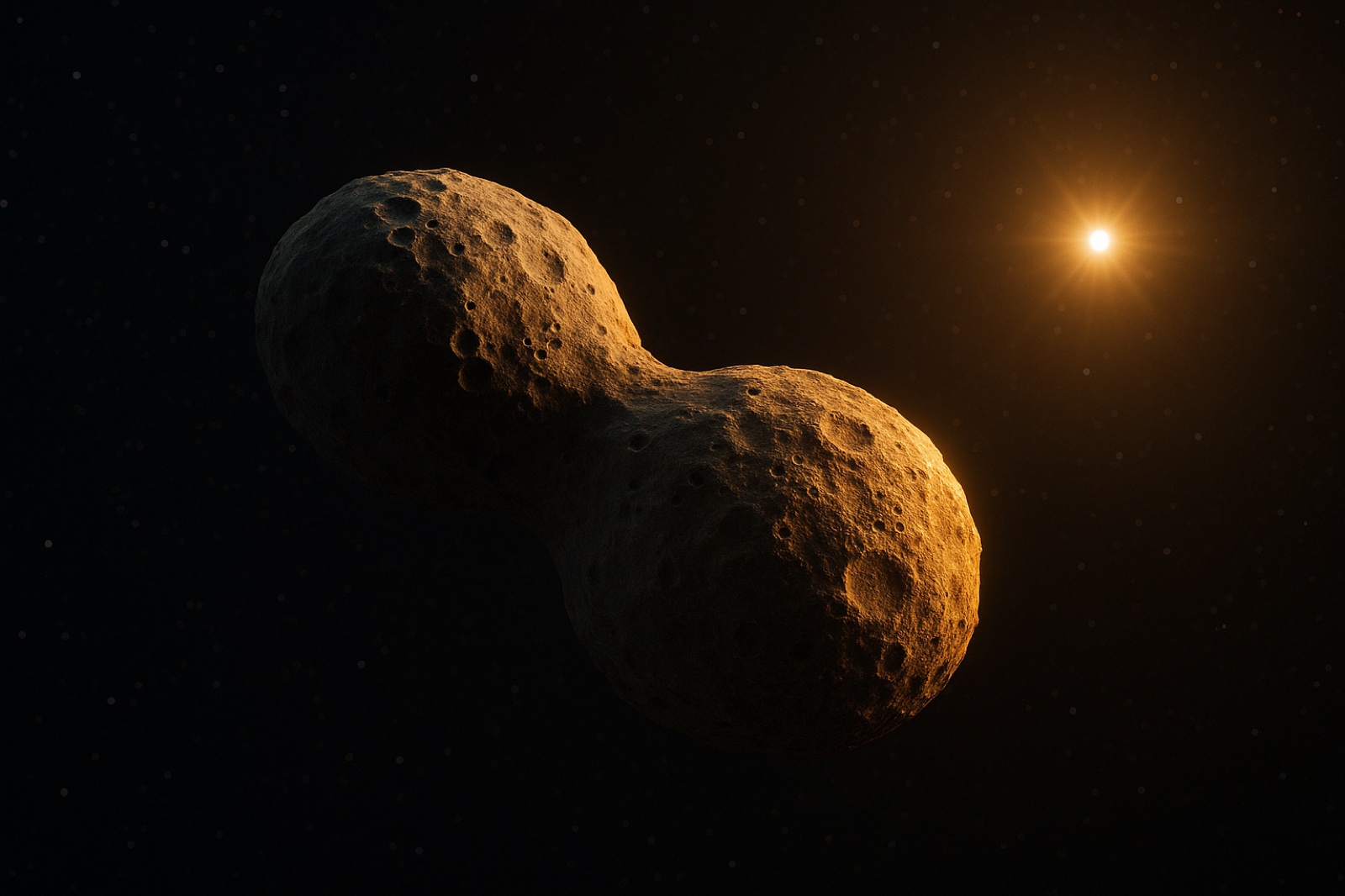
Lucy passed within about 650 miles of Donaldjohanson, close enough to capture detailed images of a lumpy, peanut-shaped object that looks almost like two lobes fused together. Researchers believe it formed roughly 155 million years ago, when a larger body was blasted apart in a collision and the debris slowly came back together into the shape Lucy photographed.
That part of the story is dramatic and sudden, exactly what you’d expect from an asteroid’s origin story. But the strangest detail wasn’t the collision. It was the tumbling.
Most asteroids spin in a simple, predictable way, rotating around one axis like a top. Donaldjohanson doesn’t. It tumbles in a more complicated, two-axis motion, wobbling as it moves through space. Scientists also found signs of ancient water locked into its structure, a clue that traces back to the earliest chapters of our solar system.
The collision explains the shape. It doesn’t explain the wobble.
An Asteroid Reshaped by Sunlight, Not a Collision
The wobble, it turns out, is being caused by something with no mass, no impact, and no force you could ever feel standing on the asteroid’s surface: sunlight.
It works through something scientists call the YORP effect. Sunlight strikes the asteroid’s uneven surface and warms it. As that surface cools, it radiates the heat back out as infrared light, and that radiating light carries a tiny, tiny amount of recoil, the same way a rocket gets pushed forward by the exhaust leaving out the back. Because Donaldjohanson’s shape is irregular rather than a smooth sphere, that recoil doesn’t cancel itself out evenly. It creates a net twist, a small, constant torque acting on one part of the asteroid more than another.
One photon’s push is immeasurably small. But Donaldjohanson has been sitting in sunlight for 155 million years. Multiply a nearly nonexistent force by that much time, and it becomes strong enough to visibly change how a five-mile chunk of rock spins through space.
No explosion did that. No second collision did that. Just light, hitting the same surface, day after day, for longer than there have been mountains on Earth.
It’s not the only object making headlines for what it’s quietly revealing this year. Just weeks earlier, NASA’s Webb Telescope found a giant planet that had been hiding in plain sight, invisible for years simply because nobody was looking with the right instrument yet. Different mission, different discovery, but the same quiet lesson: the universe rarely announces its secrets. It waits for someone patient enough to notice.
The Same Pattern Shows Up Somewhere Else
Here’s what makes Donaldjohanson worth thinking about after you close the article. We tend to assume real transformation needs a dramatic event. A breakup. A diagnosis. A collision, literal or otherwise, violent enough to leave visible scars and force a new shape into existence overnight.
But an asteroid just showed us a second way it works. Not sudden. Not violent. Just steady exposure to something larger than itself, applied so consistently and for so long that the shape and spin of the thing eventually can’t help but change.
Old wisdom has described people the same way for thousands of years, changed not by a single blinding moment but little by little, through steady exposure to something greater, until one day the shape of a life looks different than it used to, and nobody can point to the exact day it happened.
It’s an idea worth sitting with: some of the most permanent changes in us were never the loud ones.
What This Means for the Rest of Us
If you’re in a season where nothing feels like it’s happening, no breakthrough, no dramatic turning point, no collision-sized moment you can point to, Donaldjohanson is a strange kind of good news. Some of the most real change in the universe happens exactly this way: quietly, cumulatively, invisibly, for a very long time before it’s ever visible from the outside.
That’s also the story behind why so many people feel stuck in seasons that turn out to have a purpose, and it’s the same question an ancient watchman once asked when the answer he wanted never seemed to come. The waiting was never empty. It was doing something the whole time.
You don’t need a collision to become someone new. Sometimes you just need to stay in the light long enough.
A Question Worth Sitting With
If real change can happen this quietly, slow, steady, invisible until it isn’t, how would you know it was already happening in your own life right now? What would you look for?
Drop your answer in the comments. Someone else reading this might need to hear it.
Two Small Reflections
- Think of one thing you’ve been consistently exposed to this year, good or bad, and ask what shape it’s slowly pressing into you.
- Instead of waiting for a breakthrough moment, try trusting today’s small, boring exposure to do its quiet work.
Share This
- An asteroid five miles wide has been getting reshaped for 155 million years by nothing but sunlight. No collision. Just time and light. Wild to think what that same principle might be doing to us. 🌌
- NASA didn’t find an asteroid destroyed by an explosion. They found one still being quietly reshaped by sunlight, millions of years later. Sometimes the slow forces are the real ones.
- “No explosion did that. Just light, hitting the same surface, day after day, for longer than there have been mountains on Earth.” A wild NASA discovery about the asteroid Donaldjohanson.
Common Questions About Asteroid Donaldjohanson
What did NASA’s Lucy spacecraft discover about the asteroid Donaldjohanson?
Lucy’s close flyby revealed that Donaldjohanson is a peanut-shaped asteroid formed from an ancient collision about 155 million years ago, and that it has an unusual two-axis tumbling rotation along with signs of ancient water in its structure.
What is the YORP effect?
The YORP effect is a slow change in an asteroid’s rotation caused by sunlight. As sunlight heats an asteroid’s surface, the heat radiates back out as infrared light, and that radiation creates a tiny recoil force. On an irregularly shaped asteroid, this force creates a net twist over long periods of time, gradually altering how the asteroid spins.
Is the asteroid Donaldjohanson dangerous to Earth?
No. Donaldjohanson orbits in the solar system’s main asteroid belt and poses no threat to Earth. Lucy studied it as a scientific target on its way to the Jupiter Trojan asteroids, not because of any impact risk.
How far away did Lucy fly from the asteroid?
Lucy passed within roughly 650 miles of Donaldjohanson during its flyby, close enough to capture detailed images and data about its shape, rotation, and surface composition.
Why did an asteroid discovery get talked about outside of science circles?
Because the underlying idea reaches past astronomy. An object reshaped not by one violent event but by steady, quiet exposure over a very long time mirrors something true about people too: real, lasting change is often the slow kind, not the dramatic kind.