 0
0
 0
0
Maybe you saw the word in a headline. Maybe someone at work said it about the news, half joking, and it stuck with you on the way home. Now it is late, the phone is in your hand, and you typed it into a search bar: Armageddon meaning.
You are not alone. Keyword tools estimate that tens of thousands of people look up that exact phrase every month, and far more when the news turns frightening. Most of them are not doing a Bible study. They are a little scared, and they want to know what the word really means.
So here is the honest answer, and it is gentler than you might expect. The word everyone uses for the end of everything appears one time in the whole Bible. It is the name of a place. You can stand on it.
What Does Armageddon Mean in the Bible?
The only verse in Scripture that uses the word is Revelation 16:16:
“And he gathered them together into a place called in the Hebrew tongue Armageddon.” (Revelation 16:16, KJV)
That is it. One verse. The writer even tells you it is a Hebrew name. In Hebrew it is Har Megiddo, which means “the mountain of Megiddo.” Over the centuries, as it passed through Greek and into English, it became one word: Armageddon.
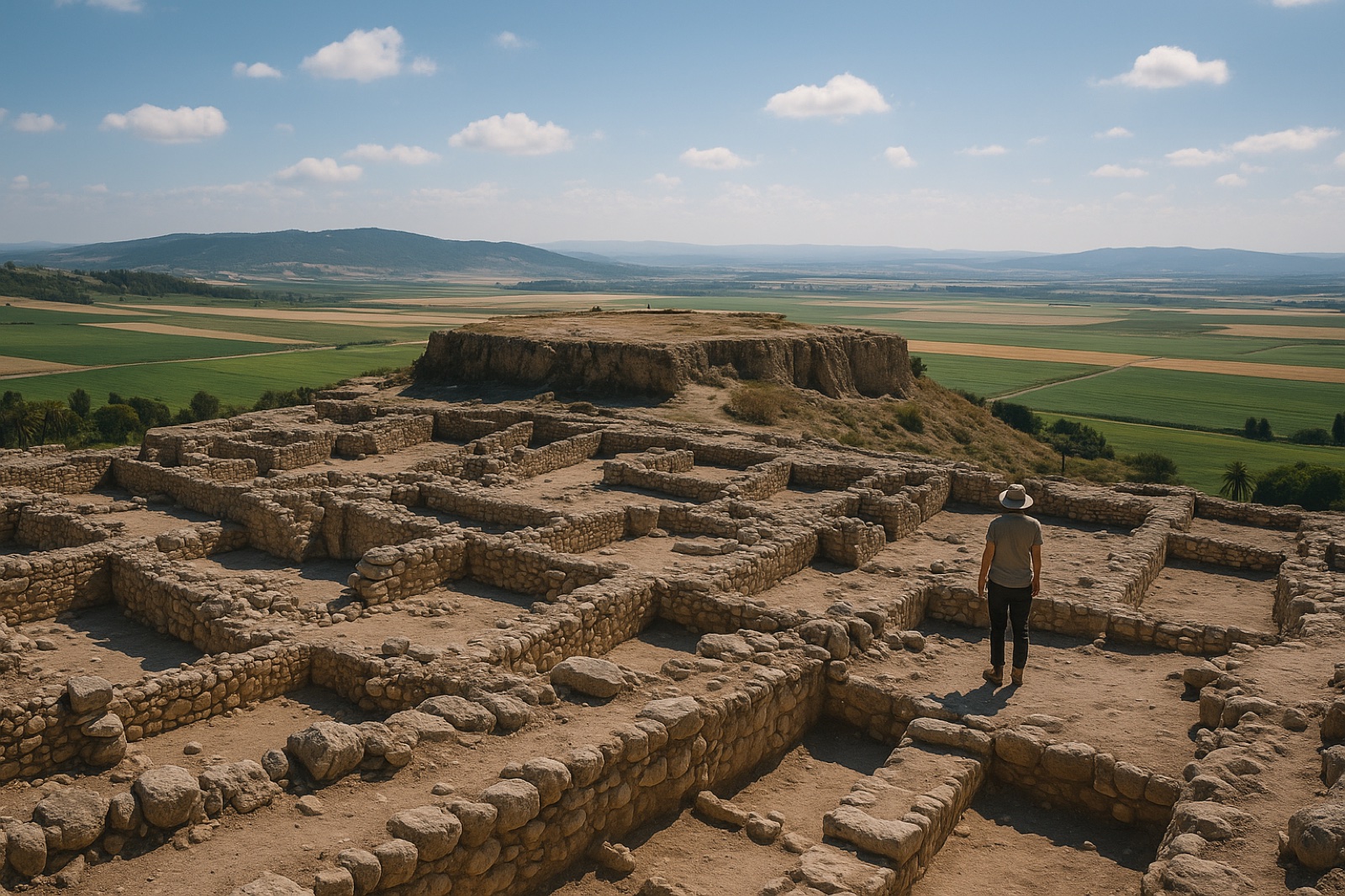
Megiddo is a real place in northern Israel. It is an ancient city mound, called a tel, sitting at the edge of the wide, flat Jezreel Valley. Today it is a national park, and it is part of a UNESCO World Heritage listing called “Biblical Tells – Megiddo, Hazor, Beer Sheba,” added in 2005. Excavators have found about 20 layers of ruins there, city built on top of city, going back thousands of years.
So the short Armageddon meaning is this: it is a place name, “the hill of Megiddo,” used once, in Revelation 16:16. Everything else people pile onto the word came later.
Why Megiddo? A Valley That Remembered War
If you had grown up in ancient Israel, the name Megiddo would not have sounded strange or mystical. It would have sounded like a place where armies kept meeting.
The city sat beside a pass on one of the main roads between Egypt and the lands to the north. Whoever held Megiddo could control the road. So people fought over it again and again. About 3,400 years ago, the Egyptian pharaoh Thutmose III fought a battle there, and his scribes carved the story into temple walls in Egypt. It is one of the earliest battles anyone wrote down in detail.
The Bible remembers Megiddo too. In the song of Deborah, one of the oldest poems in Scripture:
“The kings came and fought, then fought the kings of Canaan in Taanach by the waters of Megiddo; they took no gain of money.” (Judges 5:19, KJV)
And centuries later, it was where one of Judah’s best-loved kings died:
“In his days Pharaoh-nechoh king of Egypt went up against the king of Assyria to the river Euphrates: and king Josiah went against him; and he slew him at Megiddo, when he had seen him.” (2 Kings 23:29, KJV)
So when John wrote Revelation and named this place, his first readers already knew what it stood for. Megiddo was where the powers of the world lined up to fight. It was shorthand, the way a famous battlefield name can mean “a showdown” in many languages today.
The Grief Hidden in the Name
Here is something most people never hear about this word.
To an ancient Jewish ear, Megiddo did not only mean war. It also meant mourning. King Josiah was a good king, and his death at Megiddo broke the nation’s heart. The prophet Zechariah later used that grief as the measure of the deepest sorrow he could imagine:
“In that day shall there be a great mourning in Jerusalem, as the mourning of Hadadrimmon in the valley of Megiddon.” (Zechariah 12:11, KJV)
Many scholars connect that mourning to Josiah. And look at the verse right before it:
“…and they shall look upon me whom they have pierced, and they shall mourn for him, as one mourneth for his only son…” (Zechariah 12:10, KJV)
Christians have long read that line as pointing to Jesus. So Megiddo, in the Bible’s own memory, is not just a battlefield. It is also the place of tears, and of looking at the one who was pierced.
There is one more honest detail. “Har” means mountain, but Megiddo is a mound in a valley, not a mountain. Scholars have argued for a long time about why John called it that. Nobody knows for sure. That is fine to admit. Revelation is full of picture language, and this may be part of it.
Nobody Fights in the Armageddon Verse
Now read the Armageddon verse again, slowly, with the verses around it. This is where it gets surprising.
“For they are the spirits of devils, working miracles, which go forth unto the kings of the earth and of the whole world, to gather them to the battle of that great day of God Almighty. Behold, I come as a thief. Blessed is he that watcheth, and keepeth his garments, lest he walk naked, and they see his shame. And he gathered them together into a place called in the Hebrew tongue Armageddon.” (Revelation 16:14-16, KJV)
Notice three things.
First, in the one verse that names Armageddon, nobody fights. The kings are gathered. That is all verse 16 says. The battle is talked about in verse 14, but it is not described at Armageddon. Instead, the very next verse says this:
“And the seventh angel poured out his vial into the air; and there came a great voice out of the temple of heaven, from the throne, saying, It is done.” (Revelation 16:17, KJV)
The armies line up. And a voice from the throne says, It is done. Christians read the timeline of Revelation in many different ways, and this article is not here to pick a side. But on any reading, the word itself sits beside a gathering and a finished work, not a long, uncertain war.
Second, right in the middle of the scariest scene, Jesus interrupts. Verse 15 breaks in out of nowhere: “Behold, I come as a thief. Blessed is he that watcheth.” It is a blessing, placed in the exact middle of the armies gathering. Before the place is even named, there is a word of comfort for the people who are watching and afraid.
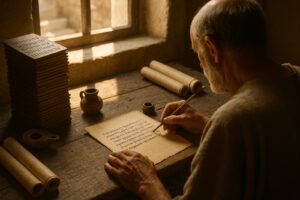
Third, Revelation was written to frightened people. John says plainly where he was and why:
“I John, who also am your brother, and companion in tribulation, and in the kingdom and patience of Jesus Christ, was in the isle that is called Patmos, for the word of God, and for the testimony of Jesus Christ.” (Revelation 1:9, KJV)
He was a companion in tribulation. He was writing to small churches who felt very small next to a huge empire. The book was meant to steady them, not to scare them.
Where Revelation Actually Ends
If you only know one word from Revelation, it is probably Armageddon. But it is not the book’s last word. Not even close. Five chapters later, the book lands here:
“And God shall wipe away all tears from their eyes; and there shall be no more death, neither sorrow, nor crying, neither shall there be any more pain: for the former things are passed away.” (Revelation 21:4, KJV)
Think about that next to the grief of Megiddo. The valley that was famous for mourning is answered by a promise about tears. The book that gave the world its word for the end of everything does not end with a battlefield. It ends with God close enough to wipe a face, and with a voice saying, “Behold, I make all things new” (Revelation 21:5, KJV).
The very first time John saw Jesus in this book, he fell down like a dead man, overwhelmed. And Jesus “laid his right hand upon me, saying unto me, Fear not” (Revelation 1:17, KJV). That is the tone of the whole book, for the person reading it in the right spirit. Hand on the shoulder. Fear not.
So if you came here because the news is frightening and the word “Armageddon” keeps showing up, here is what the Bible actually hands you. A place name, used once. A gathering, not a described battle. A blessing dropped in the middle. And at the end, tears wiped away.
A good place to start:
Why Your Mind Won’t Slow Down at Night (and the 5-Step Order That Changes It)
If scary news keeps your thoughts racing after dark, this short guide shows you a simple order of steps that helps your mind finally settle.
Get the free guide Free.
What to Do With the Fear Tonight
It is normal to feel afraid when the world looks unstable. Jesus never told anyone to pretend things were fine. But Revelation itself shows a different way to carry the fear: watch, stay steady, and remember how the story ends.
This is the same pattern we saw with another word people often get wrong from Revelation. When we looked at what a “Jezebel spirit” really is, the line most people skip in that chapter turned out to be the kindest one. Revelation keeps doing that. The gentle line is usually hiding right beside the scary one.
And it is the same lesson as the one-verse story of Lilith: a single word in Scripture can grow into a huge legend. Going back to the actual verse is often the most calming thing you can do.
If you are not sure how heavy the worry has become, our free How Anxious Am I? check-in takes a few minutes and gives you an honest picture.
Actions to Take
- Read the verse for yourself (2 minutes). Open Revelation 16 and read verses 14 to 17 slowly. Put your finger on verse 15, the blessing in the middle, and read it twice.
- Put the news down for one evening (5 minutes). Before bed tonight, close the news apps. Then read Revelation 21:1-5 instead, the real ending of the book, so it is the last thing in your mind.
- Tell one person what you learned (10 minutes). Message a friend who worries about the news: “Did you know Armageddon is a real hill, and the word is in the Bible only once?” Fear shrinks when it is shared and answered.
Journaling Prompts
- When you hear frightening news, what is the first thought that goes through your mind, and where do you think you learned it?
- Revelation 16:15 puts a blessing right in the middle of the scariest scene. Where in your own life right now might there be a blessing hiding in the middle of something hard?
- If God really will wipe away all tears, which of your tears do you most want God to see?
Quote to share: “Armageddon is mentioned once. ‘Fear not’ is said again and again.”
A Prayer for When the News Is Frightening
God, I’ll be honest. The news scares me, and sometimes I lie awake wondering where all of this is going. Thank You that the word I feared is just one verse, and that right beside it You put a blessing for the people who are watching. Help me stay steady instead of panicked, and kind instead of hard. When I am afraid tonight, remind me how the story ends: with You wiping away tears. Amen.
Discussion Question
Why do you think one word, used only once in the whole Bible, became the word the whole world uses for the end of everything? Share your thoughts in the comments below.
Share This
- I just learned Armageddon is in the Bible exactly once, and it’s the name of a real hill in Israel you can visit. Right beside it is a blessing. The book ends with tears wiped away. Feeling a lot calmer tonight.
- The scariest word in Revelation sits next to a gathering, a blessing, and a voice saying “It is done.” Then the book ends with “God shall wipe away all tears.” Read the actual verses before you let the headlines tell you what they mean.
- Megiddo was a place of war and of grief in the Bible. Revelation answers both with a promise: no more death, no more sorrow, no more crying.
Armageddon Meaning: Questions and Answers
What does Armageddon mean in the Bible?
In the Bible, Armageddon is a place name. It comes from the Hebrew “Har Megiddo,” meaning “the mountain of Megiddo,” an ancient city in northern Israel. The word appears only once in Scripture, in Revelation 16:16, where kings are gathered together at that place.
How many times is Armageddon mentioned in the Bible?
Armageddon is mentioned exactly once in the Bible, in Revelation 16:16 (KJV): “And he gathered them together into a place called in the Hebrew tongue Armageddon.” The city of Megiddo itself appears in other books, including Judges 5:19 and 2 Kings 23:29.
Is Armageddon a real place?
Yes. Armageddon refers to Megiddo, an ancient city mound (a tel) at the edge of the Jezreel Valley in northern Israel. It is now a national park and part of the UNESCO World Heritage listing “Biblical Tells – Megiddo, Hazor, Beer Sheba,” inscribed in 2005. Excavators have uncovered about 20 layers of ruins there.
Does the Bible describe a battle at Armageddon?
Revelation 16:14 says spirits gather the kings of the earth “to the battle of that great day of God Almighty,” and Revelation 16:16 names the gathering place Armageddon. But the verse that names Armageddon describes only the gathering. The next verse, Revelation 16:17, has a voice from the throne saying “It is done.” Christians interpret the timing and meaning of these events in different ways.
Should I be afraid of Armageddon?
The book of Revelation was written to frightened, persecuted believers to steady them, not to scare them. In Revelation 1:17, Jesus tells John “Fear not.” In the middle of the Armageddon passage, Revelation 16:15 adds a blessing for those who watch. And Revelation 21:4 promises that “God shall wipe away all tears from their eyes; and there shall be no more death, neither sorrow, nor crying.”