 0
0
 0
0
There is a thing you need and it has not come. Maybe it is money before a date on the calendar. Maybe it is a test result, a job, a place to live, a person who has not called back. You have prayed about it. And somewhere along the way someone told you, or you sang it in church, that God is Jehovah Jireh, the Provider.
So where is it?
If that is your question today, you are not far from the man who first said the name. Abraham said it on a mountain, with a knife in his hand and his son beside him, and the thing he needed had not arrived yet either. The real Jehovah Jireh meaning is hiding in that moment, and it is not quite what the slogan says.
Jehovah Jireh Meaning in Plain Words
Jehovah Jireh is Hebrew. The first word is God’s personal name, the one English Bibles usually print as “the LORD” in capital letters. The second word, jireh (yir’eh), is a form of the ordinary Hebrew verb ra’ah, which means to see.
Read that again. The verb in the name is not “give.” It is not “supply.” It is “see.” Word for word, Jehovah Jireh means “the LORD will see,” and many Bibles note in the margin that it can be read as “the LORD will see” or “the LORD will provide.”
So how did “see” turn into “provide”? Two ways, and both are worth knowing.
First, the English word provide comes from a Latin word, providere, which literally means “to see ahead” or “to see before.” A provider, in the oldest sense, is someone who looks ahead and sees what will be needed. The English translators were not changing the meaning. They were choosing a word that still had “see” inside it.
Second, Hebrew already used “see” that way. When God sends Samuel to anoint a new king, the King James Version says, “for I have provided me a king among his sons” (1 Samuel 16:1). The Hebrew verb there is ra’ah: God has seen a king. To see something, in this sense, is to see to it.
The name appears exactly once in the Bible, in Genesis 22:14. It belongs to a small family of place names the King James translators left in Hebrew instead of translating, like Jehovah-nissi, “the LORD my banner” (Exodus 17:15), and Jehovah-shalom, “the LORD is peace” (Judges 6:24). Each one was the name of an altar or a place, given by a person on a specific day, for a specific reason. If you want to see the pattern, we traced it in the names of God and what God said when Moses asked.
The Mountain Where Abraham Said It
Here is the day the name was born. God speaks to Abraham and asks for the unthinkable:
“And he said, Take now thy son, thine only son Isaac, whom thou lovest, and get thee into the land of Moriah; and offer him there for a burnt offering upon one of the mountains which I will tell thee of.” (Genesis 22:2, KJV)
Abraham goes. Three days of walking. Then the climb, with Isaac carrying the wood. And on the way up, the boy asks the question every reader is already asking:
“And Isaac spake unto Abraham his father, and said, My father: and he said, Here am I, my son. And he said, Behold the fire and the wood: but where is the lamb for a burnt offering?” (Genesis 22:7, KJV)
Look closely at what Abraham answers, because the name is already in it:
“And Abraham said, My son, God will provide himself a lamb for a burnt offering: so they went both of them together.” (Genesis 22:8, KJV)
“God will provide.” In Hebrew, that is Elohim yir’eh: God will see. It is the same verb that will become the name of the mountain. Abraham says it before there is any lamb in sight. He is not reporting what he can see. He is saying what God can.
Then the altar. The wood. The son bound on top of it. The knife raised. And a voice:
“And he said, Lay not thine hand upon the lad, neither do thou any thing unto him: for now I know that thou fearest God, seeing thou hast not withheld thy son, thine only son from me.” (Genesis 22:12, KJV)
Only then does Abraham turn around:
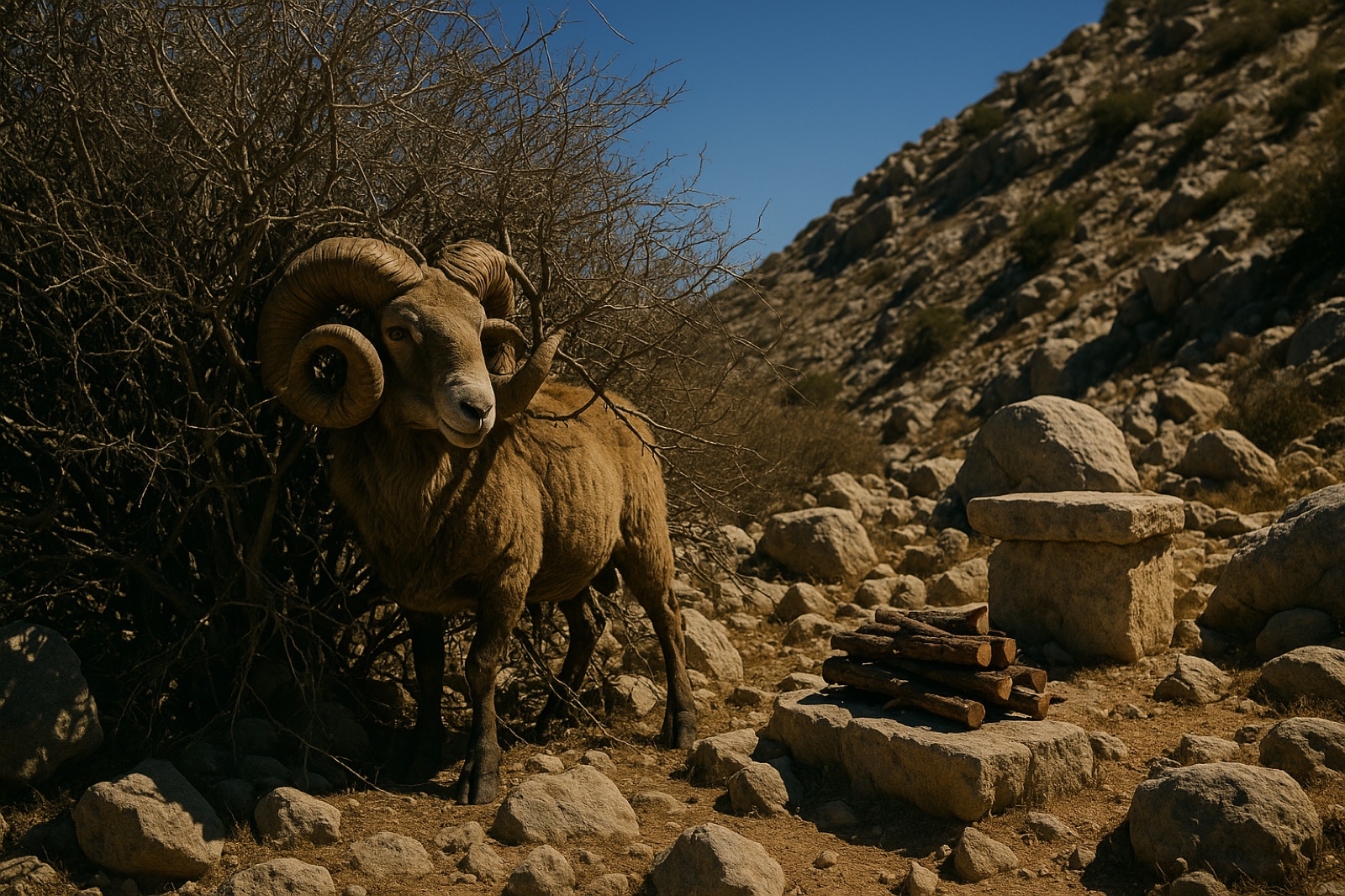
“And Abraham lifted up his eyes, and looked, and behold behind him a ram caught in a thicket by his horns: and Abraham went and took the ram, and offered him up for a burnt offering in the stead of his son.” (Genesis 22:13, KJV)
Notice the order. God spoke first. The ram came second. Abraham looked up after the voice, not before. The provision was behind him the whole time, caught by its horns, and he had not seen it. God had.
And that is when he names the place:
“And Abraham called the name of that place Jehovah-jireh: as it is said to this day, In the mount of the LORD it shall be seen.” (Genesis 22:14, KJV)
Read the second half of that verse again. “It shall be seen.” The verse that gives us the name ends with the same verb, turned around. The LORD will see, and on the LORD’s mountain, it will be seen. Something was glimpsed on that hill that the people telling the story kept repeating “to this day.”
What Was Seen on That Mountain, Later
The Bible does not forget the hill. Centuries later, when Solomon builds the temple, the writer tells us where he put it:
“Then Solomon began to build the house of the LORD at Jerusalem in mount Moriah, where the LORD appeared unto David his father, in the place that David had prepared in the threshingfloor of Ornan the Jebusite.” (2 Chronicles 3:1, KJV)
Moriah. The same name from Genesis 22:2. The place where a ram died instead of a son became the place where lambs were offered, morning and evening, for generations.
And Isaac’s question, “where is the lamb?”, hangs over the whole Old Testament without a full answer. Christians have long heard the answer in what John the Baptist said when he saw Jesus walking toward him:
“The next day John seeth Jesus coming unto him, and saith, Behold the Lamb of God, which taketh away the sin of the world.” (John 1:29, KJV)
“Behold.” Look. See. Abraham said God would see to the lamb. John says: there it is. Whatever else the name Jehovah Jireh means, the first thing it ever pointed at was a substitute, standing where a beloved son had been.
What Jehovah Jireh Does Not Mean
This matters, because the name gets used as a formula. Say “Jehovah Jireh” over the bill and the money comes. Claim it and the job appears.
Look at what Abraham actually walked down the mountain with. He came up with wood, fire, a knife and a son. He went down with wood, fire, a knife and a son. There was no surplus. He did not get richer. He got Isaac back, and a ram he had not brought, in the place where the worst thing was about to happen.
That is the shape of the first provision in the Bible’s first “Provider” story. Not more. A substitute. Not a bank balance. A way through.
And the verb still says what it says. God sees. Before the ram, before the voice, while Abraham was still climbing and still answering his son with a sentence he could not yet back up, God already saw the thicket. The provision was never the proof that God was paying attention. The attention came first. The provision was what it looked like when it arrived.
There is one other person in Genesis who named God with this same verb. A runaway servant named Hagar, alone in the desert, called God “Thou God seest me” (Genesis 16:13). Her name for God, El Roi, is built on ra’ah too. We told her story in Hagar, the only person in the Bible who named God. Put the two names side by side and you get the whole idea: the God who sees me, and the God who will see to it.
Why the Song Says “Enough”
If you learned the word “Jireh” from the song that Elevation Worship and Maverick City Music released in 2021, you may have noticed that it does not say much about money. Its refrain says that God is enough.
That is a better reading of Genesis 22 than the formula is. Abraham did not come down rich. He came down with the thing he could not have lived without. Enough is not the same as more. And a God who sees you is not a God who owes you.
If this name is landing for you today, it may help to know that another old name of God was first spoken to Abraham when he was 99 and still waiting, laughing on his face at a promise that made no sense. We looked at that one in what El Shaddai means. The two names belong to the same man, and the same long wait.
What Jehovah Jireh Means on a Hard Day
Go back to the thing you need that has not come.
Jehovah Jireh does not promise that it arrives by the date on the calendar, or in the form you have pictured. Abraham had no idea a ram was behind him. What the name promises is older and quieter than that: you are seen. The situation is seen. It was seen before you started climbing.
And the ram, when it comes, will probably not be where you are looking. Abraham was staring at the altar. The provision was in the bushes behind him. Most people who have walked through a hard season will tell you the same thing: the help came from a direction they had not been facing.
So the name is not a lever to pull. It is a sentence to say out loud on the way up the hill, before you can see anything: God will see to this. Abraham said it to his son with nothing in his hands. Then he kept walking.
A good place to start:
The Beginner’s Guide to Feeling God’s Presence Every Day
A simple guide to noticing that you are seen, in the ordinary moments and the hard ones.
Get the free guide
Free.
Actions to Take Today
- Say Abraham’s sentence, out loud, about your thing. Not “Jehovah Jireh” as a slogan. The whole sentence: “God will see to this.” Say it once, with the need named in it, the way Abraham said it to Isaac before he had any proof.
- Turn around. Take two minutes and write down one time in your life when help came from a direction you were not facing. A person, a phone call, a door you did not knock on. That is your ram in the thicket. Keep the note somewhere you will see it this week.
- Be the thicket for someone. Think of one person who is staring at their own altar right now. Send them one message, or one small thing they need, today. You may be the provision they have not turned around to see yet.
Journaling Prompts
- What is the “lamb” you keep asking about, the thing you have been told God will provide but have not seen? Write the question as plainly as Isaac asked it.
- Abraham answered his son before he had an answer. Where in your life are you being asked to say “God will see to this” while your hands are still empty? What makes that hard to say?
- If the provision turned out to be “enough” rather than “more,” would you recognise it? What would enough look like for you this month?
A Prayer for the Way Up the Hill
God, I am still climbing and I cannot see the ram. I have the thing I need written on my heart, and I am tired of asking where it is. So I am going to say what Abraham said, with nothing in my hands: You will see to this. Open my eyes to the help that is already behind me, and give me the kind of trust that keeps walking. Amen.
What Do You Think?
The first “provision” in the Bible was a substitute, not a surplus. Do you think the way we use “Jehovah Jireh” today has drifted too far toward money and comfort, or is that a fair extension of the name? Share your thoughts in the comments below.
Share This
- “Jehovah Jireh does not mean ‘the LORD will give.’ The Hebrew verb is ‘see.’ Abraham said it before the ram showed up. That changes how I pray.”
- “Abraham went up the mountain with wood, fire, a knife and a son. He came down with wood, fire, a knife and a son. The first provision in the Bible was a substitute, not a surplus.”
- “The ram was behind Abraham the whole time. He was staring at the altar. If you are waiting on God, the help may be coming from the direction you are not facing. (Genesis 22:13)”
Questions People Ask About Jehovah Jireh
What does Jehovah Jireh mean?
Jehovah Jireh is a Hebrew name that literally means “the LORD will see,” and by extension “the LORD will provide.” The word jireh is a form of the Hebrew verb ra’ah, “to see,” used in the sense of seeing to something or looking ahead to a need. The English word “provide” carries the same idea, since it comes from a Latin word meaning “to see before.” Abraham gave the name to the place where God provided a ram in place of his son Isaac.
Where is Jehovah Jireh in the Bible?
Jehovah Jireh appears once in the Bible, in Genesis 22:14. In the King James Version the verse reads: “And Abraham called the name of that place Jehovah-jireh: as it is said to this day, In the mount of the LORD it shall be seen.” Abraham named the place in the land of Moriah after God stopped him from sacrificing Isaac and provided a ram caught in a thicket (Genesis 22:13).
Why did Abraham name the place Jehovah Jireh?
Abraham named the place Jehovah Jireh because God provided a ram as a burnt offering in the place of his son Isaac. Earlier, when Isaac asked where the lamb was, Abraham had answered, “God will provide himself a lamb” (Genesis 22:8). The Hebrew verb in that answer and in the name is the same verb, “to see.” The name records that God saw the need and saw to it before Abraham could see the ram behind him.
Is Jehovah Jireh a promise about money?
The story behind Jehovah Jireh in Genesis 22 is not about wealth. Abraham did not leave the mountain with more than he brought; he left with his son and had offered a ram that God provided in Isaac’s place. The name describes God seeing a need and meeting it, in that case with a substitute at the moment of greatest loss. Some Christians apply the name to financial needs, but the original setting is about rescue and provision of what is essential, not surplus.
What is the connection between Jehovah Jireh and Mount Moriah?
Genesis 22:2 says God sent Abraham to “the land of Moriah” to offer Isaac, and Genesis 22:14 says Abraham named the place Jehovah Jireh. 2 Chronicles 3:1 later records that Solomon built the temple “at Jerusalem in mount Moriah.” Because of this, many readers connect the mountain where God provided a ram in place of Isaac with the site of the temple, where sacrifices were offered for generations afterward.