 0
0
 0
0
You buy one nice thing.
A new sofa. A good phone. A smart jacket. And for a day or two, it feels great.
Then something odd happens. The rug in front of the new sofa starts to look tired. The old phone case looks cheap next to the new phone. The jacket makes your shoes look worn out. Nothing about the old things changed. But now they look wrong.
So you replace one more thing. And then another.
There is a name for this. It is called the Diderot effect, and it started with a man, a red robe, and a room he suddenly could not stand to sit in.
What Is the Diderot Effect?
The Diderot effect is what happens when one new possession makes the things around it look not good enough, so you feel pushed to replace them too, one after another. One upgrade sets off a chain of upgrades.
It works because we do not see our things one at a time. We see them as a set. A new item that does not “match” the rest makes the whole set feel broken, and the easiest fix seems to be buying more until everything matches again.
It is not greed, exactly. Most people caught in it are not trying to show off. They are just trying to make the room, the outfit, or the kitchen feel right again. That is what makes it so easy to fall into.
The Robe That Started It: Diderot’s Story
Denis Diderot was a French writer and thinker in the 1700s. He spent years editing a huge encyclopedia, one of the biggest book projects of his time. For most of his life he did not have much money.
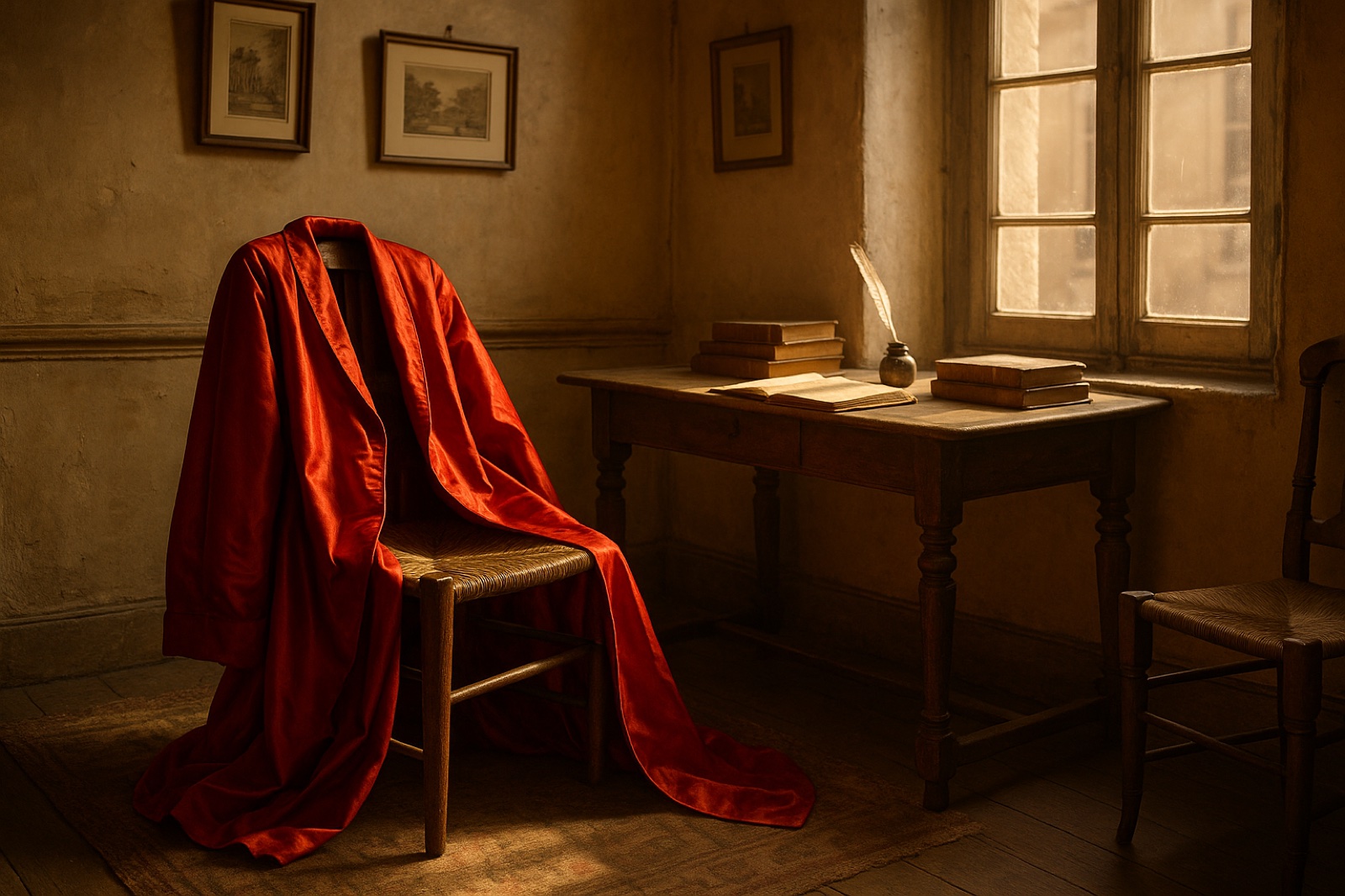
Around 1769, he wrote a short, funny, honest essay called “Regrets for My Old Dressing Gown.” In it, he describes getting a fine new scarlet robe to replace his old, ragged one.
He loved the old robe. In his words: “It was used to me and I was used to it.” It shaped itself to his body. He could wipe ink off his pen on it and nobody cared.
The new robe was beautiful. And that was the problem. Next to it, his study looked shabby. So, one by one, things changed:
- His old straw chair gave way to an armchair covered in fine leather.
- His plain wooden table was replaced by an expensive writing desk.
- His simple rug was pushed out by a rich wall hanging.
- His cheap prints came down and costlier art went up.
- A big mirror and a decorative clock filled the gaps.
Then comes the line people still quote today: “I was the absolute master of my old robe. I have become the slave of the new one.”
What Diderot Actually Said (Not What Gets Repeated)
Here is the part that surprised us when we went back to the essay itself.
Most retellings say Diderot’s new robe drove him into debt. That makes a tidy story. But it is not quite what he wrote.
Diderot says the opposite about himself. He insists he has not been corrupted yet. His door is still open to people in need. He still listens, still helps. Then he adds a chilling little sentence: “My luxury is brand new and the poison has not yet acted.”
The debt in the essay belongs to a man he is afraid of becoming. He pictures someone who has run up debts, who has forgotten his wife and daughter, who has stopped being a husband and father. That man is a warning, not a confession.
That changes the lesson. Diderot is not telling us “look how I ruined myself.” He is catching the spiral early, while it is still small, and naming where it goes if nobody stops it. That is far more useful, because that is where most of us are: not ruined, just a few purchases in, feeling the pull.
And the essay ends somewhere you would not expect for a piece about shopping. Among all the new things, there is one painting he wants to keep, because to him it stands for a friendship. His closing advice is not about money at all: “My friends, keep your old friends. My friends, fear the touch of wealth.”
Who Named It the Diderot Effect?
Diderot never used the phrase. It was named more than two centuries later, in 1988, by the anthropologist Grant McCracken in his book Culture and Consumption.
McCracken noticed that the things people own tend to “go together” in matched sets, as if they belong to the same story about who we are. He called these sets “Diderot unities.” When one new item breaks the set, we feel a pull to rebuild the whole thing around it.
That is why the effect so often shows up around big life changes. A new job, a new home, a new relationship, a new baby. A new chapter seems to ask for a whole new set of things to match it.
Why the Diderot Effect Is So Hard to Notice
It hides in plain sight for a few reasons.
- Each step feels small. No single purchase feels like a big decision. It is only the total that hurts.
- Each step feels reasonable. “Well, the old one doesn’t match anymore” sounds like a real reason. It is just not the reason you thought.
- The goal keeps moving. Once everything matches the new item, the new item is not new anymore. And the next nice thing starts the chain again.
That last point is close cousins with something we wrote about before: the hedonic treadmill, the reason nothing new stays new for long. The Diderot effect is what the treadmill looks like when it spreads sideways through a room instead of forward through time.
And there is a social version too. Seeing a friend’s new kitchen online can make your own kitchen look like the old robe. If that comparison has been eating at you, our piece on why we get jealous of other people’s lives goes deeper.
How to Break the Diderot Effect (Without Spending Anything)
You do not need to give up nice things. You just need to put a little space between “this doesn’t match” and “buy.”
- Name it out loud. When you catch yourself thinking “now the old one looks bad,” say “that’s the robe.” Naming the pattern takes away a lot of its power.
- Wait before the second purchase. Pick a waiting period, a week or a month, before buying anything that only “needs” replacing because of something new. Often the urge simply fades.
- One in, one out. If something new comes in, something old goes out, given away or sold. It keeps the total from creeping up without you noticing.
- Shop for the gap, not the set. Before you buy, ask: is something actually broken, or does it just not match? Only one of those is a real need.
- Keep one “old robe” on purpose. A favourite mug, a worn chair, a jacket you love. Let it stay. It reminds you that “good enough” and “comfortable” are allowed.
- Watch the total, not the item. If the money side is getting tight, our free budget calculator shows where it is all going in a few minutes.
This matters most in seasons of gifts and sales, when new things arrive all at once. One gift can quietly set off a whole run of spending that nobody planned.
The Thing Diderot’s Old Robe Had That the New One Didn’t
Read the essay again and notice what Diderot actually misses. Not the fabric. The ease. With the old robe, he was free. He belonged to himself. With the new one, his things started telling him what to do.
That freedom has an old name: contentment. And a very old letter has a surprising word for it.
Long before Diderot, a man wrote a thank-you note to some friends from a prison cell. He said he had known what it was like to have plenty and to have almost nothing. And he said he had learned to be content in both. Learned. Not been born with it, not stumbled into it. Practised it, like a skill. His secret was not a better robe or an emptier room. It was that he was never facing either one alone. God was the strength he leaned on, whether his hands were full or empty.
That is the quiet answer to the Diderot effect. Not “never buy anything.” Just this: you do not have to keep upgrading your life to feel at home in it. Contentment can be learned. And it can be learned starting with what is already in the room.
A good place to start: if the idea of feeling at home in an ordinary day, without needing the next new thing, landed somewhere in you, we made a short free guide called The Beginner’s Guide to Feeling God’s Presence Every Day. It is a simple video and companion PDF for noticing God in ordinary moments, including the ones at home in your old robe. Get the free guide. Free.
Keep Your Old Friends
Next time something new comes home and the room suddenly looks tired, remember Diderot sitting in his fancy new study, missing the robe he used to wipe his pen on.
The old things did not get worse. Your eyes just changed. And eyes can change back.
Keep your old friends. Keep a few old things. Enjoy the new one too. Just let it be one new thing, not the first of ten.
Discussion Question
Do you think the Diderot effect is mostly something advertisers create, or is it just how people are wired, ads or no ads? Tell us what you think in the comments.
Share This
Just learned the name for the thing where you buy one new thing and suddenly everything else looks shabby. It’s called the Diderot effect, and it’s more than 250 years old. https://bgodinspired.com/?p=117699
Everyone says Diderot’s new robe drove him into debt. Read the actual essay: he says “the poison has not yet acted.” He caught the spiral early. Good read: https://bgodinspired.com/?p=117699
“I was the absolute master of my old robe. I have become the slave of the new one.” Wrote that in 1769, still true every time I buy a new sofa. https://bgodinspired.com/?p=117699
Questions People Ask About the Diderot Effect
What is the Diderot effect in simple terms?
The Diderot effect is the pattern where buying one new item makes your other belongings look worse by comparison, which pushes you to replace them too. One purchase leads to a chain of purchases. It is named after the French writer Denis Diderot, who described this happening to him after he got a fine new scarlet dressing gown and then felt his whole study looked shabby next to it.
Who coined the term Diderot effect?
The anthropologist Grant McCracken coined the term “Diderot effect” in his 1988 book Culture and Consumption. He based it on Denis Diderot’s essay “Regrets for My Old Dressing Gown,” written around 1769. McCracken also described “Diderot unities,” the idea that people’s possessions tend to form matched sets that express a single identity, so a new item that does not fit the set creates pressure to replace the rest.
Did Diderot really go into debt because of his new robe?
Not according to his own essay. Many retellings say Denis Diderot’s new dressing gown drove him into debt, but in “Regrets for My Old Dressing Gown” he insists he has not been corrupted yet, writing that his luxury is brand new and “the poison has not yet acted.” The man with debts in the essay is a warning Diderot imagines about where the spiral could lead, not a description of himself.
What is an example of the Diderot effect?
A common example of the Diderot effect is buying a new sofa and then feeling the rug, cushions, curtains and coffee table no longer look good enough, so you replace them one at a time. Other examples include a new phone leading to new cases, chargers and headphones, or a new outfit leading to new shoes and a new bag to match it.
How do you stop the Diderot effect?
To stop the Diderot effect, put a pause between noticing that something “doesn’t match” and buying a replacement. Helpful habits include waiting a set period, such as a week or a month, before any follow-up purchase; using a one-in, one-out rule; asking whether an item is actually broken or simply does not match; keeping a few favourite old things on purpose; and tracking total spending rather than judging each item alone.