 0
0
 0
0
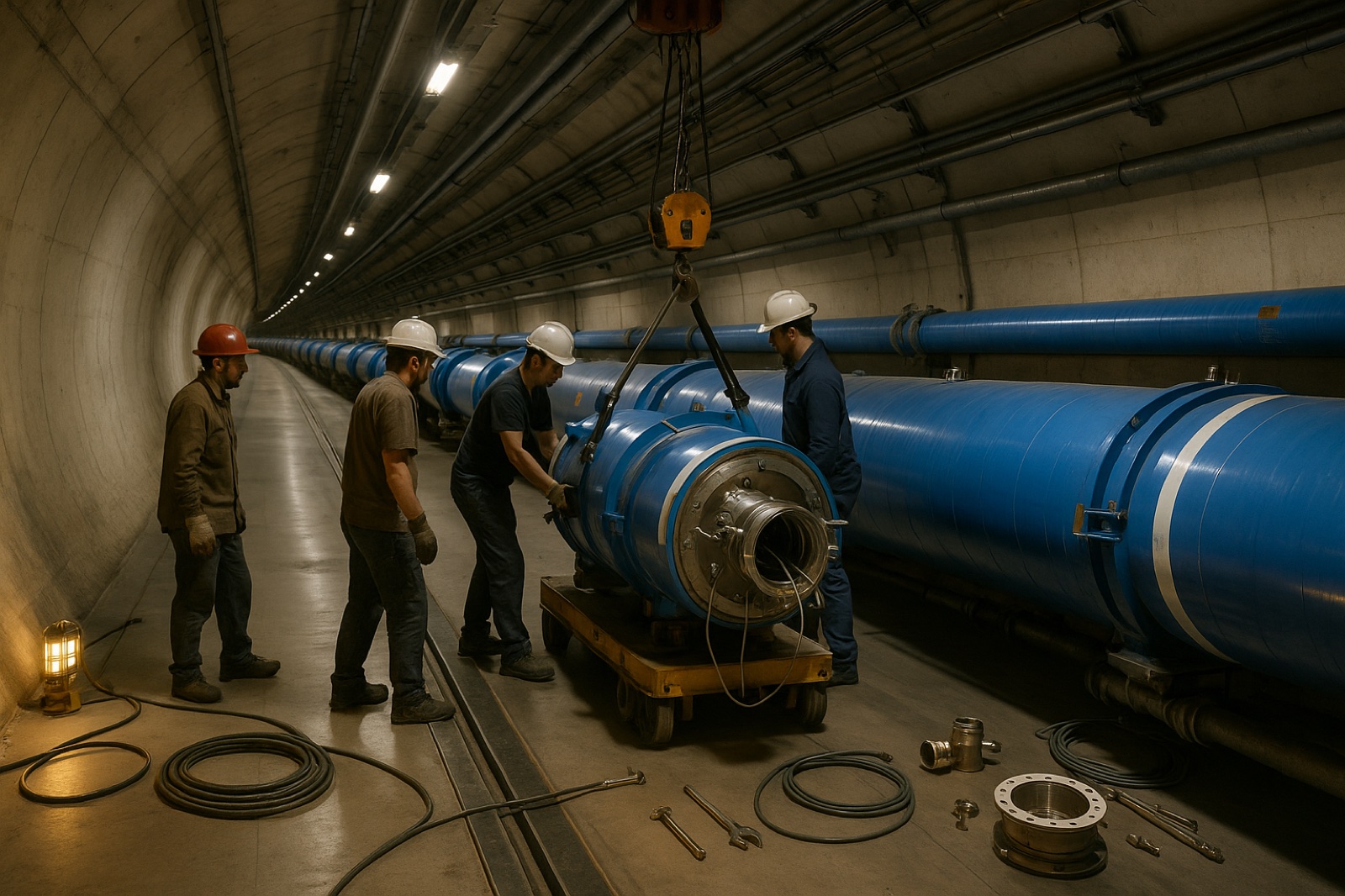
On 7 September 2026, engineers at CERN began pulling magnets out of the Large Hadron Collider. Not broken ones. Working ones. Magnets that had done their job for almost twenty years.
The Large Hadron Collider shutdown is now fully under way. The world’s biggest machine, a 27-kilometre ring buried under the border of France and Switzerland, has gone dark. It will not smash another particle until around 2030.
That sounds like an ending. It isn’t. It is the only way the machine can get stronger.
What Is Actually Happening Inside the Large Hadron Collider?
The collider’s last run of experiments ended on 30 June 2026. Since then, the machine has been in what CERN calls Long Shutdown 3. It is expected to last up to four years.
The work starts with a special group of magnets called the “inner triplets.” Think of them as the lenses of the machine. Two beams of particles race around the ring in opposite directions. Just before they crash into each other, the inner triplets squeeze each beam down tight, so more particles actually hit.
Here is what CERN has confirmed:
- Teams are removing 28 superconducting magnets near two of the big detectors, ATLAS and CMS.
- The old magnets were put in between 2005 and 2007. They have worked for close to two decades.
- The new ones use a different material (niobium-tin instead of niobium-titanium) and reach 11.3 tesla. That is about 40% stronger than what they replace.
- The first of the new magnets should be down in the tunnel at the start of 2029.
- In total, more than 1.2 kilometres of the ring is being taken apart and rebuilt.
When it switches back on, the upgraded machine will be called the High-Luminosity LHC. “Luminosity” is simply a measure of how many collisions you get. The goal is up to ten times more over the life of the new machine. More collisions means more chances to catch something rare, the kind of thing that only shows up once in billions of tries.
Why Can’t They Just Upgrade It While It Runs?
This is the part that is easy to miss.
The Large Hadron Collider does not run at room temperature. Its magnets only work when they are chilled to about 1.9 degrees above absolute zero, colder than outer space. At that temperature the wires carry huge electric currents with no resistance at all.
You cannot reach into that. To touch a single magnet, a whole section of the ring has to be slowly warmed back up, emptied, opened and disconnected. Then, when the new parts are in, it all has to be sealed and cooled down again, with great care.
So the machine faces a simple choice. It can keep running at the strength it already has. Or it can stop, and become something more. It cannot do both at once.
The Shutdown Is Not Quiet
Here is the surprise. From the outside, the collider has “gone quiet.” Inside the tunnel, this is the busiest it gets.
CERN says the shutdown involves thousands of experts across its sites and tunnels. People are cutting, lifting, rewiring and testing. The beam is off. The work is not.
CERN’s HiLumi project leader, Markus Zerlauth, described the moment the magnets started coming out as “a handover from one generation of innovation to the next.” That is a generous way to talk about old equipment. The magnets leaving the tunnel are the same ones that helped find the Higgs boson in 2012, one of the biggest discoveries in modern physics. They are not being thrown out because they failed. They are making room.
If you like this kind of story, you might enjoy this piece on how physicists made a tiny big bang from the smallest nuclei yet.
The Machine Has Been Here Before
This is not the first time the Large Hadron Collider has had to stop.
In September 2008, just days after its very first beam went around the ring, a faulty electrical connection between two magnets failed. It badly damaged part of the machine. Proton collisions were pushed back by about a year while the damage was repaired and new safety systems were added.
At the time, it looked like a disaster. The most expensive science machine in the world had broken almost as soon as it was switched on.
Four years later, that same repaired machine found the Higgs boson.
Long Shutdown 3 is different. Nothing broke this time. The stop is planned. But the lesson is the same one the tunnel keeps teaching: the long, dark, boring-looking pause is often where the real strength gets built.
When You Are the One Who Has Been Switched Off
Most of us will never stand in that tunnel. But plenty of us know what a shutdown feels like.
An injury that takes you out of work. An illness that empties your calendar. A job that ends. A move to a new city where nobody knows your name yet. Sitting out a season, watching everyone else keep running.
From the outside it can look like nothing is happening. From the inside it can feel even worse, like you are falling behind, like the best of you is over.
But the collider shows something worth holding on to. Some kinds of growth simply cannot happen while you are running at full speed. The old parts have to come out before the new ones can go in. And the work of a shutdown is often invisible to everyone who is only looking for the beam.
There is a very old line of poetry, written thousands of years before anyone dreamed of a particle collider, that says there is “a time to break down, and a time to build up.” The writer believed God was in both halves of that sentence, not just the second one. The breaking down was not a mistake in the plan. It was part of it.
That is worth sitting with, if you are in a break-down season right now.
A Few Things That Help During Your Own Shutdown
- Name what is being replaced. The collider team knows exactly which parts are coming out and why. Try writing down one old habit, belief or way of working you are letting go of in this season.
- Measure the work, not the beam. If you only count “output,” a pause will always look like failure. Count the rebuilding: the healing, the learning, the rest.
- Warm up slowly. The machine is cooled down again carefully, in stages. Coming back from your own pause does not need to happen all at once.
- Honour what got you here. The old magnets found the Higgs. What carried you this far still matters, even if it is not what carries you next.
For more on why a new season can feel like starting from nothing, read Hope vs Optimism: Why Every Season Starts at Zero. And for a very human version of stepping aside so something new can grow, see Nicolas Batum’s retirement after 18 seasons.
What Comes Next
If the plan holds, the High-Luminosity LHC will switch on around 2030. The beams will race around the ring again, squeezed tighter than ever by magnets that do not exist in the tunnel yet. Scientists hope the flood of new collisions will help answer questions the old machine could only point at.
Until then, the world’s biggest machine sits in the dark, doing the least visible and most important work of its life.
It is not finished. It is being made ready.
Discussion Question
Do you think people get stronger during the seasons when they are forced to stop, or do you think we mostly just wait them out? Share your view in the comments. We would love to hear it.
Share This
“The Large Hadron Collider had to be switched off for years to get 40% stronger. Some growth just can’t happen at full speed.” https://bgodinspired.com/index.php/personal-growth-and-life-skills/large-hadron-collider-shutdown/
“The magnets CERN is pulling out found the Higgs boson. They’re not being scrapped because they failed. They’re making room. Found this beautiful: https://bgodinspired.com/index.php/personal-growth-and-life-skills/large-hadron-collider-shutdown/”
“If you’re in a season where life has hit pause, read this. The world’s biggest machine is doing the same thing right now, on purpose. https://bgodinspired.com/index.php/personal-growth-and-life-skills/large-hadron-collider-shutdown/”
Questions People Ask About the Large Hadron Collider Shutdown
Why is the Large Hadron Collider shut down?
The Large Hadron Collider at CERN stopped running experiments on 30 June 2026 and entered a planned break called Long Shutdown 3. During this break, engineers are removing and replacing key magnets and other equipment to turn the machine into the High-Luminosity LHC, which is designed to produce far more particle collisions than the original machine.
When will the Large Hadron Collider turn back on?
CERN plans for the upgraded machine, called the High-Luminosity LHC, to start up around 2030. The long shutdown is expected to last up to four years, and the first of the new focusing magnets is due to arrive in the tunnel at the start of 2029.
Why is CERN removing magnets from the Large Hadron Collider?
From 7 September 2026, CERN teams began removing 28 superconducting magnets near the ATLAS and CMS detectors, including the “inner triplet” magnets that focus the particle beams just before they collide. The originals were installed between 2005 and 2007. Their replacements use niobium-tin coils that reach 11.3 tesla, about 40% stronger, which lets the beams be squeezed tighter so more collisions happen.
Why can’t the Large Hadron Collider be upgraded while it is running?
The Large Hadron Collider’s superconducting magnets only work when cooled to about 1.9 kelvin, colder than outer space. To replace any of them, sections of the ring must be warmed up, opened and disconnected, which is impossible while beams are circulating. The upgrade therefore requires a multi-year shutdown.
Is the Large Hadron Collider shutdown permanent?
No. The shutdown that began in mid-2026 is a planned upgrade break, not a closure. The same 27-kilometre tunnel will host the High-Luminosity LHC, which CERN expects to deliver up to ten times more collisions than the original Large Hadron Collider over its lifetime.