 0
0
 0
0
The Numbers 8:26 meaning is the part of the Bible’s only retirement rule that almost nobody reads. Verse 25 retires the Levites at fifty. Verse 26 begins with the word “But” and sends those same men straight back in — to stand with their brethren and keep the charge. This page is the full text of the video above: what the Hebrew of verse 25 actually says, which Levite families were handed wagons and which family was handed none, and the moment a few hundred years later when the ages in the text quietly move again. If you want the shorter read first, the article this was built from is What Does the Bible Say About Retirement?
Chapters
- 0:00 — The box, and the Monday after
- 1:06 — The only group ever given a retirement age
- 1:40 — Verse 26 begins with one word: But
- 1:58 — Tsaba: “retire” is an army word here
- 2:26 — What they actually carried, and who got the wagons
- 3:22 — Avodah and mishmeret: two different words
- 4:03 — Rashi: the old men were still in the choir
- 4:31 — Why twenty-five in one place and thirty in another
- 5:17 — The number that quietly disappears
- 6:28 — The one retirement plan Jesus told a story about
- 7:35 — You have changed posts
The box, and the Monday after
The box is always about the same size. A plant off the windowsill. A mug. A photograph that sat by your desk for eleven years. Then you walk out through the doors carrying less than you walked in with.
For most people the hard part isn’t the money. The money, you can at least make a plan about. It’s the Monday. The alarm doesn’t go off. Nobody needs your answer by noon. By Thursday you have reorganised a cupboard that did not need reorganising, and you have become aware of how quiet the house is. And a question starts up, quietly, somewhere underneath the ribs: if I’m not the work, what am I?
Here is the strange part. Scripture names a retirement age exactly once. One group of people. One number. Fifty. That is the entire rule, and it sits in a stranger place than you would expect. And a few hundred years later, that number quietly disappears out of the text. Where it goes, and why, tells you what it was for all along.
The only group ever given a retirement age
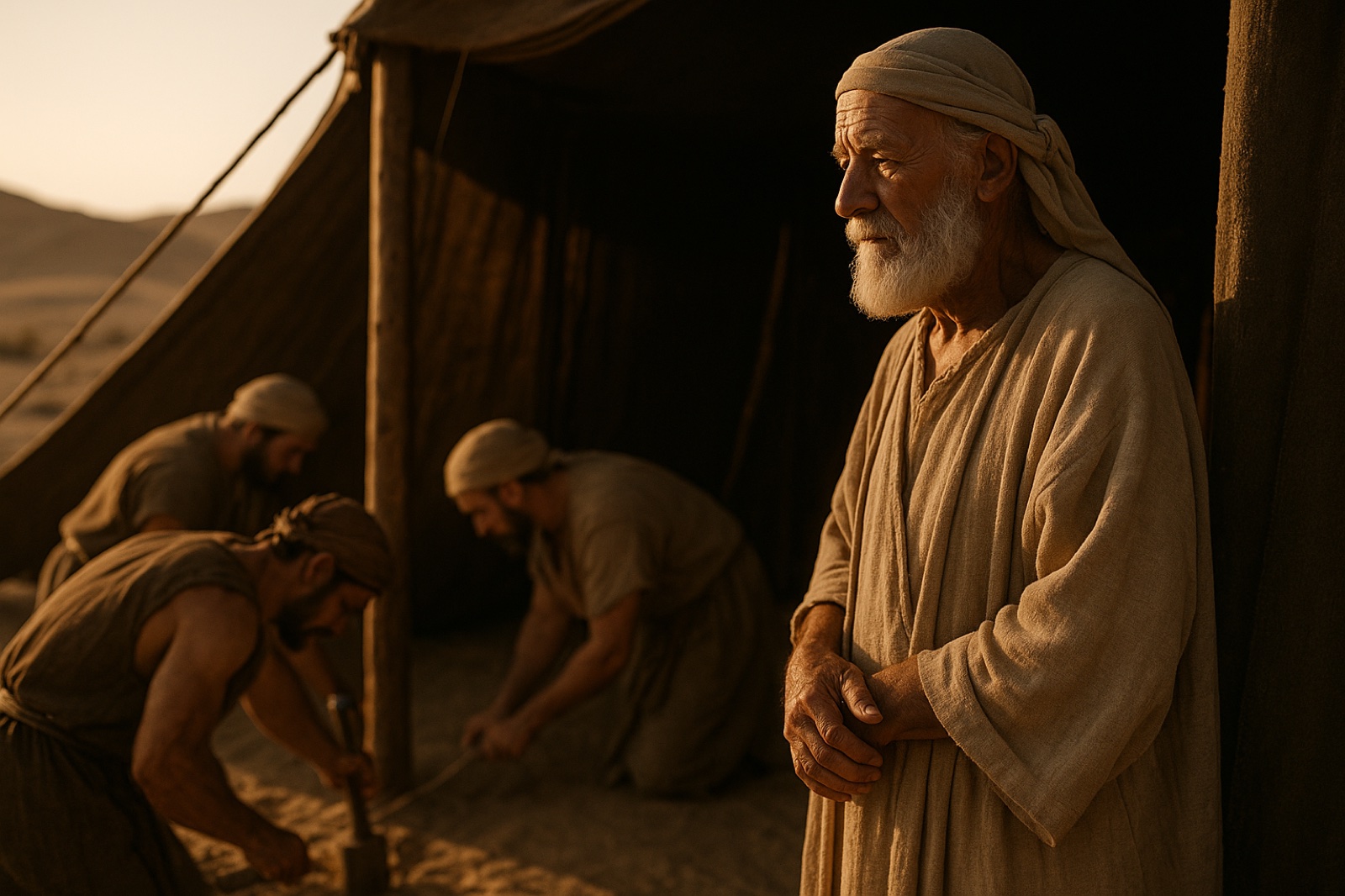
The rule belongs to the Levites — the tribe set apart to look after the tabernacle, the tent of worship Israel carried with them through the wilderness. Every time the camp moved, the Levites took the whole thing down, carried it, and raised it again on the other side.
Their rule reads like this: “From the age of fifty years they shall cease waiting upon the service thereof, and shall serve no more” (Numbers 8:25, KJV).
That’s verse twenty-five. Read it on its own and you would close the book. Done at fifty.
Numbers 8:26 meaning: verse 26 begins with one word — But
Verse twenty-six begins with a single word. But.
“But shall minister with their brethren in the tabernacle of the congregation, to keep the charge” (Numbers 8:26, KJV).
They stop. And they don’t stop. The entire passage turns on that one word.
Tsaba: “retire” is an army word here
The Hebrew in verse twenty-five doesn’t quite say cease. Word for word, it says the Levite shall return from the host of the service. Host — tsaba. It is the word for an army.
Numbers 4:3 uses the same word for the Levites who enter into the host, to do the work of the tabernacle. Their working years were counted like a tour of duty. At fifty, a man came home from it.
What they actually carried, and who got the wagons
And it was hard duty. Numbers 4 itemises the load: the curtains and the coverings, the boards, the bars, the pillars, and their heavy bases.
The work was split between three Levite families, and the split is the part worth noticing. Gershon took the curtains and the coverings. Merari took the boards, the bars, the pillars and their heavy bronze bases. Both of those families were handed wagons and oxen to haul it with.
Kohath was handed none. The holiest objects couldn’t travel on a cart at all — Numbers 7:9 says they went on the Levites’ own shoulders. Mile after mile. Then set it all up. Then take it all down again.
So fifty stops sounding like a finish line. It starts sounding like mercy, for shoulders that had carried enough.
Avodah and mishmeret: two different words
Two different Hebrew words are doing the work in that one sentence, and English flattens them both into the same idea.
Service is avodah. Labour. Hard work. The lifting. Charge is mishmeret. A watch. A guard post. Something you keep your eyes on.
The fifty-year-olds put down the avodah. They kept the mishmeret. They stopped carrying the load. They did not stop guarding what mattered.
And notice where they did it. With their brethren. Not off somewhere on his own — right there beside the younger men who had taken over the lifting.
Rashi: the old men were still in the choir
Rashi, the eleventh-century teacher from France whose commentary Jewish students still read first, tried to picture what that actually looked like. He wrote that the retired Levite gave up the load on his shoulder, but still came back to help close the gates, to load the wagons, and to sing.
Read that last one again. The old men were still in the choir. Retired from the lifting. Not from the belonging.
Why twenty-five in one place and thirty in another
Read closely, though, and you hit a bump. Numbers 4 counts the Levites from thirty years old. Numbers 8 says they started at twenty-five. So which is it?
Nobody should pretend that one is simple. But there is an old Jewish answer, found in the Talmud (Chullin 24a) and repeated by Rashi: from twenty-five, a young Levite came to learn the work; at thirty, after five years of it, he did the job in full.
That is one explanation. Not a settled fact, and it’s worth saying so out loud. But if it’s right, a Levite’s life had a clear shape. Five years learning. Twenty years carrying. And no end date at all on keeping the charge.
The number that quietly disappears
Which brings us back to the number that disappears.
Jump forward a few hundred years. Israel is settled in the land. The tent has done its work, and a permanent temple is being planned. In 1 Chronicles 23, King David reorganises the Levites — and the text says its reason out loud: “They shall no more carry the tabernacle, nor any vessels of it for the service thereof” (1 Chronicles 23:26, KJV).
No more carrying. And immediately, the starting age drops. From thirty, down to twenty. Younger men are let in, because the job no longer breaks a body to do it.
And here is the quiet part. The number fifty does not appear anywhere in that chapter. We can’t say for certain the stopping age was dropped; the text simply doesn’t tell us. But both ages moved, and they moved with the weight of the work.
Which tells you what the fifty-year rule was ever about. It was about the load. It was never about the worth of the person carrying it. The rule protected the man. It never once measured him.
The one retirement plan Jesus told a story about
Jesus told exactly one story about a man planning his later years. Luke 12. A farmer has a harvest so large his barns won’t hold it, so he builds bigger ones. And then he talks to himself: “Soul, thou hast much goods laid up for many years; take thine ease, eat, drink, and be merry” (Luke 12:19, KJV).
That is a retirement plan. Almost word for word the one most of us would write. And it goes badly: “Thou fool, this night thy soul shall be required of thee.”
Be careful here, though. Jesus doesn’t say saving is wrong. He doesn’t say resting is wrong. The problem sits in the story’s last line — “he that layeth up treasure for himself, and is not rich toward God” (Luke 12:21). The man’s whole plan had exactly one person in it.
Put the two of them side by side. Two men stop working. One stays beside his people and keeps the watch. One shuts himself in with his own things. Same stopping point. Opposite directions. We followed the verses just before that parable in Your Life Is More Than Your Stuff.
You have changed posts
So. Retirement, in the Bible, is a change of role. It is not an exit.
That matters if you have just retired, and it feels as though the world quietly decided you were finished. The heavy lifting may well be over. The charge isn’t. Somebody younger is carrying the boards you used to carry, and they need a person nearby who remembers where everything goes.
It will probably be smaller than the work was. A standing Tuesday phone call. A gate you open before everybody else arrives. One person you have quietly decided to keep an eye on. The Levites’ second post was never impressive. It was close, and regular, and it was with people.
And it matters just as much if you never get a formal retirement at all. Plenty of people never will. Sometimes the body decides — an injury, an illness, a job that ends years before you were ready for it. The Levite rule speaks to that too. When you can’t carry the load any more, you have not lost your place. You have changed posts.
“They shall still bring forth fruit in old age,” the Psalms say (Psalm 92:14). And Caleb, at eighty-five, walked up to Joshua and asked for the hill country — the part still held by the giants that everyone else had been frightened of, forty years earlier. Give me this mountain. That is not a man who had confused his age with his usefulness. His story is Caleb Was 85 and Still Asking for the Mountain With Giants On It.
Your worth was never the load you could carry.
Sources
- Numbers 8:24-26 (KJV) — the retirement rule, and the “But” of verse 26.
- Numbers 4:3 (KJV) — Levites counted “from thirty years old,” and the word tsaba, host.
- Numbers 4 (KJV) — the itemised load: curtains, coverings, boards, bars, pillars and bases, divided between Gershon, Kohath and Merari.
- Numbers 7:6-9 (KJV) — wagons and oxen given to Gershon and Merari; none given to Kohath, “because the service of the sanctuary belonging unto them was that they should bear upon their shoulders.”
- 1 Chronicles 23:26-28 (KJV) — “they shall no more carry the tabernacle,” the count from twenty years old, and the new duties.
- Luke 12:16-21 (KJV) — the parable of the rich fool.
- Psalm 92:14 (KJV) — “They shall still bring forth fruit in old age.”
- Joshua 14:6-13 (KJV) — Caleb at eighty-five asking for the hill country.
- Talmud, Chullin 24a, and Rashi on Numbers 8:24-26 — the five-years-of-learning reading, and Rashi’s picture of the retired Levite closing the gates, loading the wagons and singing. A longstanding traditional reading, not a settled fact.
Numbers 8:26 and Retirement: Questions and Answers
What is the meaning of Numbers 8:26?
Numbers 8:26 is the sentence that follows the Bible’s only retirement rule. After Numbers 8:25 retires the Levites from heavy labour at fifty, verse 26 begins with “But” and tells those same men to “minister with their brethren in the tabernacle of the congregation, to keep the charge, and shall do no service.” It changes their role rather than ending it: they put down the carrying and kept the watching.
What is the difference between avodah and mishmeret in Numbers 8?
Both Hebrew words are flattened into similar English terms, but they mean different things. Avodah is service in the sense of labour — the hard, physical work of carrying the tabernacle. Mishmeret is a charge in the sense of a watch or guard post, something you keep an eye on. Numbers 8:26 takes the avodah off the fifty-year-old Levite and leaves the mishmeret with him.
Why did the Levites retire at fifty?
Because of the weight of the work, not the worth of the worker. Numbers 4 lists what the Levites carried — curtains, coverings, boards, bars, pillars and heavy bases — and Numbers 7:9 records that the holiest objects travelled on their shoulders rather than on a cart, since the Kohathites were given no wagons at all. Fifty reads less like a finish line and more like mercy for shoulders that had carried enough.
Does the Bible still give a retirement age of fifty?
The text stops mentioning it once the carrying stops. In 1 Chronicles 23:26-27, when the Levites “shall no more carry the tabernacle,” the starting age drops from thirty to twenty, and the number fifty does not appear anywhere in that chapter. It cannot be said with certainty that the stopping age was abolished, because the text does not say so — but both ages clearly moved with the weight of the job.
What does the Bible say about purpose after you stop working?
It treats the end of the heavy work as a change of post, not an exit. The retired Levites stayed “with their brethren” and kept the charge. Psalm 92:14 says the righteous “shall still bring forth fruit in old age,” and Caleb asked for the hardest assignment available at eighty-five. If you are working out what your own charge is now, the free 3-day sample of 30 Days Walking with Jesus is a place to start.