 0
0
 0
0
Most of us know what it feels like to get away with something.
Maybe a brother or sister took the blame for something you broke. Maybe someone at work quietly covered a mistake that had your name all over it. You walked out fine. Someone else carried it. And a small part of you never quite settled the account.
So who was Barabbas? He is the man in the Bible who lived that feeling on the biggest stage imaginable. He was in prison for murder. He walked out free on the same morning Jesus was sentenced to die. And there is a detail about his name, hiding in some ancient copies of Matthew’s Gospel, that most people have never heard.
Who Was Barabbas? What the Four Gospels Actually Say
All four Gospels mention Barabbas, and each one adds a piece.
- Matthew calls him “a notable prisoner” (Matthew 27:16). A well-known name. People had heard of him.
- Mark says he “lay bound with them that had made insurrection with him, who had committed murder in the insurrection” (Mark 15:7).
- Luke says he was jailed “for a certain sedition made in the city, and for murder” (Luke 23:19).
- John says it in five words: “Now Barabbas was a robber” (John 18:40).
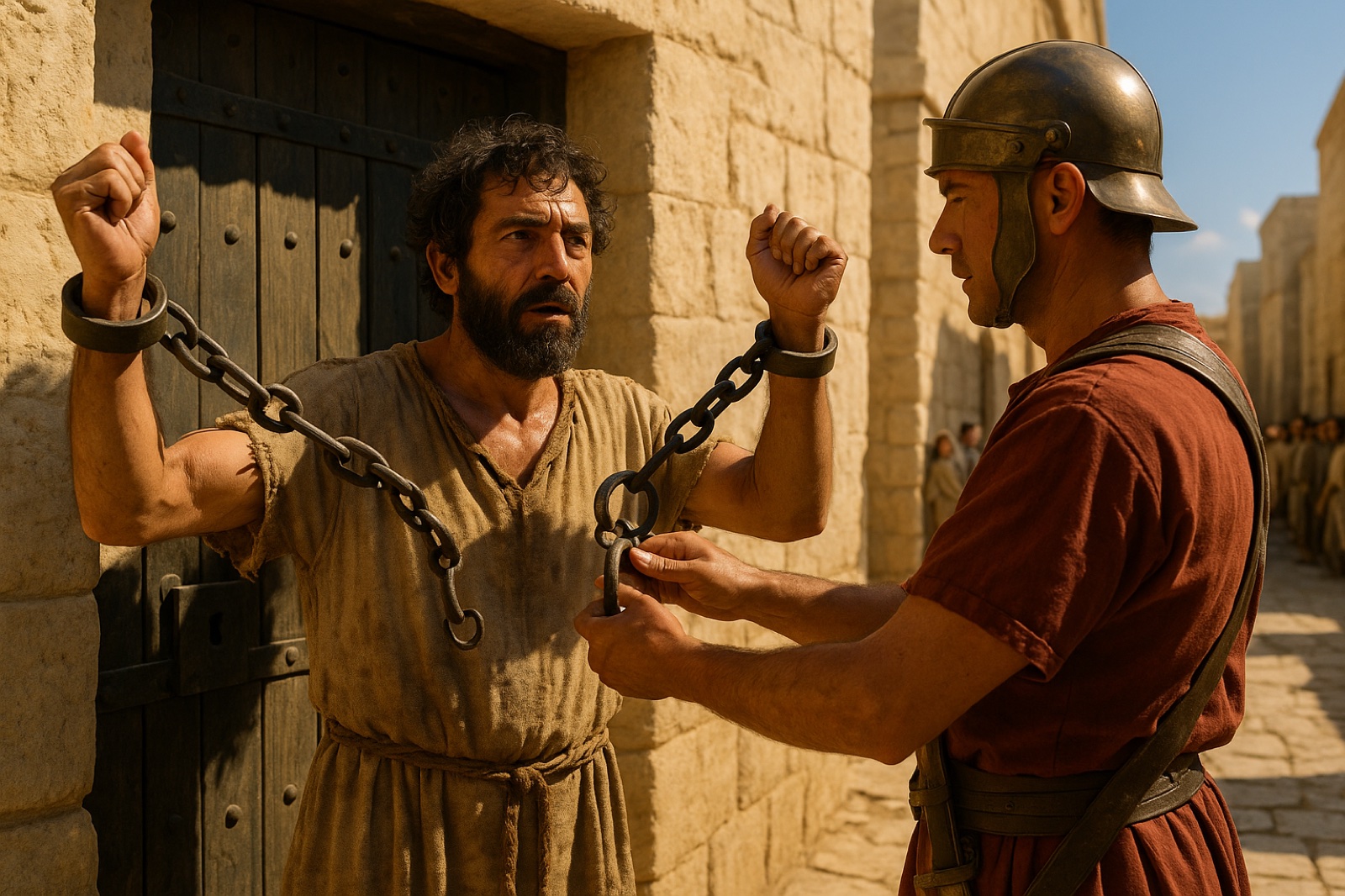
John’s word for “robber” is the Greek lēstēs. It could mean a bandit on the road, but it was also used for armed rebels who fought against Rome. Put the four pieces together and a picture comes into focus: a violent rebel, part of an uprising in Jerusalem, who had killed someone during it. He was not a pickpocket. He was dangerous, and Rome had him in chains for it.
Then came Passover. The Roman governor, Pontius Pilate, a real man whose name has been found carved in stone, offered the crowd a choice. One prisoner could go free. Barabbas, or Jesus.
The crowd chose Barabbas. “Then released he Barabbas unto them: and when he had scourged Jesus, he delivered him to be crucified” (Matthew 27:26).
Barabbas’s whole story sits inside Matthew 27, one of the most intense chapters in the Bible. If you’d like to experience it the way it was meant to be taken in, as one continuous story instead of scattered verses, we’ll send you the entire Book of Matthew as an immersive PDF and a 28-chapter audiobook, free.
What Does the Name Barabbas Mean?
Barabbas is not really a first name. It is a label built from two Aramaic words: bar, meaning “son,” and most likely abba, meaning “father.” So Barabbas is usually translated “son of the father.”
That is the common reading, but it is not the only one. The early Bible scholar Jerome reported that an old gospel used by Jewish Christians, the Gospel According to the Hebrews, explained the name as “son of their teacher,” which points to a different spelling, bar-rabban. And Abba later shows up as an ordinary personal name among Jewish rabbis. So Barabbas may simply have meant “son of a man called Abba,” a family name, the way Johnson once meant “son of John.”
Nobody can settle this for certain. But hold on to “son of the father,” because the next detail changes how it sounds.
Was Barabbas’s First Name Jesus?
Here is the part most people have never heard.
In some ancient copies of Matthew’s Gospel, Barabbas has a first name. It is Jesus.
In those copies, Matthew 27:16-17 calls him “Jesus Barabbas.” And Pilate’s question to the crowd becomes: “Jesus Barabbas or Jesus who is called the Messiah?” That is the wording of the NRSV Updated Edition, which prints the longer reading in its main text.
Read that slowly. Two prisoners. Both named Jesus. One whose name means “son of the father.” The other, the Son of God. And a crowd has to pick.
How sure can we be? Here is the honest picture:
- The reading “Jesus Barabbas” is found in a small number of Greek manuscripts, including one called Codex Koridethi, and in an early Syriac translation of the Gospels.
- The two oldest complete Bibles we have, both from the 300s, say only “Barabbas.” So does the King James Version: “Barabbas, or Jesus which is called Christ?” (Matthew 27:17). The ESV and NASB leave it out too.
- The NIV and the NRSV Updated Edition put “Jesus Barabbas” in the main text, with a footnote saying many manuscripts do not have it.
- The standard Greek New Testament that scholars work from prints the name “Jesus” in square brackets. That is the editors’ way of saying: this may well be original, but we cannot be completely sure.
So why would scholars take a less common reading seriously at all? Because of a simple question you can ask about any copying change: which direction is it more likely to have gone?
An old commentary on Matthew, which survives in a Latin translation and is usually credited to the third-century scholar Origen, noticed that many copies did not call Barabbas “Jesus,” and suggested that was perhaps for the best, so that the holy name would not belong to a wrongdoer. You can see the pressure that creates. A copyist who found “Jesus Barabbas” in front of him had every reason to quietly drop the first word. It is very hard to picture anyone adding it.
The name would not have been strange at the time, either. Jesus, Yeshua in Hebrew, the same name as Joshua, was common in first-century Judea. The historian Josephus mentions several different men called Jesus. Two prisoners with the same first name is exactly why Pilate might have said “Jesus Barabbas” and “Jesus who is called Christ,” to make clear which man he meant.
Did Pilate Really Free a Prisoner Every Passover?
Matthew, Mark and John all describe a custom of freeing one prisoner at the feast. John puts it in Pilate’s own mouth: “But ye have a custom, that I should release unto you one at the passover” (John 18:39).
It’s worth being honest here too. No other ancient history mentions this custom. Some scholars point to a line in the Mishnah, the early collection of Jewish law (Pesachim 8:6), that allows the Passover lamb to be prepared for someone who has been promised release from prison. That could hint that Passover releases happened. Others doubt the custom existed the way the Gospels describe it. The question is still debated.
There is even a small wrinkle in Luke. The King James Version includes Luke 23:17, in brackets: “(For of necessity he must release one unto them at the feast.)” But that verse is missing from some of the oldest surviving copies of Luke, including an early papyrus, so many modern Bibles leave it out or move it to a footnote. The release of Barabbas is in all four Gospels. That one explanatory line may have been added later by a copyist.
The Detail Almost Everyone Reads Past
Here is something the Gospels do that is easy to miss. They never tell us what happened to Barabbas.
Not one more word. He walks out of the prison, and he walks out of the story. No thank you. No change of heart. No bad end. Every novel, film and legend about his later life was invented long afterward, a bit like the story that Mary Magdalene was a prostitute, which the Bible never says either.
And there is one more quiet thread. John calls Barabbas a lēstēs. When Matthew and Mark describe the two men crucified beside Jesus, the King James calls them “two thieves” (Mark 15:27). The Greek word is the same one, in the plural. Mark tells us Barabbas was locked up with fellow rebels. So readers have long wondered whether the men on either side of Jesus were Barabbas’s own companions, and whether the cross in the middle was the one that had been meant for him. The Bible does not say that. It is reading between the lines. But the lines are there.
What the Barabbas Story Means for You
The Gospel writers never stop to preach about Barabbas. They don’t explain him. Luke simply puts two halves of one sentence side by side and lets them sit there:
“And he released unto them him that for sedition and murder was cast into prison, whom they had desired; but he delivered Jesus to their will.” (Luke 23:25)
Look at what Barabbas did to earn his freedom. Nothing. He didn’t apologize. He didn’t promise to change. As far as we know, he never even spoke to Jesus. He was simply the man in the cell when the door opened, and the door opened because an innocent man was sent the other way.
Years later, Peter would put it into words: “For Christ also hath once suffered for sins, the just for the unjust, that he might bring us to God” (1 Peter 3:18). The just for the unjust. Barabbas is what that looks like when it happens to one real, named person, on one ordinary morning in Jerusalem.
And if that old reading of Matthew is right, the choice the crowd heard was between Jesus, “son of the father,” and Jesus, the Son of God. The guilty man who carried the name walked free. The one who truly was that name took his place.
But here is the part hardly anyone talks about. A few weeks later, Peter stood up in Jerusalem and spoke to people who had been part of that crowd. He did not soften it: “But ye denied the Holy One and the Just, and desired a murderer to be granted unto you” (Acts 3:14). Then, moments later, he offered them the very same thing Barabbas got: “And now, brethren, I wot that through ignorance ye did it, as did also your rulers… Repent ye therefore, and be converted, that your sins may be blotted out” (Acts 3:17, 19).
The people who asked for Barabbas to go free were offered Barabbas’s freedom.
It is worth saying clearly, because this story has sometimes been twisted to blame the Jewish people as a whole: the New Testament itself doesn’t allow that. Peter, a Jew speaking to fellow Jews, calls it ignorance and offers forgiveness in the same breath. The story isn’t about which people in the crowd were the bad ones. It is about how every single person in it needed the door to open, and how it opens the same way for all of them.
If you still carry something you did, even something already forgiven, you may be living like a man standing in the doorway of an open cell, afraid to step outside. Walking out is not something you earn. It is something you accept. If that is where you are, this piece on why the Bible never actually tells you to forgive yourself goes further.
And if your struggle runs the other way, bitterness toward someone who “got away with it,” the Barabbas story asks a hard and freeing question: what if they are offered the same door you were?
3 Things You Can Do in the Next 10 Minutes
- Read Luke 23:25 with your own name in it. Where it says “him that for sedition and murder was cast into prison,” quietly say your own name instead. Then read the second half: “but he delivered Jesus.” It takes less than a minute, and it lands differently.
- Write down the thing you still carry. On any scrap of paper, write the one thing you still feel locked up by. Underneath it, copy four words from 1 Peter 3:18: “the just for the unjust.” Keep it in your pocket today and look at it once.
- Pray one sentence for someone who “got away with it.” Think of one person you still hold something against. Before the day is over, say one honest sentence to God asking for their good, by name. It doesn’t have to feel warm. It only has to be said.
Journaling Prompts
- If you’re honest, which person in this story do you recognize most in yourself right now: someone in the crowd, Pilate, or the man in the cell?
- What is something you still act as if you are locked up for, even though the door has already been opened?
- Barabbas’s story stops at the prison door. If your story picked up from the moment you were set free, what would you want the next chapter to say?
A Prayer for Walking Out Free
God, I know what it is to be the one who should not have walked out free. I have carried things I did long after they were forgiven, and some days I still sit in the cell with the door wide open. Thank you that Jesus stood where I should have stood, not because I earned it, but because you chose to love me that much. Help me walk into today like someone who has actually been released. And give me the grace to want the same freedom for the people I still hold things against. Amen.
Discussion Question
All four Gospels include Barabbas, yet not one of them tells us what happened to him afterward. Why do you think they left his story unfinished? Share what you think in the comments below.
If this story stirred something in you, don’t let it stop at one chapter. The Book of Matthew tells the whole life of Jesus, from the manger to that Passover morning and beyond, and you can have all of it as a free PDF and audiobook.
Share This
Barabbas didn’t apologize, didn’t earn it, didn’t even ask. The door just opened because someone else stood in his place. I needed that reminder today.
Did you know that in some ancient copies of Matthew, Barabbas’s first name is Jesus? Pilate may have asked the crowd to choose between Jesus Barabbas and Jesus who is called Christ.
The Gospels never say what Barabbas did with his freedom. Maybe that’s the point. The rest of the story gets written by whoever has been set free.
Questions People Ask About Barabbas
Who was Barabbas in the Bible?
Barabbas was a prisoner in Jerusalem whom the Roman governor Pontius Pilate released at Passover instead of Jesus. The Gospels of Mark and Luke say he was imprisoned for taking part in an uprising in the city and for murder. Matthew calls him “a notable prisoner,” and John calls him a robber, using a Greek word that could also mean an armed rebel. The crowd asked for Barabbas to be freed, and Jesus was crucified.
What does the name Barabbas mean?
The name Barabbas comes from the Aramaic word “bar,” meaning son, most likely joined to “abba,” meaning father, so it is usually translated “son of the father.” An ancient alternative reads it as “bar-rabban,” meaning son of the teacher. Because Abba was also used as a personal name among Jewish teachers, Barabbas may simply have meant “son of a man named Abba,” much like a family surname.
Was Barabbas’s first name Jesus?
Barabbas’s first name may have been Jesus. In some ancient manuscripts of Matthew 27:16-17, including Codex Koridethi and an early Syriac translation, he is called “Jesus Barabbas.” The NIV and the NRSV Updated Edition print that reading in the main text, while the King James Version, ESV and NASB do not. Standard Greek New Testament editions place the name “Jesus” in square brackets, meaning the editors think it may be original but cannot be certain.
Is there historical evidence that Pilate released a prisoner at Passover?
The custom of releasing one prisoner at Passover is described in the Gospels of Matthew, Mark and John, but no other ancient historical source records it. Some scholars point to a passage in the Mishnah (Pesachim 8:6) about preparing the Passover lamb for someone promised release from prison as a possible hint that such releases happened. Other scholars doubt the custom existed as described, and the question remains debated.
What happened to Barabbas after he was released?
The Bible does not say what happened to Barabbas after his release. He appears only in the trial scenes of the four Gospels, and the apostle Peter refers to him once more, without naming him, in Acts 3:14, calling him “a murderer.” Any later stories about Barabbas’s life come from novels, films and legends, not from Scripture.