 0
0
 0
0
Maybe there is a word people used about you once, and it stuck. The one who left. The one who failed. The one who fell apart that year. It might have been true for a season. It might never have been true at all. Either way, it got repeated until it started to feel like your name.
If you know that feeling, you already understand Mary Magdalene better than most people do. Ask almost anyone, “Who was Mary Magdalene?” and you will hear the same answer: a prostitute Jesus forgave. It is in paintings, films, sermons and songs.
Here is the surprising part. The Bible never says it. Not once. That label was written over her life by someone else, centuries later. And the Gospels, read slowly, record something close to the opposite.
Who Was Mary Magdalene? What the Gospels Actually Say
Luke introduces her in one quiet sentence, while Jesus is travelling from town to town:
“And certain women, which had been healed of evil spirits and infirmities, Mary called Magdalene, out of whom went seven devils, And Joanna the wife of Chuza Herod’s steward, and Susanna, and many others, which ministered unto him of their substance.” (Luke 8:2-3, KJV)
Three things are in that sentence, and none of them is a scandal.
- She had suffered. Seven devils had gone out of her. Something had held her badly, and Jesus set her free.
- She was named for a place, not a sin. “Magdalene” is generally understood to mean she came from Magdala, a town on the shore of the Sea of Galilee.
- She paid for things. “Ministered unto him of their substance” means these women supported Jesus and the twelve out of their own money and belongings. Mary Magdalene was one of the people who kept the ministry fed.
Then the Gospels follow her into the hardest places. John places her standing “by the cross of Jesus” (John 19:25). Matthew counts her among the women watching from a distance (Matthew 27:56), and then sitting across from the grave after the stone was rolled into place: “And there was Mary Magdalene, and the other Mary, sitting over against the sepulchre” (Matthew 27:61).
She was back at dawn on the first day of the week (Matthew 28:1). And Mark says it plainly: “he appeared first to Mary Magdalene, out of whom he had cast seven devils” (Mark 16:9).
A woman who was freed, who gave, who stayed, and who saw him first. That is the woman the Bible describes. So where did the other story come from?
If you would like to walk those final chapters yourself, Matthew names her at the cross, at the grave and at sunrise. The complete Book of Matthew is free as an immersive PDF and a 28-chapter audiobook, and hearing the whole story straight through is a very different experience from hearing it in pieces.
Where the Prostitute Story Actually Came From
It came from a sermon. In 591, Pope Gregory I preached a homily in Rome that joined three different women from the Gospels into one person: Mary Magdalene, Mary of Bethany (the sister of Martha and Lazarus), and the unnamed woman in Luke 7 who washed Jesus’ feet with her tears.
In a common English translation, his words run: “She whom Luke calls the sinful woman, whom John calls Mary, we believe to be the Mary from whom seven devils were ejected according to Mark. And what did these seven devils signify, if not all the vices?”
Notice the words “we believe.” Gregory did not claim to find it in the text. He offered it as an interpretation. He seems to have wanted one clear picture of a sinner who repents and is loved, and he built it by stitching three women together. The Vatican’s own 2016 explanation of her feast notes that Gregory also called her a “witness of divine mercy.” He was not trying to shame her. But the label outlived his intention.
For nearly fourteen centuries in the Western church, the merged version was simply what people knew. Artists painted her with long loose hair and a jar of perfume. In Ireland, institutions for so-called “fallen women” were named Magdalene laundries after the legend, and the last of them did not close until 1996.
The Eastern churches never merged the three women. They kept a separate day for each of them the whole time. And in 1969, when the Catholic Church revised its calendar, the official note on her feast said, in English translation, that it “concerns only Saint Mary Magdalene, to whom Christ appeared after his resurrection. It is not about the sister of Saint Martha, nor about the sinful woman whose sins the Lord forgave.”
In 2016, her memorial was raised to a full feast, with its own prayer titled “apostle of the apostles,” a name medieval writers such as Rabanus Maurus and Thomas Aquinas had already given her. The label took centuries to stick. Taking it off has taken a long time too.
The Woman in Luke 7 Was Not Called a Prostitute Either
Here is the detail almost everyone reads past. Go back to the woman in Luke 7, the one Gregory said was Mary Magdalene. This is how Luke describes her:
“And, behold, a woman in the city, which was a sinner, when she knew that Jesus sat at meat in the Pharisee’s house, brought an alabaster box of ointment.” (Luke 7:37, KJV)
“A sinner.” That is all. Luke never names her sin. The Pharisee at the dinner calls her a sinner too, and Jesus answers him by talking about her love, not her record. The word “prostitute” is not there.
Then look at what comes next. Luke 7 ends. Luke 8 begins, and Mary Magdalene is introduced by name, as if we are meeting her for the first time. Luke gives no hint that she is the woman from the dinner a few verses earlier. It is easy to see how two stories sitting side by side could blur together over the centuries. But the Bible never says they are the same woman.
To be precise: nobody can prove the woman in Luke 7 was not Mary Magdalene. The text simply does not say. What we can say for certain is that the Bible never says it was her, and never calls either woman a prostitute.
The “seven devils” do not mean what Gregory made them mean, either. In the Gospels, evil spirits are linked with suffering, sickness and torment, things that happen to a person. The historian and theologian Adriana Valerio put it plainly in a 2026 article for L’Osservatore Romano: in the Gospels, demons “do not signify moral vices.” She reads the number seven as a sign of fullness, pointing to how badly Mary had suffered, not how badly she had sinned.
So the label Mary carried for nearly fourteen centuries was built in layers. An unnamed woman’s unnamed sin. Handed to a different woman who had a name. Then filled in with the worst guess anyone could make.
The Moment Jesus Said Her Name
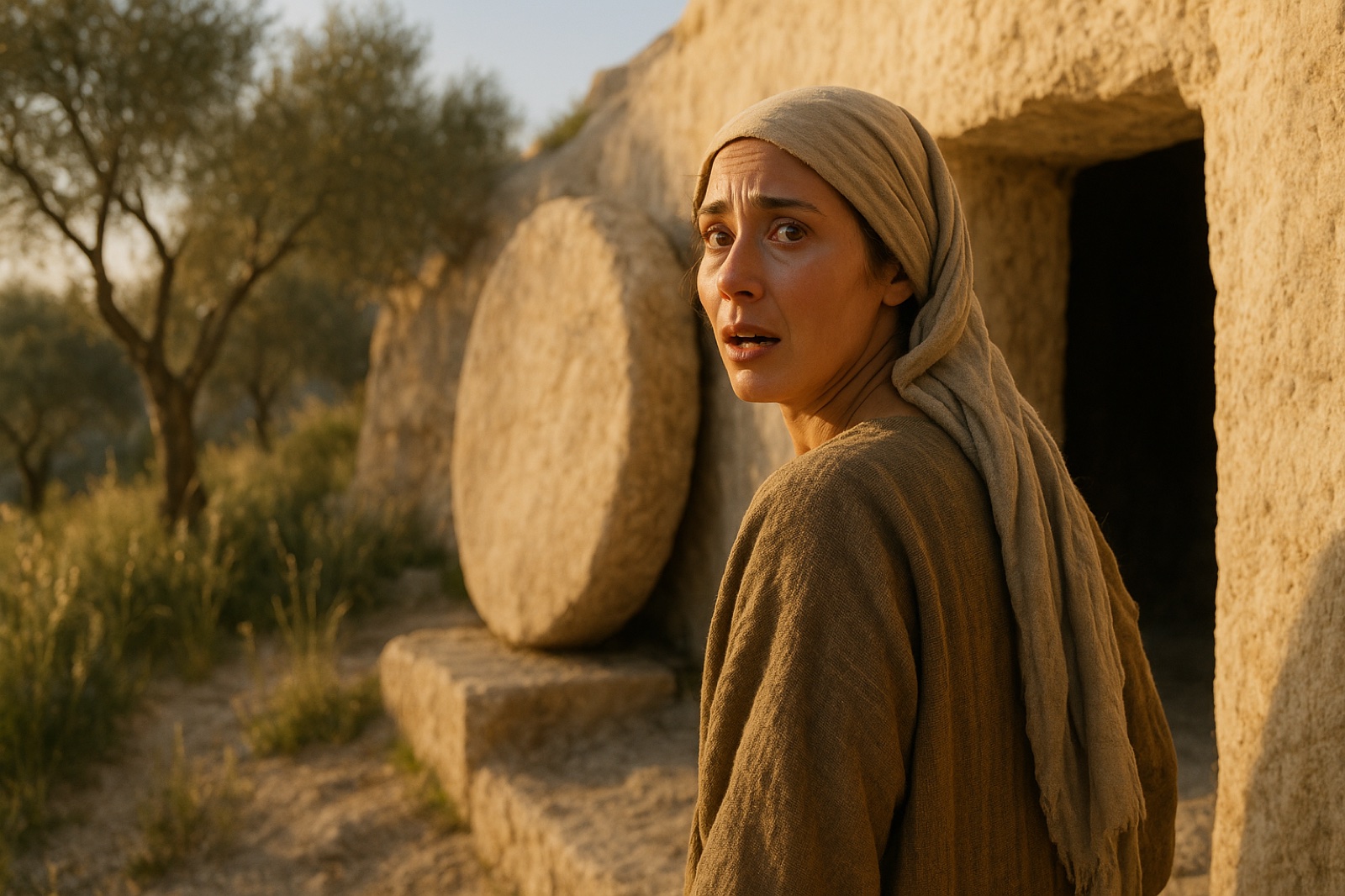
Now read the scene the Gospels give us instead. It is early morning. The tomb is open and empty. Mary is standing outside it, crying, because she does not know where the body has gone. Someone asks her why she is weeping. She thinks he is the gardener.
Then this:
“Jesus saith unto her, Mary. She turned herself, and saith unto him, Rabboni; which is to say, Master.” (John 20:16, KJV)
She did not recognize Jesus by his face. She recognized him when he said her name.
Not “the woman with seven devils.” Not “the sinner.” Not any of the things people would later decide she was. Just Mary. Her own name was the word that opened her eyes.
And he did not leave her standing there. He gave her an errand: “go to my brethren, and say unto them, I ascend unto my Father, and your Father; and to my God, and your God” (John 20:17). John records what she did next in one line: “Mary Magdalene came and told the disciples that she had seen the Lord, and that he had spoken these things unto her” (John 20:18).
The first person sent to say “he is alive” was a woman the world would spend centuries misnaming. And when she and the other women told the apostles, Luke admits it honestly: “their words seemed to them as idle tales, and they believed them not” (Luke 24:11). She was doubted even then. She told them anyway.
Here is what is easy to miss. The Bible does not hide Mary’s past. It mentions the seven devils, but only as something that went out of her. Her past is in the record as the thing she was freed from. It is never the thing she is called. God sets people free, and the Gospels describe this freed woman by what came next: who she followed, what she gave, where she stood, and what she was sent to say.
The Gospels never gave her a label. They gave her a name, and an errand.
It is the same pattern with other people history has nicknamed. Thomas got stuck with “doubting,” yet the Bible never calls him that either, and the same Gospel shows him ready to die with Jesus. Labels are easy to repeat. The record usually says something kinder, and truer.
What This Means for the Label You Carry
Most of us have a word like that. Sometimes other people gave it to us. Sometimes we wrote it ourselves, late at night, and kept repeating it. Failure. Too much. Damaged. The one who ruined it.
Mary Magdalene’s story says two things to that word. First, what happened to you can be real and still not be your name. Her seven devils were real, and Jesus did not pretend otherwise. But he called her Mary. Second, the people who repeat a label the longest are often the ones who know the least. The Gospel writers, centuries closer to her, wrote her down as faithful. The label arrived later, from far away.
If your label has grown into something heavier, and you have started to wonder whether hating yourself is just the honest response, it is worth reading what Scripture quietly assumes about you instead.
Actions to Take Today
- Hear your name in the garden (2 minutes). Read John 20:11-18 out loud. When you reach verse 16, say your own name where it says “Mary.” Notice how it feels to be addressed by name instead of by a description.
- Write the record next to the label (5 minutes). On paper or in your phone, write the one word people (or you) use about you. Next to it, write one true sentence about what you were brought through, or what you did next. Luke did that for Mary: seven devils, then a whole life of following. Keep that second sentence somewhere you will see it tomorrow.
- Take a label off someone else (5 minutes). Think of one person you have quietly filed under a single word. Send them a short message that uses their name and mentions one good thing you have actually seen them do. It costs nothing, and it may be the first time in years anyone has done it.
Journaling Prompts
- What is one word you have allowed to stand in for your whole story? Where did you first hear it, and whose voice do you hear it in now?
- If Jesus said your name the way he said Mary’s, not your worst moment, just your name, what would you most want to turn around and see?
- Mary was sent to tell people who did not believe her. Is there something true you know about God that you have stopped saying because you expect to be doubted?
A Prayer
Jesus, you know the word I have been carrying, and who first handed it to me, and I have repeated it so long it feels like my name. Say my real name to me today, the way you said Mary’s in the garden. Show me what you have already set me free from, and give me something true to go and tell. I want to be known by what you did in me, not by the worst guess anyone ever made about me. Amen.
Let’s Talk About It
Why do you think the prostitute story was so much easier for people to remember than the real one, a woman who funded Jesus, stood at the cross, and was the first to see him alive? Tell us what you think in the comments below.
Want the whole story in one place? Matthew is the Gospel that names her at the cross, at the grave and at sunrise. Get the complete Book of Matthew free: an immersive PDF plus a 28-chapter audiobook you can listen to on a walk or while you cook.
Share This
- “I grew up thinking Mary Magdalene was a prostitute. The Bible never says that. It says she was healed, she funded Jesus, and she was the first person he sent to say he’s alive.”
- “She didn’t recognize Jesus by his face. She recognized him when he said her name. John 20:16.”
- “Whatever label someone gave you, it isn’t your name. Jesus called her Mary.”
Questions People Ask About Mary Magdalene
Have a question of your own about someone in the Bible? You can explore it with our free Bible Answers AI assistant, which opens in ChatGPT.
Who was Mary Magdalene?
Mary Magdalene was a follower of Jesus from Galilee. Luke 8:2-3 says Jesus freed her from seven devils and that she was one of several women who supported Jesus and the twelve disciples out of their own means. The Gospels place her at the crucifixion, at the burial and at the empty tomb, and they record her as the first person to see Jesus after the resurrection and the first sent to tell the disciples (John 20:11-18).
Was Mary Magdalene a prostitute?
The Bible never calls Mary Magdalene a prostitute. The idea traces to a sermon Pope Gregory I preached in Rome in 591, which merged Mary Magdalene with Mary of Bethany and the unnamed “sinner” of Luke 7. Luke 7 never names that woman or her sin, and the Bible never says she was Mary Magdalene. The Catholic Church separated the three women again in its 1969 calendar revision, and the Eastern churches never merged them.
What were Mary Magdalene’s seven devils?
Luke 8:2 and Mark 16:9 say seven devils were cast out of Mary Magdalene, but neither passage says what they were. In the Gospels, evil spirits are connected with suffering and affliction rather than with a particular moral sin. Some interpreters, such as the historian Adriana Valerio, read the number seven as a sign of how serious her condition was. Linking the seven devils to sexual sin came much later, from Pope Gregory I’s sermon of 591.
Why is Mary Magdalene called the apostle of the apostles?
Mary Magdalene is called the “apostle of the apostles” because, in John 20:17-18, the risen Jesus sent her to tell his disciples that he was alive, making her the first messenger of the resurrection to the apostles themselves. Medieval writers including Rabanus Maurus and Thomas Aquinas used the title, and in 2016 the Catholic Church raised her memorial to a feast with a preface titled “apostle of the apostles.”
Why is she called Magdalene?
“Magdalene” is generally understood to mean “from Magdala,” a town on the western shore of the Sea of Galilee. The name identified her by her hometown, which helped tell her apart from the several other women named Mary in the Gospels. It is a place-name, not a description of her character.