 0
0
 0
0
You’ve probably seen the scene a dozen times, in a dozen movies. Pontius Pilate stands on a stone platform, a basin of water in his hands, and washes them in front of a crowd. It’s such a familiar image that it almost stops feeling like history and starts feeling like a symbol — a character invented to give the Gospel writers a villain, someone to blame so Rome could look complicit without a name behind it. If you’ve ever quietly wondered whether Pilate was a real person or a convenient literary device, you’re not alone. For most of history, nobody outside the Bible could prove it either way.
Then, in the summer of 1961, an Italian archaeology team clearing rubble from a Roman theater on Israel’s coast turned over a piece of broken limestone — and the question of whether Pilate really existed, holding the exact job the Gospels say he held, was settled for good.
Who Was Pontius Pilate, Really?
Here’s what we actually know from ancient sources, before the discovery changed anything: Pontius Pilate governed the Roman province of Judea from roughly AD 26 to 36 — the exact window that includes Jesus’s trial and crucifixion. Outside the New Testament, only two ancient writers mention him by name: the Jewish historian Josephus, writing decades later, and the Roman historian Tacitus, writing almost a full century after Pilate’s term ended. Neither of them was standing there. Neither left behind so much as a coin or a building stone with Pilate’s own name carved into it.
That gap mattered more than it might sound. Rome kept meticulous records of its provincial officials — inscriptions, dedications, milestones. For a man who held real power over life and death in Judea, holding the authority to approve or deny an execution, there was, for nearly two thousand years, not one surviving piece of hard evidence from his own lifetime. Just later accounts, written by people who never met him.
The Man With No Paper Trail
That silence gave skeptics real room to work with. Some 20th-century scholars pointed out that Tacitus referred to Pilate using the title “procurator,” while the Gospel of Luke’s language implies the more specific Roman office of “prefect” — a real, documented difference in rank and authority during that period of Roman administration. Without an inscription from Pilate’s own era to settle it, there was a legitimate, unresolved question: did the Gospel writers actually understand the Roman chain of command in Judea, or were they working from secondhand assumptions, decades after the fact?
It’s a fair question. Most of us have never fact-checked a Roman bureaucratic title from two thousand years ago, and there was no way, in 1960, to fact-check this one either. Pilate remained a name in a story — important, but frustratingly undocumented outside of it. He wasn’t the only figure from Jesus’s trials stuck in that gap, either — even the physical room where the apostle Paul later stood trial sat unidentified for centuries before archaeologists finally confirmed it.
What Archaeologists Found at Caesarea in 1961
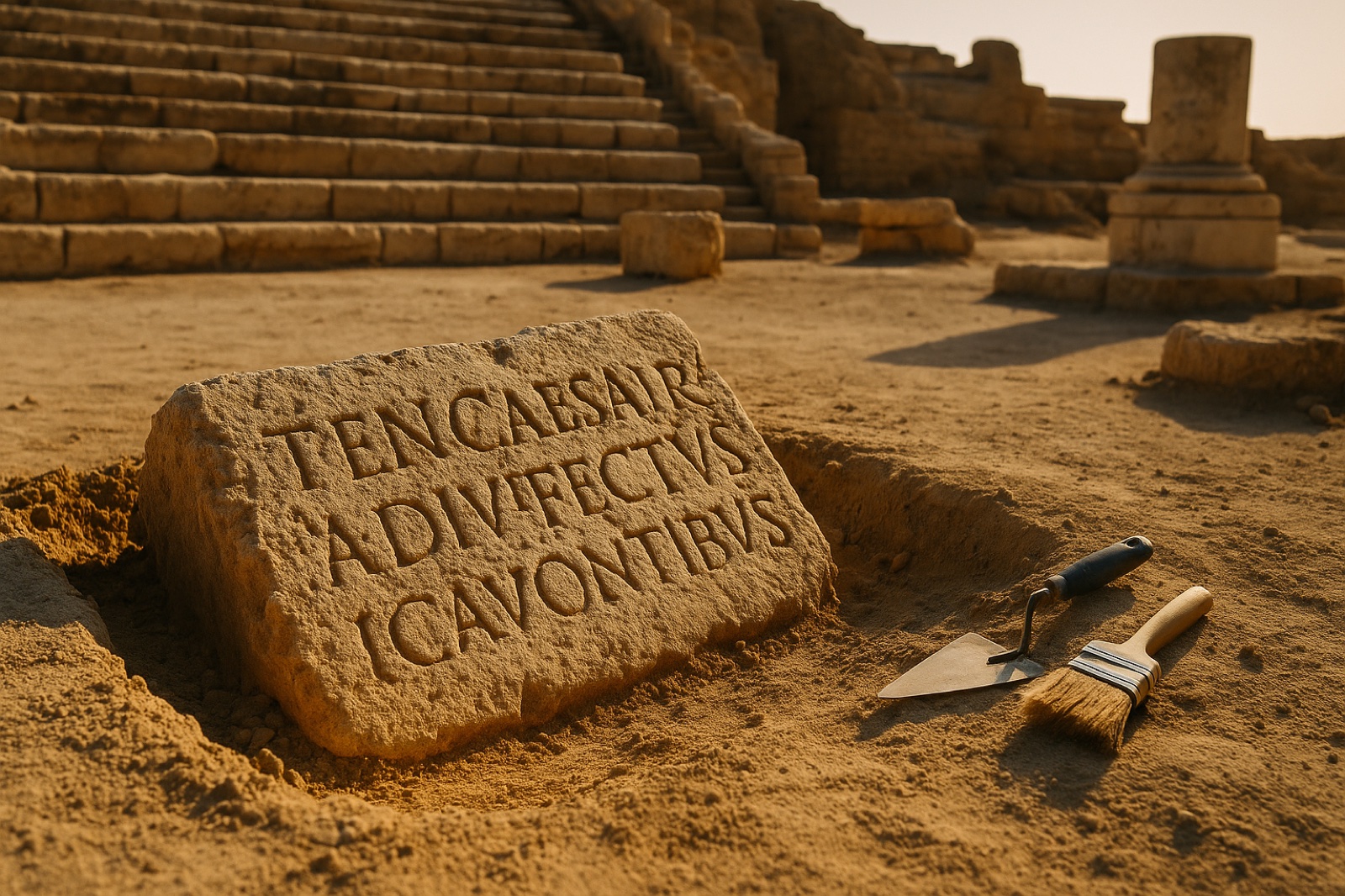
In June 1961, an Italian archaeological team led by Antonio Frova was excavating the ruins of a Roman-era theater in Caesarea Maritima — the coastal city Herod the Great built as Judea’s Roman administrative capital, and the same city where Roman governors, including Pilate, actually lived and worked (Jerusalem was where he traveled for major feasts and flashpoints, not his home base). Buried in the theater’s foundation, reused generations earlier as ordinary building material, was a broken limestone slab with a partial Latin inscription still visible on its face.
Whoever had repurposed that stone for construction had no idea what they were sitting on. It had been hiding in plain sight, holding up a staircase, for the better part of two thousand years.
The Pilate Stone’s Inscription — and Why the Wording Mattered
The surviving Latin, though damaged and partial, names a building called a “Tiberieum” — almost certainly a structure honoring the emperor Tiberius — and credits its dedication to a man identified by two words that ended the scholarly debate in a single strike: Pontius Pilatus, holding the title praefectus Iudaeae. Prefect of Judea.
Not procurator. Prefect — the exact, specific Roman military-administrative title, matching precisely the kind of authority structure implied by the Gospel accounts. This one stone, carved during Pilate’s own lifetime by people with zero interest in defending Scripture, resolved a genuine academic dispute and confirmed the writers of the Gospels had the Roman chain of command exactly right. Today, the Pilate Stone is displayed at the Israel Museum in Jerusalem, with a replica standing at the theater in Caesarea where it was found.
The Turn: A Villain Named in God’s Own Plan
Here’s where this stops being just a satisfying fact and starts being something else. Roughly two decades after the crucifixion, Peter and John were released from custody in Jerusalem after being arrested for preaching about Jesus. Scripture records the prayer the early church prayed together right after — and it names Pilate specifically, not as a symbol, but as a real participant in a plan that was never out of God’s hands:
“For of a truth against thy holy child Jesus, whom thou hast anointed, both Herod, and Pontius Pilate, with the Gentiles, and the people of Israel, were gathered together, to do whatsoever thy hand and thy counsel determined before to be done.” — Acts 4:27–28 (KJV)
Read that again next to a broken piece of limestone that spent nineteen centuries holding up a staircase: the earliest Christians weren’t describing a plot device. They were naming an actual Roman official, by his actual title, as someone whose choices — however wrong, however costly to Jesus — God’s sovereignty had already accounted for. Pilate didn’t need to be erased from history for God’s plan to hold together. He needed to be exactly who he was: a real governor, with a real signature of authority, making a real decision that history would end up documenting on its own terms, a hundred years before anyone thought to look for it.
That’s the part that should stop you. The evidence trail that could have let Pilate fade into legend instead made him one of the better-documented minor Roman officials from the entire province — specifically because of his one collision with Jesus. God’s sovereignty didn’t erase the villain of the story. It just made sure history couldn’t erase him either. It’s the same pattern you’ll find in the stone that confirmed King David was a real historical king — evidence showing up in ordinary dirt, dug up by people with no interest in defending Scripture, and handing back the same names the Bible already gave.
What This Means for the Doubts You’re Not Saying Out Loud
You probably don’t lose sleep over Pontius Pilate’s job title. But you’ve likely carried some version of the same quiet question: is this actually history, or is it a story that’s been dressed up to sound like it? Maybe it’s a miracle account that feels too clean. Maybe it’s just a low hum of “what if none of this can actually be checked” that you’ve never said to anyone.
The Pilate Stone doesn’t answer every one of those questions — no single artifact does. But it does show you something worth sitting with: the people who wrote the Gospels weren’t inventing convenient details from a comfortable distance. They got a Roman bureaucratic title right, decades before anyone had a way to check it, in a way that only makes sense if they were working from real memory, not creative license. Doubt isn’t the enemy of faith here. It’s what sent an Italian team digging through a Roman theater in the first place — and the evidence showed up anyway. You can explore this same kind of question anytime with our free Bible Answers AI assistant, built for exactly the “does this actually hold up” questions you don’t always say out loud.
3 Things You Can Do Right Now
- Read the actual prayer. Open Acts 4:23–31 tonight. It takes about five minutes, and it’s the early church naming Pilate by title in the same breath as trusting God’s plan through him.
- Fact-check one claim instead of avoiding it. Next time you hear “there’s no evidence for that in the Bible,” spend ten honest minutes actually researching it — in either direction — instead of letting it sit unexamined.
- Name your own “buried stone.” Think of one moment God’s timing or provision showed up in a way you didn’t orchestrate. Write it down somewhere you’ll actually see it again.
A Prayer for When the Story Feels Too Good to Be True
God, some days I wonder if I’m believing something that only sounds true because I want it to be. I don’t always say that out loud, but You already know it. Thank You for leaving evidence in the most unlikely places — even the man who sentenced Jesus to die turned out to be exactly who Scripture said he was. Help me trust the details I can’t personally dig up and hold in my hands. Give me the courage to keep asking honest questions instead of quietly walking away from the hard ones. And when my own life feels chaotic and out of control, remind me that Your hand and Your counsel are still writing the story, the same way they were the day Pilate signed off on Yours. Amen.
Something to Think About
If a Roman prefect’s own forgotten dedication stone ended up confirming a small detail from Scripture two thousand years later, does that change how you think about the parts of the Bible that can’t be dug up and verified? Share your take in the comments below.
Share This
- “The man who sentenced Jesus to death has better archaeological proof of his exact job title than most Roman officials from that era. History has a strange sense of irony. #PilateStone”
- “Found by accident in 1961, reused as a staircase for centuries: a stone naming Pontius Pilate by his real Roman title. The ‘villain’ turned out to be one of the best-documented people in the whole story.”
- “I used to think Pontius Pilate basically only existed inside the Easter story. Turns out there’s a 2,000-year-old stone with his name and his actual job title carved into it.”
Questions People Ask
What is the Pilate Stone?
The Pilate Stone is a limestone dedication slab discovered in 1961 by an Italian archaeological team excavating a Roman theater in Caesarea Maritima, Israel. Its partial Latin inscription names Pontius Pilate and identifies him by the title “Prefect of Judea,” making it the only known inscription referring to Pilate from his own lifetime.
Why was the discovery of the Pilate Stone significant?
Before 1961, Pontius Pilate was known only from the Gospels, the historian Josephus, and the historian Tacitus — none of them a contemporary, on-site record. The stone confirmed Pilate’s existence with a physical artifact from his own era and settled a real scholarly debate over his exact Roman title, “Prefect,” rather than the later term “procurator” used by some ancient writers.
Who found the Pilate Stone?
An Italian archaeological team led by Antonio Frova discovered it in June 1961 while excavating the ruins of a Roman-era theater in Caesarea Maritima, the coastal city that served as the Roman administrative capital of Judea during Pilate’s governorship.
What does the inscription on the Pilate Stone actually say?
The surviving Latin text is partial and damaged, but it references a building called a “Tiberieum” — likely a structure honoring the emperor Tiberius — and credits Pontius Pilate, Prefect of Judea, with dedicating it.
Where is the Pilate Stone today?
The original is held at the Israel Museum in Jerusalem, with a replica displayed at the excavation site in Caesarea where it was discovered.