 0
0
 0
0
Step into an empty stairwell and say something out loud. Anything. Your voice comes back a little bigger than you sent it.
Most of us have done this without ever thinking about it — in a car park, in a tunnel under a road, in a tiled bathroom, in a hall after everyone has gone home. You make a sound, the room hands it back, and for a second you sound like more than one person.
Researchers who study ancient acoustics have spent decades measuring exactly what rooms do to a human voice — including rooms nobody has been able to stand inside for thousands of years. What they have actually found is quieter, stranger and far more careful than the version of this story that usually gets repeated.
What Ancient Acoustics Research Actually Measures
The method is simpler than you would expect. A team walks into a space and makes one short, very sharp, very loud sound. A popped balloon works, and it is genuinely what gets used. Then they record what the room does to it.
That recording is called an impulse response, and it works like the room’s fingerprint. It captures how long a sound hangs in the air, which pitches the walls swallow and which ones they hand back, and from which directions the reflections arrive.
Once you have that fingerprint, you can take any other sound — a drum, a flute, a person singing into a microphone on the other side of the world — and mathematically stamp the room onto it. The result is called an auralisation: what that sound would have been like, heard standing in that place.
This is why the work matters. A ruin can be photographed, measured, mapped and dated. Until recently, the one thing a ruin could not do was be heard.
The Stone Corridors That Carry Only One Kind of Sound
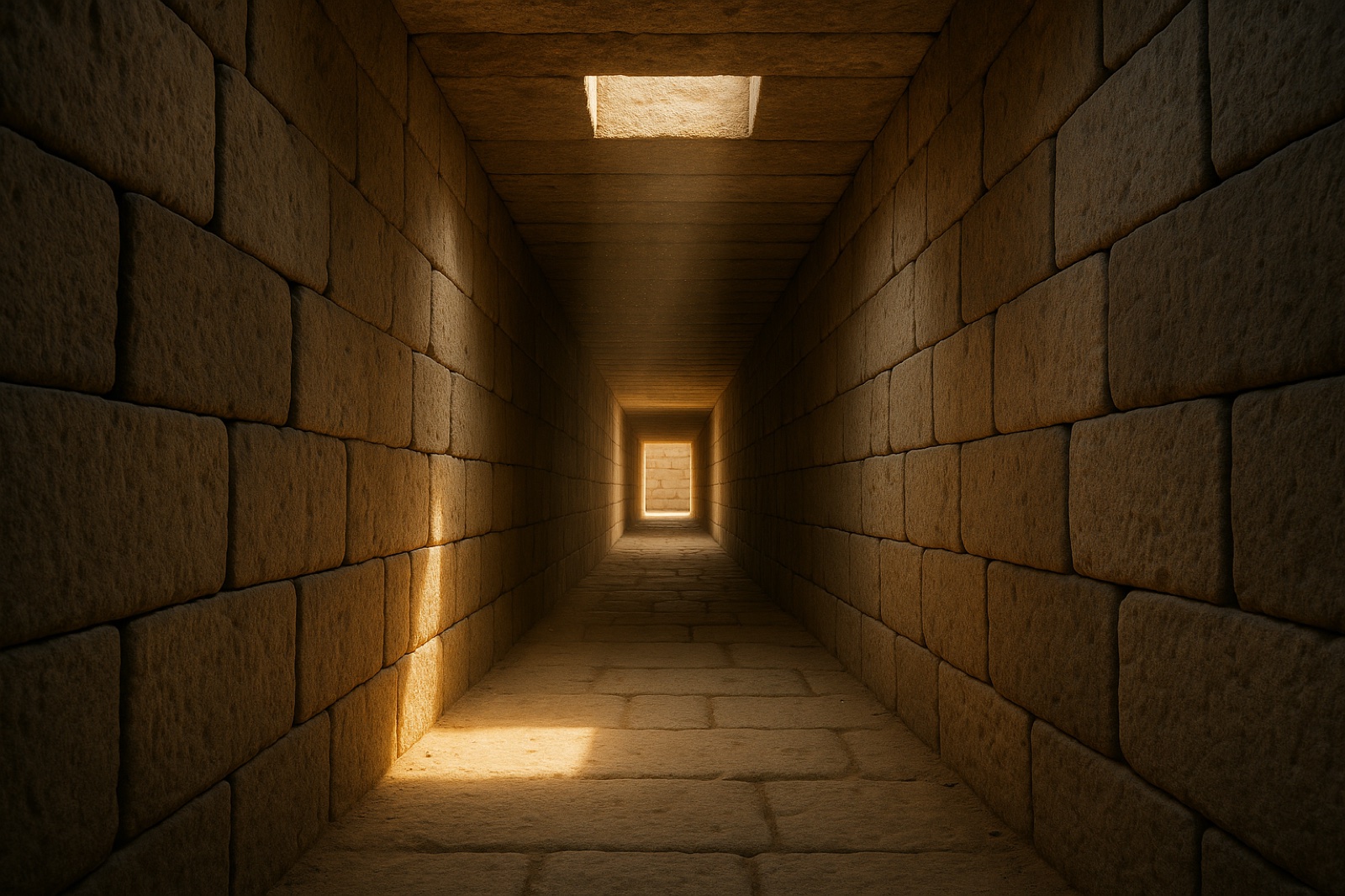
Chavín de Huántar sits high in the north-central Andes of Peru. It is roughly three thousand years old — it pre-dates Inca society by more than two thousand years — and beneath its stone platforms runs a warren of narrow, remarkably well-preserved interior passages that archaeologists call galleries.
Stanford’s Center for Computer Research in Music and Acoustics has been measuring those galleries since 2007, in a project led by the acoustician and archaeologist Miriam Kolar. The headline finding is not the one most people would guess.
The passages do not simply make everything louder. One long central corridor grows narrower as it runs, and that narrowing turns it into what engineers call a waveguide — a channel that carries sound much further than it would otherwise travel, but only sound of certain pitches. Other sounds die in the stone.
So the corridor is not an amplifier. It is a filter.
And the pitches it favours line up with the instrument found at the site: the pututu, a trumpet made from a large marine conch shell. Which carries its own small oddity — these are sea snails, hauled up into the mountains, hundreds of kilometres from any coast.
Kolar’s team measured those shells and reported that they sound in a range of roughly 272 to 340 hertz, a few notes climbing up from around middle C on a piano. Play one deep inside the temple, and the sound arrives somewhere else entirely — out of a doorway, out of a wall, out of no visible person at all.
The Detail That Is Easy To Read Past
Here is the part that is more interesting than anything the popular version of this story usually reaches for.
When people play pututus inside those spaces, the instrument stops behaving. The architecture’s own resonances reach into the shell and pull its tone into agreement with the room. Kolar has described the effect as a kind of phantom guide — something outside the player that seems to take hold of how the instrument is being played. Play two shells together and the near-matching pitches beat against one another, producing a slow wobble in the sound that neither player put there.
Sit with what that means for the person holding the shell. You are not performing into a room. The room is performing back, through you, and changing what you meant to do.
Sound does that to people more often than we notice, and usually without our permission — it is the same puzzle underneath the strange fact that sad music makes most listeners feel better, not worse.
A Cave Nobody Can Enter, Rebuilt In A Computer
Chauvet Cave in southern France holds some of the oldest known paintings on earth — lions, rhinoceroses, horses — made roughly thirty-six thousand years ago. It is also effectively sealed. Human breath and body heat damage the surfaces, so almost nobody is permitted inside.
Since 2022, an interdisciplinary team including researchers from Stanford’s CCRMA has been carrying measuring equipment into it to record the acoustic fingerprint of the cave chamber by chamber. Luna Valentin, a doctoral researcher there, built the system that ties each acoustic measurement to its exact position underground, and worked on a virtual reconstruction that lets people hear drums and flutes ringing through galleries they will never be allowed to walk.
Thirty-six thousand years is a number the mind slides off. If you enjoy getting a real feel for that kind of scale, we built a free How Old Is the Universe explorer that lays the big numbers out in a way you can actually picture.
What matters here is what is being claimed, and what is not. Nobody involved is claiming to know what happened in that cave. What exists is a set of measurements and a model built honestly on top of them. That distinction is about to do a lot of work.
Where The Echoes Are, The Paintings Are Too
In the 1980s a French scholar named Iégor Reznikoff began walking through painted caves making sounds and listening carefully. He mapped where the resonance was strongest, then compared that map against where the paintings were.
He reported a strong correlation: the more resonant a location, the more likely it was to carry images, and the denser those images tended to be. In spots too narrow or awkward to paint, he found simple red marks instead — placed, he argued, at exactly the resonant points. The pattern has been reported across caves in France and in the Ural mountains.
It is a genuinely striking result. It is also a correlation, and correlation is precisely where careful research and confident storytelling part company.
The One Thing No Measurement Can Reach
There is a large and enthusiastic popular literature claiming that ancient sites were deliberately tuned to particular frequencies in order to induce altered states of mind. It makes a wonderful story. It is not what the measurements show.
Writers who have examined these claims closely have been blunt about the gap. Reviewing an acoustic theory of Stonehenge, the science journalist Nadia Drake asked the questions the exciting version tends to skip: “Where’s the hypothesis testing? Where’s the control experiment?” Getting from an interesting acoustic effect to a claim about why a monument was built, she wrote, “requires several leaps of unsubstantiated logic.”
That is the honest boundary, and it is worth stating plainly. That these spaces do remarkable things to sound is measurable, repeatable and not in dispute. That they were built in order to do it is inference — sometimes reasonable, sometimes not.
Notice who is most careful about this: the researchers doing the actual measuring. Kolar tends to pose the question rather than answer it — might this be experienced as an outside force, and how would a person standing there have understood it? Those are questions, deliberately left open.
An honest “nobody knows why” is a stronger position than a satisfying answer that nobody can check.
What Survives All The Caution
Strip out everything unprovable and something remains that is arguably better than the myth.
Across places with no contact with each other, separated by continents and by tens of thousands of years — a mountain temple in Peru, a painted cave in France — people kept ending up in spaces where a voice does not simply stop. It comes back changed, and larger, and not entirely under the control of the person who made it.
We cannot prove they went looking for that. But we know they were there, in the dark, making sound in exactly the places where sound answers hardest.
And there is something very familiar in that. The oldest human instinct may not be the wish to be heard by other people. It may be the suspicion that we are not talking into an empty room — that if you call into the dark, something larger might answer. People have been doing that for a very long time, long before anyone wrote a single argument for or against it, and the spaces they left behind are shaped like that hope. If that question has ever nagged at you, the oldest written account of someone hearing a voice and not knowing whether it was God handles it with more honesty than you might expect.
Try It Yourself Tonight
You do not need a temple, a cave, or any equipment. This costs nothing and works anywhere:
- Find a hard, empty, echoing space. A stairwell, an underpass, an empty car park, a tiled bathroom with the door shut.
- Clap once, sharply. Then listen to what comes after the clap rather than to the clap itself. How long does it take to fade? Does it come back bright and crisp, or dull and swallowed?
- Now hum, and slide slowly from a low note up to a high one. Somewhere in that slide, one note will suddenly sound much louder than the others without you pushing any harder. That is the room’s resonance — and you have just done, by ear, the crude version of what the equipment does.
- Repeat in three different rooms. After that you will never quite hear a building the same way again.
The next time your voice comes back at you in an empty stairwell, you will know the room is doing something specific, physical and measurable. You will also know that people stood in rooms like that, listening to the very same thing, tens of thousands of years before anyone had a word for any of it. Whatever they were doing there, you are still doing it.
What Do You Think?
When a building does something remarkable to sound, is it fair to assume the builders meant it to — or should we hold off until there is real evidence either way? There are good arguments on both sides. Tell us where you land in the comments.
Share This
- Ancient stone corridors in Peru don’t amplify sound — they filter it. They carry one instrument’s pitch and let everything else die in the wall. Nobody can prove it was on purpose, and that’s somehow the best part. https://bgodinspired.com/index.php/entertainment/music/ancient-acoustics-rooms-that-change-a-human-voice/
- Researchers measured a 3,000-year-old temple and found the architecture pulls a musician’s instrument into tune with the room. The player isn’t performing into the space. The space is performing back, through them. https://bgodinspired.com/index.php/entertainment/music/ancient-acoustics-rooms-that-change-a-human-voice/
- Chauvet Cave has been sealed for decades because human breath ruins the paintings. A team has now measured its acoustics well enough that you can hear a flute in a gallery you will never be allowed to enter: https://bgodinspired.com/index.php/entertainment/music/ancient-acoustics-rooms-that-change-a-human-voice/
Questions People Ask
What is archaeoacoustics?
Archaeoacoustics is the study of how sound behaved in ancient spaces — temples, caves, tombs and ruins — using acoustic measurement rather than guesswork. Researchers record a space’s impulse response, usually by making one short, loud sound and capturing how the space responds, then use that data to model how music or a human voice would have sounded there. The field sits between archaeology, acoustics and music research.
Was Chavín de Huántar built for sound?
Chavín de Huántar, a roughly 3,000-year-old ceremonial centre in the Peruvian Andes, has interior stone passages that measurably act as waveguides, carrying certain pitches far further than others. Research led by Miriam Kolar at Stanford’s Center for Computer Research in Music and Acoustics established that the favoured pitch range matches the conch-shell trumpets, or pututus, found at the site. Whether the builders intended that effect has not been demonstrated, and the researchers themselves are careful not to claim it.
What did researchers find in Chauvet Cave?
Chauvet Cave in southern France, home to paintings roughly 36,000 years old, is closed to almost all visitors because breath and body heat damage the surfaces. Since 2022 an interdisciplinary team including Stanford CCRMA researchers has taken acoustic measurements of its chambers and linked each measurement to its precise underground location. The result is a virtual acoustic reconstruction that recreates how instruments such as drums and flutes would have sounded inside galleries that people can no longer enter.
Were ancient sites tuned to specific frequencies?
A popular claim holds that ancient chambers were deliberately tuned to particular frequencies to induce altered states of consciousness. Acoustic measurements do not support this. Measurements can show what a space does to sound; they cannot show why the space was built that way. Science writers reviewing acoustic theories of sites such as Stonehenge have criticised them for missing hypothesis testing and control experiments, and the most rigorous researchers in the field consistently treat the question of intent as unresolved.
How do researchers measure the acoustics of a ruin?
Researchers make one short, sharp, loud sound in the space — a popped balloon is a common and genuinely used source — and record how the space responds. That recording, called an impulse response, captures reverberation time, which frequencies are absorbed or reflected, and the direction reflections arrive from. Any other recorded sound can then be mathematically combined with that impulse response to produce an auralisation: a realistic simulation of how that sound would have been heard in that place.
Can you experience this effect without special equipment?
Yes. Stand in any hard-surfaced empty space such as a stairwell, underpass or tiled room, clap once, and listen to how long the sound takes to fade. Then hum slowly from a low note up to a high one. At one particular pitch the sound will suddenly grow much louder without extra effort, because that pitch matches a resonance of the room. This is an unaided version of what acoustic researchers measure with instruments.