 0
0
 0
0
Freddie Mercury’s 80th birthday fell on 5 September 2026. He was not there for it. He died in 1991, at forty-five.
The world threw the party anyway. It was not a small one.
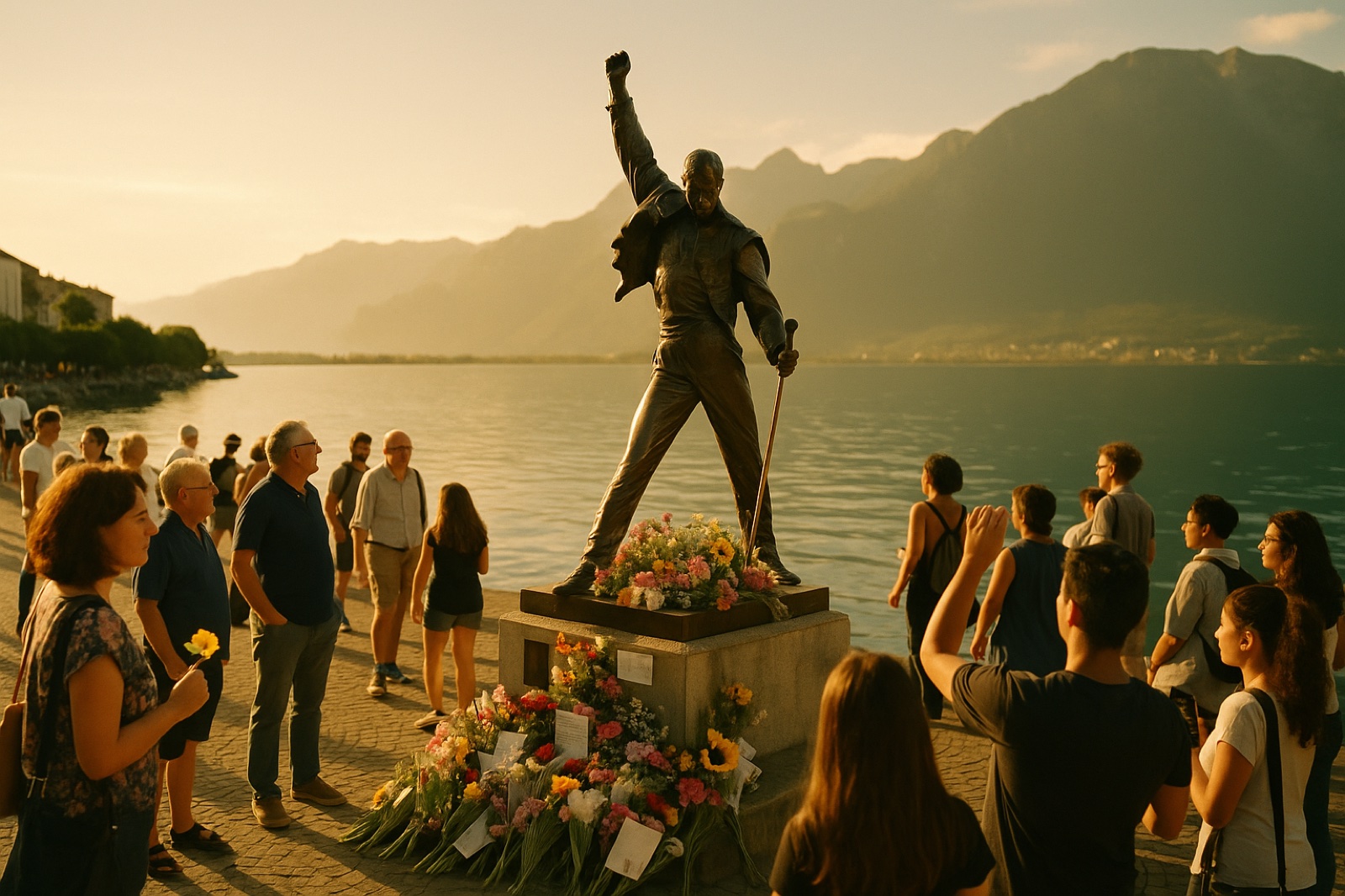
In Montreux, a quiet Swiss town on the edge of Lake Geneva, thousands of people gathered at the bronze statue of him that looks out over the water. In London, a 30ft (roughly nine-metre) portrait of him appeared across a public staircase. A museum announced it was opening its stores. A casino ballroom sold out.
And underneath all of it sits a sentence he said in 1985 that almost nobody quotes on a birthday.
Inside the Freddie Mercury 80th Birthday Tributes
The scale is worth laying out, because the scale turns out to be the point.
Montreux ran a free festival called Freddie Days from 2 to 6 September, along the lakefront, centred on the statue. On the day itself, fans filled the promenade.
That evening, the official birthday party was held at the Casino Barriere in the same town. It was called The Great Pretender’s Gala. The dress code was “Fancy and Formal” — tuxedos, cravats, waistcoats, the occasional monocle. It sold out. The money raised goes to the Mercury Phoenix Trust, the charity set up in his name to fight HIV and AIDS.
In London, the street artist Frank Styles painted a piece called I’m Mr. Mercury across all 58 of the Spanish Steps at Wembley Park, between Wembley Stadium and the OVO Arena. It is anamorphic, which means it is only a portrait from one spot: a yellow circle marked on the ground opposite. Stand anywhere else and it is 58 stripes of colour. It is free, visible at any hour, and stays up until December 2026. Its title comes from a line in his 1985 solo song “Mr Bad Guy.”
And from 24 October to 17 January, the Victoria and Albert Museum in London is running a free trail called Freddie Mercury: Splendid Things — eight of his stage outfits, including the catsuit from the “Bohemian Rhapsody” video and the crown and cloak he wore for his last performance with Queen, at Knebworth in 1986.
A statue. A gala. A staircase. A museum. That much attention, in that many places, for a man who has been gone thirty-five years.
Most of us will never be adored like that. But almost everyone knows the smaller version of the feeling underneath this story — being surrounded and still not quite reached. If that is a familiar one, this free video guide and PDF is about finding God in ordinary days rather than big moments. It costs nothing.
The Sentence He Said in 1985
In 1985 — the same year Queen played Live Aid in front of a stadium and a global television audience — Mercury told the British journalist David Wigg this:
“You can have everything in the world and still be the loneliest man. And that is the most bitter type of loneliness, success has brought me world idolisation and millions of pounds. But it’s prevented me from having the one thing we all need: A loving, ongoing relationship.”
Read it slowly, because he is not really complaining about fame. He is doing arithmetic. He is saying one column got very large, the other column stayed empty, and the large column did not fill the empty one.
He also names the loneliness precisely. Not just lonely. “The most bitter type.” The kind that has an audience.
The Gala Was Named After a Song He Did Not Write
Here is the detail that is easy to walk straight past.
The 80th birthday party was called The Great Pretender’s Gala. That name comes from Mercury’s 1987 solo single “The Great Pretender,” which reached number four in the UK.
He did not write it. It is a cover. “The Great Pretender” was a hit for The Platters in 1955, written by their manager, Buck Ram. It is a song about someone who is doing fine in public and is not fine at all — laughing, playing the part, alone.
So the song most often used to describe Freddie Mercury’s inner life is a borrowed one. He reached for someone else’s words, written three decades earlier by a man he never sang with, to say the truest thing about himself. And nearly forty years later, the people who loved him chose that same borrowed title for his birthday.
That is a strange chain. It is also very ordinary. Most people, when they finally admit the gap between how they seem and how they feel, borrow a line to do it — a lyric, a film quote, a caption on a photo. Saying it plainly, in your own words, to an actual face, is much harder. It is part of why sad songs make people feel better — someone else already found the words, and you get to stand behind them.
If you enjoy pulling a song apart like this, our free Music & Faith assistant will do it with any song you name. It opens in ChatGPT.
He Chose the Quietest Place He Could Find
Queen bought Mountain Studios in Montreux in 1978, and over the years Mercury spent more and more of his time in the town. It is not a rock-star town. It is small, mountain-backed and slow.
The reason people who knew him give is simple: nobody there made a fuss. He could walk about. He is widely quoted as saying, “If you want peace of mind, come to Montreux.”
There is a wrinkle in that story worth keeping. By several accounts he did not like the place at first. It was too quiet. The exact thing he later valued was the thing that initially put him off.
That is not a contradiction, it is a timeline. The quiet you cannot sit still in at twenty-five is often the quiet you go looking for later, once you have found out what the noise is actually worth.
It also means the largest birthday party thrown for anyone this year happened, mostly, in the town he went to in order not to be looked at.
The Part That Complicates His Own Quote
The V&A trail was not assembled by curators alone. The museum says it was made with Mary Austin — his former fiancee, and, in the museum’s own words, a close friend of twenty years.
Hold that next to the 1985 sentence. He said fame had prevented him from having a loving, ongoing relationship. And yet the person trusted with his stage clothes, thirty-five years after his death, is someone who was in his life for two decades.
It would be easy — and wrong — to say he was simply mistaken. Nobody gets to correct a person about their own loneliness from the outside.
But the gap is worth looking at. What he had was quiet, ordinary, unglamorous and long. What he was measuring it against was enormous, loud and constant. When one side of the scale is a stadium, it is very hard to feel the weight of the other side, even when the other side is genuinely there.
That is not a Freddie Mercury problem. That is a scale problem, and it is everywhere. Most people who feel unloved are not actually unloved. They are weighing a quiet, real thing against a loud, imagined one, and the quiet thing keeps losing a contest it never entered. The same trick works in far less glamorous rooms — it is a large part of why people feel invisible at work while sitting in a room full of colleagues.
Being Adored and Being Known Are Not the Same Thing
There is a difference between being adored and being known, and it is not a small one.
Adoration is about the part of you that faces out. It can be enormous and still be thin. Being known is about the part that faces in — the ordinary, unimpressive, uncurated part — and it usually happens with one or two people, quietly, over years. You cannot scale it. That is not a flaw in it.
The oldest wisdom humans have kept says something strange about this. It says the deepest need a person has is not applause but to be fully known, and that there is a God who already knows the whole of a person — the performed part and the part underneath it — and does not walk away from what is found there. Not admired. Known. It is a very old claim, and a lot of people across a lot of centuries have found it to be the one that holds.
What to Do With All of This
Freddie Mercury got the biggest available version of the thing most people quietly want. Millions of people shouting his name at once, and still shouting it eighty years after he was born. And he said, on the record, while it was actually happening, that it did not do the job.
That is useful information, and he gave it away for free.
Because the thing he said was missing is the one thing that is not gated behind talent, or luck, or being extraordinary. One person who knows the unimpressive version of you and stays. That is available on an ordinary Tuesday, to anyone, at any income, in any country. It just never feels like an achievement, so it rarely gets scheduled.
If there is a practical takeaway inside a story this large, it is probably that. The quiet relationship you keep meaning to make time for is not the small item on the list. It may be the whole list.
You can also just put “The Great Pretender” on and listen to it properly, knowing now who chose it and why. It is a different song after that.
A Question Worth Sitting With
Do you think fame creates a loneliness that ordinary life does not — or does it just make an ordinary loneliness impossible to hide? There is no right answer here, and we genuinely want to know which way you lean. Leave your answer in the comments.
And if any of this landed, the free guide below is about the same gap Mercury named: the difference between a loud life and a known one, and how people find God in the quiet, ordinary hours where that actually gets settled.
Worth Passing On
If something here is worth sharing, take one of these:
- Most people who feel unloved aren’t unloved. They’re weighing a quiet, real thing against a loud, imagined one — and the quiet thing keeps losing a contest it never entered. https://bgodinspired.com/index.php/entertainment/freddie-mercury-80th-birthday-what-fame-could-not-buy/
- Freddie Mercury’s 80th birthday party was named after a song he didn’t even write — a 1955 Platters track about pretending you’re fine. He borrowed someone else’s words to say the truest thing about himself. https://bgodinspired.com/index.php/entertainment/freddie-mercury-80th-birthday-what-fame-could-not-buy/
- He had the biggest version of the thing everyone wants — millions of people shouting his name, still shouting it eighty years on — and in 1985 he said plainly that it had cost him the one thing we all need. Worth ten minutes on his birthday: https://bgodinspired.com/index.php/entertainment/freddie-mercury-80th-birthday-what-fame-could-not-buy/
Questions People Are Asking
When was Freddie Mercury’s 80th birthday?
Freddie Mercury was born on 5 September 1946, so his 80th birthday fell on 5 September 2026. He died in 1991 at the age of forty-five, so the date was marked by tributes rather than by any appearance from him.
How was Freddie Mercury’s 80th birthday celebrated?
The main events were in Montreux, Switzerland, and in London. Montreux held a free lakefront festival called Freddie Days from 2 to 6 September 2026, and thousands of fans gathered at the Freddie Mercury statue on Lake Geneva on the day itself. The official birthday party, The Great Pretender’s Gala, was a sold-out event at the Casino Barriere in Montreux raising money for the Mercury Phoenix Trust. In London, a 30ft anamorphic mural was unveiled at Wembley Park, and the Victoria and Albert Museum announced a free costume trail opening in October.
What did Freddie Mercury say about loneliness?
In a 1985 interview with the British journalist David Wigg, Freddie Mercury said: “You can have everything in the world and still be the loneliest man. And that is the most bitter type of loneliness, success has brought me world idolisation and millions of pounds. But it’s prevented me from having the one thing we all need: A loving, ongoing relationship.” It is one of the most direct statements he made about the cost of his own fame.
Why was the Freddie Mercury 80th birthday gala called The Great Pretender’s Gala?
The name comes from “The Great Pretender,” which Freddie Mercury released as a solo single in 1987 and which reached number four in the UK. Mercury did not write the song. It was originally a 1955 hit for The Platters, written by their manager Buck Ram, and its subject is someone who appears happy in public while feeling nothing of the kind in private.
Where is the Freddie Mercury mural at Wembley Park?
The mural, titled “I’m Mr. Mercury,” is painted across all 58 of the Spanish Steps at Wembley Park in London, between Wembley Stadium and the OVO Arena. It was created by the British street artist Frank Styles and is anamorphic, so it only resolves into a portrait when viewed from a yellow circle marked on the ground opposite. It is free to visit at any hour and is scheduled to remain in place until December 2026.
Why did Freddie Mercury live in Montreux?
Queen bought Mountain Studios in Montreux in 1978 and recorded there for years, and Mercury spent increasing amounts of time in the town afterwards. The reason most often given by those who knew him is privacy: people in Montreux largely left him alone, which allowed him a more ordinary daily life than London offered. He is widely quoted as saying, “If you want peace of mind, come to Montreux.” By several accounts he found the town too quiet when he first arrived.