 0
0
 0
0
It usually happens at a meal. Someone leans in, half-joking, and asks when you are going to have children. Everyone laughs. You laugh too.
Then you go home, and the question keeps going. Not the one they asked out loud — the one underneath it. Is it a sin not to want children? Not “can I afford them” or “is this a good year.” Something colder than that. Is the missing desire itself a fault in me?
That is a heavy thing to carry quietly. And most people carrying it have never said it out loud to anyone, because the moment you say it, you brace for the answer.
The Fear Under the Question
Here is what makes this question hurt more than it should.
Most people who ask it are not looking for permission. They already suspect the answer is yes. They assume the Bible is the loudest voice in the room telling them they are broken — that a person who does not want children is a person who has quietly failed at being human.
So they never open it. They just keep the fear.
If that is you, stay with this for a few minutes. Because the Bible does speak to this. It just does not say what you are bracing for. In one of the strangest and most tender passages in all of the Old Testament, God speaks directly to people who would never have children — and hands them something better than children.
Is It a Sin Not to Want Children? Start With the Law That Said You Were Out
To feel what Isaiah 56 does, you have to know what it was written against.
There was a law in Israel. Deuteronomy 23:1 says it plainly: “He that is wounded in the stones, or hath his privy member cut off, shall not enter into the congregation of the LORD.”
That is old English for a hard thing. A man who had been castrated — a eunuch — was barred from the assembly. In the ancient world this was rarely a choice. Boys were castrated to serve in royal courts, to guard a king’s household, to hold office without founding a rival family line. It was done to them.
And the result was total. No children. No family line. No name carried forward. In a culture where your name lived on in your descendants and nowhere else, that was not just sadness — it was erasure. You would end, completely, when you died.
Then, on top of that, the law said: and you cannot come in.
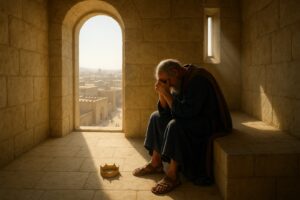
So the eunuch had a phrase for himself. Isaiah records it. He says, “Behold, I am a dry tree.”
A tree that will not fruit. Something taking up ground for no reason. Read that phrase slowly, because it is not a description of infertility. It is a description of worthlessness. It is the exact sentence a modern person is afraid is true about them when they realise they do not want what everyone assumes they should want.
The Verse That Turns the Law Around
Now read what God says next, in Isaiah 56:3-5:
“Neither let the son of the stranger, that hath joined himself to the LORD, speak, saying, The LORD hath utterly separated me from his people: neither let the eunuch say, Behold, I am a dry tree.
For thus saith the LORD unto the eunuchs that keep my sabbaths, and choose the things that please me, and take hold of my covenant;
Even unto them will I give in mine house and within my walls a place and a name better than of sons and of daughters: I will give them an everlasting name, that shall not be cut off.”
Sit with what just happened there.
God did not comfort the excluded man from a distance. God overturned the specific law that excluded him. Deuteronomy said shall not enter. Isaiah says in mine house and within my walls. The very ground he was banned from is now the ground where God gives him a name.
And notice the wording. Not “a name as good as sons and daughters.” Better than sons and daughters. God is not offering a consolation prize to people who missed out on the real thing. God is saying the thing everyone assumed was the real thing was never the source of a person’s worth in the first place.
Then the last line lands like a hammer: an everlasting name, that shall not be cut off. Said to a man whose entire identity had been cut off. That is not accidental phrasing.
The Detail Almost Nobody Notices
Here is something worth knowing, and it is easy to read straight past.
The Hebrew phrase behind “a place and a name” in verse 5 is yad vashem — closer to “a monument and a name.”
That phrase is the name of Israel’s national Holocaust memorial in Jerusalem. Yad Vashem’s own account of its name points back to this verse in Isaiah, chosen for a reason that only makes sense once you have read the passage: the memorial exists in large part for the people who died with no one left to carry their name forward. Whole families ended. No descendants. No one to remember them.
So the single most famous memorial on earth to people who left no children behind is named from a verse about God giving a name to a man who could never have any.
Nobody stumbled into that. Somebody read Isaiah 56 carefully and understood exactly what it was doing.
What Jesus Added to It
Isaiah 56 speaks to people who could not have children. That is real, and it matters — but if your situation is that you simply do not want them, you might feel the verse is being stretched to fit you.
Fair. So look at what Jesus said, in Matthew 19:11-12.
His disciples had just suggested that if marriage is that serious, it is better not to marry at all. Jesus does not scold them for it. He answers:
“All men cannot receive this saying, save they to whom it is given. For there are some eunuchs, which were so born from their mother’s womb: and there are some eunuchs, which were made eunuchs of men: and there be eunuchs, which have made themselves eunuchs for the kingdom of heaven’s sake. He that is able to receive it, let him receive it.”
Three groups. Born that way. Made that way by others. And then a third: people who chose a life without marriage and without children, on purpose, for the sake of something they cared about more.
Jesus names that third group without a hint of pity or correction. He does not call it a failure or a lesser path. He says, “He that is able to receive it, let him receive it” — the language of a calling, not a defect.
That is the piece Isaiah 56 does not cover, and it comes straight from Jesus. Chosen childlessness is not a category the Bible forgot to address. It is a category Jesus named out loud.
But What About “Be Fruitful and Multiply”?
This is the verse people reach for, so let us handle it honestly rather than dodge it.
Genesis 1:28 says: “And God blessed them, and God said unto them, Be fruitful, and multiply, and replenish the earth, and subdue it.”
Read the first four words again. And God blessed them. This is spoken as a blessing over humanity — and it is spoken over the whole human race at the moment of its creation, not handed to each individual person as a personal obligation.
And here is how we can be confident that is a fair reading, rather than a convenient one: God later tells a specific person the exact opposite.
Jeremiah 16:2 — “Thou shalt not take thee a wife, neither shalt thou have sons or daughters in this place.”
God directly instructed a prophet not to marry and not to have children. That instruction is impossible if Genesis 1:28 binds every single individual. You cannot break a universal command by obeying God.
Add to that the plain fact of who in Scripture had no children at all: Jeremiah. John the Baptist. Paul. And Jesus himself — the one person the whole Bible holds up as the fully complete human being — never married and never had a child.
Whatever “be fruitful and multiply” is, it cannot be the measure of whether a life counts. Jesus would fail that measure.
God never tied your worth to what your body produces. People did that.
The Turn: Worth Was Never About Output
Here is where this stops being about children.
The eunuch’s problem was never really his body. It was the arithmetic he had absorbed: I am worth what I produce. I produce nothing. Therefore I am nothing. A dry tree.
And God does not answer that by fixing his body. God answers it by throwing out the arithmetic entirely — and then, remarkably, gives him the one thing he thought only children could give him. A name that lasts.
You already know that arithmetic. Most of us run it about something. Not children — results. Income. A title at work. A tidy house. Something you can point at to prove the space you take up is earned.
That is why the question “is it a sin not to want children” hurts the way it does. It is rarely a real theology question. It is that old arithmetic wearing a Bible verse as a costume.
The honest answer is this: Scripture never calls it a sin not to want children. Not once. What Scripture does, repeatedly and deliberately, is refuse to tie a person’s worth to their offspring — and then go out of its way to give a permanent name to exactly the people the culture had written off.
None of that is an argument against having children. Children are a blessing all through the Bible, and the ache of wanting them and not having them is treated with enormous seriousness too — you can see that in how Scripture handles Elizabeth’s long years of waiting. This is only about one thing: whether the absence of the desire is a moral failure. It is not.
Paul goes further still, and if you want that part in full — including the four separate times he stops to say a particular piece of it is his own judgment and not a command from God — it is worth reading what 1 Corinthians 7 actually says about singleness. His summary line is short: “I say therefore to the unmarried and widows, It is good for them if they abide even as I.”
Good. Not tolerated. Good.
One More Thing: The Promise Got a Face
Centuries after Isaiah wrote that promise, a man was riding home through the desert with a scroll in his lap.
Acts 8 describes him as an Ethiopian, a eunuch, an official in charge of the treasury of Candace, queen of the Ethiopians. He had travelled a very long way to worship in Jerusalem — at a temple where the old law meant he could only ever stand at the edge.
He was reading the book of Isaiah when Philip caught up with him.
And when they came to water, the question he asks is the question of a man who had spent his whole life being turned away: “See, here is water; what doth hinder me to be baptized?”
Nothing did. He went down into the water and came up and went on his way rejoicing.
The man the law had shut out is one of the first people in the book of Acts to be brought in. Reading, of all things, the scroll of the prophet who had promised him a name better than sons and daughters.
What to Do With This Today
Three things, and none of them take long.
- Read Isaiah 56:3-5 out loud, slowly, once. Out loud matters. You have read this kind of promise silently before and let it slide past. Hearing your own voice say “better than of sons and of daughters” lands differently than reading it.
- Write down the sentence you are actually afraid is true. Not the polite version. The real one — “there is something missing in me,” or “I am a dry tree.” Write it on paper. Then write Isaiah 56:5 directly underneath it. Seeing the two sentences stacked is the whole point; one of them is your fear, and only one of them is from God.
- Draft your one-line answer, before you need it. The question is coming again at the next family gathering. Decide now what you will say — one calm sentence, no defence, no argument. Something like: “It’s not the life I’m building, but I love being an aunt.” You will not be ambushed by a question you have already answered on your own terms.
Journaling Prompts
- Picture the moment you first started believing that not wanting children made you defective. Whose voice is in that memory, and what exactly did they say?
- Where else in your life do you quietly measure yourself by what you produce rather than who you are?
- If your worth were genuinely not tied to any output at all, what would you stop trying so hard to prove this month?
A Prayer You Can Pray Right Now
God, I have carried this quietly for a long time — the fear that something in me is broken because I do not want what everyone assumes I should want. I cannot always explain it to my family, and some days I cannot explain it to myself. Thank you that Your word gives a lasting name to the very people the world had counted as finished. Help me put down the arithmetic that says I am worth only what I produce. Show me the place You have already made for me, and let that be enough.
If you are still trying to work out what your life is actually for — beyond what it produces — our free “What Is My Purpose?” assessment is a quiet ten minutes and a good place to start.
Discussion Question
Why do you think the church talks so often about “be fruitful and multiply” and so rarely about Isaiah 56? Tell us what you think in the comments — we read them.
Share This
- Isaiah 56 hands the childless “a name better than sons and daughters.” I had read that verse before. I had never noticed it was written to the exact people the law had already shut out.
- God told Jeremiah plainly not to marry and not to have children. Whatever “be fruitful and multiply” is, it clearly is not a rule binding every individual person.
- The eunuch in Isaiah called himself “a dry tree” — worthless, taking up ground for nothing. God’s answer was not to fix his body. It was to throw out the whole idea that a person is worth what they produce.
Questions People Ask
Is it a sin not to want children?
No. The Bible never states that not wanting children is a sin. Scripture treats children as a blessing, but it does not command every individual to have them, and it never attaches moral failure to the absence of the desire. Isaiah 56:5 promises the childless “a place and a name better than of sons and of daughters,” and in Matthew 19:12 Jesus describes people who choose a life without marriage or children “for the kingdom of heaven’s sake” without any criticism at all.
Does Genesis 1:28 command every person to have children?
Genesis 1:28 records a blessing spoken over humanity at creation: “And God blessed them, and God said unto them, Be fruitful, and multiply, and replenish the earth.” It is addressed to the human race, not issued to each individual as a personal obligation. The clearest evidence for this is Jeremiah 16:2, where God directly instructs the prophet Jeremiah not to marry and not to have sons or daughters — an instruction that would be impossible if Genesis 1:28 bound every person individually.
What does “a name better than sons and daughters” mean in Isaiah 56:5?
In ancient Israel a person’s name and memory survived through their descendants. Someone with no children faced being forgotten completely. In Isaiah 56:5, God promises eunuchs — men who could never have children — “a place and a name better than of sons and of daughters” and “an everlasting name, that shall not be cut off.” The promise is that God preserves a person’s identity and lasting significance directly, rather than through their offspring. The Hebrew phrase behind “a place and a name” is yad vashem, which is also the name of Israel’s national Holocaust memorial in Jerusalem.
Did anyone in the Bible deliberately have no children?
Yes. God specifically instructed the prophet Jeremiah not to marry or have children (Jeremiah 16:2). The apostle Paul was unmarried and wrote in 1 Corinthians 7:8 that for the unmarried and widows “it is good for them if they abide even as I.” Jesus himself never married and had no children. In Matthew 19:12 Jesus also names a group of people who have “made themselves eunuchs for the kingdom of heaven’s sake” — a chosen life without marriage or children.
Is choosing not to have children the same as being unable to have them?
They are different experiences and Scripture addresses them differently. Isaiah 56 speaks to people who could not have children and were excluded because of it, answering grief and shame imposed from outside. Matthew 19:11-12 addresses those who choose a life without marriage or children. Both passages arrive at the same underlying point: a person’s worth and lasting name come from God, not from having descendants.
Why were eunuchs excluded from the assembly in the Old Testament?
Deuteronomy 23:1 barred castrated men from entering “the congregation of the LORD.” In the ancient Near East, castration was usually done to boys so they could serve in royal courts and households without establishing a family line of their own — it was almost never a personal choice. Isaiah 56:3-5 directly reverses that exclusion, promising those same men a place “in mine house and within my walls.” Acts 8 then records an Ethiopian eunuch, a treasury official, being baptised after reading the book of Isaiah.