 0
0
 0
0
There is a picture of Jesus somewhere in almost every house of faith on earth. Long hair. Soft eyes. A calm, handsome face looking just past your shoulder.
So if someone asks what did Jesus look like, most of us reach for that picture without even thinking about it.
Here is the strange part.
Nobody who ever met Him wrote that face down.
What Did Jesus Look Like? Here Is Everything the Gospels Actually Record
There are four Gospels. Eighty-nine chapters between them.
They tell you what He said. What He ate, and who He ate it with. Where He slept, and the nights He did not. Who He touched, including the people nobody else would touch. They tell you He got tired. They tell you He cried.
They never tell you what His face looked like.
Not His height. Not His build. Not the colour of His hair or His eyes. Not one line.
And this is not a case of an old book simply not bothering with that sort of detail. The Bible bothers plenty. It will stop and describe a robe, a city wall, the exact number of steps in a temple. It gives angels a startlingly specific description – right down to counting the wings and telling you what four of them are for.
So the silence around the face of Jesus is not the Bible running short of words. It is four different writers, working separately, all leaving the same space empty.
The One Sentence That Comes Closest Is Probably Not About Him
There is exactly one moment in the Gospels where you feel a physical description is about to arrive. It is the story of Zacchaeus, the tax collector who climbed a tree.
“And he sought to see Jesus who he was; and could not for the press, because he was little of stature.” – Luke 19:3, KJV
Read it in English and it seems clear enough. Zacchaeus was short, the crowd was thick, so he climbed. That is almost certainly the right reading, and it is the one nearly every translation and commentary takes. It explains the tree.
But it is worth noticing what the sentence actually does. That last “he” carries no name. In the original Greek the pronoun is not attached to anybody, and at least one recent scholar has argued the line is genuinely ambiguous – that a reader could, in theory, take it as being about Jesus.
I am not going to tell you it is. The plain reading is the strong one, and the tree settles it.
The point is smaller and stranger than that. Even the closest thing to a physical note about Jesus anywhere in the Gospels turns out, when you look at it, to be about somebody else.
The Only Description We Have Says There Was Nothing to Look At
Centuries before any of this, the prophet Isaiah wrote a passage about a servant who would suffer. The earliest Christians read it as being about Jesus, and it is where almost every honest answer to this question ends up.
“For he shall grow up before him as a tender plant, and as a root out of a dry ground: he hath no form nor comeliness; and when we shall see him, there is no beauty that we should desire him.” – Isaiah 53:2, KJV
Sit with that for a second, because it is not what people expect.
It is not a description of features. There is nothing here about a nose or a jaw or a height. It is a description of impact. Nothing about Him made you stop and look.
“No form nor comeliness” means: nothing to see. “No beauty that we should desire him” means: your eye did not go to Him. In a crowd, He was not the one you would have noticed.
And the very next verse says He was despised, and that people hid their faces from Him.
That is the closest thing to a portrait that Scripture gives us. It is a portrait of somebody easy to walk past.
The Oldest Surviving Argument About His Face Was an Insult – and Christians Half Agreed
Here is the part almost nobody mentions, and it is the reason I could not stop reading about this.
In the second century, a pagan writer named Celsus wrote a book attacking Christianity called The True Word. His book is lost. We only have any of it because a Christian named Origen, writing in Alexandria around AD 248, quoted it line by line so that he could answer it.
In one of those quoted lines, Celsus argues that Jesus was nothing to look at. His body, Celsus says, was small, ill-favoured and ignoble – and he adds, pointedly, that the Christians themselves are the ones who report this.
Now, you would expect Origen to swing back hard. Deny it. Insist Jesus was magnificent.
He does not.
Origen allows the “ill-favoured.” He pushes back firmly on “ignoble.” And on “small,” he says there is no solid evidence either way. Then he goes to Isaiah’s line himself – the one you just read – and sets beside it a psalm that pictures a king in beauty, because he wants to hold both together.
Think about what that means. The oldest surviving debate we have about the appearance of Jesus is between a critic saying “he was plain” and a Christian answering, more or less, “yes, and?”
Nobody was defending a handsome face. There was no handsome face to defend. There was only a claim about what that plainness was for.
But Revelation Does Describe a Face
It would be dishonest to stop there, because Scripture does describe a face of Jesus exactly once. It is just not the one you could have seen on a road in Galilee.
“His head and his hairs were white like wool, as white as snow; and his eyes were as a flame of fire… and his countenance was as the sun shineth in his strength.” – Revelation 1:14, 16, KJV
That is John, decades later, describing a vision of the risen and glorified Christ. Hair like snow. Eyes like fire. A face like the sun at full strength.
And notice: even that is not a description you could draw. It is made entirely of things too bright to look at directly. You could not pick a man out of a market with it.
So the accurate sentence is this one. No Gospel describes the face of Jesus as people met Him. Scripture describes a face once, and it belongs to the glorified Christ, and it is deliberately more than a face.
About That “Real Face of Jesus” Image You Have Probably Seen
You have likely scrolled past it – a broad-featured, weathered, dark-haired man, shared endlessly with a caption saying science has revealed what Jesus really looked like.
That image was made by Richard Neave, a British medical artist, for the BBC series Son of God, first broadcast in April 2001. It was built from a first-century skull found in the Galilee region.
It is not Jesus. It was never claimed to be Jesus. No remains of Jesus exist to reconstruct, so no reconstruction of Him is possible.
What it actually shows is an ordinary Jewish man of that time and place. Which is useful in exactly one way: it tells you the range He fell inside. Broad face. Dark skin and hair. Short by our standards. A working man’s build.
It tells you nothing whatsoever about Him. It only tells you what everyone around Him looked like – and that, it turns out, is the whole point.
The Blank Space Is the Point
There is one verse that settles the question harder than any reconstruction ever could, and it is not about His appearance at all. It is about His arrest.
“Now he that betrayed him gave them a sign, saying, Whomsoever I shall kiss, that same is he: hold him fast.” – Matthew 26:48, KJV
Stop and think about what that sentence requires.
An armed party is sent to arrest the most talked-about man in the region. And they need a signal to know which one He is.
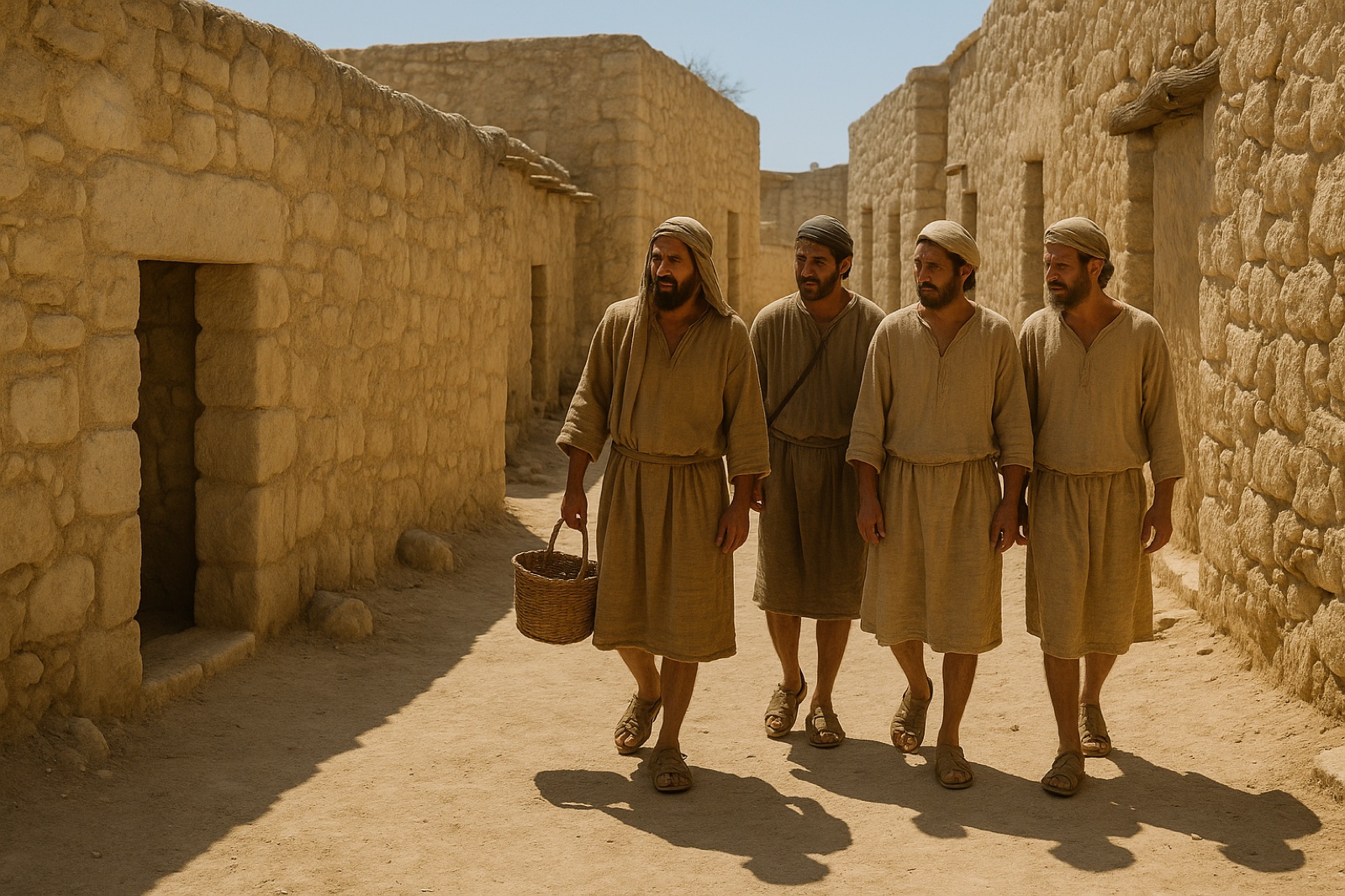
Standing in a garden among His own friends, He did not stand out. There was no glow. No unmistakable height. Nothing in His face that made Him obvious in the dark. A man had to walk up and kiss Him so the soldiers would know where to put their hands.
That is the answer to this whole question, hiding in a betrayal.
And here is where it turns.
The silence is not a gap in the record. It is a door somebody left open on purpose.
Because there is no face on file, there is no face anyone has to match. Every culture that has ever received this story has painted Him as one of its own – and that is not each of them taking a liberty. That is the mechanism working exactly as built. Scripture declined to hand anybody a face they would have to look up at, from the outside, as a stranger.
He was ordinary enough to be missed. That is exactly why He is reachable from anywhere.
It goes further than looks. The language Jesus actually spoke day to day was not a sacred one either – it was the ordinary working speech of ordinary people. And before any of the three years anyone wrote about, there were roughly thirty years nobody recorded at all.
Plain face. Common language. Decades that made no news.
If you have ever quietly wondered whether God could really be interested in a life as unremarkable as yours – that is the answer, and it has been sitting in the blank space this entire time.
What to Do With This Today
- Read one chapter with different eyes. Open Mark chapter 1 – it is short – and read it looking only for what Jesus does with His body. Where He walks. Who He touches. When He stops. Ten minutes. You will feel how much the Gospels care about that, and how completely they ignore His face.
- Name the picture in your head. Bring to mind the image of Jesus you grew up with, and say to yourself, out loud: “That is somebody’s guess.” Not to throw it away – just to notice how much weight it has been quietly carrying.
- Speak to the person easiest to overlook. Today, find the one person around you that everybody’s eyes slide past – the guard at the gate, the one who sweeps, the quiet one at the back – and say something to them that has nothing to do with what you need from them. He looked like them.
Journaling Prompts
- What does the Jesus in your head look like – and where did that picture actually come from?
- If He walked past you in an ordinary week, in ordinary clothes, with an ordinary face, what would have to be true about you for you to notice?
- Where have you been waiting for God to show up in a way that would be impossible to miss – and what might you have already walked past?
A Prayer for Seeing
God, I have been looking for You in the things that stand out. The big answer. The clear sign. The moment nobody could argue with. But You came in a face nobody thought to write down, and I think I have walked past You more times than I know. Teach me to look lower and slower than I do. And when I meet someone the world would not look at twice, help me remember whose face that is.
A Question Worth Arguing About
The Gospel writers recorded so much – the meals, the weather, the exact words – and left out the one detail every reader since has wanted. Do you think that was simply not what mattered to them, or do you think it was deliberate? Tell us what you think in the comments.
Share This
- Four Gospels. Eighty-nine chapters. They record what Jesus ate, where He slept, who He touched and when He wept – and not one of them describes His face. I always assumed that was an oversight. I don’t anymore.
- Judas had to kiss Jesus so the soldiers would know which man to arrest. That one detail tells you more about what He looked like than every painting ever made.
- The oldest surviving argument about the appearance of Jesus is a critic saying “he was plain” – and the Christian answering him more or less agreeing. Nobody was defending a handsome face. There wasn’t one to defend.
Questions People Ask
What did Jesus look like?
No book of the Bible describes the face of Jesus as people met Him. The four Gospels record what He said, ate, touched and wept over, but give no account of His height, build, hair or features. The nearest thing to a physical description is Isaiah 53:2, written centuries earlier about the suffering servant: “he hath no form nor comeliness; and when we shall see him, there is no beauty that we should desire him.”
Does the Bible describe Jesus at all?
Once, and not as a man walking in Galilee. Revelation 1:14-16 describes a vision of the risen Christ – hair “white like wool, as white as snow,” eyes “as a flame of fire,” and a countenance “as the sun shineth in his strength.” That is a glorified figure in an apocalyptic vision, not a portrait anyone could have drawn from meeting Him in person.
Is the “real face of Jesus” reconstruction accurate?
The widely shared forensic image was made by British medical artist Richard Neave for the BBC series Son of God, first broadcast in April 2001, and was built from a first-century skull found in the Galilee region. It shows what an average Jewish man of that time and place looked like. It was never a reconstruction of Jesus Himself, and since no remains of Jesus exist, no reconstruction of Him is possible.
Was Jesus handsome?
There is no record either way, and the oldest surviving argument on the subject went the other direction. The pagan writer Celsus, in the second century, claimed the body of Jesus was small, ill-favoured and ignoble. Origen, answering him around AD 248 in Against Celsus, allowed the “ill-favoured,” denied the “ignoble,” and said there was no solid evidence for “small.”
Why doesn’t the Bible say what Jesus looked like?
Scripture never explains the omission, so any answer is an observation rather than a stated reason. What can be observed is the effect: with no face on record, no culture receiving the story has been handed an appearance it must match, and every one of them has pictured Him as one of its own. Matthew 26:48 also shows He did not visually stand out – Judas had to identify Him with a kiss so the arresting party would know which man to seize.
Where can I ask more questions like this?
BGodInspired runs a free Bible Answers assistant that will take questions like this one and walk through what Scripture actually says and does not say. It opens in ChatGPT and costs nothing to use.