 0
0
 0
0
There is a moment near the end of Homer’s Odyssey that most retellings hurry straight past. The hero has survived the war, the sea, the monsters and the goddess who kept him. He is finally standing inside his own house, in his own country, after twenty years away. And not one person there has any idea who he is.
That is the bit people leave the cinema arguing about, so here is the Odyssey ending explained properly — because the poem does something stranger and better than a big reunion scene. Odysseus is recognized three separate times, by three different people. And every one of them needs a completely different kind of proof.
Christopher Nolan’s film version reached cinemas on 17 July 2026, runs 173 minutes, and was the first feature shot entirely on IMAX 70mm film cameras. It has since taken more than $1.6 billion worldwide — the highest-grossing film of Nolan’s career, and the highest-grossing R-rated film ever made. So a very large number of people have just spent nearly three hours watching a man try to get home, and a fair few of them walked out wondering why the homecoming was so oddly quiet.
The Odyssey Ending Explained: He Gets Home Long Before the Story Ends
Here is the thing a trailer can never show you. Odysseus does not arrive at the end of the poem. He arrives with roughly a quarter of it still to go.
He had been gone twenty years — ten of them fighting at Troy, ten more trying to sail a short distance across the sea. When he finally lands on Ithaca, the goddess Athena disguises him as an old beggar. So he walks into his own house as a stranger, sits on the floor of his own hall, and watches the men who want his wife and his throne eat his food.
Which means the last quarter of the oldest homecoming story we have is not about arriving. It is about being home and not being known. If you want the wider picture of why this particular story keeps getting retold, we looked at why we all ache for home when the film first broke Nolan’s box office record.
The Dog Knows Him First
The first one to work it out is not a person.
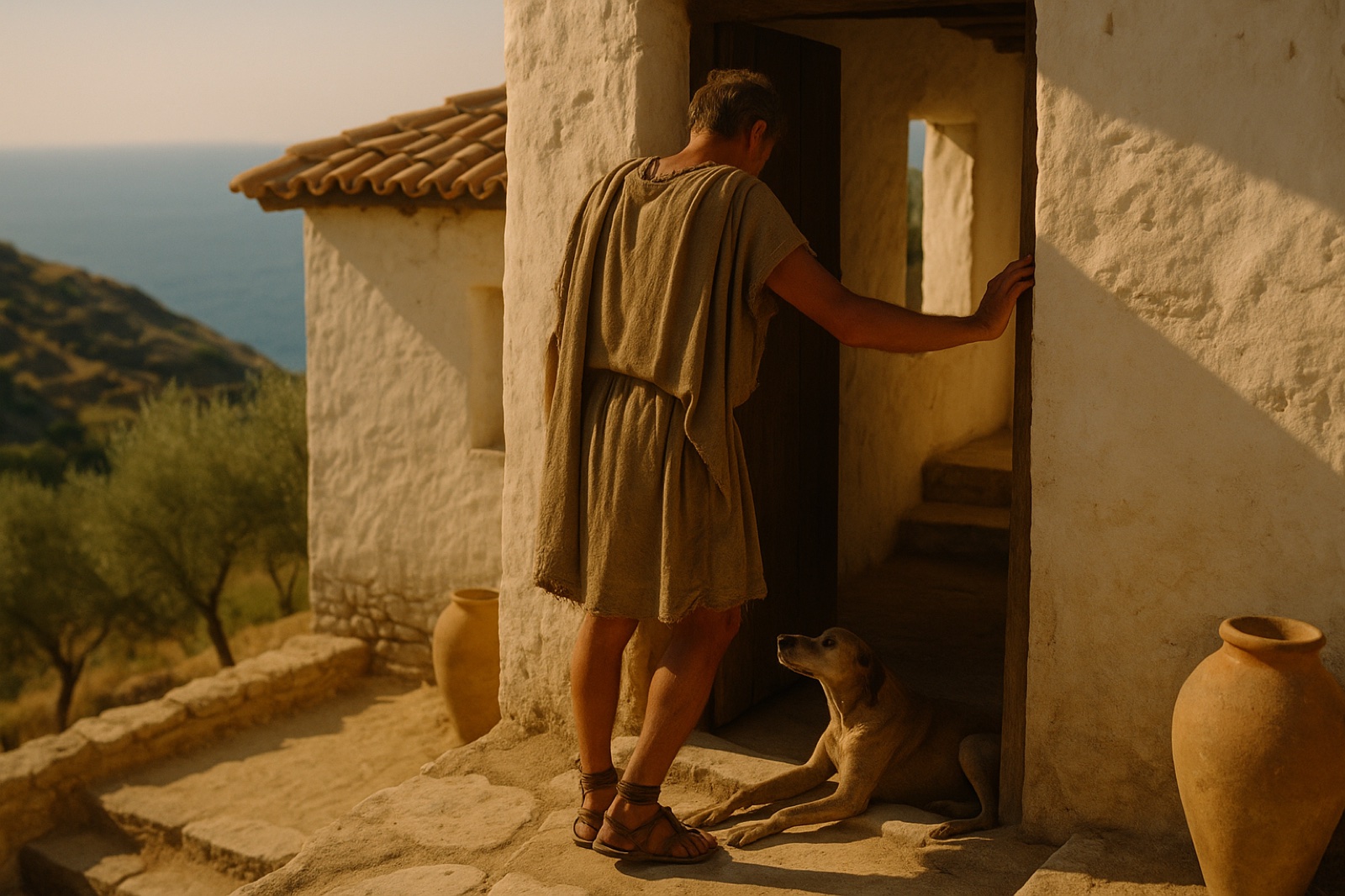
Argos is Odysseus’s dog. He was a puppy when his master left. Now he is twenty years old, neglected, lying on a heap outside the door, too weak to get up. And the moment the disguised beggar walks past, the old dog knows exactly who he is. He can’t stand. He can only manage his ears and his tail. And then he dies.
It is the shortest recognition in the poem and the only one that needs no evidence whatsoever. The dog does not check anything. The disguise simply doesn’t work on him. Twenty years, a goddess’s magic, and a completely changed face, and the animal is not fooled for a second.
The Nurse Finds the Scar
The second is Eurycleia, the old servant who nursed Odysseus when he was a baby. Penelope tells her to wash the visiting beggar’s feet — ordinary hospitality, nothing more.
So the old woman kneels down with a basin of warm water. And as her hands move up his leg, she finds a scar. She had known that scar since it was a fresh wound. She knows instantly, and nearly gives him away.
This is a beautiful piece of storytelling, and it is worth pausing on why it works. A face changes over twenty years. Weight changes. A voice changes. A scar does not. The one thing that survives two decades of war and salt water unaltered is the exact spot where he was once hurt. His body kept the record even when it stopped looking like itself.
Penelope Refuses the Scar — and Asks About the Bed
And now the part that gets cut from nearly every version, including some of the retellings that ought to know better.
Penelope does not accept the scar.
Her husband is standing in front of her, the disguise is off, their son believes it, the nurse has confirmed it with physical evidence, and Penelope — who has been waiting twenty years for exactly this — will not say yes. Their son thinks she is being cruel. She sets a trap instead.
She casually instructs a servant to move the marriage bed out of the bedroom and make it up for the stranger.
And he loses his temper. Because that bed cannot be moved. He built it himself around the trunk of a living olive tree, still rooted in the ground, and then built the room around the bed. Nobody could carry it anywhere without cutting it free. Only two people alive knew that.
That is not a scar. That is a secret. And the moment he says it out loud, she believes him.
Three People, Three Different Proofs
Put those three together and the ending stops looking like a series of reunions and starts looking like an argument the poem is quietly making.
- The dog needed nothing. No evidence, no test, no delay. He simply knew.
- The nurse needed a body. She had washed him as a child. The proof she accepted was physical, and it was an old injury.
- The wife needed a secret. Not his face, not his voice, not even his scar — a thing he had made with his own hands that nobody else on earth could know about.
Each proof matches the kind of love that is asking for it. And notice which one is hardest to fake and hardest to give: the one that belongs to the person who was closest. Penelope’s test is the strictest in the poem precisely because she had the most to lose from being wrong.
There is also something quietly devastating in what the proof turns out to be. Their marriage is verified by a piece of furniture he built out of a tree that was already growing there — a bed that literally cannot be relocated. Twenty years of absence, and the evidence that convinces her is a thing rooted in the ground.
The Other Homecoming Where Nobody Recognized the Man
Here is what struck me while reading the ending back.
Homer’s poem was written down somewhere around 2,800 years ago. Several centuries later, a different set of writers told a story about another man who came home — this time from death — and kept running into the same problem.
Two of his friends walked a long road with him and talked to him the entire way without ever working out who he was. They only got there when he sat down and broke bread at the table. A woman standing a few feet from him assumed he was the gardener, right up until he said her name. And one of his closest friends flatly refused to believe any of it until he had seen the scars in the man’s hands.
Three people. Three completely different proofs. A shared meal, a name spoken out loud, and a set of old injuries.
Whoever shaped that story understood exactly what Homer understood — that people do not recognize each other by their faces, and that the proof one person needs is useless to the next. What is interesting is that in the older story the returning man has to keep proving himself, while in that later one it is Jesus who does the adjusting, meeting each person with the specific evidence that particular person needed and not a scrap more. God, in that telling, does not hand out one standard proof and expect everyone to be satisfied with it.
Neither story borrowed from the other, as far as anyone can show. They just both noticed the same true thing about people. (If pulling threads like this out of films is your sort of thing, our free Movies & the Bible assistant does it on request — it opens in ChatGPT.)
If You Have Come Back Different
Most of us will never sail past a monster. Almost all of us will come back from something.
A long stretch of work in another country. A hospital. A war. A year so hard that it rearranged you. Grief. Recovery. And then you walk back into the same kitchen with the same people in it, and something is off — they are talking to a version of you that no longer exists, and you find yourself performing him so they don’t have to notice.
That gap is not a sign that anything has gone wrong. It has its own physical shape too: an astronaut coming back after 241 days off the planet has to relearn how to stand up, and nobody treats that as a personal failing. Coming home is its own event. It takes its own time.
What the poem quietly offers is this: not one single person in that house recognizes Odysseus by looking at him. They get there through a smell, an old wound, and a secret about a tree. The people who actually loved him did not need his face at all.
You are not required to look the same to be known.
Discussion Question
Which proof would convince you — the scar, or the secret only the two of you know? And was Penelope right to hold out after everyone else was sure, or was that a step too far? Tell us what you think in the comments.
Share This
- Just found out Penelope refuses to accept the scar as proof that Odysseus is home. She makes him describe the bed instead. 2,800 years old and still the best written character in the story. https://bgodinspired.com/index.php/entertainment/the-odyssey-ending-explained-why-nobody-recognizes-odysseus/
- The ending of The Odyssey isn’t one reunion, it’s three — and each person needs completely different proof. The dog needs nothing. The nurse needs a scar. The wife needs a secret. https://bgodinspired.com/index.php/entertainment/the-odyssey-ending-explained-why-nobody-recognizes-odysseus/
- If you have ever come back from something hard and found that the people at home were talking to a version of you that doesn’t exist anymore, this one is worth five minutes. Nobody in the oldest homecoming story ever written recognizes the man by his face either. https://bgodinspired.com/index.php/entertainment/the-odyssey-ending-explained-why-nobody-recognizes-odysseus/
Questions People Ask About The Odyssey’s Ending
How does the Odyssey end?
Odysseus returns to Ithaca disguised as a beggar by the goddess Athena, kills the suitors who have taken over his house, and is reunited with his wife Penelope after twenty years away — ten spent fighting at Troy and ten spent trying to get home. He arrives with about a quarter of the poem still remaining, so most of the final section is about him being home without being recognized.
Who recognizes Odysseus first?
His dog. Argos was a puppy when Odysseus left for Troy and is twenty years old, neglected and too weak to stand when his master returns in disguise. The dog recognizes him immediately, manages only to move his ears and tail, and then dies. It is the only recognition in the poem that requires no evidence at all.
How does Eurycleia recognize Odysseus?
Eurycleia is the old servant who nursed Odysseus as a child. Penelope tells her to wash the visiting beggar’s feet, and while she is kneeling with the basin she feels an old scar on his leg — a wound she had known since it was fresh. She recognizes him instantly from the scar alone, despite the disguise and twenty years of absence.
How does Penelope test Odysseus?
Penelope refuses to accept the scar as proof, even after their son and the old nurse are convinced. Instead she instructs a servant, within his hearing, to move the marriage bed out of the bedroom. Odysseus objects that the bed cannot be moved, because he built it himself around the trunk of a living olive tree still rooted in the ground. Only the two of them knew that, and his answer is what convinces her.
Is Christopher Nolan’s The Odyssey faithful to Homer?
Nolan’s 2026 film, starring Matt Damon as Odysseus, tells Homer’s story non-linearly, weaving the return journey together with flashbacks to the Trojan War and the sea voyage. It released on 17 July 2026, runs 173 minutes, and was the first feature shot entirely on IMAX 70mm film cameras. It has grossed more than $1.6 billion worldwide, making it the highest-grossing film of Nolan’s career and the highest-grossing R-rated film ever released.