 0
0
 0
0
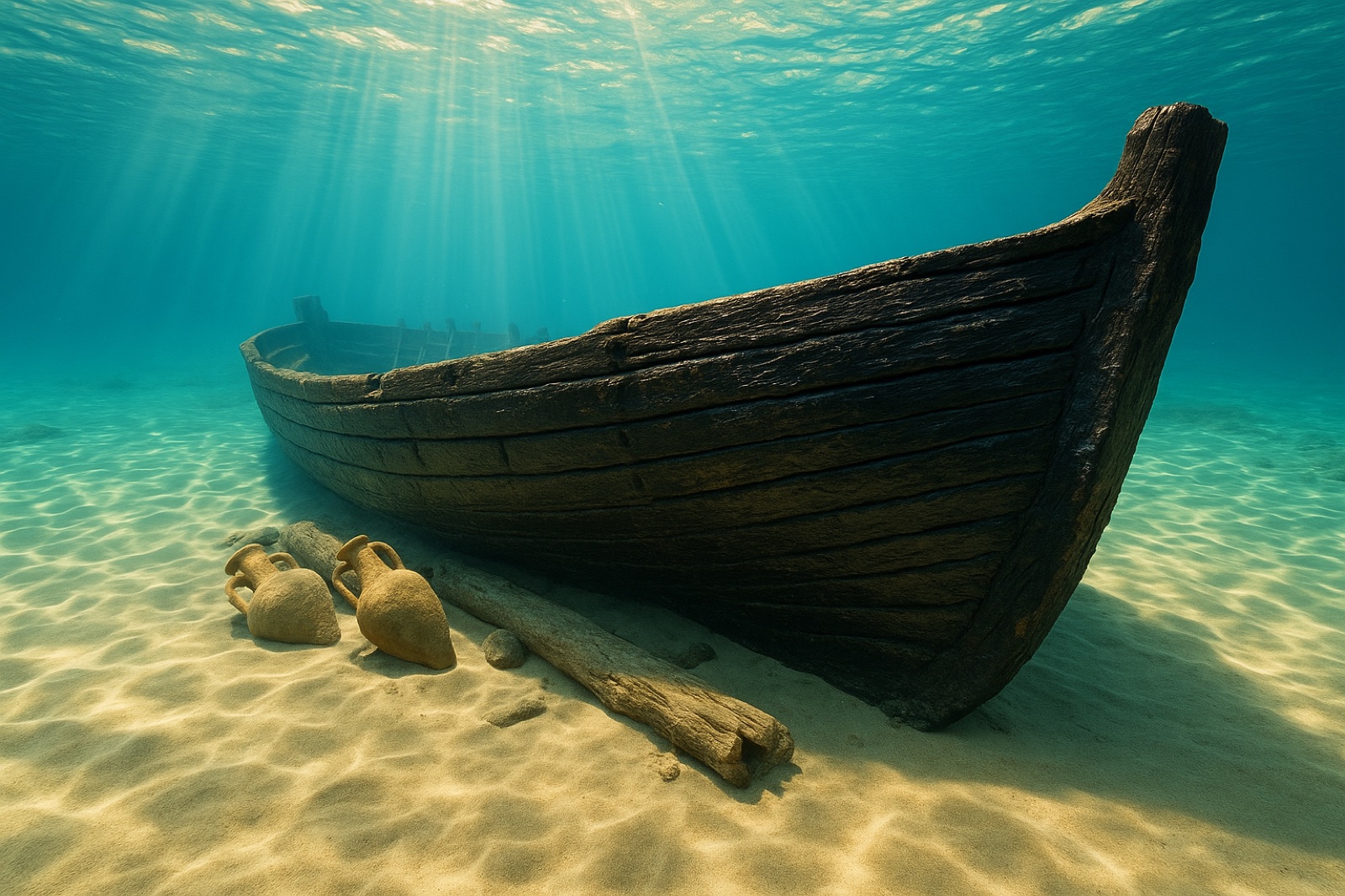
In 2016, divers working off the Croatian island of Ilovik found a wooden hull sitting quietly in the sand of the Adriatic. It had been there for roughly 2,200 years. It still had its cargo — logs and amphoras — and, more surprisingly, it still had its skin: a thick, dark, sticky layer smeared across the planks. That layer turned out to be the whole story. Researchers finally analyzed it, and in doing so they answered a question nobody had ever been able to answer with hard evidence: exactly how ancient ship waterproofing actually worked.
Not how we assume it worked. Not how a Roman writer said it worked. What was physically on the boat.
The Ship That Kept Its Own Receipts
The wreck is called Ilovik–Paržine 1. It sank around 170 BC, during the Roman Republic, and the stone used as ballast points to it being built at Brundisium — the port we now call Brindisi, on the heel of Italy.
It was built shell-first, which is the old way: you shape the outer planking into a hull, edge to edge, and only then add the internal skeleton to stiffen it. Beautiful to look at. Also a leak waiting to happen, because a hull made of edge-joined boards has a seam everywhere two boards meet.
So the builders coated it. A team of French and Croatian researchers, led by Dr. Armelle Charrié at the Laboratory of Mass Spectrometry of Interactions and Systems in Strasbourg, worked with Croatia’s Department for Underwater Archaeology and the ADRIBOATS program at Aix-Marseille University to pull eleven samples off the wreck — bow, stern, midships — and run them through a mass spectrometer. The results were published in Frontiers in Materials earlier this year.
What they found was not a mystery compound. It was tar. Specifically, pine tar — heated conifer resin, brushed on thick.
How Ancient Ship Waterproofing Actually Worked
Some of the samples were straight pine pitch. Others had something mixed into them: beeswax.
That combination has a name. The Greeks called it zopissa, and Pliny the Elder mentions it in his Natural History. For a long time it was mostly a word in a book — a thing ancient writers claimed shipwrights used. Now it’s a thing sitting on an actual hull in an actual laboratory. Wax makes the tar more flexible so it can move with a hull that flexes in a swell, and it makes the mixture easier to spread while it’s hot.
Then there’s the detail that quietly reframes everything. The samples contained retene and methylretenes — aromatic compounds that only form when conifer resin has been heated past roughly 300°C.
That number matters more than it sounds. Nobody hits 300°C by accident with a campfire and a bucket. Getting there means a controlled burn, a kiln or a covered pit, a process someone learned and taught and repeated. These weren’t people slapping sap on a boat. They were refining a raw material to spec, because the refined version performed better, and they knew it.
If you like this kind of thing — the moment where a small physical detail rewrites the picture we had of ancient people — you’ll probably also like the Roman governor’s residence archaeologists recently uncovered, where the room itself turned out to be the evidence.
The Pollen Wrote an Itinerary
Here’s the part that made the study genuinely new.
Tar is sticky. When a crew brushed a fresh coat onto the hull in some harbor, whatever was floating in the air that day got stuck in it — including pollen. Every repair sealed a snapshot of the local plant life underneath the next layer.
So the team read the pollen. Holly oak. Pine. Olive and hazel from dry Mediterranean scrubland. Alder and ash, which grow near rivers. Fir and beech, which mean mountains — the northeastern Adriatic.
Those aren’t all the same place. Layered together, they describe four to five separate coating jobs done in different regions. The stern and the middle of the ship shared one coat. The bow had been re-done three times, which is exactly what you’d expect from the end of the boat that takes the beating.
That’s an itinerary. Not from coins, not from cargo — from glue. A working merchant ship’s maintenance history, recovered from the stuff that kept it afloat. As Charrié put it, “Pollen has been very useful in identifying different coatings where the molecular profiles were identical.”
The picture that comes out of it is oddly human. A crew pulls into a harbor. Somebody checks the bow again. Somebody heats a pot of tar. They seal it, they sail, and a few hundred miles later they do it again — because a boat is not a thing you finish. It’s a thing you keep sealing.
The Instruction Was Already Written Down
Here’s the strange footnote.
Pliny wrote about zopissa in the first century AD — after this ship had already sunk. But the same basic instruction shows up in a much older text, and it’s compressed into about eight words.
In Genesis, when Noah is told to build the ark, the entire waterproofing spec is one clause: “shalt pitch it within and without with pitch.”
Tar it. Inside and outside.
Now hold that next to what the lab actually found on the Ilovik hull. In the researchers’ own description, the waterproofing system was a thick layer of adhesive coating brushed onto the inside and outside of the hull. Not just the part the sea touches. Both faces.
Let’s be straight about what this is and isn’t, because it gets overstated constantly. A Roman merchant ship from 170 BC is not evidence of a flood, and nobody should pretend it is. Different era, different ocean, different story entirely. This wreck proves nothing about Noah.
What it does show is smaller and, honestly, more interesting. That ancient line isn’t mystical, and it isn’t vague. It’s the correct engineering answer. Tar-sealing a wooden hull on both faces is what actually worked — physically, chemically, verifiably — and it stayed the right answer for thousands of years afterward. Shipwrights were still doing it in essentially the same way well into the age of sail.
An old text got a technical question right, in one clause, with nothing wasted. That’s it. That’s the whole claim. It’s a good one.
What Actually Lasts
There’s something worth sitting with in the fact that the ship sank anyway.
It was well built. It was well maintained — five times over, in five places, by people who knew what they were doing. And it still went down. What survived wasn’t the voyage. It was the care: the layers, the re-sealing, the evidence that somebody kept showing up for a boat that was never going to be finished.
People who spend time with those old texts have said something similar about a life for a very long time — that the work isn’t to build something that never leaks, but to keep sealing it, inside and out, and to keep sealing it again. The maintenance is the thing. Not the launch.
Twenty-two centuries later, the tar is what’s left. Not the cargo, not the crew, not the destination. The care.
That’s not a bad standard for anything you’re currently holding together.
The Adriatic is still there. So is the wreck, and so is the pollen, and somewhere in a lab in Strasbourg a machine is still reading the difference between one harbor and another out of a smear of two-thousand-year-old glue. If that kind of deep-time question is your favorite kind, our free How Old Is the Universe? explorer is built for exactly that itch — and if the ark thread is what caught you, how long Noah was actually on board is not the number most people assume.
What Do You Think?
Ancient shipwrights refined their tar past 300°C because the refined version simply worked better — no theory, just accumulated trial and error passed down until it became standard practice. Do you think we’ve lost that kind of slow, hands-on knowledge in the modern world, or have we just moved it somewhere else? Drop your take in the comments — genuinely curious which way people land on this one.
Share This
- Divers found a 2,200-year-old Roman hull in the Adriatic and the tar was still on it. Scientists read the pollen stuck in the layers and reconstructed the ship’s entire repair route. An itinerary made of glue. https://bgodinspired.com/index.php/bible-resources/bible-history/ancient-ship-waterproofing-roman-shipwreck/
- TIL ancient shipwrights heated pine resin past 300°C on purpose, because refined tar sealed a hull better than raw sap. That’s not folk knowledge, that’s a process. A 2,200-year-old wreck off Croatia just proved they were doing it. https://bgodinspired.com/index.php/bible-resources/bible-history/ancient-ship-waterproofing-roman-shipwreck/
- The oldest written instruction for waterproofing a wooden ship is about eight words long, and a Roman shipwreck just confirmed it was the correct answer. Tar it, inside and out. That’s the whole spec. https://bgodinspired.com/index.php/bible-resources/bible-history/ancient-ship-waterproofing-roman-shipwreck/
Questions People Are Asking
How did ancient ships stay waterproof?
Ancient ship waterproofing relied on pine tar — conifer resin heated until it broke down into a thick, dark, water-repelling pitch — brushed in a heavy layer over the hull planking, on both the inside and the outside surfaces. On the 2,200-year-old Roman wreck Ilovik–Paržine 1, found off Croatia, some coatings were straight pine tar and others were pine tar mixed with beeswax, which made the sealant more flexible and easier to spread while hot. The coating was reapplied periodically throughout the ship’s working life, because it wore off.
What is zopissa?
Zopissa is the ancient Greek term for a mixture of pine pitch and beeswax used to seal wooden ships. Pliny the Elder describes it in his Natural History. Until recently it was known mainly from written sources, but chemical analysis of coatings taken from the Roman Republican wreck Ilovik–Paržine 1 identified beeswax mixed into the pitch on parts of the hull — physical confirmation that shipwrights really were using the wax-and-tar blend the ancient texts described.
How can pollen show where a ship was repaired?
Fresh tar is sticky, so when a crew brushed a new coat onto a hull in a harbor, airborne pollen from the surrounding landscape stuck to it and was sealed in place by the next layer. Researchers studying the Ilovik–Paržine 1 wreck identified the trapped pollen species in each coating layer — holly oak, pine and olive scrub from dry Mediterranean coasts, alder and ash from river valleys, fir and beech from mountainous areas — and matched those plant communities to different regions. The layers indicated four to five separate repair jobs done in different places along the ship’s route.
Does the Roman shipwreck prove the story of Noah’s ark?
No, and it should not be presented that way. Ilovik–Paržine 1 is a Roman Republican merchant vessel that sank around 170 BC, carrying logs and amphoras in the Adriatic. It has no connection to the flood narrative and offers no evidence about it. The genuine and much narrower point of interest is technical: the one-line waterproofing instruction in Genesis 6:14 — pitch the vessel inside and outside — matches the method that chemical analysis shows shipwrights actually used, and it remained the correct method for wooden hulls for thousands of years.
Why did shipwrights heat the resin to such high temperatures?
Raw conifer resin is brittle and does not adhere or flex well on a working hull. Heating it above roughly 300°C chemically transforms it, producing a tar that spreads evenly, grips the wood, and moves with the planking as the ship flexes at sea. Researchers know the Ilovik–Paržine 1 coatings were processed this way because the samples contained retene and methylretenes, aromatic compounds that only form at those temperatures. Reaching 300°C requires a controlled kiln or covered pit, so the presence of these compounds indicates a deliberate, learned industrial process rather than casual use of raw sap.