 0
 0
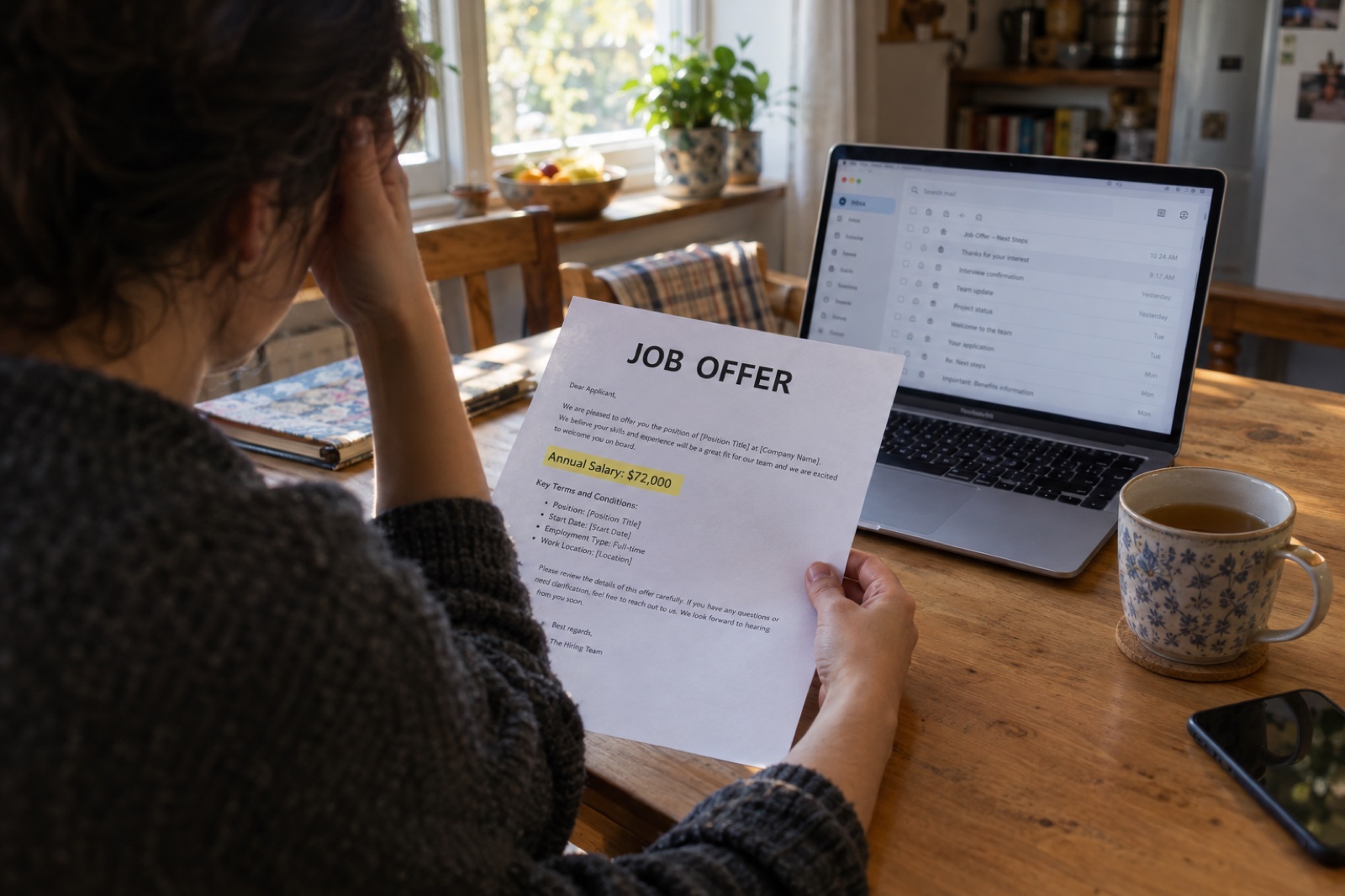
The offer is sitting in your inbox. It pays more. Not a little more – enough that you did the sum in your head before you finished reading the email. Rent would stop being a monthly knot in your stomach. You could say yes to things.
And yet you already know what the job is like. You have heard about the hours. You have seen the people who do it, how they look on a Thursday. Maybe you are already in a job like that, and the question is whether to stay for the money. Either way, the same question keeps coming back at night: is a higher paying job worth the stress if it makes you miserable?
Everyone you ask gives you one of two answers. “Money isn’t everything.” Or “You’d be mad to turn that down.” Both sound right. Neither helps you decide.
Is a Higher Paying Job Worth the Stress? Why the Usual Advice Fails
The usual advice treats this as a fight between money and happiness. Pick your side. But that is not really how the choice feels, and it is not how it works.
Here is what is actually going on. The offer letter shows you the gain as a clear number. The cost does not come with a number at all. Nobody writes “about four evenings a week of feeling flat” or “Sunday afternoons spent dreading Monday” on a contract. So when you compare the two jobs, you are comparing something you can see with something you can only feel. The thing you can see nearly always wins.
There is a second trick hiding in it. When you picture the extra money, you picture it landing in your life as it is now – with your current energy, your current evenings, your current patience with the people you live with. But the new job does not leave that life in place. It spends the very hours the money was supposed to make better. You imagine the bigger salary paying for a calm weekend, and then you spend the weekend recovering.
And there is a third thing, which most advice skips. Sometimes the extra money really is the calm. If you cannot cover food, rent, school costs or a debt that wakes you up at 3am, more pay is not greed. It buys you sleep. Telling someone in that spot that “money isn’t everything” is easy to say from a comfortable chair.
So the real question is not “money or happiness?” It is this: at what point does more money stop buying you peace, and start costing it?
The Question That Actually Decides It
Try looking at it with your hands instead of your bank balance.
Picture one handful of something you can carry easily. You can walk with it. You can still open a door, hold a child’s hand, wave at a neighbour. Now picture both hands full, arms straining, everything held tight so nothing falls. You have more. But you cannot hold anything else. You cannot even scratch your nose.
That is the trade a draining job often offers. Not “more” against “less,” but “more” against “free hands.” The extra is real. So is what you lose the ability to hold while you carry it – your evenings, your temper, your sleep, your attention when someone you love is talking to you.
This turns the decision around. Stop asking “is the extra money worth it?” Ask: “At the end of an ordinary Tuesday, which job leaves me holding more of what I actually want to hold?” Sometimes that is the higher paying job, because your current one leaves your hands nearly empty and full of worry. Sometimes it is the smaller one, because you already have enough to carry and what you lack is the room to enjoy it.
That way of putting it is much older than it sounds. It turns up in Ecclesiastes, a book that spends most of its time looking hard at work and money: “Better is an handful with quietness, than both the hands full with travail and vexation of spirit.” What surprised me is where the line sits. Just before it, the writer describes people working themselves to the bone mainly so their neighbours will envy them. Just before that, he describes the opposite – someone who folds their hands and does nothing at all, and is ruined by it. The line is the middle path between the two. It does not praise empty hands. It keeps a full handful. You do not need any religious belief to see that it is simply good sense.
How to Decide Between More Money and Your Peace of Mind
Work out your real hourly pay for both jobs. This idea comes from the book Your Money or Your Life by Joe Dominguez and Vicki Robin. Take what each job pays, then subtract the money the job itself costs you: travel, work clothes, the food you buy because you are too tired to cook. Then add up all the hours the job really takes, including the commute, the unpaid extra time, and the hour you need to come down after. Divide one by the other. A “better paid” job often shrinks a lot once you do this, and sometimes it doesn’t – either way, now you are comparing two real numbers.
Decide your “enough” before you look at the offer again. Write down what it would take to cover the basics plus a small cushion for emergencies. Not a dream life – just enough that money stops waking you up. If the job you have now does not reach that line, the higher pay is buying you quiet, and you should take it seriously even if the job is hard. If you are already above the line, every extra amount should face a harder question: what is it actually for?
Count the misery in hours, not just feelings. Feelings are easy to argue yourself out of. Hours are not. For one week, notice how much time the hard job takes beyond the work itself – lying awake, dreading, going over a meeting in your head, snapping at home and then making up for it. Write it in a phone note or on a scrap of paper. That time comes out of the same week the extra money was meant to improve, so it belongs in the sum.
Give a hard season an end date. Sometimes the honest answer is “yes, for now.” Taking a tough job for two years to clear a debt or save a deposit is very different from taking it with no end in sight. If you say yes, decide now what you are carrying it for and when you will put it down to check. A heavy load you can see the end of is much lighter than one you can’t.
Ask someone who is doing the job now. Not the person hiring you – someone actually in the role, or someone who has just left it. Ask them one plain question: “What does a normal Wednesday evening look like for you?” Their answer will tell you more than the job description, and it costs nothing but a message.
If you are not sure whether your current job is already wearing you down, the free Am I Burned Out at Work? check takes a few minutes and can help you see where you really stand before you choose. And if you take the bigger salary, it is worth reading about lifestyle creep first, because a raise has a way of vanishing into new spending before it ever buys the calm you took it for. If the choice in front of you is a second job rather than a new one, this guide runs the real math on that too.
What Do You Want to Be Holding?
Nobody can make this choice for you, and there is no answer that is right for everyone. Some people need the bigger handful. Some people already have enough and are about to trade their quiet for more than they can hold.
So here is the question to sit with tonight. Set the offer letter down for a moment. Picture yourself at nine o’clock on an ordinary weeknight a year from now, in each version of your life. Which one are you sitting in? And which one would you actually choose?
Have you ever taken – or turned down – more money for the sake of your peace? What happened, and what would you tell someone standing where you stood?
Questions and Answers
Is a higher paying job worth it if it makes me miserable?
A higher paying job is worth the misery only when the extra money buys something the person truly lacks, such as covering basic bills, clearing a debt, or building an emergency cushion. Once basic needs and a small safety margin are met, extra pay from a draining job often costs more in sleep, evenings and relationships than it adds. A useful test is to compare what each job leaves you with at the end of an ordinary weekday, not just the salary figure.
How do I calculate my real hourly wage?
To calculate a real hourly wage, take the pay from a job and subtract the costs the job itself creates, such as travel, work clothing and convenience food bought because of tiredness. Then add up every hour the job truly takes, including commuting, unpaid overtime and time needed to recover. Divide the adjusted pay by the total hours. The method was popularised by the book Your Money or Your Life by Joe Dominguez and Vicki Robin.
Should I take a stressful job for more money for a short time?
Taking a stressful, higher paying job for a limited time can be a sound choice when there is a clear purpose and a clear end date, such as paying off a specific debt or saving a set amount. The risk is that a temporary stretch quietly becomes permanent. Writing down the goal and a date to reassess before starting makes it far easier to step away once the goal is met.
How do I know how much money is enough?
Enough money is the amount that covers essential living costs plus a small cushion for emergencies, so that money worries stop disrupting sleep and daily life. The figure differs for every household and country. Writing it down before comparing job offers helps, because below that line extra pay usually reduces stress, while above it extra pay from a harder job often adds stress instead.
Social Share Posts
“Is the extra money worth it?” is the wrong question. Better one: which job leaves me holding more of what I actually want at 9pm on a Tuesday?
Worked out my real hourly pay for the “better” job – travel, the takeaway I buy because I’m wiped out, the hours I lie awake. It was a lot closer than the offer letter made it look.
One handful you can carry easily, or both hands full and nothing free to hold anyone’s hand. Thinking about that before I sign anything.