 0
0
 0
0
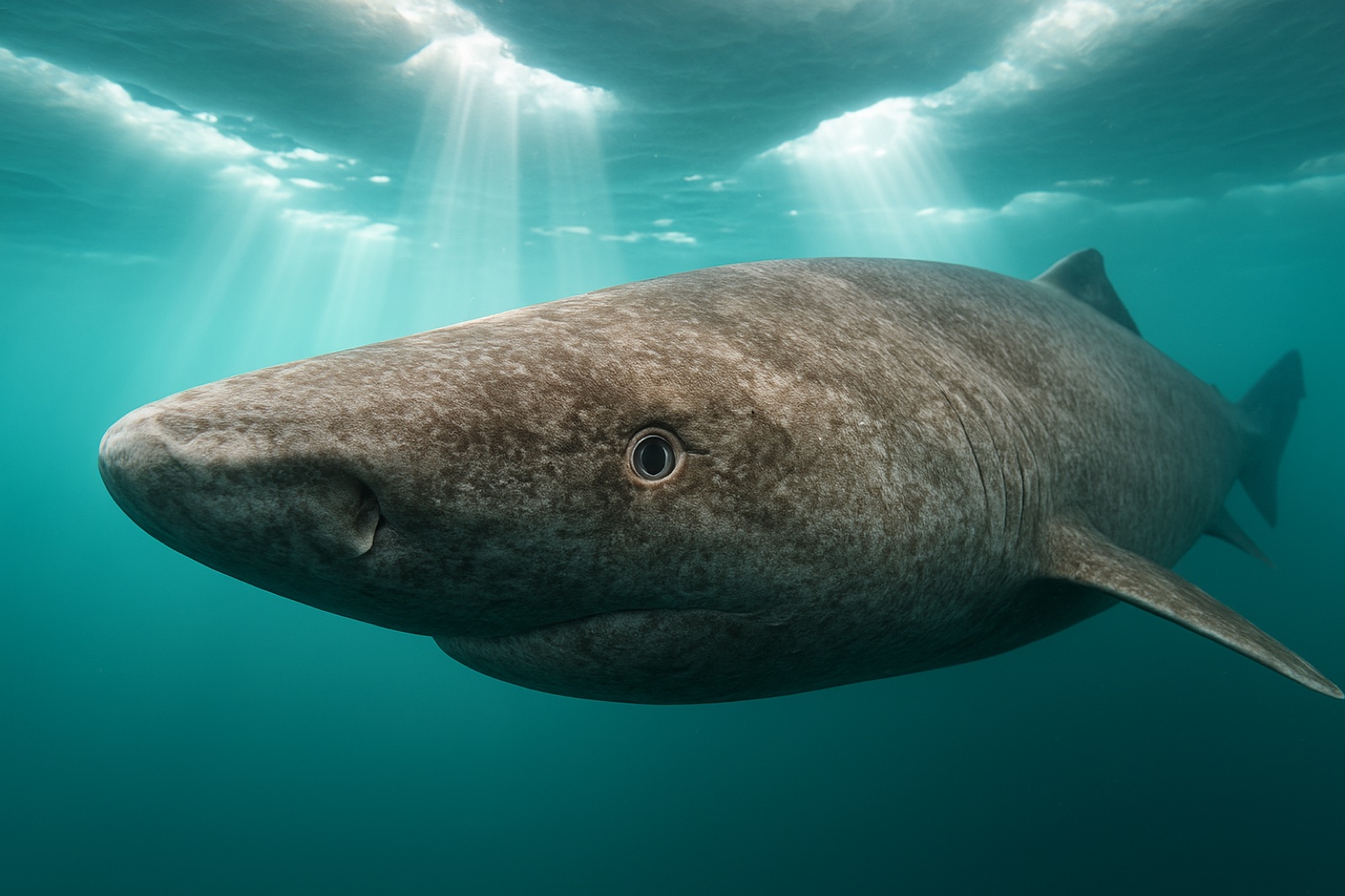
Somewhere under the ice off Greenland, a shark is swimming right now that was probably born before the United States existed. For decades, scientists assumed Greenland shark eyes had long since stopped working. They were wrong.
The animal is not fast and not sleek. It moves at roughly one mile per hour, which makes it one of the slowest fish in the ocean. It is grey, blunt-nosed, and covered in rough skin. Many of them have small parasites dangling from their eyeballs — which is exactly why everyone assumed the shark was blind, and why nobody thought a creature in the pitch-dark Arctic deep needed sight anyway.
Then a team decided to actually look. What they found was not what anyone expected.
A Shark That Outlives Nations
The Greenland shark is the longest-living vertebrate we know of — the longest-living animal with a backbone. Researchers estimate that individuals can reach somewhere around 400 years old.
Here is the strange part. We know how old they are because of their eyes.
A shark’s eye lens has a center that forms while the animal is still developing, and that tissue is never replaced. It just sits there for the rest of the shark’s life, chemically frozen at the moment it was made. So scientists can radiocarbon-date the middle of the eye and read it like a birth certificate. That method is how we learned, in the first place, that these animals were living for centuries.
Which means the eye was already the most interesting part of this animal before anyone checked whether it still worked.
And one more thing worth sitting with. Greenland sharks are thought not to reach maturity until they are around 150 years old. The sharks in this new study were estimated at 100 to 134 years. By the standards of their own species, those were teenagers. If a century-old shark is still a kid, the numbers on the far end of that lifespan stop being trivia and start being genuinely difficult to picture — a little like trying to hold the actual age of the universe in your head and finding that the number just slides off.
What Scientists Found Inside Greenland Shark Eyes
The study, published in Nature Communications and led by Dorota Skowronska-Krawczyk at UC Irvine with collaborators at the University of Basel, examined eyes recovered from ten deceased Greenland sharks. The eyeballs are about the size of a baseball.
The team expected damage. In almost every animal studied, retinas wear down with age. Cells die. Structure breaks apart. In humans, the light-sensing rod cells at the back of the eye are lost steadily over a lifetime — at published rates, a person who somehow lived to 400 would be expected to lose the vast majority of them.
The shark retinas showed no evidence of that. No sign of cell death. The tissue was intact and, more surprising, still chemically busy.
Two findings stood out:
- Rhodopsin was still active. Rhodopsin is the protein that lets an eye see in very dim conditions. In these sharks it was not only present but tuned specifically to blue light — the exact wavelength that travels deepest into cold ocean water. That is not the signature of an organ that has been abandoned. That is a specialized instrument, calibrated for a specific job.
- DNA repair genes were running hot. Two in particular, ERCC1 and ERCC4, showed unusually high activity in the retina. Both are part of the machinery a cell uses to fix damage to its own DNA. The working idea is that these sharks are not avoiding wear and tear. They are repairing it, constantly, for centuries.
As Skowronska-Krawczyk put it, evolution does not tend to keep an organ that an animal does not need. The eye is still there, and it is still maintained. That maintenance is the whole story.
Why Everyone Assumed They Were Blind
The parasites are real. Many Greenland sharks carry a small copepod that attaches to the cornea and hangs off the front of the eye like a tag. It is one of the odder sights in marine biology, and it is easy to look at a photo of it and conclude the animal cannot possibly see.
Outside researchers have been careful to say that the parasite probably does blur the image. Functional light detection is not the same as sharp vision, and nobody is claiming these sharks read fine print in the dark.
But “blurry” and “blind” are very different words. The retina behind that blurry window turns out to be in remarkable shape — after more than a hundred years of use, in an animal that had every excuse to let it fall apart.
It is a familiar pattern once you start noticing it. The natural world keeps turning out to have solved problems quietly and early, long before anyone thought to check. A pufferfish smaller than your hand builds a geometrically perfect circle in the sand with no instruction. Bacteria were manufacturing a fully biodegradable plastic hundreds of millions of years before we filed the patent. Now a shark with parasites on its eyeballs turns out to have better retinal maintenance than we do.
What This Might Mean for Human Eyes
This is the part where it would be easy to overpromise, so let’s not.
The repair pathways involved are not exotic. Humans have ERCC1 and ERCC4 too. But scientists outside the study have pointed out that when those same genes malfunction in mammals, the result is premature aging, not protection from it. The system exists in us; it clearly does not behave the way it behaves in a shark. Copying it across is not a matter of flipping a switch.
There is no supplement here. No treatment. No protocol. What there is, is a working example — proof that a vertebrate retina can stay healthy for well over a century, which means the decline we consider normal is at least not a hard law of biology. Knowing something is possible is where the search usually starts.
The Part That’s Hard to Shake
Most of us carry an assumption we have never really examined: that wearing out is simply what being alive means. Eyes dim. Bodies slow. That is the deal, and you make peace with it.
The Greenland shark does not argue with that. It just quietly does not do it. Down in the cold and the dark, with almost no light and no obvious reason to keep its eyes working at all, something in it keeps repairing the damage — year after year, century after century. Not because the shark is trying. Because that is how it was built.
There is a line in one of the oldest books we have, written about a man who reached the end of a very long and very hard road. The account could have said anything about him at the end. What it chose to record was that his eyes were still clear. Somebody, thousands of years ago, thought that detail was worth keeping — the idea that lasting well is not only something a person earns, but something that can be placed in a creature from the beginning.
Which is, more or less, what a marine biologist just found at the back of a shark’s eye.
Still Down There, Still Seeing
None of this is advice. Nothing here will change how your own eyes age, and it would be dishonest to suggest otherwise.
But there is a shark, somewhere under the ice off Greenland, that has been swimming since before your great-great-great-grandparents were born. It is moving at one mile an hour through water so dark that most animals would have given up on seeing a long time ago. And its eyes still work. Still tuned, precisely, to the single color of light that makes it that far down.
It is a strange thing to find comforting. It is anyway.
Questions People Ask About Greenland Shark Eyes
How long do Greenland sharks live?
Greenland sharks are the longest-lived vertebrates known to science, with estimates suggesting individuals can reach roughly 400 years old. Their age is determined by radiocarbon-dating the center of the eye lens, a piece of tissue that forms before birth and is never replaced, making it a chemical record of the year the shark was born.
Are Greenland sharks blind?
Not blind, though their vision is likely blurry. Many Greenland sharks carry a parasitic copepod attached to the surface of the eye, which researchers believe reduces image clarity. But a 2026 study published in Nature Communications found their retinas intact and functioning, with the light-sensing protein rhodopsin still active and tuned to blue light — the wavelength that penetrates deepest into cold ocean water.
What did scientists find in Greenland shark eyes?
A team led by Dorota Skowronska-Krawczyk at UC Irvine examined eyes from ten Greenland sharks estimated to be 100 to 134 years old. They found no evidence of retinal cell death, active rhodopsin, and unusually high activity in two DNA repair genes, ERCC1 and ERCC4. The likely explanation is that these sharks continuously repair age-related damage to their retinal cells rather than accumulating it.
Could Greenland shark research help human vision?
Possibly, but not soon and not simply. Humans carry the same DNA repair genes, yet when those genes malfunction in mammals the result is accelerated aging rather than protection from it. The research is valuable as proof that a vertebrate retina can remain healthy for over a century, which suggests age-related vision loss is not an unavoidable rule of biology. There is currently no treatment or supplement derived from this work.
Why do Greenland sharks live so long?
The full explanation is not settled, but extreme cold and an exceptionally slow metabolism are believed to play major roles — these sharks swim at around one mile per hour and are thought not to reach maturity until roughly 150 years of age. The new eye research adds another piece: unusually active cellular repair machinery that appears to maintain tissue over very long timescales.
Your Turn
Here is the question this study left behind: do you think aging is something science will eventually treat like a problem to be solved — or is there something we would lose if it did? There is no correct answer, and both sides of it are interesting. Drop your take in the comments; we read them.
Share This
If this one stuck with you, here it is in a sentence someone else might actually click:
- There’s a shark off Greenland that can live 400 years, and scientists just found its eyes barely age. Ten of them, over a century old, and no retinal damage at all. https://bgodinspired.com/index.php/bible-resources/bible-and-science/greenland-shark-eyes-barely-age/
- We know how old Greenland sharks are by radiocarbon-dating the center of their eye. The tissue forms before birth and never gets replaced. The eye is literally the birth certificate. https://bgodinspired.com/index.php/bible-resources/bible-and-science/greenland-shark-eyes-barely-age/
- Scientists assumed Greenland sharks were blind because of the parasites on their eyeballs. Turns out the retina behind them is in better shape after 130 years than ours is after 60. https://bgodinspired.com/index.php/bible-resources/bible-and-science/greenland-shark-eyes-barely-age/