 0
0
 0
0
Somebody asks who you are. Not your name — who you are. And you get about four words.
Most of us reach for something small. “I drive a taxi.” “I’m somebody’s mum.” “I’m the one who fixes the machines when they break.” We pick the smallest true thing, partly from habit, partly because the big words feel like they were handed out to other people.
Jesus had every big word available. Messiah. Lord. King. Son of God. And the name he used for himself, over and over, in all four Gospels, is the one that sounds smallest: the Son of Man.
So why did Jesus call himself the Son of Man? Because in one book of the Bible that phrase means nothing grander than “mortal” — a creature made of dirt who will one day go back to it. And in another book, the same phrase belongs to someone coming on the clouds of heaven to be handed a kingdom that never ends. Jesus picked the one name that meant both. On the night he was arrested, it is the half nobody asked about that got him condemned.
What “Son of Man” Meant Before Jesus Ever Said It
Long before the Gospels, the phrase already had a home. It lives in the book of Ezekiel, and it is not a compliment.
Ezekiel was a priest carried off to Babylon with the rest of the prisoners of war. Out by an irrigation canal called the river Chebar, God began speaking to him. And this is how God addressed him:
“And he said unto me, Son of man, stand upon thy feet, and I will speak unto thee.” (Ezekiel 2:1, KJV)
Then again: “Son of man, I send thee to the children of Israel” (Ezekiel 2:3). And again at the start of nearly every new instruction. “Son of man, I have made thee a watchman unto the house of Israel” (Ezekiel 3:17). “Son of man, can these bones live?” (Ezekiel 37:3).
Count them in the King James text of Ezekiel and you land on ninety-four.
The Hebrew behind it is ben adam — son of Adam. And Adam is built on the word for ground. So the phrase has soil in it. It means: mortal. Creature. Dust with a name. When God says it to Ezekiel it is not an insult, but it is not flattery either. It is a reminder, ninety-four times over, of the difference between the one speaking and the one being spoken to.
If this is the kind of detail you want more of — the Bible read slowly enough that the small words start talking — the complete Gospel of Matthew is yours free, as an immersive PDF and a 28-chapter audiobook. Twenty-eight chapters of watching Jesus use this exact name for himself.
The Prophet God Never Called by Name
Here is the part most articles on this title skip right past.
The book of Ezekiel runs forty-eight chapters. The name “Ezekiel” appears inside it exactly twice. Once in the opening lines, where a narrator introduces him — “The word of the LORD came expressly unto Ezekiel the priest, the son of Buzi” (Ezekiel 1:3) — and once in chapter 24, where he is told he is a sign to the people.
That is the whole list. Through visions, sieges, dry bones, and a temple measured out stone by stone, the man is addressed as “son of man” and nothing else.
Imagine working alongside someone for years who calls you “human being” every single time they speak to you. You would never once be confused about where you stood.
Daniel 7: The One Who Looked Human in a Room Full of Beasts
Now go to the other end of the story, into a night vision in the book of Daniel.
Daniel watches four great beasts come up out of the sea. A lion with eagle’s wings. A bear with ribs in its teeth. A leopard with four heads and four wings. Then a fourth one the text can only describe as “dreadful and terrible, and strong exceedingly”, with great iron teeth and ten horns (Daniel 7:3-7). These are empires. That is what power looked like from inside Babylon: teeth.
And then the thrones are set, and Daniel sees this:
“I saw in the night visions, and, behold, one like the Son of man came with the clouds of heaven, and came to the Ancient of days, and they brought him near before him.” (Daniel 7:13, KJV)
Read that again with the beasts still in the room. Everything else in the vision is a monster. The one who gets handed the kingdom is the one who looks human.
And what he is handed is not small: “dominion, and glory, and a kingdom, that all people, nations, and languages, should serve him: his dominion is an everlasting dominion, which shall not pass away” (Daniel 7:14).
That section of Daniel is written in Aramaic rather than Hebrew, and the phrase there is bar enash — the same plain idea in a different language. A human one. Which is exactly the point. In a vision full of claws, the winner is the one shaped like us.
So by the time Jesus arrives, those three words are carrying two loads at once. In Ezekiel the phrase means only a mortal. In Daniel it belongs to a human-looking figure riding the clouds — and in the Old Testament, riding the clouds is something God does.
Why Did Jesus Call Himself the Son of Man Instead of Anything Else?
Across all four Gospels, Jesus keeps reaching for this phrase. Watch what he attaches to it.
He uses it for having nowhere to sleep: “The foxes have holes, and the birds of the air have nests; but the Son of man hath not where to lay his head” (Matthew 8:20). That is the Ezekiel meaning exactly — a mortal, tired, with no bed.
He uses it for being nobody’s boss: “For even the Son of man came not to be ministered unto, but to minister, and to give his life a ransom for many” (Mark 10:45).
And then he uses it for something no mortal gets to claim: “But that ye may know that the Son of man hath power on earth to forgive sins” (Mark 2:10).
Same three words. Homeless in one scene, a servant in the next, and then forgiving sins — which in that room was God’s work and nobody else’s.
People noticed, and people were confused. In John 12:34 a crowd throws the phrase back at him with an honest question buried inside it: “how sayest thou, The Son of man must be lifted up? who is this Son of man?” They could not place it. It was not a settled title you could look up and be done with. It was a phrase with two histories, and he was standing in the overlap on purpose.
The ordinariness of Jesus runs deeper than the name, too — even the job everyone assumes he had turns out to be a sharper question than most people expect.
The Night the Title Became the Evidence
Then comes the trial, and everything sharpens.
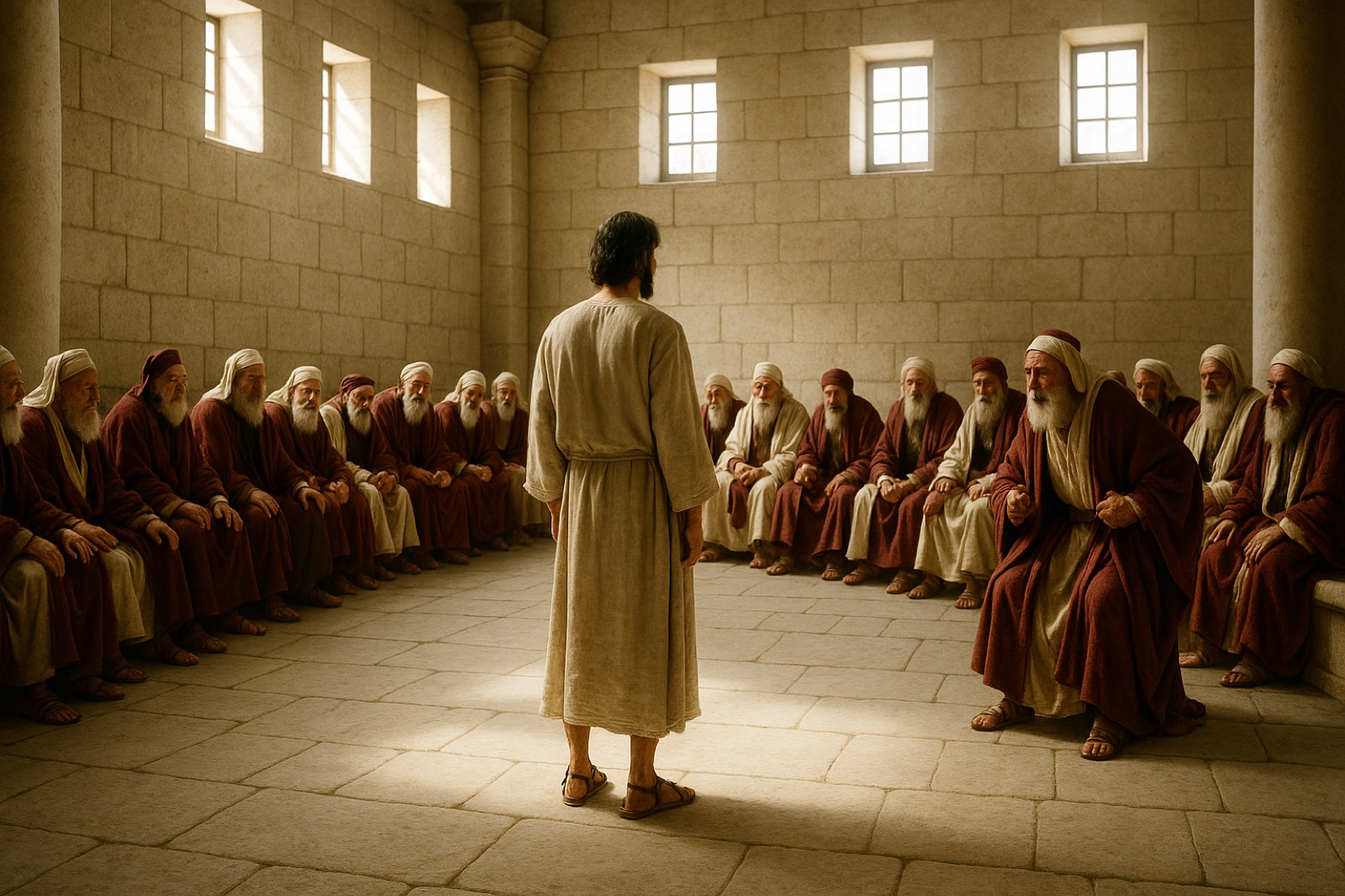
Jesus is standing in front of the high priest. He has said nothing at all. And the high priest asks him one direct question, about one title only:
“Again the high priest asked him, and said unto him, Art thou the Christ, the Son of the Blessed?” (Mark 14:61, KJV)
Jesus answers. But he does not stop where the question stopped:
“And Jesus said, I am: and ye shall see the Son of man sitting on the right hand of power, and coming in the clouds of heaven.” (Mark 14:62, KJV)
Two words answer what was asked — “I am.” Everything after that is volunteered.
And what he volunteers is two older lines stitched together. “Sit thou at my right hand” is Psalm 110:1. “Coming in the clouds of heaven” is Daniel 7:13. He has taken the title that means “just a human being,” and placed it on the clouds, in the seat at God’s right hand.
The response is immediate:
“Then the high priest rent his clothes, and saith, What need we any further witnesses? Ye have heard the blasphemy.” (Mark 14:63-64, KJV)
Notice what tore the robes. It was not “I am.” It was the sentence he added when nobody had asked for it. The most ordinary-sounding name in the room was the one that could not be survived.
The Turn: The Smallest Name Was the Largest One
Here is what that leaves us holding.
For forty-eight chapters, God called a man “son of man” to keep the distance clear. You are dust. I am God. Stand on your feet and listen.
And then God closed that same distance using that same word.
Whatever else “Son of Man” says, it says this first: God did not come near to us as a beast, or a storm, or an army. God came near as a human being — hungry, tired, with nowhere to sleep, walking ordinary distances on ordinary feet. The word that once measured the gap became the word that crossed it. That is what an older reflection here called the divine bridge between heaven and humanity — and the bridge is built out of the plainest material available.
Which means the small sentence you use about yourself is not the thing holding God at arm’s length. It is the exact address God chose.
You are probably carrying a version of that sentence right now. I’m just a… Just a driver. Just a mother. Just the one who cleans up after everyone else has gone home. And somewhere along the way you quietly decided God handles the important people first and gets to you later, if there is time.
The name Jesus used most often for himself was that same “just a.” He carried it into the room on the worst night of his life, and it turned out to be the largest claim anyone there had ever heard.
The smallest name Jesus could have chosen turned out to be the largest.
Actions to Take
- Write your small sentence down. The one you use when someone asks what you do — the slightly embarrassed one. Put it on the back of a receipt, or the last page of a notebook. Underneath it, write “Son of Man.” Keep it in your pocket today.
- Tonight, hand God the boring part. Before you sleep, pick the most unremarkable detail of your day — the queue, the aching back, the meal eaten standing up — and say it out loud to God. Not as a request. Just as the detail. The name Jesus used means that part counts.
- Use one invisible person’s name. Tomorrow, find someone whose work makes them easy to look past — the cleaner, the guard, the person collecting the trolleys — and speak to them by name. If you do not know it, ask for it, and then use it.
Journaling Prompts
- Where did you first learn that “ordinary” and “unimportant” were the same word? Go back as far as you can remember and name the place you heard it.
- Which part of your life do you leave out of your prayers because it feels too small to bring? Write down what it is, and write down when it got put on that list.
- If the plainest word about you is the same word God chose to come near in, what would you stop apologising for?
A Prayer You Can Pray
God, I have spent a long time assuming I was too ordinary to be worth your attention. I keep bringing you the tidy parts and leaving out the tired, unimpressive middle of my day. Thank you that the name Jesus used for himself was the plainest word there is for someone like me. Help me stop treating my small life as a reason to hang back. Meet me in it today. Amen.
Talk About It
Of all the names available to him, Jesus kept choosing the one that sounded least impressive. Do you think the people around him heard that as humility, or did they hear it as a claim? Tell us what you think in the comments — we read them.
Share This
- Jesus had every title available to him. He picked the one that just means “a human being.” Then he put it on the clouds of heaven. (Mark 14:62)
- In Ezekiel, God addresses the prophet as “son of man” ninety-four times. The prophet’s own name shows up twice in the entire book. Then Jesus picks up that same phrase and wears it. The word that measured the distance became the word that crossed it.
- My “I’m just a…” sentence is not what keeps God away. It is the address God chose.
Questions and Answers
What does “Son of Man” actually mean in the Bible?
In Hebrew the phrase is ben adam, literally “son of Adam,” and Adam is built on the word for ground — so the plain sense is “human being” or “mortal.” In the book of Ezekiel, God uses it as the standard way of addressing the prophet, where it carries no royal meaning at all. In Daniel 7:13 a similar phrase describes a figure “like the Son of man” who comes with the clouds of heaven and is given an everlasting kingdom. Jesus used the title in both senses.
How many times does God call Ezekiel “son of man”?
The phrase “son of man” appears ninety-four times in the King James text of the book of Ezekiel, almost always as the way God addresses the prophet directly. By contrast, the name “Ezekiel” appears only twice in the entire forty-eight-chapter book — at Ezekiel 1:3 and Ezekiel 24:24.
Why did the high priest tear his clothes at the trial of Jesus?
In Mark 14:61 the high priest asked Jesus whether he was “the Christ, the Son of the Blessed.” Jesus answered “I am,” and then added a sentence nobody had asked for: “ye shall see the Son of man sitting on the right hand of power, and coming in the clouds of heaven” (Mark 14:62). That sentence combines Psalm 110:1 with Daniel 7:13. The high priest tore his clothes and called it blasphemy (Mark 14:63-64).
Does “Son of Man” point to the humanity of Jesus or to his divinity?
Both at once, and that is the point of the title. The Ezekiel background makes it the plainest possible word for a mortal creature. The Daniel 7 background attaches it to a figure who arrives on the clouds of heaven and receives a kingdom that never ends. Jesus used the same three words for having nowhere to lay his head (Matthew 8:20) and for having power on earth to forgive sins (Mark 2:10).
Did anyone besides Jesus use the title “Son of Man”?
In the Gospels the phrase is almost always on the lips of Jesus himself. When a crowd repeats it in John 12:34 they are quoting him back, and they still ask “who is this Son of man?” — which shows it was not a settled, commonly used title. After the Gospels, Stephen uses it in Acts 7:56: “Behold, I see the heavens opened, and the Son of man standing on the right hand of God.”
Still have a question about what Jesus said and why he said it that way? You can ask our free What Jesus Teaches assistant — it opens in ChatGPT and costs nothing.