 0
0
 0
0
Someone asks, “So, what do you do?” And you answer. And you watch their face decide who you are.
Maybe you have felt that. You clean, or drive, or stack shelves, or care for someone all day. And the moment you say it, the conversation gets smaller. You are not a person anymore. You are a job.
Here is a question people type into a search bar all the time: was Jesus a carpenter? Most people expect a quick yes. But the real answer is more interesting. Only one verse in the Bible calls Jesus himself a carpenter. And the people who said it were not paying him a compliment.
Was Jesus a Carpenter? The Short Answer
Yes, most likely. But the word the Bible uses is bigger than our word “carpenter.” And the way it shows up is surprising.
The Gospel of Mark has the verse. Jesus goes back to his hometown of Nazareth. He teaches in the synagogue. And the people who grew up with him say this:
“Is not this the carpenter, the son of Mary, the brother of James, and Joses, and of Juda, and Simon? and are not his sisters here with us? And they were offended at him.” (Mark 6:3, KJV)
That is it. That is the only place in the Gospels where Jesus himself is called a carpenter. The only other Gospel to mention the trade, Matthew, gives it to his father instead.
So the one time Jesus is named by his job, it comes from people who knew his work best. And they used it to cut him down to size.
What “Tekton” Actually Meant
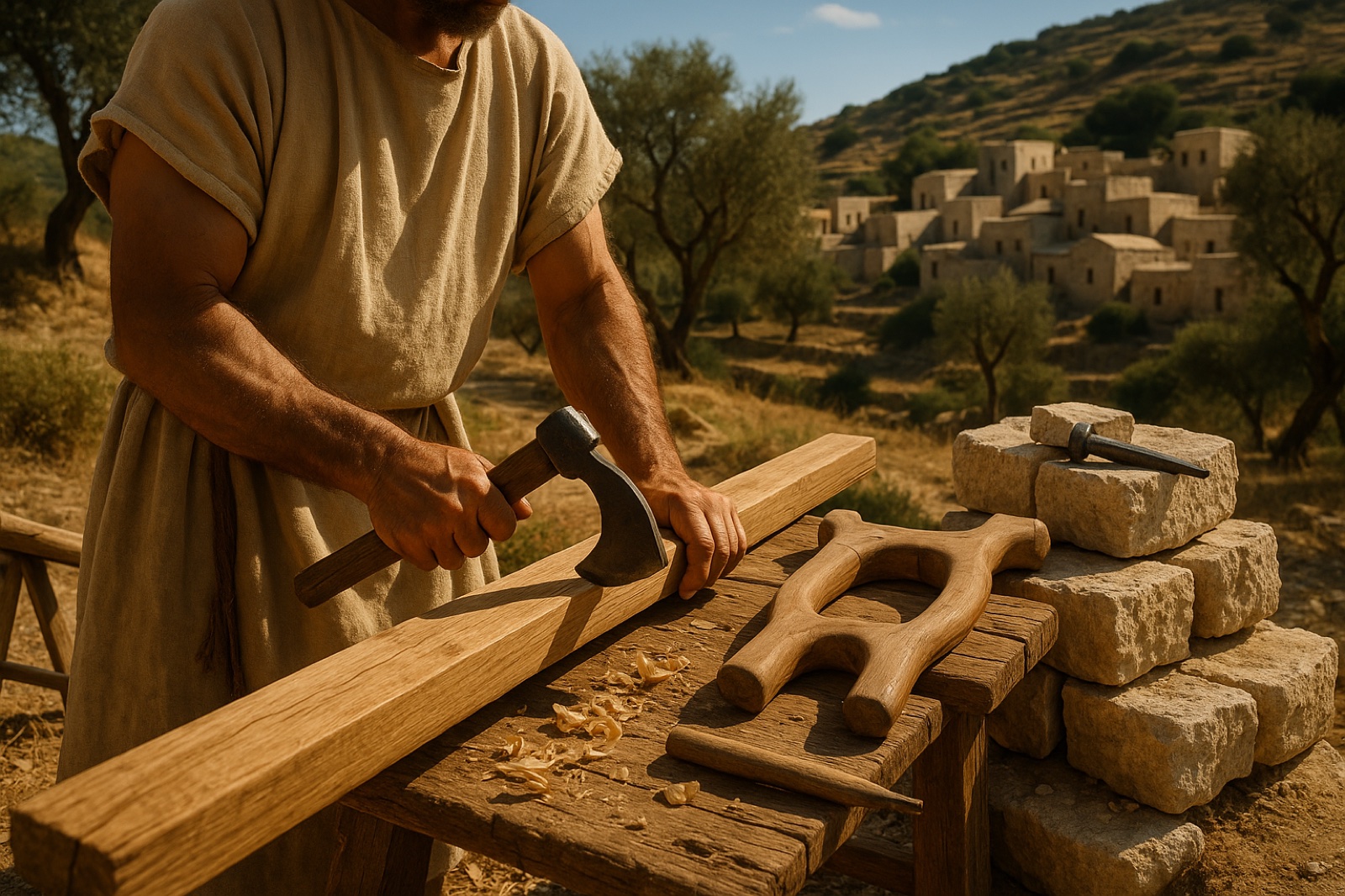
The Greek word in Mark 6:3 is tekton. We translate it “carpenter.” But a tekton was really a builder. Someone who made things with their hands.
Wood was a big part of it. Doors, beams, roofs, tables, farm tools. But a tekton could work with stone too. The Greek translation of the Old Testament shows this well. In 2 Samuel 5:11, King Hiram sends builders to make David a house. The Greek calls them “tektons of wood” and “tektons of stone.” The word needed an extra label because on its own it could mean either one.
Nazareth was a small village. A builder there would have fixed whatever needed fixing. A roof beam one week. A plough the next. A stone wall after that.
There was also a bigger city close by. Sepphoris sat about 6 kilometres from Nazareth, and it was being rebuilt during the years Jesus was growing up. Some scholars wonder if Joseph and Jesus walked there for work. That is a reasonable guess. But it is only a guess. The Bible never mentions Sepphoris at all.
The Hands They Had Hired
Read the verse just before Mark 6:3. It changes everything.
“And when the sabbath day was come, he began to teach in the synagogue: and many hearing him were astonished, saying, From whence hath this man these things? and what wisdom is this which is given unto him, that even such mighty works are wrought by his hands?” (Mark 6:2, KJV)
Notice those last three words. By his hands.
These were the same hands that had fixed their doors. Maybe built their tables. Maybe mended their ploughs. And now those hands were healing people. The town could not fit the two pictures together.
So they reached for the picture they already had. Is not this the carpenter? We know him. We know his mother. We know his brothers. His sisters live right here. Who does he think he is?
Some scholars also point out that calling a grown man “the son of Mary” was unusual. Men were normally named after their father. It may have been a quiet jab. Or it may simply mean Joseph had already died. Nobody knows for sure. Either way, the town was saying the same thing: you are only what we already know about you.
Matthew Changes One Small Word
Here is something most readers pass right by.
Matthew tells the same story. But when Matthew records what the town said, it reads a little differently:
“Is not this the carpenter’s son? is not his mother called Mary? and his brethren, James, and Joses, and Simon, and Judas?” (Matthew 13:55, KJV)
Not “the carpenter.” The carpenter’s son. Luke has the town say, “Is not this Joseph’s son?” (Luke 4:22). John has the crowd say, “Is not this Jesus, the son of Joseph, whose father and mother we know?” (John 6:42).
Only Mark lets the insult land directly on Jesus.
Matthew softens something else too. Mark says Jesus “could there do no mighty work, save that he laid his hands upon a few sick folk, and healed them” (Mark 6:5). Matthew says “he did not many mighty works there because of their unbelief” (Matthew 13:58). Could not becomes did not.
Many Bible scholars think Mark was written first, and that Matthew smoothed out a few rough edges. You do not have to decide that to see the point. Mark kept the raw version. The one where a hometown’s small view of Jesus really did get in the way.
Two Early Christians Who Disagreed
This is the part that surprised me most.
Around the year 155 to 160, a Christian teacher named Justin Martyr wrote about Jesus’s working years. He said Jesus “was in the habit of working as a carpenter when among men, making ploughs and yokes.” (Dialogue with Trypho, chapter 88.) Justin even saw a lesson in it. A yoke and a plough are tools for honest, steady work.
That detail is worth holding next to Jesus’s own words, “my yoke is easy.” We looked at what that Greek word for “easy” really means, and why a man who knew how yokes are made would choose it.
But almost a century after Justin, another Christian scholar said the opposite. A critic named Celsus had mocked Christians for following a carpenter. The scholar Origen answered him in a book called Against Celsus. Origen wrote that “in none of the Gospels current in the Churches is Jesus Himself ever described as being a carpenter” (Book 6, chapter 36).
How could Origen say that, when Mark 6:3 is right there?
The likely answer is in the old handwritten copies. Some early copies of Mark read “the son of the carpenter” instead of “the carpenter.” Origen probably knew that version, or chose to lean on it while arguing with a critic. Scholars still debate which one he was doing.
So even the early church felt the sting of this verse. One writer embraced the carpenter. Another pushed the word away. And the question underneath it is one we still ask: Is ordinary work beneath someone who matters?
What the Hometown Got Wrong
Nazareth was not wrong about the facts. Jesus really did work with his hands. His family really did live there. They knew true things about him.
What they got wrong was thinking those facts were the whole story.
Go back to the very start of Mark’s Gospel. Before Jesus teaches anyone. Before one healing. Before a single crowd. Jesus is baptized, and this happens:
“And there came a voice from heaven, saying, Thou art my beloved Son, in whom I am well pleased.” (Mark 1:11, KJV)
Look at the order. God names Jesus beloved before he has done any public work at all. As far as the Gospels tell us, the only work he had to his name at that point was building. Beams and ploughs and doors. And God was already “well pleased.”
That is the quiet answer hiding under “was Jesus a carpenter.” His job was real. His work was good. But his job was never where his name came from. His name came from God first.
And notice what Jesus did next. The town took offence. Mark says “he marvelled because of their unbelief.” And then, in the very next breath: “And he went round about the villages, teaching” (Mark 6:6). He did not stay in Nazareth trying to win the argument. He did not shrink to fit their label. He kept going.
If you have ever been introduced as “just” something, this belongs to you too. The people around you may know true things about you. Where you work. Who your family is. What you used to be. But those facts are not your name. God says who you are before anyone checks what you do.
Jesus also knew what long, unseen years of ordinary work feel like. Most of his adult life happened in that workshop. None of it was wasted.
What This Looks Like on a Normal Day
This is not about quitting your job or pretending it does not matter. Jesus did not look down on building. The work was honest and good.
It is about where your worth comes from. A job is something you do. It is not the thing that decides if you are loved.
If you want to dig further into questions like this one, you can explore it with our free Bible Answers AI assistant (it opens in ChatGPT).
Actions to Take Today
- Change your answer once. The next time you think “I’m just a…” about yourself, stop and finish the sentence differently. Try: “I work as a ___, and I am loved by God.” Say it quietly, even if only in your head.
- Read Mark 6:1-6 slowly. It takes about two minutes. Notice the words “by his hands.” Then look at your own hands for a moment and think about what they did today.
- Refuse to shrink someone else. Think of one person you tend to see only by their job. A cleaner, a driver, a cashier, a guard. The next time you see them, use their name, or ask one real question about their day.
Journaling Prompts
- When someone asks what you do, what do you feel in the moment before you answer? Where do you think that feeling comes from?
- Who in your life “knows all about you” but may not see all of you? What would you want them to understand?
- If God called you “beloved” before you had done anything worth praising, what would you stop trying to prove?
A Line Worth Keeping
“Your job is something you do. It was never your name.”
A Prayer for When You Feel Like Just a Job
God, sometimes I feel like people only see what I do, and some days I only see that too. Thank you that Jesus knew what it was like to be written off by people who thought they knew him. Help me hear what you say about me before I listen to anyone else. Let me do my work well today, without needing it to prove I am worth something. And help me see the people around me as more than their jobs, the way you see me. Amen.
A Question for You
Why do you think Mark kept the harsher version of the hometown’s words, while Matthew moved the word “carpenter” onto Joseph, and Luke and John left it out completely? Was Mark being more honest, or was something else going on? Tell us what you think in the comments.
Share This
- “Only one verse calls Jesus a carpenter, and it came from his hometown as a put-down. Being known for your job was never the same as being known.” #WasJesusACarpenter
- “Before Jesus healed anyone, God called him beloved. The only work he had done was building. My job isn’t my name either.”
- “‘Is not this the carpenter?’ They knew true facts about Jesus and still missed who he was. People can know about you without knowing you.”
Questions People Ask About Jesus Being a Carpenter
Was Jesus a carpenter?
Most likely, yes. Mark 6:3 records the people of Nazareth asking, “Is not this the carpenter, the son of Mary?” It is the only verse in the Gospels that calls Jesus himself a carpenter. Matthew 13:55 calls him “the carpenter’s son” instead. The Greek word used is tekton, which means a builder or craftsman who could work with wood and sometimes stone.
What does tekton mean in the Bible?
Tekton is the Greek word translated “carpenter” in Mark 6:3 and Matthew 13:55. It means a builder or skilled craftsman who worked with their hands. It often meant working with wood, but it was a broad word. The Greek translation of 2 Samuel 5:11 describes both “tektons of wood” and “tektons of stone” building King David’s house.
Why did the people of Nazareth reject Jesus?
According to Mark 6:1-6, the people of Nazareth were amazed by the wisdom and mighty works of Jesus, but they could not accept them from someone they had known as a local carpenter with an ordinary family. They asked, “Is not this the carpenter, the son of Mary?” and “they were offended at him.” Mark says Jesus “marvelled because of their unbelief” and then went on teaching in the surrounding villages.
Did Jesus make yokes and ploughs?
The Bible does not say which objects Jesus made. The Christian writer Justin Martyr, writing around 155 to 160, said Jesus worked as a carpenter “making ploughs and yokes.” That is an early tradition, not a statement from the Gospels. Farm tools like ploughs and yokes would have been common work for a village builder in Galilee.
Did Jesus work in Sepphoris?
Nobody knows. Sepphoris was a city about 6 kilometres from Nazareth that was being rebuilt during the early life of Jesus. Some scholars suggest Joseph and Jesus may have found building work there, but the Bible never mentions Sepphoris, so the idea remains a reasonable guess rather than a known fact.