 0
0
 0
0
Maybe it is an old photo that stops your thumb mid-scroll. A house you don’t live in anymore. A job, a friendship, a marriage, a body that used to work the way you wanted it to. You are here now, but part of you is still standing back there.
And maybe somewhere along the way, someone quoted three words at you: “Remember Lot’s wife.” It usually lands like a warning. Don’t look back, or else.
But if you want the real remember Lot’s wife meaning, don’t stop at those three words. Read the sentence Jesus said right after them. It changes the whole picture, and it is much kinder than the way this verse usually gets used.
Where Jesus Said “Remember Lot’s Wife”
These words are not in Genesis. Jesus is the one who said them. You find them in Luke 17:32, and in English they are only three words long.
Jesus was talking about the day when He would be revealed, and how suddenly it would come. Here is the whole passage:
“Likewise also as it was in the days of Lot; they did eat, they drank, they bought, they sold, they planted, they builded; But the same day that Lot went out of Sodom it rained fire and brimstone from heaven, and destroyed them all. Even thus shall it be in the day when the Son of man is revealed. In that day, he which shall be upon the housetop, and his stuff in the house, let him not come down to take it away: and he that is in the field, let him likewise not return back. Remember Lot’s wife. Whosoever shall seek to save his life shall lose it; and whosoever shall lose his life shall preserve it.” (Luke 17:28-33, KJV)
Look at that first list again. Eat. Drink. Buy. Sell. Plant. Build. Jesus does not describe Sodom by listing its sins here. He describes a normal week. Shopping, gardening, building, dinner.
That is the first surprise. The danger Jesus points to is not a wild life. It is an ordinary life held so tightly that a person can’t let go of it, even when it is ending.
If you want to walk with Jesus forward, one ordinary day at a time, this free 3-day sample is a gentle place to start:
What Actually Happened to Lot’s Wife
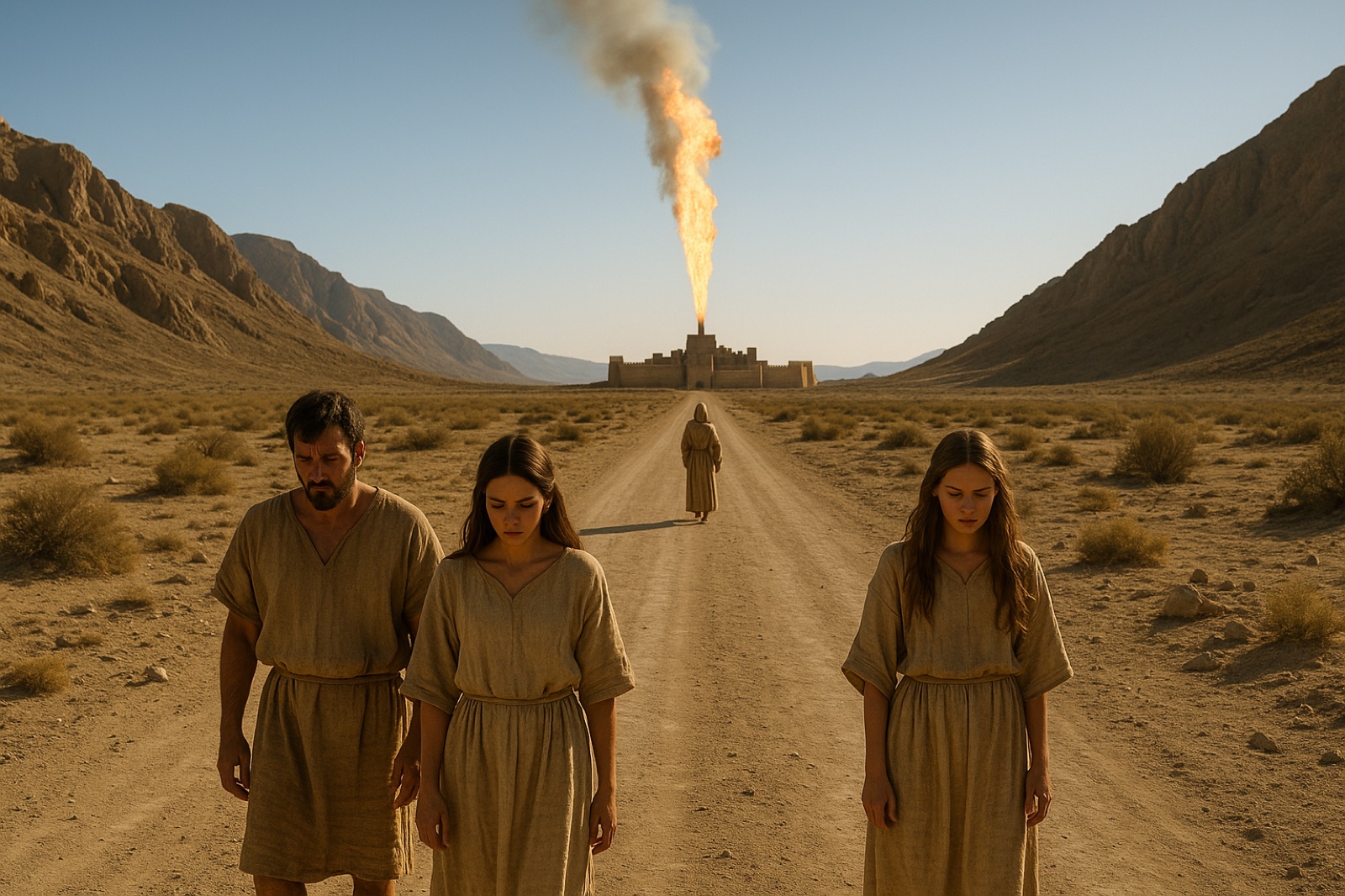
The story itself is in Genesis 19. Two angels came to Sodom to get Lot’s family out before the city was destroyed. And here is a detail that almost nobody mentions: the family did not want to leave.
“And while he lingered, the men laid hold upon his hand, and upon the hand of his wife, and upon the hand of his two daughters; the LORD being merciful unto him: and they brought him forth, and set him without the city.” (Genesis 19:16, KJV)
They lingered. They had to be taken by the hand and walked out. Lot’s wife was not a rebel storming off. She was a woman being led by the hand out of her home, by mercy, while everything she knew stayed behind.
Then came one clear instruction: “Escape for thy life; look not behind thee, neither stay thou in all the plain; escape to the mountain, lest thou be consumed” (Genesis 19:17).
And a few verses later:
“But his wife looked back from behind him, and she became a pillar of salt.” (Genesis 19:26, KJV)
Two small things are worth slowing down for.
- “From behind him.” She was walking behind Lot. Trailing. Her feet were on the road out, but she was at the back.
- The same word. In Hebrew, the word for “look” in the warning (“look not behind thee”) and the word for “looked” in verse 26 come from the same verb, nabat. The text is making sure you see it: she did the one thing she was told not to do. Young’s Literal Translation, an old word-for-word English version, even renders it that she “looketh expectingly from behind him.”
So let’s be honest about the story. Lot’s wife did disobey. Some people say this verse has nothing to do with disobedience, and that goes too far. She was given one instruction, and she broke it.
But that is not the part Jesus chose to point at. Jesus did not say, “Remember Lot’s wife, and do what you’re told.” He put her between two other sentences. And those sentences tell us what her look really meant.
The Sentence Before: “His Stuff in the House”
Right before “Remember Lot’s wife,” Jesus says: if you are on the roof when that day comes, and your stuff is in the house, don’t go down to get it. If you are in the field, don’t go back.
That is the picture Jesus sets up. Not someone taking a quick peek. Someone turning around to go back for things.
Genesis never tells us what Lot’s wife was thinking. But by placing her right here, Jesus shows how He read her story: her feet were leaving Sodom, and her heart was still in the house. Everything she had built, bought, planted and loved was back there, and she turned toward it. Jesus uses her as the picture of a person whose body is being rescued while their heart is still trying to go home to a place that is ending.
The Sentence After: What “Remember Lot’s Wife” Means
Then comes the sentence that explains it:
“Whosoever shall seek to save his life shall lose it; and whosoever shall lose his life shall preserve it.” (Luke 17:33, KJV)
This is the heart of it. Lot’s wife was trying to save her life, the life she had in Sodom. Holding on to it cost her the life she was being led into.
And here is the gold in this verse. The word translated “preserve” is the Greek word zōogoneō. It is a rare word, used only three times in the New Testament. According to Thayer’s Greek Lexicon, its original meaning in ordinary Greek was “to bring forth alive,” like a birth, and in the Bible it means “to preserve alive.” Thayer also notes that the old Greek translation of the Old Testament uses it when the Hebrew midwives saved the baby boys alive in Egypt (Exodus 1:17).
So Jesus isn’t only saying, “Let go, and you’ll survive.” The word carries something closer to this: let go, and you will be kept alive. Let go, and life will be brought out of it.
Jesus never used Lot’s wife to warn against missing home. He used her to warn against going back.
One honest note. In Luke 17, Jesus is first talking about the day He is revealed, and how quickly it will come. That is the main meaning. But Jesus also says almost the same save-and-lose words in a different setting, Luke 9:24, where He is talking about following Him every day. So this is not only a warning for one final day. It is how life with Jesus works all the time. We looked at what that sounded like to the crowd in Take Up Your Cross Meaning: What Jesus’ Crowd Heard.
Missing What You Lost Is Not the Same as Looking Back
If you are grieving, please hear this part.
This verse is not a warning against tears. It is not a warning against missing people, places, or seasons you loved. Jesus Himself stood at the grave of His friend Lazarus, and the Bible says, “Jesus wept” (John 11:35). Missing what you lost is love. It is not sin.
Lot’s wife is a picture of something different. It is the difference between remembering a place and trying to live there. Between carrying a loss with you and turning around to stand in it.
Here is how that can look in real life:
- Missing a marriage that ended is grief. Keeping every choice on hold until it “goes back to how it was” is looking back.
- Loving the city you grew up in is memory. Refusing to let a new place ever become home is looking back.
- Being sad about the job you lost is honest. Measuring every new day against the old paycheck and title is looking back.
- Remembering who you were before an illness is natural. Believing your life only counts if that version of you returns is looking back.
Notice what God did in the story before any of this. Mercy took Lot’s wife by the hand. God was not waiting for her to fail. God was pulling her out. The whole point of the rescue was a new life on the mountain.
Isaiah heard the same invitation centuries later: “Remember ye not the former things, neither consider the things of old. Behold, I will do a new thing; now it shall spring forth; shall ye not know it?” (Isaiah 43:18-19). The new thing is already growing. Looking back is how we miss it.
Earlier in Luke’s Gospel, Jesus said something very close to this: “No man, having put his hand to the plough, and looking back, is fit for the kingdom of God” (Luke 9:62). We explored that moment, and the small word hiding inside it, in Let the Dead Bury Their Dead: What Jesus Meant.
If you’d like to keep digging into what Jesus actually said, you can ask our free What Jesus Teaches AI assistant any question about His words. It opens in ChatGPT.
Actions to Take Today
- Name the house. Finish this sentence on paper or in your phone: “Part of my heart is still living in ______.” Just naming it takes away some of its pull.
- Keep the memory, drop the errand. Pick one thing you do to try to get the old life back, like checking an old profile, replaying an old argument, or waiting for things to “go back to normal.” Skip it today, just once.
- Take one step toward the mountain. Do one small thing that belongs to the life in front of you, not the one behind you. Say yes to one invitation, unpack one box, or send one message to someone in your life now.
Journaling Prompts
- What are you afraid you would lose for good if you stopped looking back?
- Where can you see God taking you by the hand, even when you were lingering?
- What might God be bringing to life in the place you are standing right now?
A Prayer for When Your Heart Is Still Back There
God, You know the place I keep turning toward. I miss it, and I don’t want to pretend I don’t. Thank You for taking me by the hand when I was lingering, even when I didn’t want to go. Help me carry what I loved without trying to live inside what is over. Keep me alive in the life You are leading me into now. Amen.
What Do You Think?
Do you think Lot’s wife looked back because she missed her home, or because she didn’t believe the new place would be better? Tell us in the comments. We would love to hear how you read it.
Share This
- “Jesus said ‘Remember Lot’s wife’ and then immediately explained it: whoever tries to save their life will lose it. It was never about peeking.”
- “Missing what you lost is love. Trying to live back there is looking back. Lot’s wife taught me the difference.”
- “Genesis 19:16 says Lot’s family lingered, so the angels took them by the hand, ‘the LORD being merciful.’ Even the leaving was mercy.”
Questions People Ask About “Remember Lot’s Wife”
What does “Remember Lot’s wife” mean?
“Remember Lot’s wife” is a warning Jesus gave in Luke 17:32. It points to the woman in Genesis 19:26 who looked back at Sodom as it was destroyed and became a pillar of salt. Jesus explains the warning in the next verse, Luke 17:33: whoever seeks to save their life will lose it, and whoever loses it will preserve it. The warning is about clinging to a life that is ending.
Where is “Remember Lot’s wife” in the Bible?
The words “Remember Lot’s wife” appear in Luke 17:32 in the King James Version. Jesus spoke them while describing the day when the Son of man is revealed. The story they refer to is in Genesis 19:15-26, where Lot’s wife looks back at the city of Sodom and becomes a pillar of salt.
Why did Lot’s wife turn into a pillar of salt?
Genesis 19:17 records a direct instruction to Lot’s family: “look not behind thee.” Genesis 19:26 says Lot’s wife “looked back from behind him, and she became a pillar of salt.” The Hebrew verb for “look” is the same in both verses, showing she did exactly what she was told not to do. Genesis does not describe how the change happened.
Is it a sin to miss your old life or grieve a loss?
No. The Bible treats grief as a normal part of love, and John 11:35 records that Jesus wept at the grave of His friend Lazarus. The warning about Lot’s wife in Luke 17:31-33 concerns turning back to hold on to a life that is ending, not feeling sorrow over what has been lost.
What does “shall preserve it” mean in Luke 17:33?
In Luke 17:33, “preserve” translates the Greek verb zōogoneō, which Thayer’s Greek Lexicon defines as “to preserve alive” and notes originally meant “to bring forth alive.” The word appears only three times in the New Testament. Jesus uses it to say that a person who lets go of their life will be kept alive.