 0
0
 0
0
Somebody at work makes your week harder than it needs to be. A relative says the same cutting thing every time you see them. Your body hurts in a way that has no end date. And somewhere along the line you learned to say it with a small shrug: well, it is my cross to bear.
Most of us picked up the take up your cross meaning that way — secondhand, from people who also got it secondhand. It sounds humble. It sounds patient. It sounds like faith.
It is also not what Jesus said. And it is nowhere near what the people standing in front of Him heard.
What we usually think it means
Today the phrase mostly means one thing: put up with something you cannot change. A hard marriage. A long illness. A boss who makes every week worse. Carry it quietly. Do not complain. That is your cross.
You can see why it settled there. It is a kind thing to say to a suffering person, and it holds a real truth — God is with you in the thing you never chose.
But look at what that version does to the sentence. It turns the cross into something that happens to you. Something you receive.
Jesus made it something you pick up.
Take up your cross meaning: what the crowd actually pictured
Here is the part that changes everything.
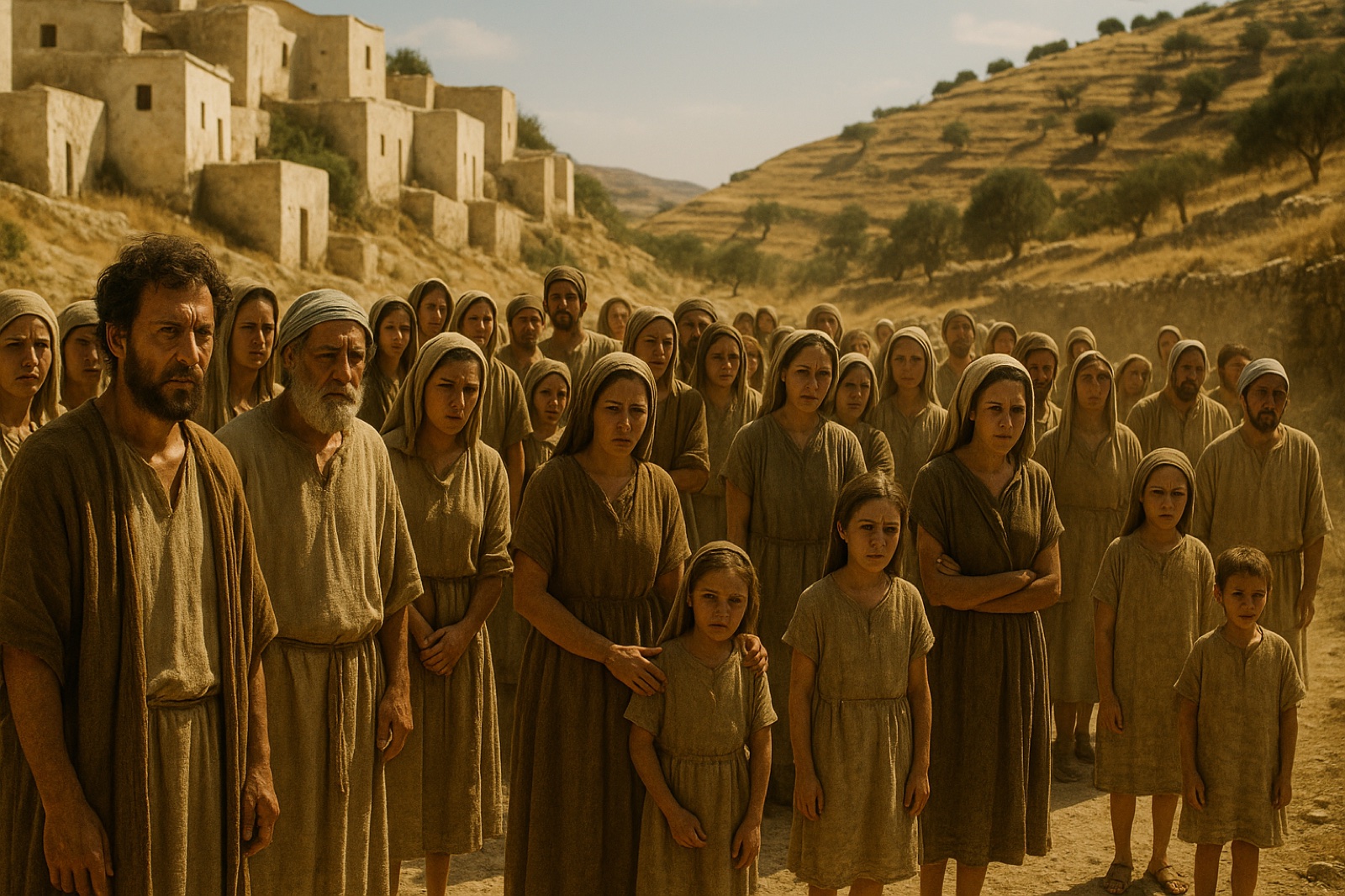
When Jesus said this, crucifixion was not a religious idea. It was not a symbol on a wall. It had not happened to Him yet. It was the most ordinary and most frightening thing Rome did to people in that part of the world, and everyone listening had grown up with it.
Roughly thirty years before this moment, after Herod the Great died, the country rose up. Rome put it down hard. The historian Josephus, writing later in that same century, records that two thousand people were crucified over that revolt (Antiquities 17.295). That is an ancient historian’s count, not a modern census. But even a fraction of that number marks a generation.
So the older people in that crowd could remember it. The younger ones grew up hearing about it from parents who had seen it. Crosses were not kept somewhere holy. They stood beside roads and outside town walls, where ordinary people had to walk past them on the way to somewhere else.
Now hear the sentence again, in the King James wording:
Whosoever will come after me, let him deny himself, and take up his cross, and follow me. (Mark 8:34)
To that crowd, that was not a line about patience. It was a picture of a condemned person walking a public road toward a death they could still have avoided.
One honest note about the carrying
You have probably heard that the condemned always carried their own cross through the streets. It is worth being careful here. Only a couple of ancient writers mention it at all — the Greek writer Plutarch describes a wrongdoer carrying out his own cross, and the playwright Plautus refers to the same practice — so historians do not claim it happened every time. Often the upright post was already standing at the execution ground, and the condemned man carried only the crossbeam.
That small correction does not weaken the picture. It sharpens it. The force of Jesus’ sentence is not really about weight on your shoulders. It is about the walk. A public walk, out in the open, in front of everyone who knows you, toward something you agreed to.
He said it to the crowd, not just the twelve
Here is a detail that is easy to read straight past.
Mark does not open this scene with Jesus and His disciples off to one side. He opens it like this:
And when he had called the people unto him with his disciples also, he said unto them… (Mark 8:34)
Jesus stopped and gathered the crowd first. He wanted ordinary people — not only the inner circle — to hear the cost before they agreed to anything. Luke says the same thing in four words: And he said to them all (Luke 9:23).
Most invitations hide the price until you are already committed. This one led with it, in public, on purpose.
Peter had just said what you would have said
Matthew sets the sentence in a scene that makes it land even harder.
Jesus had just told the disciples plainly that He was going to Jerusalem to suffer and be killed. Peter — who moments earlier had said the truest thing anybody had said about Jesus — pulled Him aside:
Then Peter took him, and began to rebuke him, saying, Be it far from thee, Lord: this shall not be unto thee. (Matthew 16:22)
That is not villainy. That is love. It is exactly what any of us would say to somebody we care about who is walking toward something that will cost them everything.
Jesus’ answer is one of the sharpest things He ever said to a friend: Get thee behind me, Satan… for thou savourest not the things that be of God, but those that be of men (Matthew 16:23).
And then, right after that, with no pause:
If any man will come after me, let him deny himself, and take up his cross, and follow me. (Matthew 16:24)
The order matters. The invitation arrives immediately after somebody tried to talk Him out of the hard road. It is aimed straight at the instinct in all of us that wants faith to stay safe.
Luke added one word the others left out
Matthew and Mark both write “take up his cross.” Luke writes:
And he said to them all, If any man will come after me, let him deny himself, and take up his cross daily, and follow me. (Luke 9:23)
Daily.
One word, and the whole thing changes shape. A cross is a one-time event. Nobody does that daily. By adding that word, Luke says something the image cannot say on its own: this is not a single dramatic moment you brace yourself for. It is a Tuesday. And then another Tuesday.
Two verses later, Luke comes at the same idea from the other side — asking what a person gains by winning the whole world and quietly losing themselves in the process.
The turn: your cross is the one you choose
Put those pieces together and something surprising comes out. It is lighter than the version most of us were handed, not heavier.
If the cross is something you pick up, then the thing that simply happened to you is not your cross.
Your illness is not your cross. Your grief is not your cross. The cruel relative, the bill you cannot pay, the body that will not cooperate — none of that is what Jesus was describing. All of it is real, and God is with you in every bit of it. But God did not hand you those things as a religious assignment, and God is not asking you to carry them silently with a brave face.
You are allowed to say it hurts. You are allowed to ask for help. The uncomplaining endurance so many of us were taught to call “my cross” was never in the sentence.
Your cross is what you choose. Not what happened to you.
What Jesus described is the thing you could avoid and pick up anyway. Telling the truth when a lie would be cheaper. Being known as somebody who follows Him, in a place where that costs you something. Forgiving a person nobody would blame you for cutting off. Giving away money, time, or standing you could easily have kept.
That is the walk. And it is public — that was the whole force of the image. Not a private feeling nobody can see.
The people listening found out what it meant. It is worth knowing that scripture itself only records how two of the twelve died — the rest is tradition, not the Bible — but not one of them got to keep the safe version of the road.
What to do with this on Monday
Here is the practical shift. Stop scanning your life for a burden heavy enough to qualify. That is the softened version, and all it produces is guilt.
Ask a smaller, harder question instead: what is following Jesus actually costing me this week?
If the honest answer is “nothing,” that is worth sitting with. Not as an accusation — as information. It usually means the following has gone completely private, and Jesus put this sentence in front of a crowd for a reason.
And if the answer is something real, you already know where your cross is. It is not the thing you are enduring. It is the thing you keep almost putting down.
That question is easier to answer honestly with something in front of you than in the abstract. Our free How Close Am I to God? assessment walks you through it in a couple of minutes.
Actions to take today
- Rename one thing. Say out loud the hard thing you have been calling your cross, then name it accurately instead — an illness, a loss, a difficult person. Just that. Naming it correctly takes the religious weight off it, and lets you grieve it honestly.
- Make the following visible once. Send one message today that names Jesus to somebody who does not know you follow Him. One sentence. Not an argument, not a debate — just a true thing said out loud.
- Name the cost and answer it. Pick the one thing following Jesus is actually costing you right now, and decide out loud whether you are still willing to pay it. Tell God your real answer, even if the answer today is “not yet.”
Journaling prompts
- What have you been carrying quietly as a religious duty that God never asked you to carry in silence?
- If following Jesus cost you something public this week — a reputation, a friendship, a promotion — which one would you fight hardest to protect, and what does that tell you?
- Peter’s instinct was to protect Jesus from the hard road. Whose hard road are you most tempted to talk them out of, and what is that instinct protecting in you?
A prayer you can pray right now
God, I have been calling a lot of things my cross that You never handed me. I am tired, and I think some of that tiredness came from carrying things silently that I was always allowed to say out loud. Show me what following Jesus actually costs me this week — the real thing, not the imaginary heavy one. And when I see it, give me enough courage to pick it up on purpose instead of complaining my way around it. I want to follow Him with my eyes open. Amen.
One question to think about
Do you think the softened version of this phrase — “it is my cross to bear” — has done more good or more harm in the church? Tell us what you think in the comments.
Share this
- Turns out “take up your cross” was never about putting up with a difficult boss. Jesus said it to a crowd who had seen real crosses on real roads. Completely changes the sentence.
- I always thought my chronic pain was “my cross to bear.” Just learned Jesus was describing something you choose, not something that happens to you. That is oddly freeing.
- Luke adds one word Matthew and Mark leave out: daily. One word, and the whole thing turns from a single dramatic moment into an ordinary Tuesday.
Questions people ask
What does “take up your cross” mean in the Bible?
In Matthew 16:24, Mark 8:34 and Luke 9:23, Jesus tells anyone who wants to follow Him to deny themselves, take up their cross, and follow. In first-century Roman Judea, a cross meant a public execution that people saw beside roads and outside town walls. The phrase describes something a person deliberately picks up and walks toward in the open — not a hardship that simply arrives in their life.
Did Jesus say “take up your cross” before He was crucified?
Yes. In Matthew’s account the sentence comes shortly after Jesus first tells His disciples plainly that He will suffer and be killed in Jerusalem, and long before the crucifixion itself. The disciples had no way to connect the words to Jesus’ own death at the time. They would have pictured the Roman executions they already knew.
Why does Luke say “daily” when Matthew and Mark do not?
Luke 9:23 adds the word “daily” to a sentence that Matthew 16:24 and Mark 8:34 record without it. A crucifixion is a single event, so the addition shifts the picture from one dramatic moment to a repeated, ordinary choice made again each day. It is the clearest difference between the three accounts of this saying.
Is a chronic illness or a difficult relationship “my cross to bear”?
The phrase, as Jesus used it, describes something chosen rather than something suffered. An illness, a loss, or a painful relationship is real hardship, and Christian faith holds that God is present in it — but treating unchosen suffering as a religious duty to endure silently goes beyond what the passage says. There is no requirement in these verses to hide the pain, refuse help, or stop asking for it to change.
Who was Jesus speaking to when He said it?
Mark 8:34 states that Jesus called the people to Him together with His disciples before speaking, and Luke 9:23 says He addressed the words “to them all.” The invitation was made publicly to a crowd of ordinary listeners, not privately to the twelve disciples.