 0
0
 0
0
Maybe you read it late at night. Maybe someone quoted it at you. A man asks Jesus for time to bury his father, and Jesus answers, “Let the dead bury their dead.”
If you have ever stood beside a grave, that line can land like a slap. Is that really what following Jesus costs? Missing your own father’s funeral? Walking away from the people who raised you?
If this verse has bothered you, you are in good company. It has bothered careful readers for a very long time. But “let the dead bury their dead” does not mean what it sounds like at first. And the key to it is not the word “dead.” It is a much smaller word that most of us read right past.
Let the Dead Bury Their Dead: Who Was Jesus Talking To?
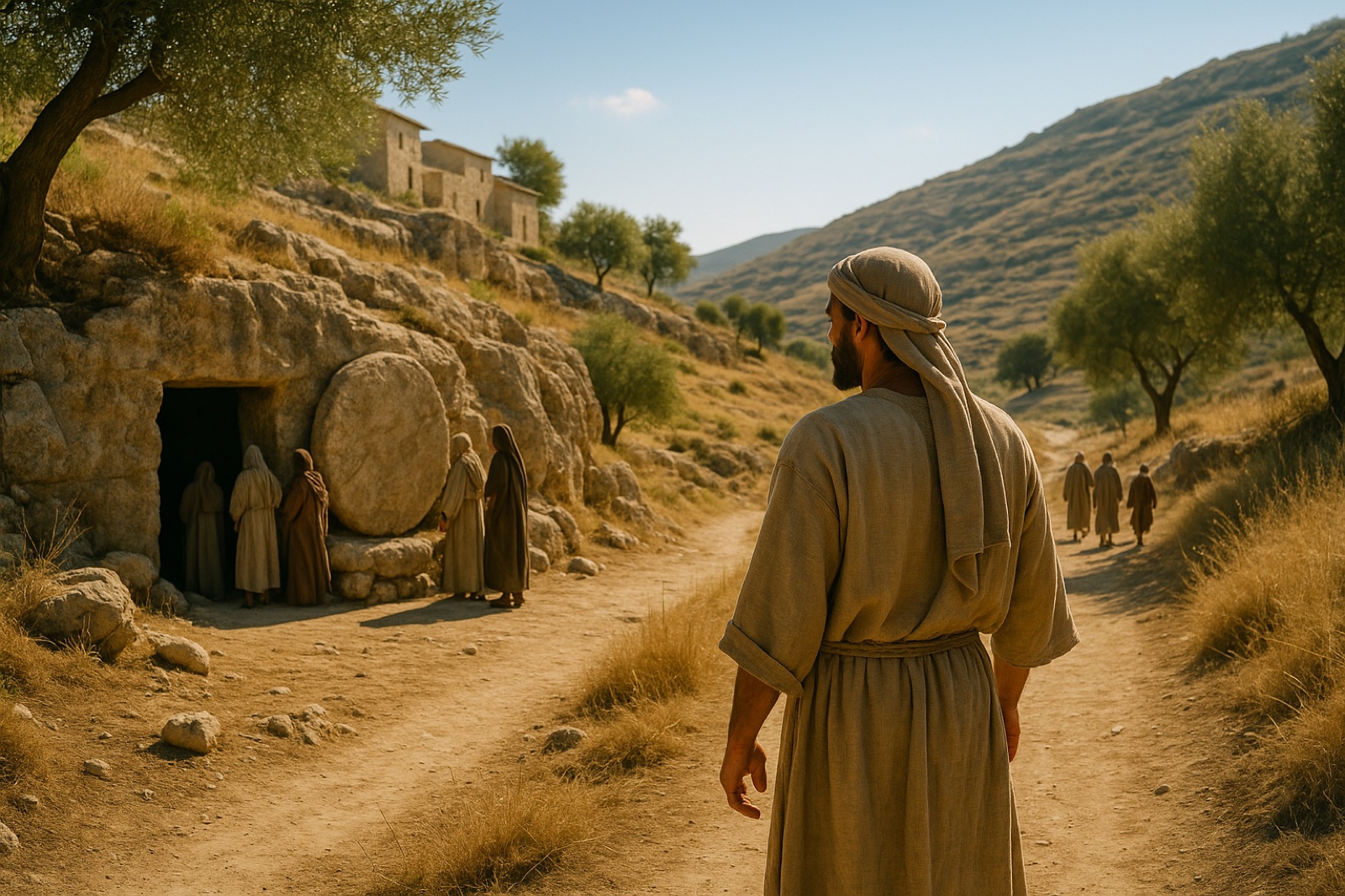
Luke tells this story on a road. Jesus is walking toward Jerusalem, and three people meet Him, one after another.
The first man offers himself: “Lord, I will follow thee whithersoever thou goest.” Jesus answers him honestly: “Foxes have holes, and birds of the air have nests; but the Son of man hath not where to lay his head” (Luke 9:57-58).
The second man is where the surprise is. He did not volunteer. Jesus invited him:
“And he said unto another, Follow me. But he said, Lord, suffer me first to go and bury my father. Jesus said unto him, Let the dead bury their dead: but go thou and preach the kingdom of God.” (Luke 9:59-60, KJV)
Matthew tells the same moment and calls this man “another of his disciples” (Matthew 8:21). So this was not a stranger making excuses. It was someone Jesus already knew, and wanted.
Then a third man speaks: “Lord, I will follow thee; but let me first go bid them farewell, which are at home at my house.” And Jesus says, “No man, having put his hand to the plough, and looking back, is fit for the kingdom of God” (Luke 9:61-62).
And then Luke simply moves on. We are never told what any of the three men decided. The door is left open, the way it is left open for us.
If you want to walk through what following Jesus actually looked like, one ordinary day at a time, this free sample is a gentle place to start:
Burying Your Father Was One of the Most Sacred Duties There Was
This man was not asking for something small. He was asking for something every person listening would call right.
The command was carved in stone: “Honour thy father and thy mother” (Exodus 20:12). And burying a parent was part of honoring them. Long before, Joseph, the second most powerful man in Egypt, asked Pharaoh for nearly the same thing: “let me go up, I pray thee, and bury my father, and I will come again.” Pharaoh said, “Go up, and bury thy father” (Genesis 50:5-6).
So when Jesus says no, it is sharp. On purpose.
But here is a detail most people never notice. The Law of Moses already had two kinds of people who were not allowed to go near even a father’s dead body.
The high priest was one: “Neither shall he go in to any dead body, nor defile himself for his father, or for his mother” (Leviticus 21:11).
The Nazirite, a person who made a special vow to God, was the other:
“He shall not make himself unclean for his father, or for his mother, for his brother, or for his sister, when they die: because the consecration of his God is upon his head.” (Numbers 6:7, KJV)
Notice the reason. Not “because family doesn’t matter.” Because this person has been set apart for God, completely.
So a listener who knew the Law had a place to put Jesus’ words. Being told to leave a father’s burial to others was not a sign of a cold heart. In the Law, it was the mark of someone wholly given to God. One way to read Luke 9, then, is that Jesus was treating an ordinary follower the way the Law treated a high priest. That is not an insult. It is closer to a startling honor.
Was His Father Even Dead Yet?
Here is something else the text never tells us: when the father died. Readers have suggested a few honest possibilities.
- He had just died. Burial in that world usually happened very soon after death. Many readers have noticed it seems odd that a son would be out on the road with Jesus on that exact day, but it is possible.
- He was not dead yet. Some interpreters suggest “let me first bury my father” meant “let me wait until my father has died, and then I will come.” That could mean years.
- He was waiting for a second burial. In and around Jerusalem in Jesus’ time, families often laid a body in a rock tomb. Later, once only bones were left, they gathered the bones into a small stone box called an ossuary. Archaeologists have found many of these boxes. In 1990, scholar Byron McCane argued in the Harvard Theological Review that this man may have been waiting for that second burial. If so, Jesus’ words may even carry a grim play on words: the dead already lying in the family tomb could look after his father’s bones.
There is also the reading many people know best. The first “dead” means people who are spiritually dead, and the second means people who have physically died. The Bible does use “dead” that way. The father in the prodigal son story says, “this my son was dead, and is alive again” (Luke 15:24).
Nobody can prove which of these is right, and it is more honest to say so. But look at what they share. In every one, the man is asking to wait. And not one of them needs Jesus to be cold toward a grieving son.
The Same Jesus Blasted People for Using God to Skip Their Parents
If you still worry that this verse means “Jesus comes before caring for your family,” listen to what He said in Mark 7.
Some religious teachers had a loophole. A person could declare their money “Corban,” which means a gift set aside for God. After that, they could tell an aging mother or father, “Sorry, I can’t use that to help you.” Jesus was furious about it:
“For Moses said, Honour thy father and thy mother… But ye say, If a man shall say to his father or mother, It is Corban, that is to say, a gift, by whatsoever thou mightest be profited by me; he shall be free. And ye suffer him no more to do ought for his father or his mother; Making the word of God of none effect through your tradition.” (Mark 7:10-13, KJV)
Jesus called using God as an excuse to neglect your parents a way of cancelling God’s word.
And while He was dying on the cross, Jesus looked at His mother and at the disciple He loved and said, “Woman, behold thy son!” and “Behold thy mother!” John adds, “from that hour that disciple took her unto his own home” (John 19:26-27). With almost His last breath, Jesus made sure His mother would be cared for.
So whatever “let the dead bury their dead” means, it cannot mean “Jesus doesn’t care about your family.” The rest of the Gospels won’t let it.
The Word That Matters Is “First”
Go back and read what the second and third men said. “Suffer me first to go and bury my father.” “Let me first go bid them farewell.”
Jesus never argues with the funeral. He never says goodbyes are wrong. He answers the word “first.”
The plough line gives it away. Anyone who knew the Scriptures well would likely have thought of Elisha. When the prophet Elijah called him, Elisha “was plowing with twelve yoke of oxen before him” (1 Kings 19:19). Elisha asked, “Let me, I pray thee, kiss my father and my mother, and then I will follow thee.” And Elijah let him go.
But look at how Elisha said goodbye:
“And he returned back from him, and took a yoke of oxen, and slew them, and boiled their flesh with the instruments of the oxen, and gave unto the people, and they did eat. Then he arose, and went after Elijah, and ministered unto him.” (1 Kings 19:21, KJV)
He burned his plough to cook the meal. He turned his old life into food for his neighbors. There was nothing left to go back to.
That is the difference. A goodbye that ends your old life is one thing. A “first” with no end date is another. Elisha’s goodbye closed a door. “Let me first” keeps it propped open forever.
Jesus never argued with the funeral. He argued with the word “first.”
For most of us, “let me first” does not sound like a funeral. It sounds like this:
- “When work calms down.”
- “After the kids are older.”
- “Once I’ve got my life together.”
- “When I feel ready.”
Each one is a good, reasonable thing, just like burying a father. That is exactly what makes it so hard to see. Jesus asked people to take up their cross, and that saying meant something very concrete to the crowd who first heard it. This one is the same. It is not about hating your family. It is about the living thing you keep putting off until “someday.”
If You Are Caring for a Parent Right Now
Maybe you are reading this beside a hospital bed, or between a parent’s doctor visits. Please hear this clearly: this verse is not telling you to walk away.
The Jesus of Mark 7 and John 19 would call that care a way of honoring God. For you, following Jesus today might look exactly like staying. Paul put it bluntly: anyone who does not provide “for those of his own house, he hath denied the faith” (1 Timothy 5:8).
If the care is wearing you thin, you are not failing. Our free Am I Burned Out From Caregiving? check can help you see where you really are. And if the parent in front of you is also the person who hurt you, Can You Honor a Parent You Haven’t Forgiven? was written for exactly that.
Actions to Take Today
- Finish one sentence. On paper or in your phone, write: “Jesus, I’ll follow You, but let me first…” and finish it honestly. Then read it back. That is your “first.”
- Send one message to family. Text or call a parent, grandparent or relative, just to say thank you or to check in. Honoring them is part of following Jesus, not a detour from it.
- Burn one small plough. Pick one thing that keeps you looking back, like an app, a habit or an old excuse, and end it today. Delete it, cancel it, or tell one person you are done with it.
Journaling Prompts
- What good, reasonable thing have you been putting “first,” and how long has it held that place?
- When you picture following Jesus with no “first,” what are you most afraid you would lose?
- Elisha turned his old life into a meal for other people. What part of your past could become a gift instead of a way back?
A Prayer for When “Not Yet” Has Become a Habit
Jesus, I know my “first.” I have been saying it for a long time, and it always sounds so reasonable. Thank You that You never asked me to stop loving my family. You showed me how to love them, even from the cross. Help me stop waiting to feel ready, and take one real step with You today. Whatever keeps me looking back, give me the courage to set it down. Amen.
What Do You Think?
Which reading do you find most convincing: that the man’s father had just died, that he was not dead yet, or that the man was waiting for a second burial? Tell us in the comments. We would love to hear how you read it.
Share This
- “Jesus never argued with the funeral in Luke 9. He argued with the word ‘first.’ I have a few ‘firsts’ of my own.”
- “The same Jesus who said ‘let the dead bury their dead’ condemned people for using religion as an excuse not to care for their parents (Mark 7). The verse isn’t anti-family. It’s anti-someday.”
- “Elisha went home to say goodbye, then burned his plough and followed. The goodbye was never the problem.”
Questions People Ask About “Let the Dead Bury Their Dead”
What does “let the dead bury their dead” mean?
“Let the dead bury their dead” is Jesus’ reply in Luke 9:60 and Matthew 8:22 to a follower who asked to bury his father before following Him. It is not a command to abandon family, since Jesus condemned neglecting parents in Mark 7:10-13. The saying targets the word “first”: a good duty used to postpone following Jesus with no end date.
Where is “let the dead bury their dead” in the Bible?
The saying appears twice in the Gospels. Matthew 8:22 reads, “Follow me; and let the dead bury their dead.” Luke 9:60 reads, “Let the dead bury their dead: but go thou and preach the kingdom of God.” In both, a man had asked Jesus for permission to bury his father first.
Did Jesus tell a man not to go to his father’s funeral?
The Bible does not say whether the man’s father had already died. Interpreters suggest the father may have just died, may still have been alive, or may have been awaiting a second burial of his bones in a stone ossuary, as scholar Byron McCane argued in the Harvard Theological Review in 1990. The text leaves the question open.
Does following Jesus mean abandoning your family?
No. In Mark 7:10-13 Jesus condemned people who used a religious gift called Corban to avoid supporting their parents, and in John 19:26-27 He arranged care for His mother while dying on the cross. 1 Timothy 5:8 says a person who does not provide for their own household has “denied the faith.”
Why did Jesus mention a plough in Luke 9:62?
In Luke 9:62 Jesus said no one who puts a hand to the plough and looks back is fit for the kingdom of God. The image likely recalls Elisha in 1 Kings 19:19-21, who was plowing when Elijah called him. Elisha said goodbye to his parents, then burned his plowing equipment to cook a meal for the people and followed Elijah.