 0
0
 0
0
You know the feeling. Someone asks how you’re doing spiritually, and you give the answer you think you’re supposed to give. “Blessed.” “Trusting God.” “Growing.” But underneath it, the truth is you feel tapped out — like you’ve been trying to have enough faith, pray hard enough, be disciplined enough, and it still isn’t landing. You keep waiting to feel like you’ve arrived somewhere. You haven’t.
If that’s you right now, Matthew 5:3 was written for you specifically. It’s the first thing Jesus says in the Sermon on the Mount — before the miracles, before the parables, before any instruction on how to live — and it’s not what most people expect. The poor in spirit meaning in that verse has almost nothing to do with the humility we usually associate with it. It’s something much rawer, and much better news, than “try to be more modest.”
What “Poor in Spirit” Actually Means in Matthew 5:3
Here’s the verse in full:
“Blessed are the poor in spirit: for theirs is the kingdom of heaven.” — Matthew 5:3 (KJV)
Most sermons treat this as a call to humility — don’t be arrogant, stay teachable, keep a low opinion of yourself. That’s not a bad thing to aim for. But it’s not what this verse is actually describing, and reading it that way flattens the most radical opening line in the entire Sermon on the Mount into a piece of decent life advice.
The Greek Word Jesus Used — And Why It Isn’t “Humble”
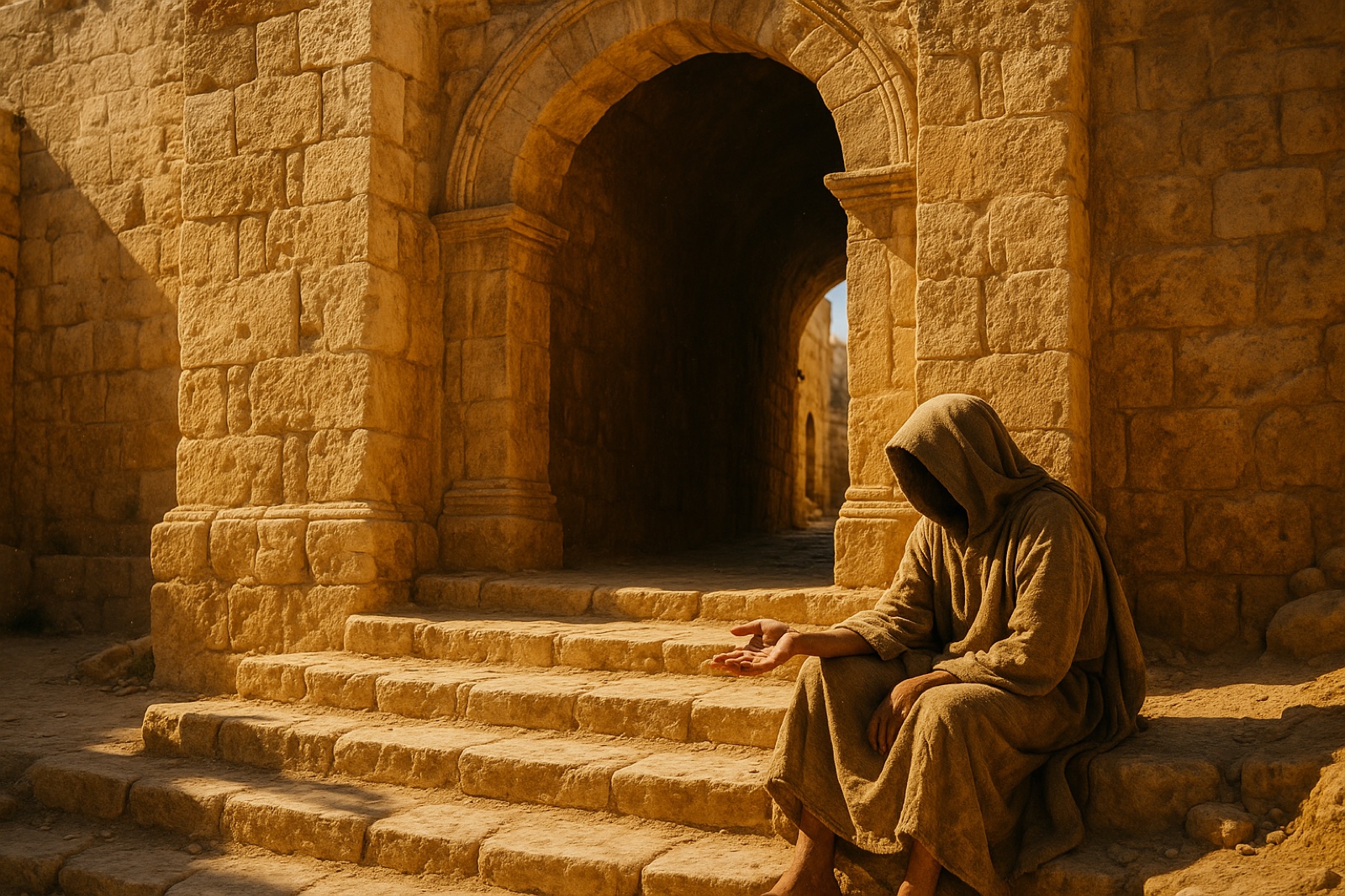
The word translated “poor” here is the Greek ptóchos. Koine Greek actually had two different words for poor, and the distinction matters. Penés described someone who had to work for a living — no savings, no cushion, but functioning. Ptóchos described someone who had nothing at all: a beggar, someone reduced to crouching and cowering, completely dependent on whatever another person chose to hand them. It’s the word for the man sitting at the gate with his hand out, because he has no other option.
Jesus didn’t say, “Blessed are the modest.” He said, “Blessed are the ones who have absolutely nothing to offer, and know it.” That’s not a personality trait you cultivate through discipline. It’s a state of total dependence — spiritual bankruptcy, named without flinching.
What Poverty Looked Like in Jesus’ World
To feel the weight of this, picture what ptóchos looked like in first-century Judea. There was no social safety net. A person reduced to begging sat at a city gate or a temple entrance, because that’s where people passed by — and they depended entirely on the mercy of strangers for that day’s food. They brought nothing to the transaction. No skill to trade, no goods to offer, no leverage. Just an open hand and a hope that someone would be generous.
That image — a person with nothing, positioned at the entrance to something sacred, utterly reliant on mercy — is exactly the picture Jesus is painting onto the human soul in Matthew 5:3. He’s not describing people who are bad at faith. He’s describing people who have finally stopped pretending they have something to trade for it.
Why This Is the First Beatitude
This isn’t a random opening line — it’s the foundation the other seven Beatitudes are built on. You can’t genuinely mourn over what’s broken in you (the second Beatitude) until you’ve stopped defending yourself. You can’t hunger and thirst for righteousness until you admit you don’t already have it. We’ve walked through this same pattern before, in what Jesus actually meant by “blessed are those who mourn” — it’s the same move. Jesus keeps blessing the people who stop performing and start telling the truth about their condition.
It’s the same kind of close reading that changes everything when you dig into the Greek behind what Jesus felt in Gethsemane — the original language keeps refusing to let these moments stay tame and churchy. Jesus wasn’t composed in the garden, and the people he calls blessed here aren’t composed either. They’re empty, and he says that’s exactly where the kingdom starts.
You don’t get filled by proving you’re enough. You get filled by admitting you’re not.
The Turn: Why This Blessing Doesn’t Fit “You Are Enough” Culture
Here’s where it gets uncomfortable in a good way. Modern self-help culture — even a lot of well-meaning spiritual self-help — runs almost entirely on the opposite message. You are enough. You already have everything you need within you. Trust yourself. Believe in your own strength. It sounds empowering, and some of it isn’t wrong as far as it goes. But it is the exact opposite of what Jesus opens the Sermon on the Mount with.
Jesus doesn’t bless the people who found their inner reserves. He blesses the people who ran out of them. Not people who worked hard enough to feel spiritually put-together, but people who finally admitted they aren’t — and stopped performing otherwise. If you’ve been quietly convinced that your faith has to look more disciplined, more confident, more “together” before God will really move in your life, this verse says the opposite. The emptiness you’ve been trying to hide is not disqualifying you. According to Jesus, it’s the doorway.
That’s the real poor in spirit meaning: not a virtue you achieve, but a truth you stop hiding. The kingdom of heaven doesn’t belong to the people who climbed high enough to deserve it. It belongs to the ones with nothing in their hands, standing at the gate, finally honest about it.
What This Looks Like in Your Life Today
This isn’t meant to stay as a nice historical observation about Greek vocabulary. It’s meant to change how you show up in front of God tonight. If you’ve spent years quietly practicing humility as a discipline — the way the path to true righteousness through humility is often taught — this is the piece that’s easy to miss: you’re not trying to earn a posture. You’re allowed to simply arrive with nothing, today, as you actually are.
Actions to Take
- Name one thing right now. Pick one specific area of your life where you’ve been pretending to have it handled — your marriage, your finances, your temper, your doubt — and say the true state of it out loud, to God, in one sentence. Takes two minutes.
- Read Acts 3:1-10 tonight. It’s the story of the beggar at the temple gate — the literal picture behind the word ptóchos. Read it before you read Matthew 5:3 again, and notice what changes.
- Change how you open your next prayer. Instead of your usual opening, start with: “God, I’ve got nothing to bring you today.” Then just wait and see what you actually say next.
Something to Sit With
- Where in your life have you been performing spiritual strength instead of admitting you’re running on empty?
- What would it cost you to stop defending yourself in front of God the way you defend yourself in front of people?
- If the kingdom of heaven already belongs to people with nothing to offer, what have you been trying so hard to earn?
A prayer for right now:
God, I’m tired of pretending I have this together. I don’t have the faith I keep performing, or the patience I keep promising, or the confidence I keep projecting. I’ve got nothing in my hands to hand you today except the truth of that. So here it is, empty-handed and honest. Meet me here.
Here’s a question worth sitting with, and maybe talking through with someone you trust: if being “poor in spirit” isn’t about acting humble but about being honest about having nothing — where’s the one place in your life you’re still pretending otherwise? We’d love to hear your answer.
Share This
- “I keep waiting to feel spiritually put-together before God will really use me. Matthew 5:3 just told me that’s backwards.”
- “Poor in spirit doesn’t mean humble. It means empty-handed. Big difference — and it changes how I’m praying tonight.”
- “The kingdom of heaven belongs to people with nothing to offer. I’ve been trying to earn a spot that was never for sale.”
Questions People Ask About “Poor in Spirit”
Does “poor in spirit” mean I should have low self-esteem?
No. It’s not about how you feel about yourself in general — it’s about your posture toward God specifically. It means dropping the pretense that you’ve earned or achieved your way into His kingdom, not thinking less of yourself as a person.
Is being “poor in spirit” the same as humility?
They’re closely related but not identical. Humility is often described as a virtue you practice and grow in over time. “Poor in spirit,” from the Greek ptóchos, describes a more specific and immediate state — total dependence, like a beggar with nothing to trade. It’s less something you build and more something you admit.
Why is this the first Beatitude?
Because it’s the foundation the rest are built on. You can’t mourn honestly, hunger for righteousness, or receive mercy in the way Jesus describes until you’ve first admitted you don’t already have it all together.
What’s the difference between “ptóchos” and “penés” in Greek?
Penés described a working person without savings — poor but functioning. Ptóchos described someone with absolutely nothing, dependent entirely on others’ mercy, like a beggar at a gate. Jesus deliberately chose the stronger word.
How do I actually live this out, not just understand it?
Start small and specific: one honest sentence to God about where you’re actually empty, instead of the polished version you usually offer. That single act of honesty is what “poor in spirit” looks like in practice.