 0
0
 0
0
You sent the letter. You said the thing that cannot be unsaid. A friend hears about it, raises an eyebrow and says, “Well. You have crossed the Rubicon now.”
The crossing the Rubicon meaning is simple. You have taken a step you cannot take back. There is no return to how things were.
The phrase comes from one night in 49 BC, when Julius Caesar led his soldiers over a small river in northern Italy and started a civil war. It is a great story, and we will walk through what the old writers really say about it.
But roughly eighty years later, in a far corner of the same Roman world, another man made the biggest decision of his life. He had no river and no army. And the way he decided may fit your real life better than Caesar’s way does.
Crossing the Rubicon Meaning: What the Phrase Means Today
To “cross the Rubicon” means to make a choice that cannot be undone. Once you do it, the old road is closed. You can only go forward.
People use it for big moments. Handing in your notice at work. Telling a hard truth. Moving to a new country. Signing the paper.
It sits next to phrases like “the point of no return” and “burning your bridges.” It also has a twin from the very same night: “the die is cast.”
What Really Happened at the Rubicon in 49 BC
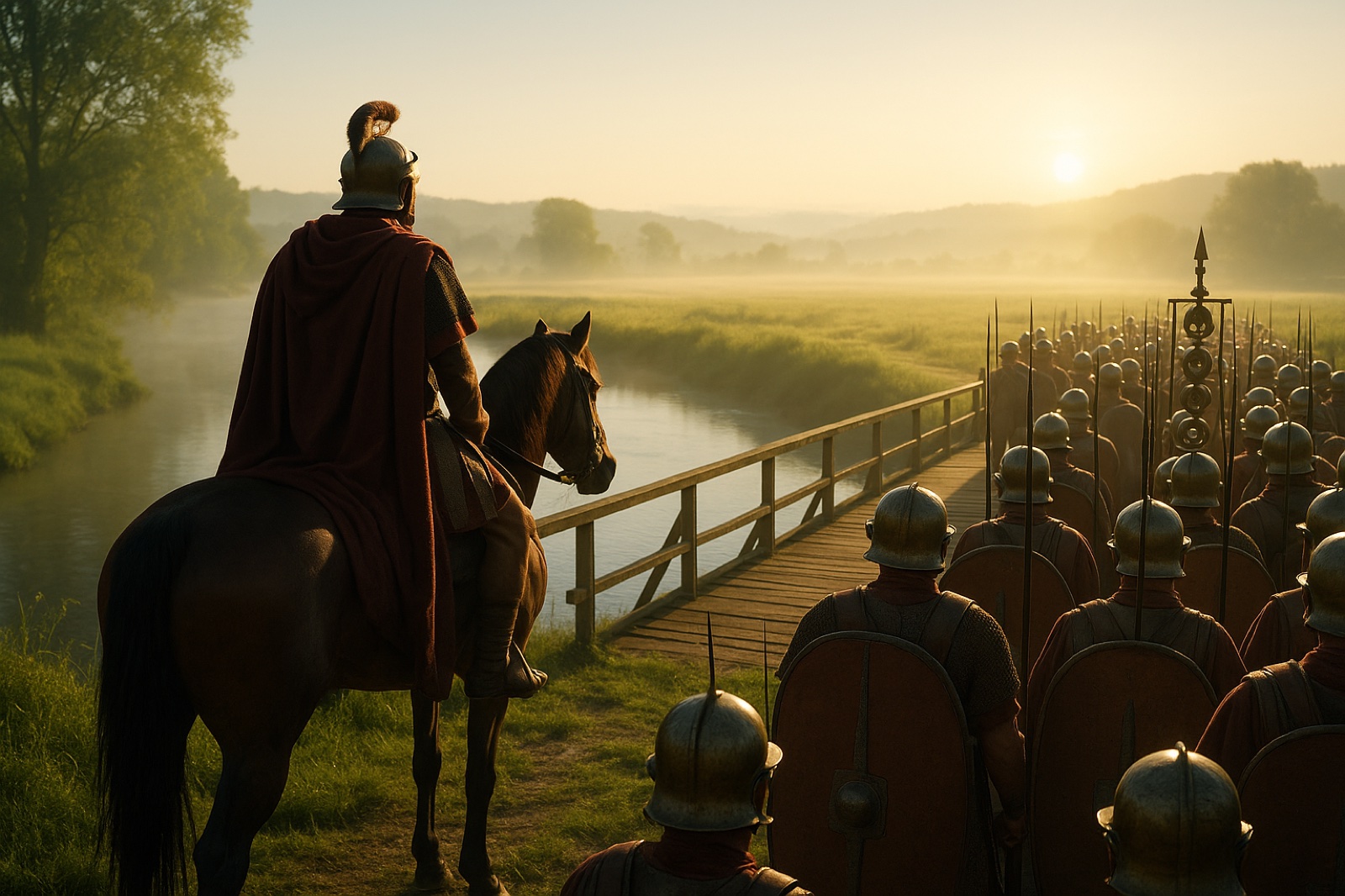
The Rubicon was a small river. It marked the edge of the land Caesar governed. A Roman general was not allowed to lead his army out of his own province and into Italy. To do it was to break the law and, in effect, to go to war with his own government.
Caesar had spent years fighting in Gaul. His enemies in Rome wanted him to give up his army and come home as a private citizen. The Roman writer Suetonius says one senator, Cato, had sworn to put Caesar on trial the moment he did.
So Caesar came to the river. Nobody knows the exact date. Historians usually place it around 10 January, 49 BC. The Greek writer Plutarch says he had no more than five thousand foot soldiers and three hundred horsemen with him. The rest of his army was still on the far side of the Alps.
And he stopped. Plutarch writes that Caesar “communed with himself a long time in silence as his resolution wavered back and forth” (Life of Caesar, chapter 32). Suetonius gives him a line to say to the men around him:
“Even yet we may draw back; but once cross yon little bridge, and the whole issue is with the sword.” (Suetonius, Life of Julius Caesar, 31)
Then he crossed, with the words that became famous: “The die is cast.” In Latin, Suetonius wrote iacta alea est. Most of us know it in a different word order, alea iacta est.
Plutarch tells it a little differently. In his version the words are “Let the die be cast,” and in his Life of Pompey he adds that Caesar called them out in Greek. He describes the line as “the phrase with which men usually prelude their plunge into desperate and daring fortunes.” It was a gambler’s saying. It did not mean “I know how this ends.” It meant “throw the dice and see.”
What followed was years of civil war, Roman against Roman. (The Caesars left more marks on the world of the Bible than most people know. Even the word “gospel” was Caesar’s word first.)
The Man Who Crossed Never Mentioned the River
Here is a detail that is easy to miss. Caesar wrote his own book about this war. In it, he says that once he knew his soldiers were with him, he “set off with that legion to Ariminum,” the first town on the other side (The Civil War, Book 1). That is all. He does not mention a river, or dice, or a long silence on the bank.
The scene we all know comes from Plutarch and Suetonius, who wrote more than a hundred years later. Plutarch notes that a man named Asinius Pollio was there that night, and Pollio later wrote a history that is now lost. So the story may well go back to someone who saw it. But the man who made the most famous crossing in history left it out of his own account.
Why did he cross? In his book, Caesar says he asked his soldiers to defend his reputation and standing against his enemies. Suetonius lists several ideas people had. Then he passes on what Pollio reported Caesar saying, word for word, as he looked at his beaten enemies after a later battle:
“They would have it so. Even I, Gaius Caesar, after so many great deeds, should have been found guilty, if I had not turned to my army for help.” (Suetonius, Life of Julius Caesar, 30)
If that is right, the most famous decision in history was made, at least in part, to stay out of a courtroom and to protect a name.
Another Decision: “He Stedfastly Set His Face”
Now go forward about eighty years, to a small territory on the eastern edge of the Roman world. Jesus is in Galilee, in the north. Crowds follow Him there. In the south is Jerusalem, where the leaders who will reject Him hold the power.
He knows what waits there. In Luke chapter 9 He tells His friends plainly: “The Son of man must suffer many things, and be rejected of the elders and chief priests and scribes, and be slain, and be raised the third day” (Luke 9:22, KJV).
Then, a few verses later, Luke writes one quiet sentence:
“And it came to pass, when the time was come that he should be received up, he stedfastly set his face to go to Jerusalem,” (Luke 9:51, KJV)
The Greek verb here is sterizo. It means to fix something firmly in place, or to make it steady. Put very literally, He “fixed His face” to go.
Luke uses that verb only two other times in his Gospel. Once it is for “a great gulf fixed” (Luke 16:26). Once it is when Jesus tells Peter, “strengthen thy brethren” (Luke 22:32). So this is not the word for a hard heart. It is the word for something set in place, and for making a shaky person steady. Jesus pointed His whole self in one direction and held it there.
If you would like to walk that road with Him a little each day, this free sample is a gentle place to begin.
Caesar Threw Dice. Jesus Walked With Open Eyes.
Put the two men side by side and the differences begin to show.
Caesar gambled. Plutarch says that at the river he was “like one who casts himself from a precipice,” and that he “closed the eyes of reason” to the danger. He hoped to win, and he did not know if he would.
Jesus did not gamble. He had already said out loud what the road would cost Him. He was not hoping it would turn out some other way. His eyes were open the whole time.
Caesar crossed, it seems, so that he would not be put on trial. Jesus walked toward a trial He had already said He would lose.
There Was No Rubicon on the Road to Jerusalem
This is the part that surprised me most.
What makes a Rubicon a Rubicon is that the step itself shuts the door behind you. Once Caesar’s army was over the bridge, the law had been broken. He could not un-cross. In a strange way, that makes things simpler. You decide once, and after that there is nothing left to decide.
Luke’s story has no line like that. No law locked Jesus in. The road back to Galilee stayed open every single day.
And it was not a short walk. The trip that starts in Luke 9:51 does not reach the city until Luke 19, almost ten chapters later. Luke keeps reminding us He is still going. He “went through the cities and villages, teaching, and journeying toward Jerusalem” (Luke 13:22, KJV). Partway there Jesus says, “I must walk to day, and to morrow, and the day following” (Luke 13:33, KJV).
Even on the last night, the way out was still there. He prayed, “Father, if thou be willing, remove this cup from me: nevertheless not my will, but thine, be done” (Luke 22:42, KJV). That is not a man carried along by a choice He can no longer undo. That is a man choosing again.
There is a small clue to this back in chapter 9. Jesus says that anyone who wants to come after Him must “take up his cross daily, and follow me” (Luke 9:23, KJV). Matthew and Mark record this saying too. Only Luke’s has the word “daily.”
So Caesar crossed once. Jesus chose daily.
What Jesus Did Next With a Set Face
Look at what happens right after each man decides.
Caesar’s words at the bridge, as Suetonius gives them, were that from then on “the whole issue is with the sword.”
The very next thing in Luke is a village that will not let Jesus in. They “did not receive him, because his face was as though he would go to Jerusalem” (Luke 9:53, KJV). His set face cost Him a welcome on day one.
Two of His friends, James and John, are angry. They ask if they should call fire down from heaven on the village. Luke says:
“But he turned, and rebuked them, and said, Ye know not what manner of spirit ye are of. For the Son of man is not come to destroy men’s lives, but to save them. And they went to another village.” (Luke 9:55-56, KJV)
He used no sword and no fire. He simply went on to another village.
He was firm about where He was going. He was gentle with the people who stood in the way. Most of us find it hard to hold those two together. When we finally make up our minds, we tend to get sharp with everyone who does not clap for us.
Most of Your Big Decisions Are Not Rubicons
We love the Rubicon story because it makes a promise. One brave moment, and it is settled for good. Send the letter. Buy the ticket. Say the words. Done.
Some choices are like that. But the ones that shape a life almost never lock behind you.
Staying married. Staying sober. Forgiving someone who hurt you. Caring for a parent who is sick. Following Jesus. With every one of these, you can turn around on any ordinary morning, and nobody will stop you.
So if you are waiting to feel a point of no return, you may wait a very long time. And if the old pull comes back on day four, it does not mean your decision was fake. It means it was never a Rubicon. It is a road, and roads are chosen again each morning.
That is why Jesus, a few lines later in the same chapter, uses a picture from the farm: “No man, having put his hand to the plough, and looking back, is fit for the kingdom of God” (Luke 9:62, KJV). It can sound like a threat. But it is simply how ploughing works. You make a straight line by looking at where you are going. The line follows your face.
This is good news if you find big choices hard. You do not need Caesar’s nerve. You do not have to be sure about the next thirty years. You only need today’s direction. If deciding at all feels impossible, that is worth knowing too. And if you are waiting to feel brave first, it helps to see that courage in the Bible was never a feeling.
And you do not walk alone. The One who asks for “daily” did it first. He walked today, and tomorrow, and the day following.
A good place to start: 30 Days Walking with Jesus. Short daily videos, audio and a guide that take you through the life of Jesus one day at a time, so you can keep choosing the road each morning. Get the free sample. Free.
Actions to Take
- Sort your decision. Write down the choice in front of you. Next to it write “Rubicon” (one step that cannot be undone) or “Road” (something you will have to choose again each day). A Rubicon needs slow, careful thought before you step. A Road needs a small plan for tomorrow morning. If you are not sure what is worth walking toward, our free What Are My Core Values? quiz takes a few minutes.
- Set your face for one day. Finish this sentence on paper or on your phone: “Today I am walking toward ____.” Put it where you will see it when you wake up. Do not promise forever. Promise today.
- Go to another village. Think of one person who has made your road harder by not supporting it. Choose one gentle thing to do today. Send a kind message, or just drop the argument and keep walking. Be firm about the direction and soft with the person.
Journaling Prompts
- Which choice in your life have you been treating like a Rubicon, waiting for one big moment to settle it, when it is really a road?
- When does the pull to turn back show up for you? What time of day, what place, what mood? What would “setting your face” look like right then?
- Where has being firm made you hard toward people? What would firm and gentle look like with one of them?
A Prayer
God, I keep waiting for one big moment that will make my choice final, so I never have to make it again. I see now that Jesus did not get that either. He set His face and then chose the road again each morning. Give me enough steadiness for today’s part of the road, and make me gentle with the people who do not understand where I am going. When I look back tomorrow, turn my face forward again. Amen.
Discussion Question
Which do you think takes more courage: one big step you can never take back, or a choice you have to make again every morning? Tell us in the comments. We would love to hear how you see it.
Share This
- “Caesar crossed the Rubicon once and could not go back. Luke says Jesus ‘set his face’ for Jerusalem and could have turned around any day. He kept going anyway. I think I have been waiting for a Rubicon when what I have is a road.”
- “Julius Caesar never mentions the Rubicon in his own book about the war. The famous river scene comes from writers a hundred years later.”
- “‘Take up his cross daily.’ Only Luke has the word daily. The big choices are not made once.”
“Caesar crossed once. Jesus chose daily. Most of life is the second kind.”
Questions About Crossing the Rubicon
What does crossing the Rubicon mean?
Crossing the Rubicon means making a decision that cannot be undone and that commits a person to a course of action with no way back. The phrase comes from Julius Caesar leading his army across the Rubicon river in northern Italy in 49 BC, an act that broke Roman law and started a civil war.
Where does the phrase “crossing the Rubicon” come from?
The phrase “crossing the Rubicon” comes from 49 BC, when Julius Caesar led soldiers across the Rubicon, a small river that marked the edge of his province. A Roman general was not allowed to bring his army out of his province into Italy, so crossing the river meant war with the Roman government. The exact date is not known, but historians usually place it around 10 January, 49 BC.
Did Julius Caesar really say “the die is cast”?
The Roman writer Suetonius reports that Julius Caesar said “the die is cast” (in Latin, iacta alea est) at the Rubicon. The Greek writer Plutarch reports that Caesar said it in Greek, as “Let the die be cast,” and calls it a common saying for people about to take a great risk. Both men wrote more than a hundred years after the event, and Caesar’s own book about the civil war does not mention the Rubicon or the saying at all.
Is crossing the Rubicon in the Bible?
The phrase “crossing the Rubicon” is not in the Bible. It comes from Roman history. The Bible does describe a moment of firm decision in Luke 9:51, which says that Jesus “stedfastly set his face to go to Jerusalem” (KJV), knowing He would suffer and die there. Unlike Caesar’s crossing, that decision could have been reversed on any day of the journey, and Luke shows Jesus choosing it again and again.
What does “he stedfastly set his face to go to Jerusalem” mean?
Luke 9:51 in the King James Version says that Jesus “stedfastly set his face to go to Jerusalem.” The Greek verb is sterizo, which means to fix firmly or make steady. Luke uses the same verb for “a great gulf fixed” in Luke 16:26 and for “strengthen thy brethren” in Luke 22:32. The verse means Jesus firmly decided to travel to Jerusalem even though He had already told His disciples that He would be rejected and killed there.