 0
0
 0
0
A striker scores in the 89th minute. Before the teammates even reach him, before the crowd noise finishes climbing, his hand goes up. One finger, sometimes two, pointed straight at the sky. He holds it for a second, maybe two, then gets swallowed by the pile of bodies celebrating with him.
Nobody in the stadium blinks. Nobody in the broadcast booth mentions it. It happens so often, in so many sports, that it’s stopped registering as a thing that happens at all. It’s just part of the furniture of scoring — like the sprint to the corner flag, like the chest thump, like the fist pump.
But it is a specific gesture. It has a specific target. And almost nobody watching has ever stopped to ask what the athlete is actually doing in that second — or why it spread to nearly every sport on earth without anyone deciding it should.
It’s Not Just Soccer — and It’s Not New
Point to the sky after a touchdown. Point to the sky after a home run. Point to the sky crossing the finish line first. Tennis players do a quieter version — eyes up, racket lowered, a half-second pause before the fist pump. Sprinters do it mid-stride, arm still moving.
The gesture crosses sports that have almost nothing else in common — different rules, different countries, different cultures of celebration — which is itself worth sitting with. Gestures don’t usually spread that broadly by accident. Something about this one is doing real work for the people making it.
Ask athletes directly and the answers cluster into a small number of patterns. Some say it plainly: they’re thanking God, in the middle of the biggest moment of their day, before they thank anyone else. Others say it’s for someone specific who isn’t there anymore — a parent, a coach, a sibling — a private message aimed upward because there’s nowhere else to send it. And a surprising number say something closer to: they’re not entirely sure why they do it. They saw someone else do it, it felt right, and now it’s automatic. Muscle memory built on top of an emotion, not a decided belief.
That last group matters more than it sounds like it should. A lot of what looks like devotion in sports is actually imitation — one athlete sees another do something in a moment of real feeling, copies the shape of it without necessarily copying the meaning, and the gesture keeps traveling long after its original intent got separated from it.
Why Rituals Show Up Exactly When the Stakes Are Highest
Sports psychologists have studied this territory for decades, mostly around pre-performance routines — the same free-throw dribble, the same walk-up song, the same glove tap before every pitch. The consistent finding is that ritual behavior isn’t superstition in the way people dismiss it. It’s a nervous system doing something useful: giving an overwhelmed brain a small, controllable action to perform when the actual outcome is completely out of its hands.
The skyward point is the post-performance version of that same instinct. The moment right after a goal or a win is often described by athletes as disorienting — a flood of adrenaline, relief, and disbelief arriving all at once, with thousands of people watching and no script for what to do with your body in that second. The gesture gives the moment somewhere to go. It’s fast, it’s physical, and it points the emotion at something bigger than the scoreboard, even if the athlete couldn’t fully explain in words what that “something bigger” is.
That’s a genuinely interesting thing about human beings, independent of what anyone believes: in our most overwhelming moments, we tend to reach for a gesture aimed outward and upward, not inward. Joy that big apparently doesn’t want to stay contained in the person who’s feeling it.
The Part Almost Nobody Asks About
Here’s the question that gets skipped every single time the camera catches the gesture: does it matter who’s watching?
If an athlete points to the sky in an empty stadium during a solo training session, it means exactly the same thing to them as when they do it in front of eighty thousand people and a global broadcast. The private version and the public version should, in theory, come from the same place. But it’s worth being honest that they don’t always land the same way to everyone watching — some viewers read it as sincere, some read it as performance, and both reactions usually say more about the viewer than the athlete.
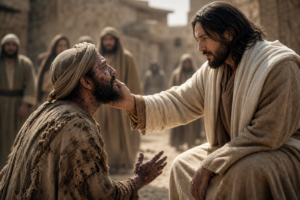
This exact tension — between something being genuinely felt and something being performed for an audience — isn’t a new problem sports invented. Jesus talked about it directly, two thousand years ago, when he described people who prayed loudly on street corners specifically so they’d be seen doing it, versus people who did the same thing behind a closed door where no one but God would ever know. He wasn’t saying the public version was automatically fake. He was pointing at something harder to see from the outside: the gesture itself doesn’t tell you the truth. The audience it’s aimed at does.
An athlete who’d point to the sky the exact same way with the cameras off is doing something different from an athlete performing a gesture they picked up because it plays well on replay — even if, from the stands, the two look identical.
What This Actually Changes
None of this is really about sports, or at least not only about sports. Most people have a version of this same gesture somewhere in their own life — a small, semi-public act that’s supposed to signal gratitude, humility, or faith, and that gets performed so often it’s stopped being examined. A grace said before a meal at a crowded table. A “blessed” caption under a photo. A thank-you posted where people can see it, instead of said quietly where no one would ever know.
None of that makes the gesture wrong. It just means the gesture was never really the point. The point was always what was happening underneath it — whether anyone was watching or not.
Next time the camera catches that finger going up after a goal, it’s worth a different kind of curiosity than usual. Not “is that real,” like it’s a performance to be graded. Just — what would this same person do if the stadium were empty and nobody was ever going to see it? That question, more than the gesture itself, is where the real answer lives.
Take a Moment With This
- Notice one gesture you repeat without examining it. A grace before meals, a phrase you say out of habit, a post you make. Just notice — don’t change anything yet.
- Ask the empty-room question about it. Would you still do this exact thing, the exact same way, if no one would ever know? The honest answer isn’t a verdict — it’s just information.
- Do one private version of something you usually do publicly. Say the thank-you where nobody hears it. See what’s left when the audience is gone.
Something Worth Sitting With
Do you think a gesture’s meaning depends on who it’s performed for, or does it carry its own meaning no matter who’s watching? Drop your take in the comments — this one splits people more than it seems like it should.
📌 Share this if it gave you something to think about:
“The gesture doesn’t tell you the truth. The audience it’s aimed at does.” Full read →
Ever wonder if athletes actually mean it when they point to the sky after scoring — or if it’s just something they picked up from watching other players do it? bgodinspired.com
The most interesting question about that skyward point after a goal isn’t whether it’s real. It’s what the athlete would do if the stadium were empty. Full read →
Frequently Asked Questions About Athletes Pointing to the Sky
Why do athletes point to the sky after they score?
Athletes give a range of reasons: many say it’s a quick expression of thanks to God in the moment right after a big play. Others say it’s aimed at a specific person who has passed away — a parent, coach, or sibling. Some admit they picked up the gesture from watching other athletes and it became automatic, without a specific meaning attached each time.
Did one specific athlete start the sky-point gesture?
There’s no single confirmed originator — the gesture appears across multiple sports and decades, which suggests it developed independently in more than one place rather than spreading from one source. Its consistency across sports as different as soccer, baseball, and track points to it meeting a common emotional need after high-stakes performance rather than being a copied trend from one athlete.
Is pointing to the sky always religious?
Not always. While many athletes describe it as a spiritual gesture of thanks, others use it to honor a deceased loved one, and some do it purely out of habit picked up from teammates or idols, without consciously attaching meaning to it each time.
What did Jesus say about public displays of faith?
Jesus described the difference between people who prayed publicly to be seen doing it and people who prayed privately, where only God would know. His point wasn’t that public devotion is inherently wrong — it was that the value of the act depends on what’s actually happening in the person doing it, not on how visible it is.
Why do humans reach for rituals in high-pressure moments?
Sports psychologists have found that ritual behavior — a consistent gesture, routine, or action performed under pressure — helps give an overwhelmed nervous system something small and controllable to do when the actual outcome is out of its hands. This applies both before high-stakes moments and in the flood of emotion right after them.
—
If this opened a door, you might also find these worth reading:
→ Paul Had One Word for the Comparison Trap — and It’s Been in Your Dictionary This Whole Time