 0
0
 0
0
Someone scores three goals and the announcer says it: hat trick. Three wickets in a row in cricket. Three goals in football. Three wins at almost anything.
Nobody is wearing a hat. Nobody mentions a hat. So why is it called that?
It is not a figure of speech. There was a real hat. A crowd bought it, one summer afternoon in 1858, for a bowler who had just done something they had never seen.
Why is it called a hat trick?
Short answer: because the first man to do it was handed an actual hat.
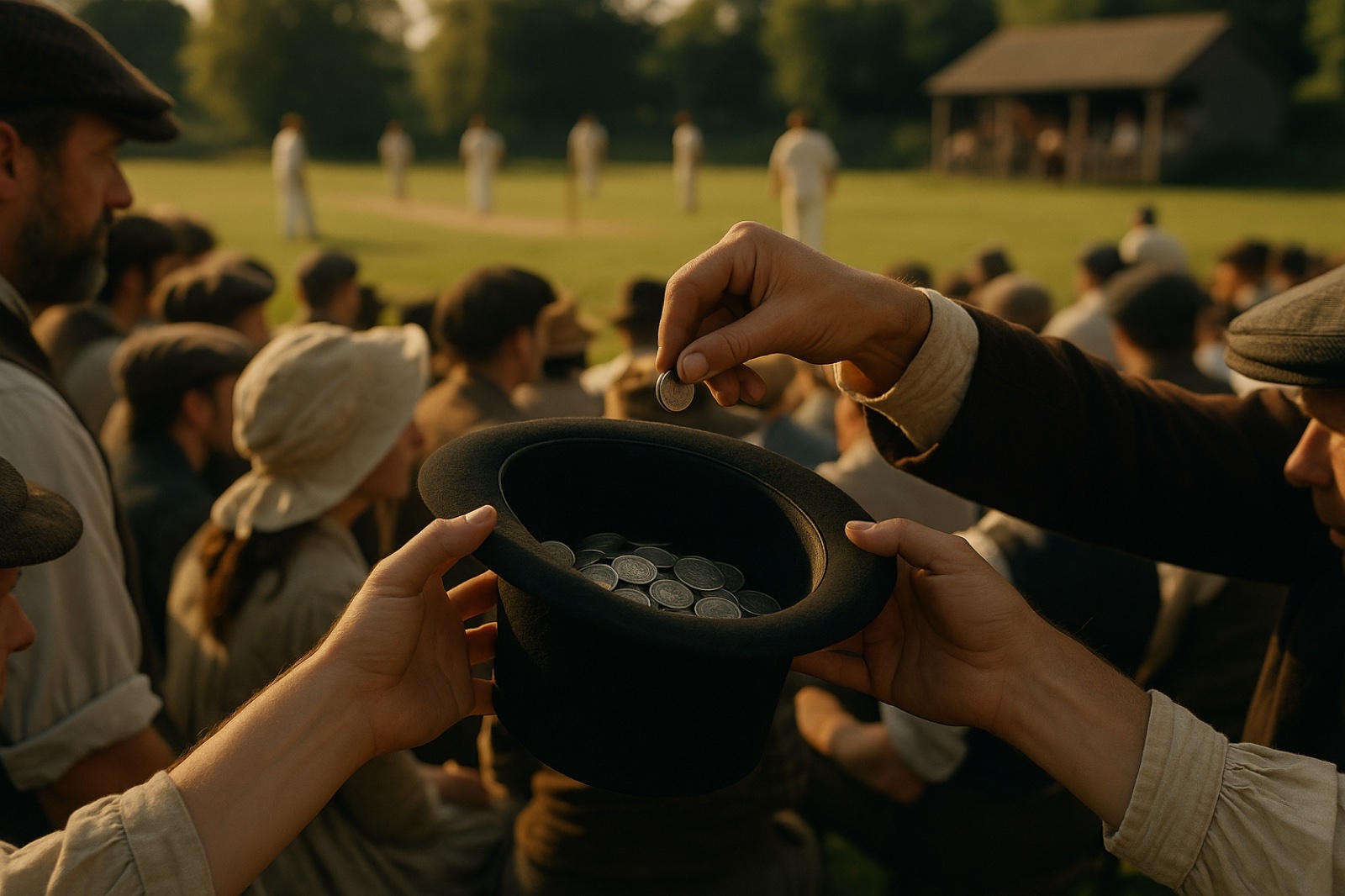
In 1858 an English cricketer named Heathfield Harman Stephenson — everyone called him H. H. Stephenson — took three wickets with three balls in a row. The people watching took up a collection, passed a hat around the ground, and used the money to buy him a new one.
No rule said they had to. There was no trophy for it, no record book waiting, no league office to approve anything. A crowd decided that what they had just watched deserved something, and went and got it.
More than a century and a half later, we still use their word for it.
The match was eleven men against twenty-two
This is the part most retellings skip, and it is the part that makes the feat make sense.
Stephenson was bowling for the All-England Eleven against the Twenty-Two of Hallam, at the Hyde Park ground in Sheffield. Those numbers are not a misprint. The All-England Eleven were touring professionals, so far ahead of local sides that the locals were allowed to field twenty-two players instead of eleven just to make a contest of it.
So when Stephenson took three wickets with three balls, he was doing it against a side with twice the batsmen to spare. The match details come from the Oxford English Dictionary‘s account of the phrase, which is where most tellings of the story eventually lead back to.
He was a professional — a paid player, not one of the gentleman amateurs. Collections like this one were customary for professionals who did something outstanding, and that detail tells you something on its own. The money was worth collecting.
It may not even have been a hat
Here is where the story gets honest about itself.
The dictionary’s account says Stephenson was presented with “a cap or hat” bought with the money. A cap or hat. The reference work that defines the phrase cannot tell you for certain which object started it.
That is not a hole in the story. That is the story. Nobody filed it anywhere. No governing body logged the award, because there was no award — just a crowd, a collection, and something bought on the day.
It took seven years for anyone to write the word down
The feat was 1858. The earliest printed use of “hat-trick” anyone has located so far is 1865. Seven years later.
And it is not in a report of some famous match. It is in a local paper — the Chelmsford Chronicle, in a write-up of a club game between Grays and Romford. The line says a bowler “effected the hat-trick by getting three wickets in the over.”
Read that again: in the over. Not three balls in a row — three wickets in the same over. The phrase we use today was looser when it first reached print, and tightened up afterwards.
Sources differ on which 1865 publication deserves the credit; some accounts name a cricket periodical instead of the Chelmsford paper. What they agree on is the year, and that it took years. The honour existed first. The word caught up later, from the bottom up, through people writing about village games.
Hockey got it from a hat shop, not a league
Cricket gave the phrase to the world. In North America the hat itself came back — and again, not from anyone official.
“Hat trick” had already turned up in some newspapers in the 1930s and early 1940s. But the Hockey Hall of Fame credits a Toronto businessman named Sammy Taft with making it stick. Taft sold hats, and he offered a free one to any player who scored three goals in a Toronto game.
On 26 January 1946, a Chicago forward named Alex Kaleta walked into Taft’s shop wanting a fedora he could not afford. Taft told him he could have it for nothing if he scored three that night against the Maple Leafs. Kaleta scored four. His team still lost 6-5. He got the hat.
Taft’s own explanation of why he said it was not complicated: “I just, for some reason, said ‘You go out there and score three goals tonight and I’ll give you the hat.'”
There is a competing claim as well. A Montreal hat shop, Henri Henri, gave free hats to three-goal scorers at the Forum between 1950 and 1970. Two hat sellers, two cities, one tradition — and no league in either version.
Which is why, in arenas today, the hats come out of the stands. Fans throw their own onto the ice. Nobody presents anything. The crowd just takes what is on its heads and throws it.
What the hat was actually for
Line up all three moments and the same thing happens every time.
A crowd in Sheffield decided a bowler deserved something, and bought it. A hat seller in Toronto decided a goal-scorer deserved something, and gave it. Strangers in an arena tonight will decide the same thing and throw what they are wearing.
In none of them is there a rule. No form to fill in, no committee, no points table. One of the oldest honours in sport has never once been awarded by the sport.
And you cannot arrange one for yourself. That is the quiet thing about it. A player can earn the three goals — that part is skill and work and nerve. But nobody can buy their own hat and have it mean anything. The moment you organise your own ovation, it stops being one. The opposite reflex is just as human — people can be quick to cut you down when you rise — and both of them point at the same fact. Honour that passes between people is never actually in your hands.
There is old wisdom about this, far older than cricket: the praise worth having is the praise somebody else gives you. Let another person do the praising. And sitting underneath that is a harder idea — that the honour people hand around among themselves and the honour that comes from God are two different currencies, and only one of them can be campaigned for. Chase the first and you will spend your life reading the room. The second was never up for a vote.
Maybe that is why the story lasted and the object did not. The hat itself dropped out of the record completely. The dictionaries cannot even agree whether it was a hat or a cap.
Stephenson went on to captain the first English cricket team ever to tour Australia, in 1861-62, sailing out on the SS Great Britain. He coached, he umpired a little, he died in 1896. None of that is what he is remembered for.
He is remembered because one afternoon, some people who owed him nothing passed a hat around.
Worth knowing the next time you hear the phrase. And worth knowing about your own work, too — the parts that get noticed are rarely the parts you campaigned for. If you catch yourself keeping count of who has clapped, a few honest questions can show you how much of your week is being spent waiting on other people’s approval. Fiction has chewed on this for a long time as well; one of the most talked-about endings in recent television is four people fighting over a blessing that none of them could hand themselves.
A good place to start:
The Beginner’s Guide to Feeling God’s Presence Every Day
A short video guide and companion PDF for noticing God in ordinary days — the commute, the kitchen, the waiting.
Get the free guide
Free.
Questions people ask about the hat trick
Why is it called a hat trick?
The term comes from cricket in 1858. The English bowler H. H. Stephenson took three wickets with three consecutive balls, and the spectators passed a hat around the ground to collect money, which was used to buy him a hat. The name stuck and later spread to other sports, where three goals or three wins in one game became a hat trick.
Who got the first hat trick?
Heathfield Harman Stephenson, an English professional cricketer who lived from 1833 to 1896. He took three wickets with three balls in 1858, bowling for the All-England Eleven against the Twenty-Two of Hallam at the Hyde Park ground in Sheffield. He was presented with a hat — some accounts say a cap — bought with money collected from the crowd.
What sport did the term hat trick come from?
Cricket. The phrase was first used for a bowler taking three wickets with three consecutive deliveries, and only later moved into ice hockey, football and other sports, where it usually means three goals by one player in a single game.
When was the phrase hat trick first used in print?
The earliest printed use found so far is 1865, seven years after the 1858 cricket feat that inspired it. It appears in a match report of a club game between Grays and Romford, describing a bowler who got three wickets in an over. Sources disagree about which publication carried it first, but they agree on the year.
Why do hockey fans throw hats on the ice?
Because the honour was always given by the crowd rather than by the league. The custom was popularised by hat sellers — the Hockey Hall of Fame credits the Toronto businessman Sammy Taft, who gave a free hat to Alex Kaleta in January 1946 after Kaleta scored four goals in a game. Today fans supply the hats themselves, throwing them onto the ice when a player scores three.
A question for you
Which honour would mean more to you — the one your field officially hands out, with a ceremony and a certificate, or the one that comes from people who had no obligation to give you anything at all? Tell us which one you would rather have, and why, in the comments.
If you want to share this
Just learned “hat trick” comes from cricket in 1858. A crowd passed a hat around to buy a bowler a new one after he took three wickets with three balls. No league, no rule — just people who decided it deserved something. https://bgodinspired.com/index.php/sports-and-faith/why-is-it-called-a-hat-trick/
Nobody can say for certain whether it was a hat or a cap. The dictionary that defines “hat trick” hedges on the object itself. More than a century and a half later, we still use the crowd’s word for it: https://bgodinspired.com/index.php/sports-and-faith/why-is-it-called-a-hat-trick/
The hat trick reached hockey because a Toronto hat seller told Alex Kaleta in 1946 he could have the fedora free if he scored three that night. He scored four. The league had nothing to do with it. https://bgodinspired.com/index.php/sports-and-faith/why-is-it-called-a-hat-trick/