 0
0
 0
0
There’s a number that has been sitting with scientists, journalists, and anyone who pays attention to what NASA has been quietly building toward.
100,000.
That’s how many new worlds NASA’s next great space telescope is expected to discover. Not accumulated slowly over a decade. Not spread across a generation of smaller missions and incremental upgrades. One telescope. One survey. 100 million stars watched at once — and roughly 100,000 new planets expected to emerge from the data.
In the thirty years since scientists confirmed that planets orbit other suns, humanity has found about 5,700 of them. The Nancy Grace Roman Space Telescope — scheduled to launch in fall 2026 — could find nearly seventeen times that total in a fraction of the time.
The scientists building it are not shy about what is really driving the search.
They want to know if we’re alone.
What the Roman Telescope Is Actually Looking For
The telescope is named for Nancy Grace Roman — NASA’s first Chief of Astronomy, the woman who spent decades laying the institutional groundwork for the Hubble Space Telescope while navigating a field that wasn’t built to accommodate her. It’s a fitting name for an instrument designed to see what prior missions have been looking past.
Roman will conduct what NASA calls the Galactic Bulge Time Domain Survey — a deep, wide-field scan of 100 million stars near the heart of the Milky Way, watching for the precise dimming that happens when a planet passes in front of its star. Every blink is a candidate world.
Previous missions like Kepler and TESS found planets by watching smaller patches of sky for months at a time. Roman’s field of view is 100 times wider than Hubble’s. It is built, essentially, to see everything at once.
The mathematics of what that means for planetary discovery are staggering. Among the expected 100,000 new planets, researchers anticipate finding Earth-sized worlds in habitable zones around distant suns — places where liquid water is theoretically possible, where the chemistry of life could have had billions of years to run its experiments.
What those experiments produced, if anything, is the question Roman is really asking.
The Question Underneath the Question
On the surface, “are we alone?” is a scientific inquiry. Are there planets with the right conditions? Has chemistry elsewhere in the galaxy had 13 billion years to arrive at something that breathes, moves, wonders?
But the question doesn’t stay on the surface for long.
If the universe is large enough to contain 100,000 undiscovered worlds — if the same physics that formed our sun formed a hundred billion others — then what does that say about us? Are we one improbable accident among trillions of other improbable accidents? Does our existence mean something specific, or is it simply what happens when hydrogen has enough time?
These are not questions that fit neatly into a paper published in The Astrophysical Journal. They are the questions that show up at 2am. They are the reason the Drake Equation — a formula for estimating how many communicating civilizations might exist in the galaxy — has a cultural footprint far larger than any formula has a right to have.
We’re not just asking whether microbes exist on a distant moon. We’re asking whether the universe knows we’re here.
What Fermi’s Paradox Might Actually Be Telling Us
There’s a problem that has shadowed the search for extraterrestrial life since physicist Enrico Fermi raised it at a Los Alamos lunch in 1950. He looked up from his tray, made some rough calculations about the age and size of the galaxy, and asked the question that still hasn’t been answered:
If they’re out there — where is everybody?
The Milky Way is old enough that if intelligent life arose elsewhere even a billion years before us, there should be some evidence by now. Radio signals. The signature of industrial civilizations in the spectra of distant stars. Megastructures. Something. The galaxy is old. The distances, while vast, are not infinite. Something should have reached us.
We have nothing.
The Roman Telescope will widen this paradox rather than solve it. We may discover that the galaxy is full of planets and silent throughout. Earth-sized worlds at the right distance from the right kind of star — and not a single signal coming from any of them. The universe full of possibility, and possibly empty of everything else.
That possibility doesn’t settle the question of what we are. It sharpens it.
If we are the only ones — if this planet is the one place in a galaxy of 400 billion stars where the chemistry crossed the threshold into awareness — what does that mean? Does it make us precious? Or does it make the silence even lonelier?
This is the kind of question that ancient writers were wrestling with long before science had the instruments to frame it in data.
A Question Asked 3,000 Years Earlier
There’s a piece of ancient writing that keeps surfacing in my mind whenever this conversation comes up.
It was written by a shepherd-king who spent enough time under open desert skies to feel the same vertigo that NASA’s exoplanet count is meant to produce. He didn’t have a telescope. He didn’t have spectroscopy, orbital mechanics, or the concept of a galaxy. He had a clear night, a reasonable mind, and a question that 3,000 years of scientific progress has not made obsolete.
He wrote: “When I consider your heavens, the work of your fingers — the moon and the stars, which you have set in place — what is mankind that you are mindful of them? Human beings, that you care for them?”
That’s Psalm 8, written around 1000 BCE. Before Copernicus established that Earth moves around the sun. Before Newton described the laws of motion that govern planetary orbits. Before we understood that the faint smudges visible to the naked eye on a clear night were entire galaxies, each containing hundreds of billions of stars.
He was staring at a fraction of the actual universe and already feeling the vertigo of scale. And he was asking — without the language of astrophysics but with the same underlying urgency — the question that Roman is being built to answer.
In all of this, does anyone know we’re here?
What’s striking is what he didn’t do with the question. He didn’t treat it as a crisis. He didn’t arrive at despair. He arrived at wonder — and then at something more specific. The psalm ends not with an answer to the cosmic scale problem, but with a claim about a different kind of significance altogether.
And then there’s another ancient text, written by a different voice from the same tradition, that approaches the scale question from a different direction. The prophet Isaiah, writing about the one who created the stars, says: “He who brings out the starry host one by one, and calls forth each of them by name.” (Isaiah 40:26)
By name.
Not “the 400 billion stars in the Milky Way.” Not catalog designations and coordinate systems. By name. Each one.
The astronomers building Roman have named exactly zero stars individually. The practical work of naming billions of objects is impossible at human scale — they use identifiers in databases, coordinates in catalogs. The idea of knowing each one individually, personally, by something that corresponds to identity rather than location, belongs to a category of knowing that science doesn’t attempt.
And yet the ancient claim is that this has already been done.
What 100,000 New Worlds Won’t Answer
Roman will launch in fall 2026 and begin returning data not long after. The first wave of exoplanet candidates will reshape what we know about how common planets are, how often they occur in habitable zones, and whether Earth is a statistical anomaly or something like a template.
The discoveries will be extraordinary.
And the deepest version of the question will likely remain.
Because here’s the thing about “are we alone?”: it’s actually two questions wearing the same coat. One of them is scientific — a question about the distribution of biology across the cosmos, answerable in principle with the right instruments and enough data. Roman may make real progress on that one.
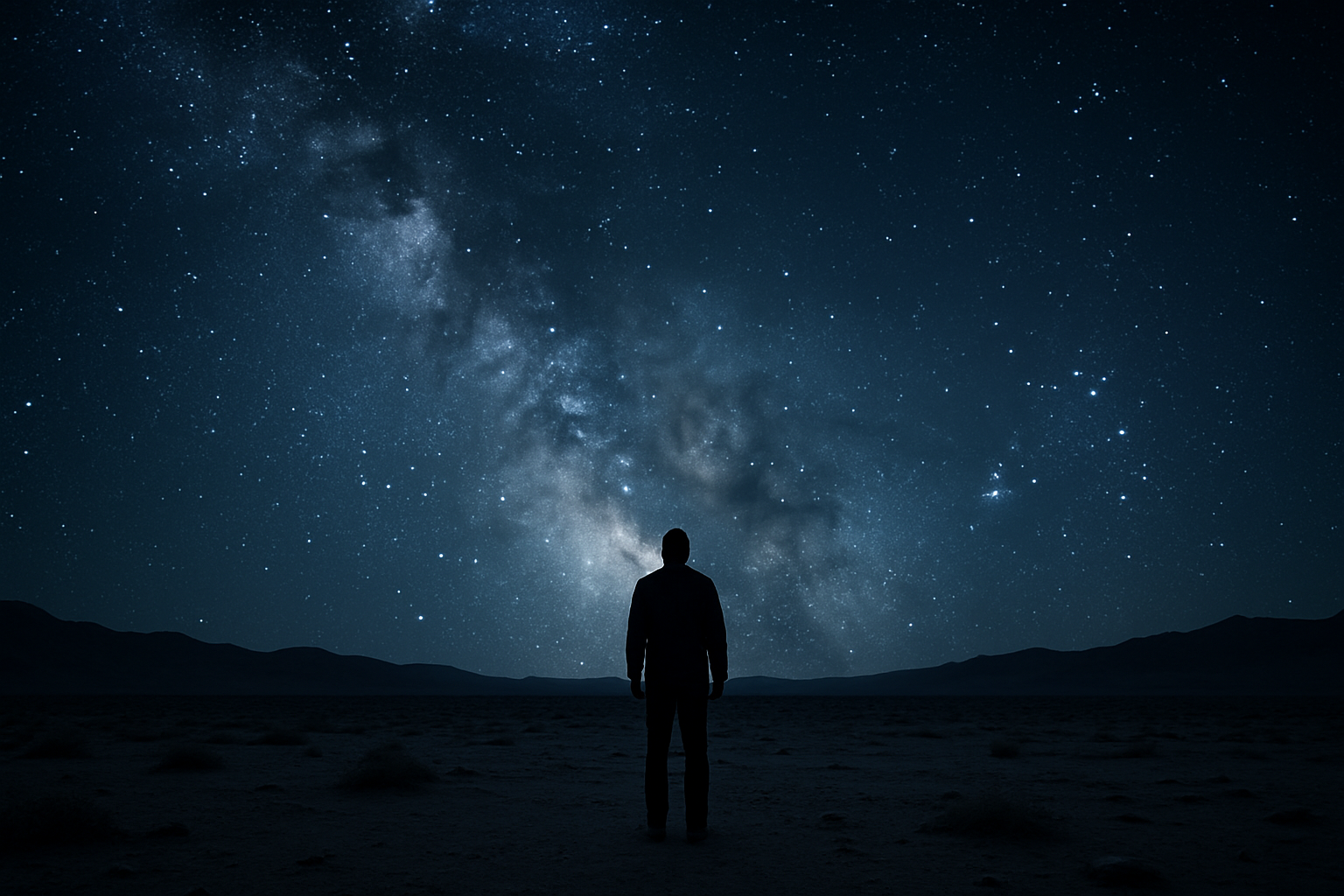
The other question is something else entirely. It’s the question the shepherd-king was asking under his desert sky. It’s the question you’re actually asking when you look up on a genuinely dark night and feel small in a way that is both uncomfortable and, somehow, important.
That question isn’t really “is anyone else out there?”
It’s: does anyone know I’m here?
Scale doesn’t answer that. A catalog of 100,000 new worlds doesn’t answer that. The answer to that question, if it exists at all, comes from somewhere other than a telescope.
What’s worth considering is that the ancient writers who first felt this vertigo — who looked up at a sky they couldn’t explain and asked the same question — weren’t reaching for a scientific answer. They were reaching for a personal one. And they believed they found it. Not in data. In encounter.
Whether you share that belief or not, there’s something worth sitting with: the same question driving a $4 billion space mission has been alive in the human heart for at least three millennia. That’s not a coincidence. That’s a need so deep it outlasts every instrument we build to answer it.
Roman will find worlds. That part is almost certain.
What it will also find, if we’re honest, is that the question underneath the question is still there — waiting.
If you’ve been sitting with that question and want to explore what it might mean to actually feel the presence of what the ancient writers were pointing at, this free resource is a place to start. No telescope required.
And if science and faith crossing paths is a territory you find worth exploring further, this piece on what neuroscience just confirmed about gratitude — and what David wrote about it first — covers ground that might surprise you.
Discussion Question
Scientists have now confirmed thousands of planets outside our solar system — and Roman may find 100,000 more. If the search eventually concludes that Earth is the only place with life, does that make human existence feel more significant to you — or lonelier? Share your honest reaction.
Frequently Asked Questions
What is the NASA Roman Space Telescope?
The Nancy Grace Roman Space Telescope is NASA’s next major space observatory, scheduled to launch in fall 2026. Named for NASA’s first Chief of Astronomy, it will conduct a wide-field survey of 100 million stars and is expected to discover approximately 100,000 new exoplanets — nearly seventeen times the total number found in the previous thirty years of planet-hunting combined.
How many exoplanets could NASA’s Roman Telescope find?
Scientists estimate the Roman Telescope could catalog roughly 100,000 new exoplanets during its primary mission. Previous telescopes like Kepler and TESS discovered planets by watching smaller sky patches for months at a time. Roman’s field of view is 100 times wider than Hubble’s, allowing it to observe far more stars simultaneously — making its discovery potential dramatically larger.
What is Fermi’s Paradox?
Fermi’s Paradox is a question raised by physicist Enrico Fermi in 1950: if intelligent life exists elsewhere in the galaxy, given how old and large the universe is, why haven’t we detected any evidence of it? The galaxy is old enough that a civilization arising even a billion years before us should have produced detectable signals. The fact that we’ve found none remains unexplained and is sometimes called ‘the Great Silence.’
What does Psalm 8 say about the universe and human significance?
Psalm 8, written approximately 3,000 years ago, opens with the writer gazing at the night sky and asking: ‘When I consider your heavens, the work of your fingers — the moon and the stars, which you have set in place — what is mankind that you are mindful of them?’ The psalm addresses the same question driving modern space exploration: in the face of cosmic scale, do human beings matter? The ancient writer’s answer was not despair but wonder — arriving at a claim that significance comes not from scale, but from being personally known.
What does Isaiah 40:26 say about the stars?
Isaiah 40:26 says: ‘He who brings out the starry host one by one, and calls forth each of them by name.’ The verse describes God as knowing each star individually by name — not by catalog number or coordinate, but by identity. For context, modern astronomers have named no stars individually at scale; the Roman Telescope database will use identifiers and coordinates. The ancient claim that each star is known by name is presented not as poetic exaggeration but as a statement about the nature of the one who created them.