 0
0
 0
0
This week a headline started going around that asked a big, scary question: the end of humanity? It was about the Yellowstone supervolcano, the huge sleeping volcano under the famous park in the western United States. The piece walked through, step by step, what would happen if Yellowstone erupted today.
If you clicked on it with your heart beating a little faster, you are not alone. Yellowstone is one of the most searched volcanoes on Earth, and almost every search carries the same quiet fear: could it just go off, with no warning, and change everything overnight?
Here is the short answer, before anything else. No. Not with no warning. And right now, none of the warning signs are happening.
What would happen if Yellowstone erupted? First, what this “study” actually is
The piece behind the headlines was written by two disaster researchers in the UK: Ilan Kelman, a professor of disasters and health at University College London, and Matthew Blackett, a natural hazards geographer at Coventry University. It was published on September 21, 2026 on The Conversation, and then shared widely by science news sites.
Here is the part most of the headlines skipped. It is not a prediction. The authors call it, in their own words, “a thought experiment into what might happen in the worst case scenario.” They built it from what is already known about big eruptions and about how countries handle disasters. It is a “what if” story, told carefully, so that people can think about it before they ever have to.
And here is the other part that got lost. After walking through the whole terrible scenario, their conclusion is not “the end of humanity.” They write that this power “changed the planet, but did not end humanity – or come close to doing so.”
The headline asked the scariest question. The authors answered it with a calm no.
The Yellowstone supervolcano warning signs would come weeks first
The most useful part of the scenario is the timeline. The researchers describe an eruption that sends signals for weeks, and even months, before anything comes out of the ground. In their story it goes something like this:
- About two months before: a swarm of small earthquakes starts under the caldera, the giant bowl the last big eruption left behind. The instruments notice the quakes are slowly moving upward.
- About one month before: the swarm keeps climbing. GPS stations on the ground start to drift apart. The ground itself begins to rise faster. Geysers start acting strangely. Gas sensors pick up more carbon dioxide and sulfur gases.
- About two weeks before: the ground is moving by centimetres a day. In the scenario, scientists hold a press conference, give a very high chance of eruption, and an evacuation zone reaching about 100 kilometres beyond the park is ordered.
- Then the eruption.
Notice what that means. The scariest version of Yellowstone, the one people picture, is the one where it happens with no notice at all. The experts’ version is the opposite. A super-eruption would be one of the loudest, slowest, most watched events on the planet.
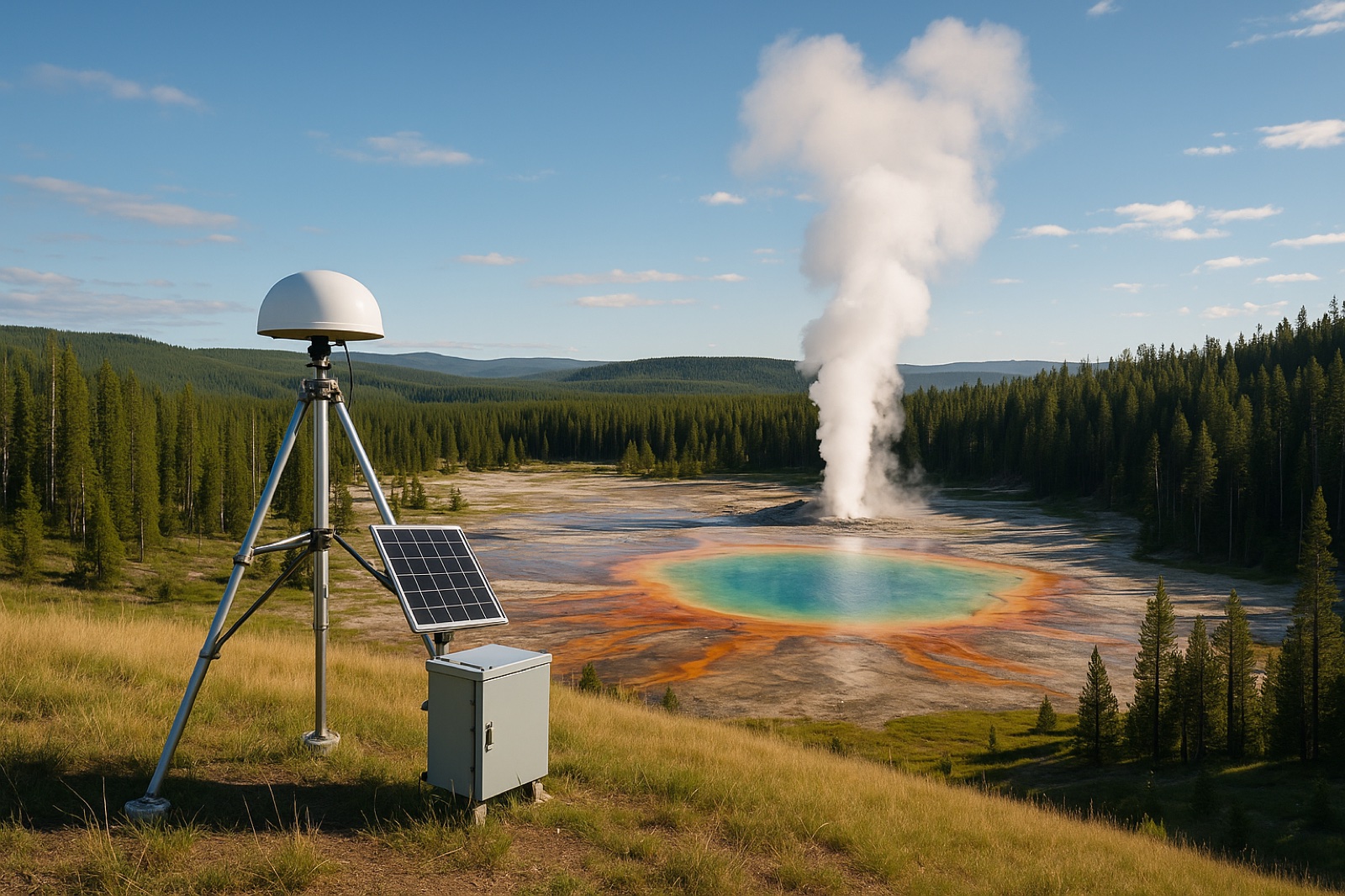
Yellowstone is already one of the most closely watched volcanoes in the world. It is covered with seismometers, GPS stations and gas sensors, much like the kind of station you would see on a hillside in the park. People are paid to watch it every single day.
Is Yellowstone going to erupt? What the monitors say right now
The United States Geological Survey (USGS) runs the Yellowstone Volcano Observatory. Its most recent monthly update, on September 1, 2026, says it plainly: “Yellowstone Caldera activity remains at background levels.” There were 61 small earthquakes in August. The biggest was a magnitude 2.0, the kind most people would never feel.
The update also says there has been “no significant uplift” of the north rim of the caldera since January, and only minor uplift of the caldera this year. The official alert level is Normal. The aviation code is Green. That is the lowest setting on both scales.
The USGS has also said there is no evidence right now that enough melted, ready-to-erupt magma has built up under the park to feed a super-eruption.
Warning signs can also be false alarms
Here is a detail the researchers include that is worth sitting with. Yellowstone has had restless periods before. Around 2013 and 2014 it showed some of the same kinds of signals, with earthquakes and ground movement. Nothing erupted.
The authors point out that earthquake swarms and a rising ground, on their own, do not mean an eruption is coming. What worries scientists is many signs happening together, and getting stronger. One strange week is not a countdown.
That is good news, and it also says something about fear. Fear usually grabs the first scary sign and runs ahead with it. Good watchers look at the whole picture, over time, before they decide anything.
What would a Yellowstone eruption actually do?
The scenario does not pretend a super-eruption would be small. In the worst case the researchers describe:
- An eruption column rising 30 to 50 kilometres into the sky.
- Deadly flows of hot gas and ash near the volcano, which is why the evacuation matters so much.
- Ash falling hundreds of kilometres away, more than a metre deep in the nearest cities in their model.
- Power grids, farms and supply chains badly hit, and a global cooling of around 1.5°C for a few years, which would hurt harvests far from America.
It would be a true global disaster. That is exactly why the authors wrote it. Ilan Kelman has spent much of his career arguing that a natural event like an earthquake or an eruption does not decide on its own how many people get hurt. What people do beforehand, and whether they are ready, has a lot to do with it. He even wrote a book about that idea, called Disaster by Choice.
So their thought experiment is not really about fear. It is about getting ready while there is time, which is the whole point of a warning.
For perspective, the last super-eruption at Yellowstone happened about 631,000 years ago. The USGS puts the yearly chance of another one at roughly 1 in 730,000. You can read how scientists read a different kind of early warning in our piece on the four warning signs a hurricane is about to strengthen fast, and how researchers found a hidden magma reservoir under Tuscany by listening closely.
Why warnings exist
There is something quietly hopeful in the way this story is built. The volcano does not want anything. It is rock and heat. But the warning signs, and the people watching them, turn a blind catastrophe into something humans can see coming and step out of the way of.
A warning, when you think about it, is not the threat. It is the kindness that comes before the threat, so that the worst never has to happen.
That idea is very old. Some of the oldest stories people tell about God are stories of warnings given early, and given plainly, to people who had time to listen. In one of the best known, a whole city is given forty days’ notice. The point of that story is not the disaster. The point is that the people listened, and the disaster never came. The warning was never meant to frighten them. It was meant to save them.
Maybe that is a better way to hold the big fears we carry, about volcanoes, about the future, about things we cannot control. The world is not built to ambush us. Even the ground under Yellowstone speaks up long before it moves.
What to do with the fear
If a headline like this one leaves your mind spinning at night, a few simple things help:
- Go to the people who actually watch it. The USGS Yellowstone Volcano Observatory posts plain updates every month, free for anyone.
- Read past the headline. The question in a headline is written to be clicked. The answer is usually further down, and usually calmer.
- Notice the difference between “could” and “will.” A thought experiment says what could happen. A monitor says what is happening.
- Give the worry somewhere to go. If worry is a pattern for you and not just a one-off, our free How Anxious Am I? check-in can help you see it more clearly.
Right now the caldera is quiet. The instruments are on. The people are watching. And if that ever changes, we will not be the last to know. We will be told, weeks ahead.
Discussion question
Do you think “what if” disaster scenarios like this one help people get ready, or do they mostly just make people more afraid? Tell us what you think in the comments below.
Share this
“Saw the ‘end of humanity?’ Yellowstone headline. Turns out it’s a thought experiment, the authors say it wouldn’t come close to ending humanity, and the USGS says Yellowstone is at background levels right now. Worth reading past the headline: https://bgodinspired.com/?p=116492”
“If Yellowstone ever did erupt, it would give weeks of warning signs first: quakes climbing, ground rising, geysers changing. A warning isn’t the threat, it’s the kindness before it. https://bgodinspired.com/?p=116492”
Questions People Ask About a Yellowstone Eruption
Would a Yellowstone eruption happen without warning?
A Yellowstone super-eruption is not expected to happen without warning. Disaster researchers Ilan Kelman and Matthew Blackett, in a September 2026 worst-case scenario, describe weeks to months of warning signs first, including earthquake swarms moving upward, rapid ground uplift, changing geyser behaviour and rising volcanic gases. Yellowstone is monitored daily by the USGS Yellowstone Volcano Observatory.
Is Yellowstone showing signs of erupting right now?
No. The USGS Yellowstone Volcano Observatory’s September 1, 2026 update said Yellowstone Caldera activity remained at background levels, with 61 small earthquakes in August 2026 and a largest of magnitude 2.0. The volcano alert level is Normal and the aviation colour code is Green, the lowest levels on both scales.
Was the “end of humanity” Yellowstone article a real prediction?
No. The widely shared September 2026 Yellowstone piece by Ilan Kelman of University College London and Matthew Blackett of Coventry University is a thought experiment about a worst-case super-eruption, not a forecast. The authors concluded that such an eruption would change the planet but would not end humanity or come close to doing so.
How likely is a Yellowstone super-eruption?
A Yellowstone super-eruption is very unlikely in any given year. The last one happened about 631,000 years ago, and the US Geological Survey estimates the yearly chance of another at roughly 1 in 730,000. The USGS has also said there is currently no evidence of enough eruptible magma beneath Yellowstone to feed a super-eruption.
Do earthquakes at Yellowstone mean an eruption is coming?
Not on their own. Yellowstone regularly has small earthquakes and has had restless periods, such as around 2013 and 2014, that produced earthquakes and ground movement with no eruption. Scientists look for many warning signs happening together and growing stronger over time before treating an eruption as likely.