 0
0
 0
0
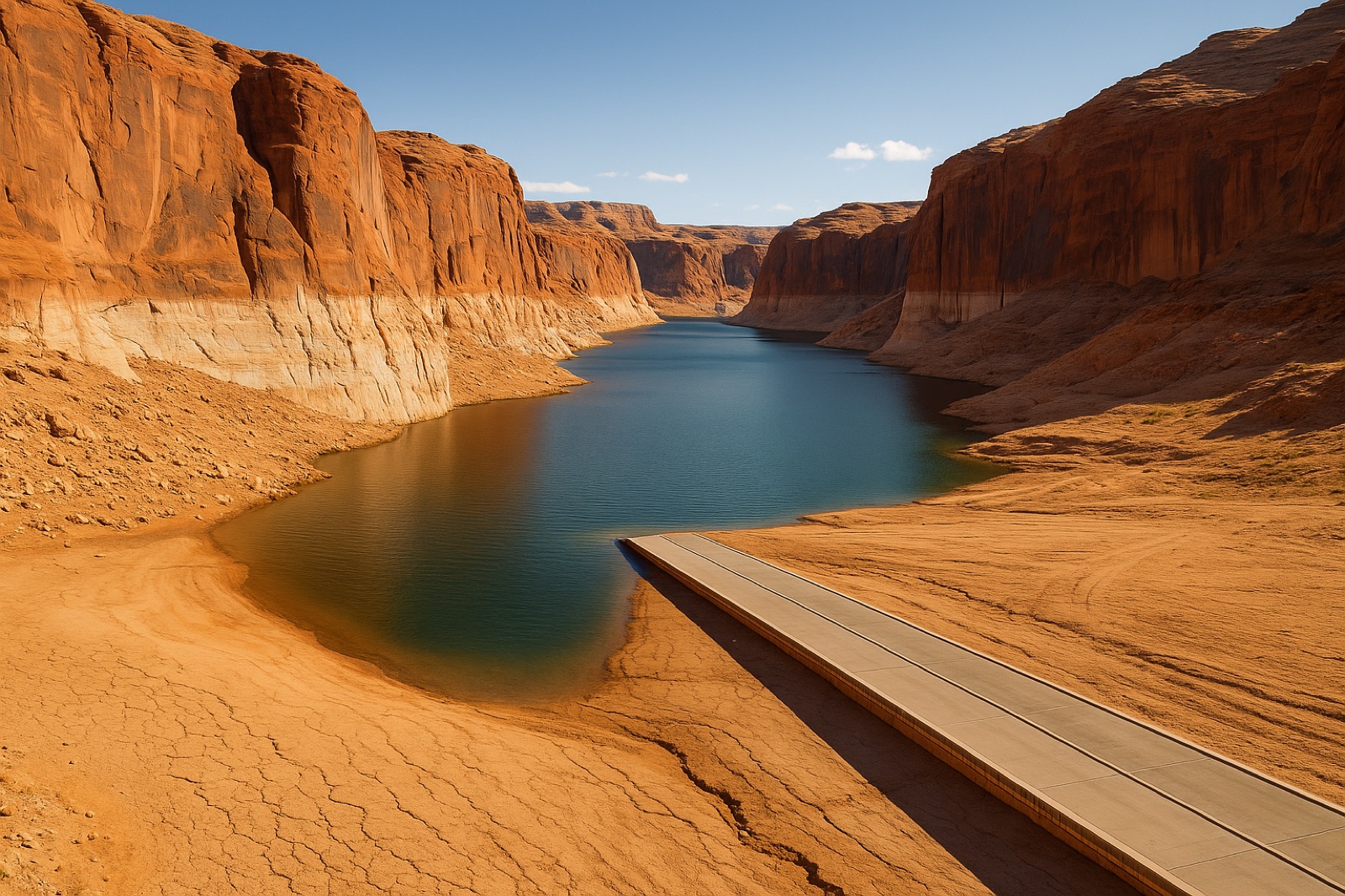
Lake Powell is the second-largest human-made reservoir in the United States. Full, it holds more than 24 million acre-feet of water. That’s around 30 billion cubic metres, backed up behind a concrete dam in a red-rock canyon on the Colorado River.
This summer it fell to the lowest level ever recorded.
The easy version of this story is simple: not enough snow, so not enough water. That’s true, but it’s not the whole story. The number that actually explains the Lake Powell record low is stranger than that. It’s the gap between the snow that fell on the mountains and the water that actually got to the lake.
Lake Powell Record Low: What the Numbers Say
These are the dated facts, from NASA’s Earth Observatory and the daily reservoir record:
- 13 April 2023: the old record low, 3,519.92 feet above sea level (about 1,073 metres).
- 15 August 2026: the lake drops below that mark for the first time.
- 10 September 2026: the surface reaches 3,517.24 feet, a new record low (about 1,072 metres).
- 21 September 2026: about 3,517.4 feet, still hovering at the bottom.
That’s the lowest level since the reservoir first began filling in 1963. At around 5.1 million acre-feet stored, the lake is roughly a fifth full.
There’s one more number to know. At 3,490 feet (about 1,064 metres) is the minimum power pool. Below that level, the dam’s turbines can no longer make electricity. Right now the lake is about 27 feet (roughly 8 metres) above that line.
More than 40 million people rely on water from the Colorado River system. Lake Powell is one of its two giant savings accounts.
The Snow Fell. The Water Didn’t Arrive.
Almost all of the water in Lake Powell starts as snow. It falls in winter on the Rocky Mountains, sits there for months, then melts in spring and runs downhill into the river. The whole system is really one long, slow delivery.
The winter of 2025–26 was a weak one. NASA describes it as a snow drought, with unusually little snow and stretches of record warmth that wore down what little snow there was. Across the basin above Lake Powell, snowpack peaked on 9 March 2026 at about 60% of its usual peak. That was weeks earlier than normal.
Sixty percent is bad. But you’d expect it to turn into something like 60% of a normal year’s water.
It didn’t. According to the Bureau of Reclamation’s own hydrology updates, the water that actually flowed into Lake Powell from April through July came to about 1.14 million acre-feet. That’s 18% of normal.
Sixty percent of the snow. Eighteen percent of the water.
Where did the rest go? Mostly into the ground. Water managers call it runoff efficiency: how much melting snow actually reaches the river. After years of drought, the soil across the region was bone dry. When the snow melted early and warm, the thirsty ground drank much of it first. What the dirt didn’t take, the warm air helped carry off.
We saw the same thing on a smaller scale earlier this year, when Elephant Butte Reservoir fell to 1.4% full after the earliest snowmelt on record on the Rio Grande. That water melted too. It just never showed up where it was needed.
So the snow wasn’t the real supply. The snow was a promise of supply, and a lot of that promise vanished on the way down the mountain.
What a Reservoir Can Do — and What It Can’t
It’s easy to look at a dam that size and think of it as a source of water. It isn’t. A reservoir makes no water at all. It’s a very large, very expensive container. It can hold water, slow it down, and let it out on a schedule. But every drop in it came from somewhere upstream.
That’s why Lake Powell took so long to fill in the first place. The gates closed in 1963. The lake didn’t reach full pool until 22 June 1980, sixteen years later. You can’t pour a lake. You can only wait for a river to fill it.
And when the river runs thin, all the concrete in the world can’t make up the difference. The dam is holding. Nothing is leaking. This record low isn’t a failure of engineering. It’s what happens when a container keeps giving and its source stops keeping up.
This spring, Reclamation began stretching what was left. It released extra water from Flaming Gorge Reservoir further upstream, sent less water downstream from Lake Powell to Lake Mead, and cancelled a planned spring “controlled flood” through the Grand Canyon. Those are sensible moves. But look at what they have in common: every one of them moves existing water around. None of them makes more.
This Week’s Small Rise Isn’t a Rescue
For the first time in a while, the gauge has ticked up. In the week to 21 September the lake rose by about two-thirds of a foot, around 20 centimetres, with more water coming in than going out.
That’s worth knowing, and worth being honest about. Twenty centimetres on a lake still roughly 56 metres below full is a rounding error. It’s a small late-season bump, not a sign that the source has recovered. The next real change for Lake Powell won’t come from anything that happens at the dam. It will come from how much snow falls this winter, and how much of it actually makes it down the mountain in spring.
In other words, the only thing that can fix this is the thing upstream.
A Container Is Only as Good as Its Source
It’s hard to watch this story and not think about our own reserves.
Most of us build some version of a Lake Powell. Savings, if we have any. A reputation. A thick skin. The strength we’ve stored up from better years. Those things are good. They help us get through a dry season. But they’re containers, and like every container they’re only as full as whatever keeps flowing into them. We spend most of our lives watching the level. We spend much less time asking what feeds it.
There’s a picture from an old prophet, written roughly 2,600 years ago in a land that knew drought better than most. It describes people who walked away from a spring of living water and chose to dig their own cisterns instead. Cracked cisterns, the kind that can’t hold water. The problem in that picture isn’t the digging. Storage is wise. The problem is forgetting the difference between the thing that holds water and the thing that is water. In the prophet’s picture, the spring is God, a source that doesn’t depend on a good winter. (If you’re curious, we explored that old image of the cistern and the spring in more depth.)
Lake Powell is a good cistern. It’s not cracked. It’s just not a spring. And no cistern ever is.
What to Take From a Record Low
You don’t need to live anywhere near the Colorado River for this to be useful. A few honest questions, borrowed from the lake:
- What’s actually flowing in? Not what’s stored, but what’s arriving this week. Rest, real friendship, quiet, the things that refill you. Some of them cost nothing at all.
- Where is it getting lost on the way? Like the dry ground soaking up snowmelt, some of what should refill us gets absorbed before it arrives. Endless scrolling, worry on a loop, and busyness can all soak it up.
- Am I treating the container like the source? A full account or a good record can make it feel like we’re fine on our own. Until a dry year shows the difference.
Lake Powell will probably rise again. It has before, in wetter years. It’ll take snow and a lot of patience. And the people who manage it already know exactly where to look for the answer: upstream, at the source.
It’s not a bad place for the rest of us to look either.
Discussion Question
When something you count on starts running low, whether it’s money, energy, or patience, is your first instinct to protect what’s left, or to go looking for what refills it? Tell us in the comments. We read every one.
Share This
“Lake Powell got 60% of its normal snow but only 18% of its normal water. The ground drank the rest. Weirdly relatable. https://bgodinspired.com/index.php/nature-and-creation/lake-powell-record-low-2026/”
“A reservoir doesn’t make water. It only holds what flows in. I needed that reminder about my own reserves this week. https://bgodinspired.com/index.php/nature-and-creation/lake-powell-record-low-2026/”
“Didn’t expect an article about Lake Powell’s record low to make me think about where my strength actually comes from. Worth the read: https://bgodinspired.com/index.php/nature-and-creation/lake-powell-record-low-2026/”
Questions People Ask About Lake Powell
What is the record low water level at Lake Powell?
Lake Powell set a new record low of 3,517.24 feet (about 1,072 metres) above sea level on 10 September 2026, according to NASA’s Earth Observatory. That beat the previous record of 3,519.92 feet set on 13 April 2023. The lake first dropped below the 2023 mark on 15 August 2026, and it was still near 3,517 feet in late September 2026.
Why is Lake Powell so low in 2026?
Lake Powell is low in 2026 mainly because of a snow drought in the Upper Colorado River Basin during the winter of 2025–26. Snowpack peaked at about 60% of its usual level, but dry soils and record warmth meant only about 18% of the normal April–July water actually flowed into Lake Powell, according to the U.S. Bureau of Reclamation. Much of the melting snow soaked into dry ground before it reached the river.
What happens if Lake Powell reaches minimum power pool?
Minimum power pool at Lake Powell is 3,490 feet (about 1,064 metres) above sea level. Below that level, Glen Canyon Dam’s turbines can no longer generate hydroelectric power. In September 2026 Lake Powell sat roughly 27 feet (about 8 metres) above minimum power pool.
How full is Lake Powell right now?
In late September 2026 Lake Powell held about 5.1 million acre-feet of water, roughly a fifth of its full capacity of about 24.3 million acre-feet. At full pool, Lake Powell’s surface sits at about 3,700 feet (1,128 metres). In September 2026 the surface was roughly 183 feet (about 56 metres) below that.
How long did it take Lake Powell to fill?
Lake Powell took about sixteen years to fill. Glen Canyon Dam began holding back the Colorado River in 1963, and the reservoir first reached full pool on 22 June 1980. A reservoir makes no water of its own, so it can only fill as fast as the river feeding it allows.