 0
0
 0
0
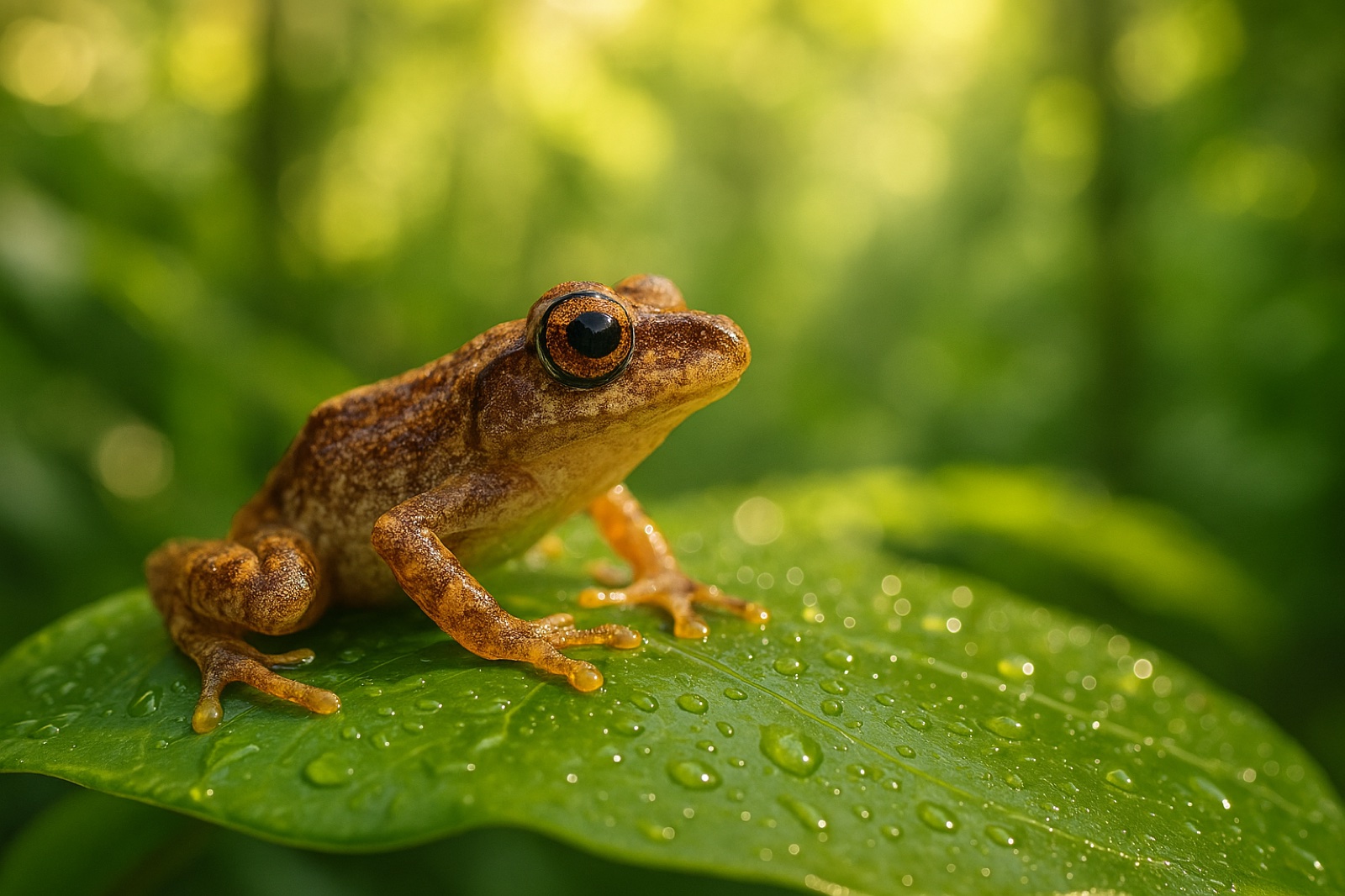
Somewhere in the wet forests of western Ecuador, a small frog calls every night. It is not rare. It is not shy. It is not hidden away in one remote valley. It lives across a stretch of forest larger than many countries, it is easy to find, and its call is loud enough to hear without any equipment at all.
In 2026, scientists formally named it. On paper, that makes it a new frog species in Ecuador. In the forest, it had been there the whole time — loud, common, and completely obvious.
Which raises an awkward question. If it was that easy to find, what exactly took so long?
A new frog species in Ecuador that nobody had trouble finding
The frog is Pristimantis milpe, the Milpe robber frog. It was described in the journal ZooKeys by Santiago Ron and colleagues at the Pontificia Universidad Católica del Ecuador.
Most animals that get named for the first time are named because they are hard to reach. They live on one mountainside, or in one cave, or twenty metres up a single kind of tree. You need luck and a lot of walking to find them.
This one is the opposite. The study puts its range at more than 67,000 square kilometres of Chocó forest, running across western Ecuador and into southern Colombia, from sea level up to about 1,200 metres. That makes it one of the most widespread rain frogs in the whole region. It calls at night, loudly. Local people have known it for a very long time.
So the delay was never about the frog being hidden. It was about paperwork.
The mistake was in London, not in the forest
Until this year, these frogs were all being called Pristimantis subsigillatus — a name published in 1902. Everyone used it. Field guides used it. Later research used it. It looked settled.
Santiago Ron travelled to the Natural History Museum in London to look at the original nineteenth-century Ecuadorian specimens held there. This is the unglamorous part of biology: jars, labels, handwriting, and a lot of squinting. Every species name is anchored to a physical specimen — the one that officially defines what the name means. If you want to know what a name really refers to, that jar is the only place to look.
The jar did not match.
The specimen that defines Pristimantis subsigillatus was not the same animal as the frogs in the Chocó forests that had been carrying its name. It was something else — and worse, it was something that already had a name.
The same man named it twice
Here is the part that did not make most of the headlines.
The 1902 specimen turned out to match a specimen of Pristimantis latidiscus, a species described four years earlier, in 1898. Both original descriptions were the work of the same naturalist, George Boulenger, working from Ecuadorian material sent back to London. Both type localities sit in the same province, Esmeraldas.
In other words: he described the same frog twice, four years apart, and gave it two different names.
Under the rules of zoological naming, the older name wins. So Pristimantis subsigillatus is now treated as a junior synonym of Pristimantis latidiscus — a duplicate entry, quietly retired.
Which left the actual forest frogs, all 67,000 square kilometres of them, holding a name that had just been cancelled. They were not a species that had lost its name. They were a species that had never had one. That is what Pristimantis milpe is: not a discovery in the jungle, but a correction in the records that finally left something without a label.
The name itself comes from the Milpe Bird Sanctuary in Pichincha Province, Ecuador, managed by the Mindo Cloudforest Foundation, where the defining specimens were collected.
How a wrong name survives for over a century
This is the bit worth slowing down for, because it is not really about frogs.
The mistake was made once, in 1902. After that, nobody remade it. They inherited it. Each new study checked the study before it, which had checked the study before that, all the way back to a starting point nobody had gone back to physically examine. The research team said as much themselves: the original error became accepted fact in the work that followed, without anyone returning to the defining specimen.
The chain was never broken because the chain was never tested. It was just long enough to look like consensus.
That pattern shows up far outside taxonomy. It is the same reason a health claim can circulate for years attached to a study that said something noticeably narrower than what gets repeated about it. Copies of copies feel like evidence. They accumulate confidence without accumulating a single new check.
One of the study’s co-authors, Jhael Ortega, put the lesson this way: “That such a common species has gone unnoticed under the wrong name for decades highlights the importance of correctly connecting scientific names with living populations in nature.”
What the frog actually looks like
Small. Females run larger than males — averaging roughly 34 millimetres against about 26. That size gap is normal enough for frogs. The colour is the odd part.
The females carry orange or pale blue markings with black spots on the groin and thighs. The males do not; they are plainer. That kind of split, where the females are the vivid ones, is unusual enough that the researchers flagged it in the description.
Its closest known relative is another Chocó frog, Pristimantis degener. The two lineages separated in the late Miocene — millions of years before anyone existed to write a label, let alone get one wrong.
There are more than 600 named species in the genus Pristimantis. It is one of the largest groups of vertebrates on the planet. Getting a name right in a crowd that size is genuinely hard work, and it is the kind of work almost nobody gets credit for.
Being seen is not the same as being known
What strikes me about this story is that the frog was never lost. It was heard, constantly, by everyone within earshot. It was measured, photographed, collected and catalogued. It was, by any ordinary standard, extremely well seen.
It just was not known. There is a long thread in ancient writing about exactly that distance — the idea that God is described, over and over, as the one who calls a person by their real name rather than by whatever label the crowd happened to settle on, and that being recognised is a different event from being noticed. It is a strange thing to run into in a paper about rain frogs. But the shape matches: the record everyone was working from had it filed wrong, and the correction had to come from going back to the beginning.
That feeling of being visible without being understood is common enough that people search for it in a hundred different ways. If it is familiar, our free “Do I Have Imposter Syndrome?” assessment is a decent, quick place to put words to it.
The correction ran backwards
The thing that fixed this was not new technology, or a new expedition, or a bigger budget. It was one researcher getting on a plane and going to look at a jar that had been sitting in London since the nineteenth century.
Old records have a way of holding more than the people who filed them understood at the time. A set of footprints preserved in Kenyan mud for 1.4 million years turned out to carry information nobody was looking for. A jar of frogs from 1902 turned out to be the answer to a question that would not be asked for another 124 years.
Nothing changed in the forest. The frog is doing exactly what it was doing last year, and last century. The only thing that changed is that it is finally being called by the right name — which, it turns out, is not a small thing to give something.
Questions people are asking
What is Pristimantis milpe?
Pristimantis milpe, the Milpe robber frog, is a small rain frog formally described in 2026 in the journal ZooKeys by Santiago Ron and colleagues at the Pontificia Universidad Católica del Ecuador. It lives in the Chocó forests of western Ecuador and southern Colombia, from sea level up to about 1,200 metres, across a range the study puts at more than 67,000 square kilometres. Females average roughly 34 millimetres in length and males about 26 millimetres.
Why did it take so long to name this new frog species in Ecuador?
The frogs were never missed — they were being called Pristimantis subsigillatus, a name published in 1902. When Santiago Ron examined the original 1902 specimen at the Natural History Museum in London, it did not match the living populations carrying that name. It matched an older specimen of Pristimantis latidiscus, described in 1898. That left the forest populations with no valid name, so a new one was needed.
What does “junior synonym” mean?
A junior synonym is a scientific name that turns out to describe an animal already covered by an earlier valid name. Zoological naming rules give priority to the older name. Because the 2026 study concluded that the 1902 name Pristimantis subsigillatus and the 1898 name Pristimantis latidiscus were based on the same species, the later name is a junior synonym and is no longer used for a separate species.
Where does the name “milpe” come from?
The species name refers to the Milpe Bird Sanctuary in Pichincha Province, Ecuador, managed by the Mindo Cloudforest Foundation. That reserve is the type locality — the place the specimens that officially define the species were collected.
Is Pristimantis milpe endangered?
The 2026 description does not assign a conservation status; formal threat assessments are a separate process. What the description does report is an unusually wide range for a Chocó rain frog, more than 67,000 square kilometres, which is the opposite of the narrow single-mountain distributions that most often make a newly named frog an immediate conservation concern.
A question for you
Here is the part worth arguing about. This was only caught because one person went back and checked the original instead of trusting the copy of the copy. Where else do you think that habit would pay off — in science, at work, in the news, in the way we describe each other? Leave your answer in the comments; we read them.
Share this
- A frog in Ecuador spent over 120 years under the wrong name. Not rare. Not hidden. Loud, common, everywhere — and filed wrong, because nobody went back to check the original specimen. https://bgodinspired.com/index.php/nature-and-creation/new-frog-species-ecuador-wrong-name/
- The same naturalist named this frog twice, four years apart, and nobody caught it until 2026. The mistake was never in the forest. It was in a jar in London. https://bgodinspired.com/index.php/nature-and-creation/new-frog-species-ecuador-wrong-name/
- I keep thinking about this one. A frog you could hear across 67,000 km² of forest carried a name belonging to a different animal for over a century — not because it was hard to find, but because every study after 1902 checked the study before it instead of the original. https://bgodinspired.com/index.php/nature-and-creation/new-frog-species-ecuador-wrong-name/