 0
0
 0
0
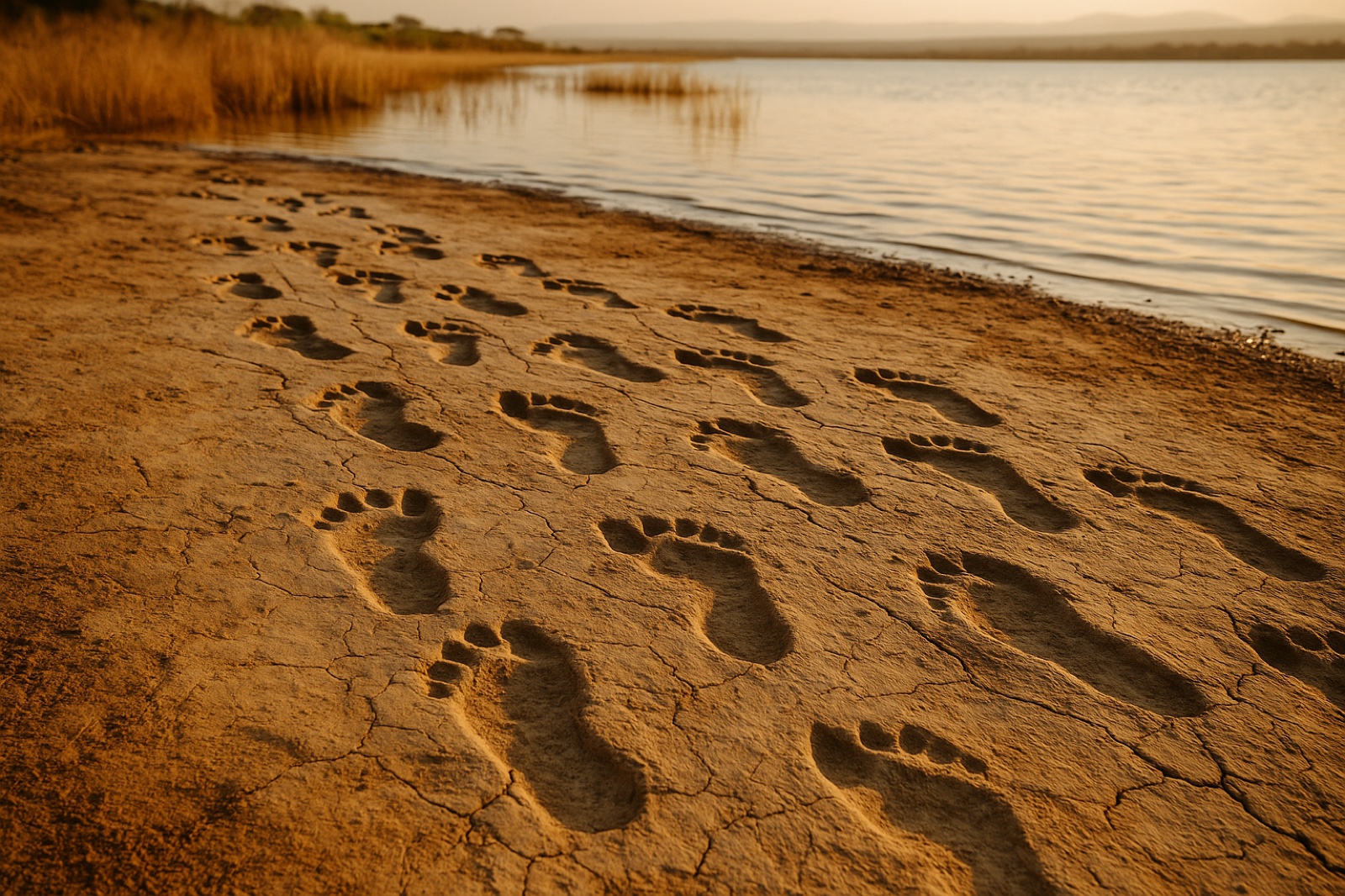
Someone walked across wet mud beside a lake in northern Kenya. Then someone else did. Then six more.
They were gone within minutes. The mud dried. Silt buried it.
Those 1.4-million-year-old footprints stayed buried until researchers uncovered them at a site called GaJi10, in the Koobi Fora Formation of East Turkana. The tracks were described in a 2026 paper in the journal Proceedings of the National Academy of Sciences, led by Kevin Hatala of Chatham University and the Max Planck Institute for Evolutionary Anthropology, working with colleagues in the United States and Kenya.
Twenty-one hominin tracks. Five continuous trackways. Provisionally, eight individuals.
And here is the strange part. Almost nothing about who they were survived. Almost everything about who they were with did.
What 1.4-Million-Year-Old Footprints Can Do That Bones Cannot
A skull tells you about a body. It tells you nothing about a Tuesday.
Bones are anatomy. They can sit in the ground for a million years and never once tell you what that creature did, where it went, or whether anybody went with it. A skeleton is a portrait of one individual, alone, out of time.
Footprints are different. A footprint is not a body. It is a moment — the exact pressure of a foot on soft ground on one specific afternoon that will never happen again.
That is why this site matters more than its size suggests. The researchers noted that footprints can record behaviour almost as it happened. Not a species. Not a skeleton. An afternoon.
And the afternoon at GaJi10 is remarkably narrow. The tracks appear to have been made within a very short window of each other, in fresh silt, before the surface could dry or wash. Hippos and other animals crossed the same ground. A volcanic layer sitting about 40 centimetres above the tracks dates to roughly 1.43 million years ago.
So this is not eight creatures who passed through over centuries. This is eight, more or less at once, on the same shore, in the same soft mud, on the same day.
The Part That Surprised Everyone: They Were Big
The shape of the feet points toward Paranthropus boisei — a human relative, not a direct ancestor of ours, a branch of the family that eventually ended. The tracks show wide, splayed big toes and flat arches. They do not look like modern human footprints.
But the size did not match the story.
For decades, what was known about this species came from a small handful of skeletal remains, and those remains suggested a fairly small creature. The footprints suggest something else. Based on track dimensions, the researchers estimated body sizes reaching about 1.8 metres tall — near six feet — and somewhere around 75 kilograms, roughly 165 pounds.
That is not small. That is a body size researchers had generally associated with Homo erectus, a different human relative living in the same part of East Africa at the same time.
The team also concluded the eight trackmakers were likely all adults, and that most were likely adult males, with no obvious evidence of females or children among them.
Worth saying plainly: every one of those numbers is an estimate drawn from a footprint, not a measurement taken from a body. The paleoanthropologist John Hawks, writing about the study, pointed out that body mass estimates carry even more uncertainty than height estimates do — and that the all-adult, mostly-male reading has more than one possible explanation. He raised the possibility of “a male foraging group, or a bachelor group of young male adults” rather than a whole community.
The researchers were careful in the same way. They used words like likely, appear to have been, and may have. That is not weakness. That is what honest science sounds like.
The Puzzle Nobody Has Solved Yet
Now put the two halves together and you get something genuinely unresolved.
The feet say one species. The size says another. And the research team was direct about where that leaves things: the tracks cannot yet be assigned to a species with absolute certainty.
Sit with that for a second, because it is easy to read past.
After 1.4 million years, after volcanic dating, after careful measurement by an international team of specialists, we still cannot say for sure what these eight were.
Their identity did not survive. Their names obviously did not survive. Their faces did not survive. Their species is still an open question.
What Actually Survived
One fact came through the 1.4 million years completely intact.
Not one of them was out there alone.
That is the piece the mud kept. Not the anatomy — that is contested. Not the identity — that is unresolved. The thing that made it across a million and a half years without breaking is the simple, physical fact of company. Eight sets of feet, the same shore, the same short window of time.
We do not know what they were. We know they were together.
There is something quietly humbling in that, and it is worth noticing that the oldest writing humans ever produced about themselves lands in the same place. One of those ancient texts opens with a long list of things declared good — light, water, land, living things, all of it good. And then, abruptly, one thing gets called not good. Not danger. Not hunger. Not the dark.
A person being alone.
That is a strange thing to have flagged first, thousands of years before anyone could have known that the oldest surviving record of our relatives would turn out to be a record of them travelling in company. But there it sits, in the text and in the mud, saying the same small thing from two completely different directions: whatever people are for, God did not seem to design them to do it by themselves.
Deep Time Has a Way of Shrinking the Right Things
Numbers like 1.4 million years are almost impossible to feel. If you enjoy that particular kind of vertigo, our free How Old Is the Universe? explorer lets you walk the timeline yourself and see where a number like this actually sits.
But here is what deep time does that is genuinely useful. It sorts things by what lasts.
Almost everything those eight were probably worried about that afternoon — food, water, weather, whatever they were walking toward — left no trace at all. What left a trace was proximity. Who was near them.
That is not a small thing to learn from mud, and it lands somewhere uncomfortably close to modern life. We have gotten very good at being alone on purpose. There are real, genuine benefits to it, and there is also a cost that gets talked about far less — something we looked at in what solo-maxxing quietly costs. And for anyone in the harder version of this, where the aloneness was not chosen at all, there is a practical piece on what to do when you have no one to turn to.
You will not leave footprints in volcanic silt. Nobody is going to date the layer above your Tuesday.
But the record those eight left behind is not a bad one to have left. They crossed some difficult ground. And whatever else was true about them — whatever they looked like, whatever we end up calling them — they did not cross it by themselves.
A Question Worth Sitting With
If the only thing that survived from your life was a record of who was near you — not your work, not your face, not your name — do you think that would be a fair summary of you, or an unfair one? Tell us in the comments. There is no correct answer here, and the disagreement is the interesting part.
If You Want to Share This
- Eight sets of footprints sat in Kenyan mud for 1.4 million years. Scientists still cannot agree what species made them. But they can prove none of them was walking alone. https://bgodinspired.com/index.php/bible-resources/bible-and-science/1-4-million-year-old-footprints-kenya/
- Bones tell you what something was. Footprints tell you what it was doing, and who it was doing it with. A 1.4-million-year-old set in Kenya lost the first answer completely and kept the second one perfectly.
- Reading about 1.4-million-year-old footprints in Kenya and it has quietly wrecked me. Their identity did not survive. Their company did. Make of that what you will.
Questions People Ask About the Kenya Footprints
How old are the footprints found in Kenya?
The hominin footprints at the GaJi10 site in the Koobi Fora Formation of East Turkana, northern Kenya, are approximately 1.4 million years old. The dating comes from a volcanic deposit lying about 40 centimetres above the track surface, which dates to roughly 1.43 million years ago. The findings were published in 2026 in the journal Proceedings of the National Academy of Sciences.
How many individuals made the 1.4-million-year-old footprints in Kenya?
Researchers documented 21 hominin tracks at the site, including five continuous trackways, which provisionally represent eight individuals. The tracks appear to have been made within a very short window of time on the same lakeshore surface, rather than accumulating over a long period.
What species made the Kenyan footprints?
The foot anatomy — wide, splayed big toes and flat arches — points toward Paranthropus boisei, an extinct human relative that is not a direct ancestor of modern humans. However, the estimated body sizes derived from the tracks, up to about 1.8 metres tall and around 75 kilograms, are larger than skeletal remains had suggested for that species and closer to estimates for Homo erectus. The research team stated that the tracks cannot yet be assigned to a species with absolute certainty.
Why are fossil footprints more useful than bones for studying behaviour?
Bones preserve anatomy — the physical structure of a single individual, isolated from any moment in time. Footprints preserve an event. Because tracks are made in soft ground that must be buried quickly to survive, a trackway captures where individuals moved, how they moved, and whether others were present at the same time. Researchers describe footprints as recording behaviour almost as it happened, which is information a skeleton simply cannot provide.
Does the Kenya footprint discovery tell us anything about early social groups?
It offers a hint rather than proof. The research team concluded the eight trackmakers were likely all adults, most of them likely adult males, with no obvious evidence of females or children, which they read as a possible sign of complex social structure. Other researchers have urged caution, noting that an all-adult, mostly-male group could equally represent a foraging party or a group of young adult males rather than a full community. What the tracks establish firmly is that multiple individuals were present on the same ground at the same time.