 0
0
 0
0
By the time the evacuation order reached most of them, they had minutes, not hours. A fast-moving wildfire tore through the hills near Bordeaux in southwest France this week, and in a matter of days, more than 220,000 people were told to leave their homes — one of the largest evacuations Europe has seen since World War II.
Some grabbed a phone charger and a passport and nothing else. Some grabbed pets. A few, according to local reports, grabbed nothing at all — they simply drove, following taillights out of neighborhoods that were, by nightfall, unrecognizable.
A Fire Season That Started Early and Never Really Stopped
This isn’t an isolated event. France’s 2026 wildfire season began weeks earlier than usual, fed by back-to-back heatwaves and a drought that has left the countryside dry as kindling. By late July, officials said nearly 40,000 hectares had already burned nationwide — more land than burned in the entirety of 2025.
Earlier in the month, a separate fire along the Mediterranean coast between Marseille and Nice forced hundreds of evacuations of its own before crews brought it under control. Then came the fire near Bordeaux — the one now being called, in French headlines, the “monster fire.” It grew fast enough that evacuation zones expanded twice in 48 hours.
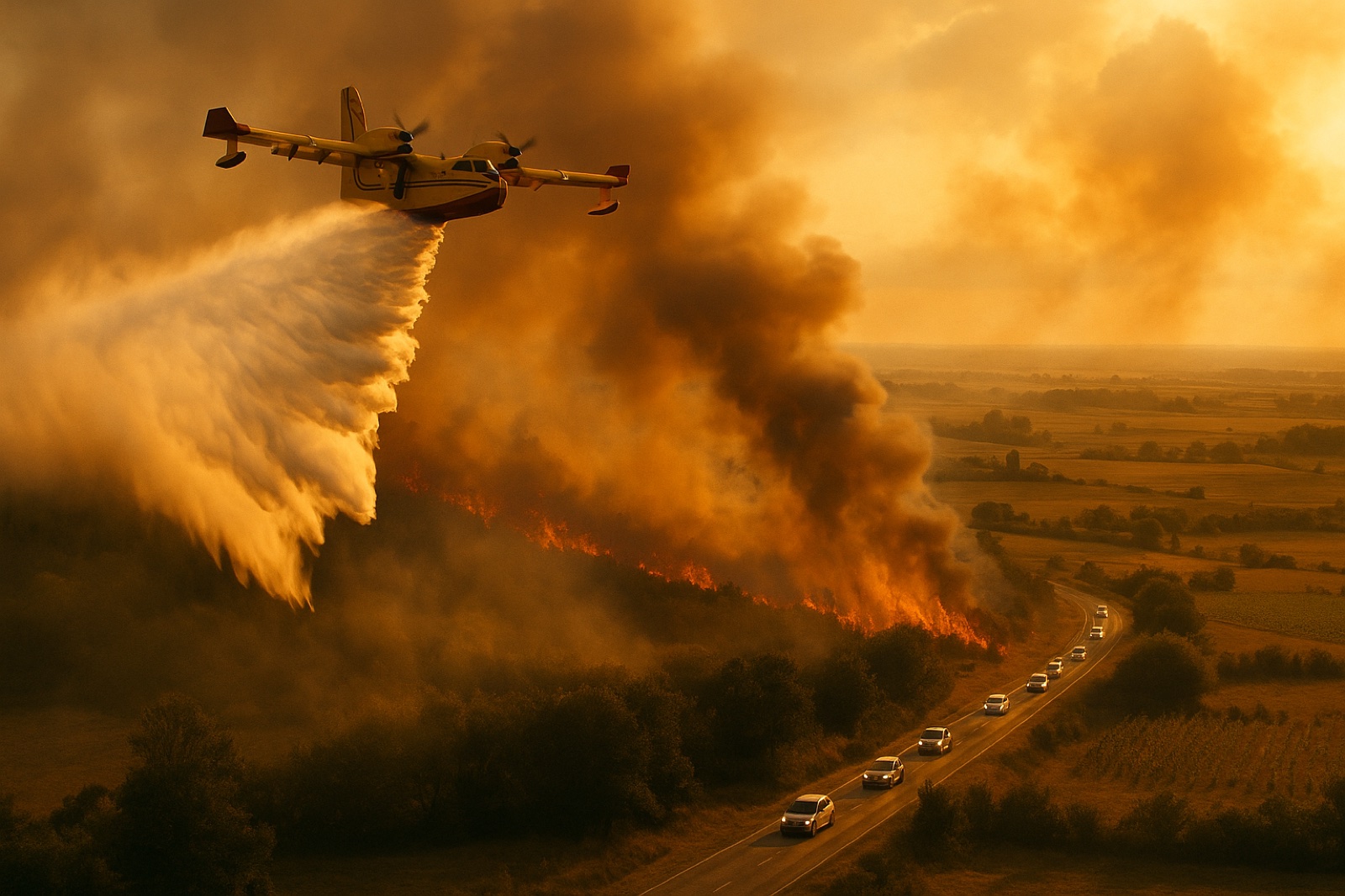
France mobilized nearly 1,000 firefighters and every piece of aerial firefighting equipment it had: Canadair water bombers skimming reservoirs and dumping thousands of gallons at a time, Dash planes dropping retardant along the fire’s edge, helicopters ferrying water bucket by bucket. It wasn’t enough on its own. Romania had already pre-positioned a ground crew in the region. Croatia, the Czech Republic, Germany, Portugal, Slovakia, Sweden, and Turkey sent aircraft, helicopters, or firefighters of their own within days.
By the weekend, officials said the largest blaze had stopped growing and was being held inside its perimeter — though with the heat and drought still unbroken, no one was calling it over.
You could read a story like this and it would already be worth your time. It’s a real story about a real fire, and it’s still unfolding. But there’s something underneath the headlines that’s easy to miss if you only read for the numbers.
What Nearly a Quarter-Million People Had in Common This Week
Strip away the specifics — the country, the century, the cause — and every wildfire evacuation in recorded history has produced the exact same behavior. People don’t scatter randomly. They move toward whatever, in that moment, feels like it can hold them: a stadium, a gymnasium, a relative’s spare room, a stranger’s open door two towns over. In France this week, it was schools, sports halls, and community centers that filled first, some run by local governments, some by volunteer groups who simply showed up with water and folding cots before anyone asked them to.
This is one of the more remarkable things about how humans respond to disaster, and researchers who study crowd behavior in emergencies have documented it again and again: the instinct to run isn’t really “away from” as much as it is “toward.” Toward shelter. Toward higher ground. Toward anyone who looks like they know where safety is. It’s not a plan anyone makes in advance. It’s older than planning.
It’s older, in fact, than almost anything else we do as a species.
The Instinct Underneath the Instinct
Long before smoke alerts and evacuation zones, before satellite maps and emergency broadcast systems, people were already writing down what it feels like to run from something bigger than themselves and to need somewhere — someone — to run to. Some of the oldest surviving writing in the world is exactly that: prayers, songs, pleas, written by people standing in the middle of their own version of this week’s fire, asking for shelter that wasn’t made of walls.
One ancient song, written roughly three thousand years ago, doesn’t describe God as a fire extinguisher or a rescue plan. It describes Him as a hiding place — the kind of shelter you run toward on instinct, before you’ve even decided to. Not because the danger disappears the moment you get there, but because you’re no longer facing it alone.
It’s the same instinct that sent a quarter-million people in France running toward a school gym this week instead of an empty field. We don’t run toward nothing. We run toward something we believe can hold us. Somewhere in human history, someone put words to the belief that the thing worth running toward doesn’t have an address at all — and for the people willing to sit with that idea a little longer, this short meditation for fearful nights and this piece on what to do with morning dread both go deeper into where that promise of shelter actually comes from.
What Happens After the Fire Is Out
Most wildfire coverage ends when the flames are contained, but for the people who evacuated, containment is just the start of a much longer story. Insurance claims. Temporary housing. The specific grief of not knowing, for days, whether your street is still standing. Rebuilding, when it happens, rarely follows a straight line — it’s a school reopening three towns over, a neighbor sharing a spare room for a month that turns into three, a community fundraiser that raises more than anyone expected.
If you’re reading this from somewhere the sky is clear and your street is fine, the honest takeaway isn’t guilt. It’s attention. Somewhere near Bordeaux tonight, a family is sleeping in a gym cot, grateful for the cot, still thinking about the house. The fire may be contained. The week they just lived through isn’t over yet — not for them.
The same instinct showed up earlier this year when Tropical Storm Bertha bore down on the Gulf Coast — different disaster, same reflex, same ancient shelter-seeking pattern underneath it. It shows up every time, in every language, on every coastline and hillside on earth. It might be the most human thing we do.
Discussion Question
If you had twenty minutes’ notice before you had to leave your home and might not be able to come back, what’s the one thing — besides people and pets — you’d grab first, and why does that particular thing matter to you?
A Few Practical Things Worth Doing Today
- Build a “go bag” now — copies of ID and important documents, a week of any medications, a phone charger, a change of clothes — even if you don’t live anywhere near a fire risk zone. Most people who needed one this week didn’t have one either.
- Pick a family meeting point outside your immediate neighborhood in advance. Cell networks get overwhelmed fast during real evacuations, and “just call me” isn’t always a plan that works.
- Sign up for local emergency alerts directly through your city or county — don’t rely only on your phone’s default wireless alert system, which can lag behind fast-moving fires.
- If you’re able, give toward relief efforts supporting people displaced by this fire. Local French Red Cross chapters and regional relief funds are actively distributing aid to evacuees right now.
Frequently Asked Questions
How many people have been evacuated by the wildfires in France in 2026?
More than 220,000 people were evacuated from a single wildfire near Bordeaux in late July 2026, making it one of the largest evacuations Europe has seen since World War II. Combined with an earlier fire along the Mediterranean coast, France’s 2026 wildfire season has forced well over a quarter million people from their homes.
Why has France had so many wildfires in 2026?
Repeated heatwaves and a prolonged drought caused France’s 2026 wildfire season to start earlier than usual and burn far more land than normal. Officials reported nearly 40,000 hectares burned nationwide by late July — more than burned in all of 2025 combined.
What countries sent help to fight the France wildfires?
France mobilized nearly 1,000 firefighters along with Canadair water bombers, Dash planes, and water-carrying helicopters. Romania, Croatia, the Czech Republic, Germany, Portugal, Slovakia, Sweden, and Turkey all sent additional firefighting aircraft, helicopters, or ground crews to help.
Is the France wildfire under control now?
As of late July 2026, French officials said the largest fire near Bordeaux had stopped growing and was being held within its perimeter. The situation remained active, though, and authorities stopped short of calling it fully contained given the ongoing heat and drought.
What can I actually do if a wildfire evacuation order reaches me?
Fire officials consistently recommend having a “go bag” ready before any warning ever comes — copies of important documents, medication, chargers, water, and a change of clothes — plus a pre-decided meeting point for your household, since evacuation routes and cell service often get overwhelmed at the same time.
Share This
- 224,000 people had to leave everything and run this week near Bordeaux — one of the biggest evacuations Europe has seen since WWII. What struck me wasn’t the fire. It was that every single person did the exact same thing when the warning came.
- Firefighters from eight countries are on the ground in France right now for a fire that’s already burned more land than all of last year combined. Worth understanding what’s actually happening there.
- A quarter-million people fled a wildfire in France this week, and every one of them ran toward the same thing: whatever felt like shelter. That instinct is older than any alarm system we’ve ever built.