 0
0
 0
0
Pour a glass of seawater and you are holding something useless. There is roughly 35 grams of salt in every litre of it, which is about the average for the open ocean. Drink it and your body has to spend water getting that salt back out — more water than the glass gave you. The largest water supply on the planet is sitting right there, and almost none of it is drinkable.
Taking the salt out is not new. Whole cities already run on it. The part nobody had got clean was what to do with the salt afterwards. So a result out of the University of Rochester on desalination without brine is worth a few quiet minutes, because it goes after the leftovers rather than the water.
Why the Leftover Salt Is the Hard Part
Here is the thing most people never think about. A desalination plant does not make salt disappear. It splits seawater into two streams. One is fresh water you can drink. The other is everything that got left behind — the same salt, now packed into far less water.
That second stream is called brine. It is heavy, it is hot, and it is far saltier than the sea it came from. Most plants send it back into the ocean, where it sinks and sits. Marine life living on that patch of seabed did not sign up for it.
The big methods we use today — reverse osmosis, which pushes water through a fine membrane, and thermal distillation, which boils it — are also energy hungry and usually need chemicals added before and after. And on any surface where seawater is being evaporated, salt builds up and clogs the works. So you either keep cleaning it or you keep replacing it.
A Black Metal Panel That Cleans Itself
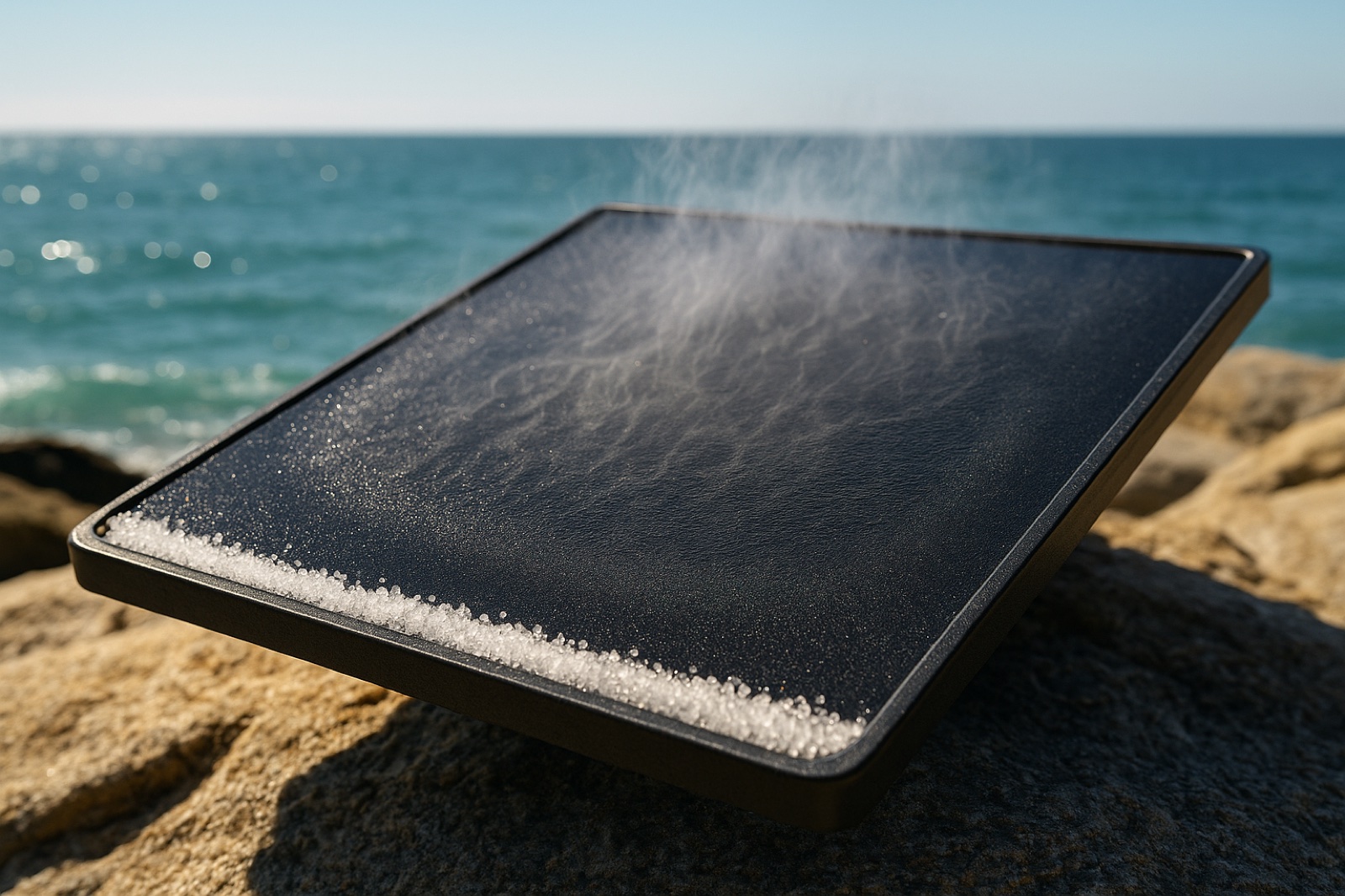
The Rochester group, led by Chunlei Guo, a professor of optics and physics there, took a very different route. They started with a plain sheet of metal and hit it with a femtosecond laser — a laser that fires in pulses so short they are measured in quadrillionths of a second.
Those pulses carve microscopic structures into the surface. The metal that comes out the other side has two useful habits at once. It goes black, absorbing nearly all the sunlight that lands on it. And it becomes what the team calls superwicking: water does not bead up on it, it races across it in a thin film.
Thin film plus strong sunlight equals fast evaporation. No pump. No boiler. No membrane. Just sun on dark metal.
But that still leaves the salt. And this is the part that made me sit up.
The Coffee Ring Trick
You have seen this effect a thousand times without naming it. Spill a drop of coffee on a table and leave it. When it dries, you do not get an even brown circle. You get a ring — a dark outline with a pale middle, because as the water evaporated it carried the coffee particles outward to the edge.
Guo described it almost exactly that way: the water goes, and what is left is a concentrated ring at the outer edge. The team uses that same principle to move the salts out to the passive region of the panel.
So only part of the panel is laser-treated. That treated part does the evaporating. The untreated part around it is where the salt is quietly walked off to and left as dry crystals. The working surface stays clear. The machine keeps going.
Which is a strange and rather lovely thing: the same physics that ruins a coffee stain on your table is the physics that keeps this thing from clogging.
What the Numbers Actually Say
The main paper appeared in the journal Light: Science & Applications in 2026, with a companion paper in the Journal of Materials Chemistry A on the mineral side. A few results stand out.
- Nearly all of the salt came out as a solid rather than as liquid brine.
- They did not test it on a convenient salt solution mixed in a lab. They used real seawater from the Pacific, the Atlantic and the Indian Ocean, plus water from the Great Salt Lake and two kinds of industrial wastewater.
- The surface kept working. Mineral build-up did not degrade it the way it degrades conventional evaporators.
- From the Great Salt Lake samples, they pulled back roughly half of the lithium present in the leftover salts.
That last one quietly reverses the whole equation. Lithium is what goes into the battery in the phone you are probably reading this on, and mining it from the ground is hard on both energy and land. If the salt you used to dump is instead a dry solid you can pick up and sort, then the waste stream stops being a disposal bill and starts being a supply.
Now the honest part, and the researchers said it themselves: this is early. What exists so far are proofs of concept on small devices. Guo argues the design is inherently scalable, and it may well be — there is no exotic part in it, and sunlight is free. But “inherently scalable” is a claim about the future, not a measurement. Lab results in desalination have a long history of not surviving contact with industrial scale. Nobody is desalinating a city with this yet, and nobody involved is pretending otherwise.
The Waste Was Never the Problem
There is a very old story about a group of people who had walked three days through a desert without finding water. When they finally found some, they could not drink it. It was bitter. The name they gave that place was simply the word for bitterness.
What is interesting is how the story resolves. They are not led off to a different spring. Nobody finds better water. Something is put into the water they already had, and the bitter part is dealt with, and then they drink.
That is the same move being made here, four thousand years later, with lasers. Nobody in Rochester went looking for more water. There is no more water. They went and looked at the part everyone had already written off as ruined and found it was not ruined at all — it was just in a form nobody had learned to receive yet.
People have been crediting God with that particular pattern for a very long time. It is one of the oldest ideas we have: that the bitter part of a thing is not the same as the thing itself.
Where This Leaves Us
We have covered this shape before without noticing it was a shape. Engineered yeast that eats old plastic bottles and turns them into protein is the same story with different rubbish. So, in its way, is the reef off Benin that was written off as dead in the 1960s and turned out to be alive — the verdict was wrong, not the reef.
None of this solves the water crisis. Around two billion people still live without safely managed drinking water at home, and no single panel changes that. What it does is remove one specific excuse: the idea that the mess left over at the end is just the price of the useful thing and there is nothing to be done about it.
Turns out there is sometimes something to be done about it. It just took somebody willing to stare at the waste instead of the water.
And if all this talk of litres has made you thirsty, we built a small free hydration calculator that works out roughly how much water your own day actually needs. It takes about thirty seconds.
A Question Worth Sitting With
If the leftover salt from desalination can be turned into a resource instead of a pollutant, should countries be required to recover it rather than dump it back into the sea — even if that makes water more expensive? Tell us where you land in the comments. We read them.
If You Want to Share This
Steal any of these:
Spill coffee on a table and it dries into a ring, not a circle. Scientists just used that exact effect to keep a solar desalination panel from clogging with salt. The stain physics is the solution. https://bgodinspired.com/index.php/nature-and-creation/desalination-without-brine-salt-comes-out-solid/
We have been desalinating seawater for decades and dumping the leftover brine back in the ocean. A laser-etched black metal panel now takes the salt out as a dry solid instead — and about half the lithium in it can be recovered. The waste was the valuable part. https://bgodinspired.com/index.php/nature-and-creation/desalination-without-brine-salt-comes-out-solid/
Nobody found more water. They looked again at the part everyone had written off as ruined. https://bgodinspired.com/index.php/nature-and-creation/desalination-without-brine-salt-comes-out-solid/
Questions People Ask About Desalination Without Brine
What is brine in desalination?
Brine is the concentrated saltwater left over after a desalination plant removes fresh water from seawater. It contains the same salt the seawater started with, packed into a much smaller volume of water, and is often warmer and denser than the sea. Most plants discharge it back into the ocean, where it can settle on the seabed and harm marine life in that area.
How does desalination without brine work?
In the University of Rochester system, a sheet of metal is etched with a femtosecond laser so that it turns black and absorbs almost all sunlight, while also becoming superwicking, meaning water spreads across it in a thin film instead of beading up. Sunlight evaporates that film, and the leftover salts are carried to an untreated edge region of the panel by the coffee ring effect, where they dry into solids. Because the salt never accumulates on the working surface, there is no brine stream and no clogging.
What is the coffee ring effect?
The coffee ring effect is what happens when a drop of liquid containing particles dries on a surface. As the liquid evaporates, flow inside the drop carries the suspended particles outward to the edge, leaving a dark ring rather than an evenly coloured spot. It is the reason a dried coffee spill has a strong outline and a pale middle, and the same outward movement is what pushes salt away from the active area of the laser-etched desalination panel.
Can lithium be extracted from desalination waste?
In the Rochester experiments, roughly half of the lithium present was recovered from the solid salts left after processing water from the Great Salt Lake. Because the salts come out as a dry solid rather than as liquid brine, they can be collected and sorted. This is a laboratory result on small devices, not a commercial process, but it suggests desalination leftovers could become a source of useful minerals rather than a disposal problem.
Is solar desalination ready to replace reverse osmosis?
Not yet. The Rochester work is described by its own researchers as proof of concept using relatively small devices, and while they argue the design is inherently scalable, that has not been demonstrated at industrial scale. Reverse osmosis currently supplies water to entire cities and has decades of engineering behind it. The value of the solar approach at this stage is that it needs no chemical pretreatment, no membranes, and produces no brine discharge.