 0
0
 0
0
Maybe you’ve had a project that ran so long people stopped asking how it was going. The house repair in its third year. The course you finish one class at a time. The thing you started building before anyone around you understood why.
Noah would understand. And if you’ve ever wondered how long it took Noah to build the ark, you’ve probably heard a confident answer: 120 years. It shows up in sermons, children’s books and plenty of search results.
Here’s the honest answer first. The Bible never says how long it took Noah to build the ark. No verse gives a start date. No verse gives a finish date. The famous “120 years” comes from a verse that is about something else. And the one verse in the whole Bible that does measure the build doesn’t measure wood or work at all. It measures God’s patience.
How Long Did It Take Noah to Build the Ark? What Genesis Actually Gives Us
Genesis gives two firm ages in Noah’s life:
- “And Noah was five hundred years old: and Noah begat Shem, Ham, and Japheth” (Genesis 5:32).
- “And Noah was six hundred years old when the flood of waters was upon the earth” (Genesis 7:6).
That’s a window of about a hundred years between Noah’s sons arriving and the rain. But when did the building start? Genesis 6:14 gives the order, “Make thee an ark of gopher wood,” and never tells us how old Noah was when he heard it.
The best clue comes a few verses later. When God lays out the plan, Noah’s whole family is already in it: “thou shalt come into the ark, thou, and thy sons, and thy wife, and thy sons’ wives with thee” (Genesis 6:18). And Genesis 6:10 has already named the three sons before any of the building instructions begin.
If the sons were already born when Noah got the command, which is the most natural way to read it, then the build can’t have taken much more than about a hundred years. If they were already married, probably less. That’s as far as the text can honestly take you. It isn’t airtight, and anyone who gives you an exact number is giving you more than Genesis does.
One small detail shows how loosely these numbers fit together. Genesis 11:10 says “Shem was an hundred years old, and begat Arphaxad two years after the flood.” Do the math and Shem was born when Noah was around 502, not exactly 500. So “five hundred years old” in Genesis 5:32 marks roughly when Noah’s sons started arriving, not one birthday for all three.
If you enjoy Noah’s timeline, the wait didn’t end when the building did. Noah then spent over a year inside the ark, not 40 days, and Genesis keeps the dates like a ship’s log.
So Where Does the “120 Years” Come From?
It comes from Genesis 6:3: “And the LORD said, My spirit shall not always strive with man, for that he also is flesh: yet his days shall be an hundred and twenty years.”
Look at what that verse doesn’t say. There’s no ark in it. There’s no building. It doesn’t mention Noah at all. People have argued for a very long time about what the 120 years means, and there are two main readings:
- A countdown. God would wait 120 more years before the flood came.
- A lifespan limit. Human life would shrink to around 120 years. Moses died at exactly that age: “And Moses was an hundred and twenty years old when he died” (Deuteronomy 34:7). The trouble with this reading is that people after the flood kept living far past 120 for generations. Shem “lived after he begat Arphaxad five hundred years” (Genesis 11:11).
Neither reading says anything about carpentry. “Noah built the ark for 120 years” is a step on top of the verse, not something the verse says.
The Surprise: The 120-Year Build Is a Very Old Idea
That step wasn’t invented by modern Sunday school. It’s centuries old.
Rashi, the 11th-century Jewish commentator whose notes are still printed beside the Hebrew Bible today, read Genesis 6:3 as a countdown. Then, at Genesis 6:14, he asked a sharp question. God had many ways to save Noah. So why make him build something so enormous? His answer, drawing on the Talmud, was this: so that the people of that generation “might see him employed on it for 120 years and might ask him, ‘What do you need this for?'” And when Noah told them what was coming, perhaps they would turn back to God.
Here’s the part almost nobody repeats. Rashi saw the math problem himself. At Genesis 6:3 he raised the objection that from the birth of Noah’s sons to the flood there were only 100 years. His fix was to say the decree came twenty years before Noah had any children, because the Torah doesn’t always tell events in order.
You don’t have to land where Rashi did. But notice what that old tradition was really reaching for. It wasn’t interested in how fast Noah could cut timber. It saw the building years as time given, on purpose, for people to turn around. And that is exactly what the New Testament says out loud.
The Only Verse That Measures the Build
Peter’s first letter is the only place in the Bible that puts a length on the construction. Here’s how it does it:
“…when once the longsuffering of God waited in the days of Noah, while the ark was a preparing, wherein few, that is, eight souls were saved by water.”
1 Peter 3:20
Read it slowly. “While the ark was a preparing.” That’s the building period. And the measuring stick isn’t years, and it isn’t Noah’s effort. It’s what God was doing the whole time: waiting.
The Greek word behind “longsuffering” is makrothumia. It’s built from “long” and “temper.” It means slow to run out of patience. So Scripture’s only measurement of the build isn’t “how long did Noah work?” It’s “how long did God hold the door open?”
Peter comes back to the same word in his second letter and says what that kind of patience is for: “The Lord is not slack concerning his promise, as some men count slackness; but is longsuffering to us-ward, not willing that any should perish, but that all should come to repentance” (2 Peter 3:9).
Two more details make this even clearer.
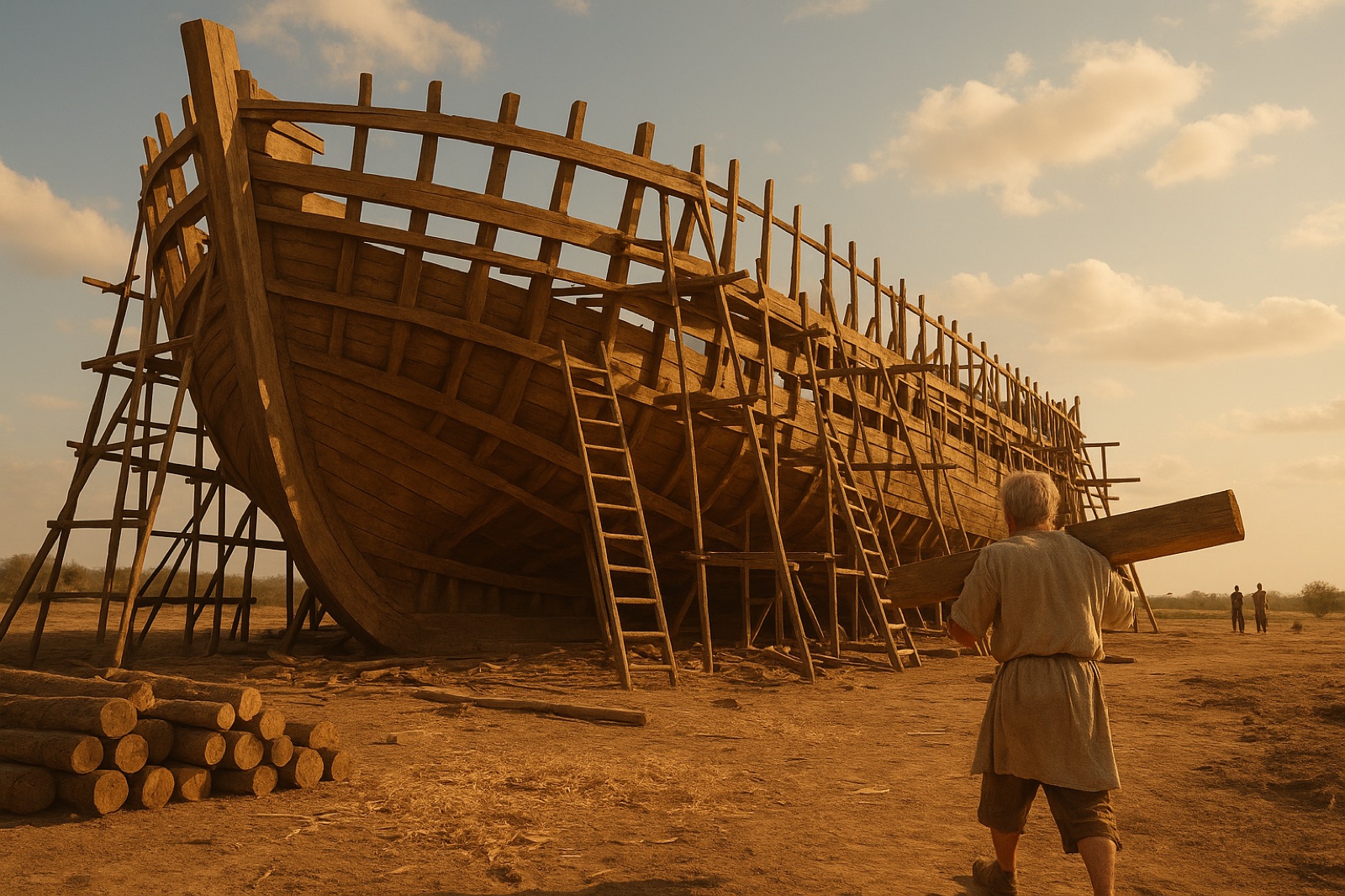
First, Genesis never records a single word Noah said to his neighbours. Through the whole flood account he doesn’t speak once. What Genesis records instead is this: “Thus did Noah; according to all that God commanded him, so did he” (Genesis 6:22). The New Testament calls him “a preacher of righteousness” (2 Peter 2:5), and Hebrews 11:7 says he “prepared an ark to the saving of his house; by the which he condemned the world.” Whatever Noah said out loud, the half-built boat was saying it too, every single day it stood there.
Second, look at who closed the door. When the day finally came, it wasn’t Noah: “and the LORD shut him in” (Genesis 7:16). The door stayed open until the very last moment, and God was the one who closed it.
Slow Isn’t Always Late
Here’s where this stops being trivia.
We usually measure a long wait from the builder’s side. How long is this taking me? Why isn’t it finished? Why hasn’t God fixed this yet?
1 Peter 3:20 measures the very same stretch of time from the other side. The years that looked like slow, dusty work in Noah’s field were years of open door for everyone who walked past it. The delay wasn’t God being slow. It was God being patient, on purpose, with people who hadn’t turned around yet.
That changes how you can read the slow things in your own life. The prayer for someone you love that still hasn’t been answered. The situation you wish God would just settle today. Sometimes “not yet” is the longsuffering of God, still waiting. For them. And honestly, sometimes for us. Every one of us has stood outside that door at some point, and been glad it was still open.
The waiting isn’t empty on our side either. Noah kept building. Showing up faithfully in the slow middle is its own quiet message, and people notice what you keep showing up for. Biblical patience was never just sitting still. The Bible’s word for patience means staying under real pressure, not simply waiting it out.
If you like digging into stories like this one, you can ask your own questions about Noah and the rest of Genesis with our free Bible Stories AI assistant (it opens in ChatGPT).
Three Things You Can Do Today
- Save the real answer. Put 1 Peter 3:20 in your phone’s notes right now. The next time someone says “Noah built for 120 years,” you can say: Genesis never gives a number, and the one verse that measures the build says it was God’s patience at work.
- Rename one “why is this taking so long?” Pick one slow situation that involves another person. Write it down, and next to it write: “Maybe this is the door still open.” Notice whether that changes how you feel about the delay.
- Pray for one person by name for two minutes. Choose someone you’ve quietly given up on. The ark years show God hadn’t given up on that generation yet. You don’t have to give up on this person either.
Journal It Out
- Where in your life have you been reading God’s patience as God being late?
- Think of a time a door stayed open for you longer than you deserved. Who, or what, kept it open?
A Prayer for the Slow Years
God, I’ll be honest: I usually want things done faster than You do them. Thank You that the long years in Noah’s field weren’t wasted time, but Your patience holding a door open. Thank You for every time that door stayed open for me. Help me stop reading every delay as You being late, and help me keep building faithfully while I wait. And please keep the door open for the person on my heart right now. Amen.
Let’s Talk About It
Why do you think “Noah built the ark for 120 years” became such a popular answer, even though Genesis never says it? Tell us what you think in the comments.
Share This
- “The Bible never says how long Noah took to build the ark. The only verse that measures it says ‘the longsuffering of God waited.’ The build was measured in patience.”
- “Genesis never records Noah saying a word to his neighbours. The half-built ark did the talking.”
- “Slow isn’t always late. Sometimes the delay is the door still being held open. (1 Peter 3:20)”
Noah’s Ark Build: Questions and Answers
How long did it take Noah to build the ark?
The Bible never says how long it took Noah to build the ark. Genesis 5:32 says Noah was 500 when his sons were born and Genesis 7:6 says he was 600 when the flood came. Because God’s instructions in Genesis 6:18 already include Noah’s sons and their wives, the most natural reading puts the build at no more than about 100 years, but no exact length is recorded.
Where does the idea that Noah built the ark for 120 years come from?
The 120-year figure comes from Genesis 6:3, which says “yet his days shall be an hundred and twenty years.” That verse does not mention an ark or building. Jewish tradition, recorded by the 11th-century commentator Rashi and drawn from the Talmud, read it as a 120-year countdown to the flood and pictured Noah building the whole time so people would ask why and turn back to God.
What does Genesis 6:3 mean by 120 years?
Genesis 6:3 is read in two main ways. Some read the 120 years as a countdown before the flood. Others read it as a limit on the human lifespan, noting that Moses died at 120 (Deuteronomy 34:7), though people after the flood, such as Noah’s son Shem, lived far longer. The verse itself does not say how long the ark took to build.
What does 1 Peter 3:20 say about Noah’s ark?
1 Peter 3:20 says “the longsuffering of God waited in the days of Noah, while the ark was a preparing, wherein few, that is, eight souls were saved by water.” It is the only Bible verse that describes the time the ark was being built, and it describes that time as God patiently waiting rather than giving a number of years.
Did Noah preach while he was building the ark?
2 Peter 2:5 calls Noah “a preacher of righteousness,” but the Book of Genesis does not record any words Noah spoke to other people before the flood. Genesis 6:22 simply says Noah did everything God commanded, and Hebrews 11:7 says that by preparing the ark he “condemned the world,” suggesting the building itself was a visible warning.